This black family had just moved into their new home in a quiet suburban neighborhood, eager to begin a fresh chapter filled with promise and possibility. The Johnson's with their two young children were drawn to the charm of treelined streets and the sense of community that seemed to pulse gently through the neighborhood. The house had been their dream for years. a modest, sunlit place with a welcoming porch and a yard that begged for life and color. Mr. Johnson, a man with a steady gaze and hands accustomed to hard work, saw the front yard as more than just a patch of grass.
It was a canvas, a way to express pride in their new home and to connect with neighbors through the simple beauty of nature. He spent weekends at the local nursery, selecting vibrant flowers, shrubs, and a small assortment of vegetables. Each plant was chosen with care, a deliberate choice to create a garden that would bring joy and perhaps inspire others. As the garden began to take shape, neighbors passing by offered nods and smiles. The children were delighted by the bright maragolds and cheerful sunflowers, their laughter mingling with the soft hum of bees.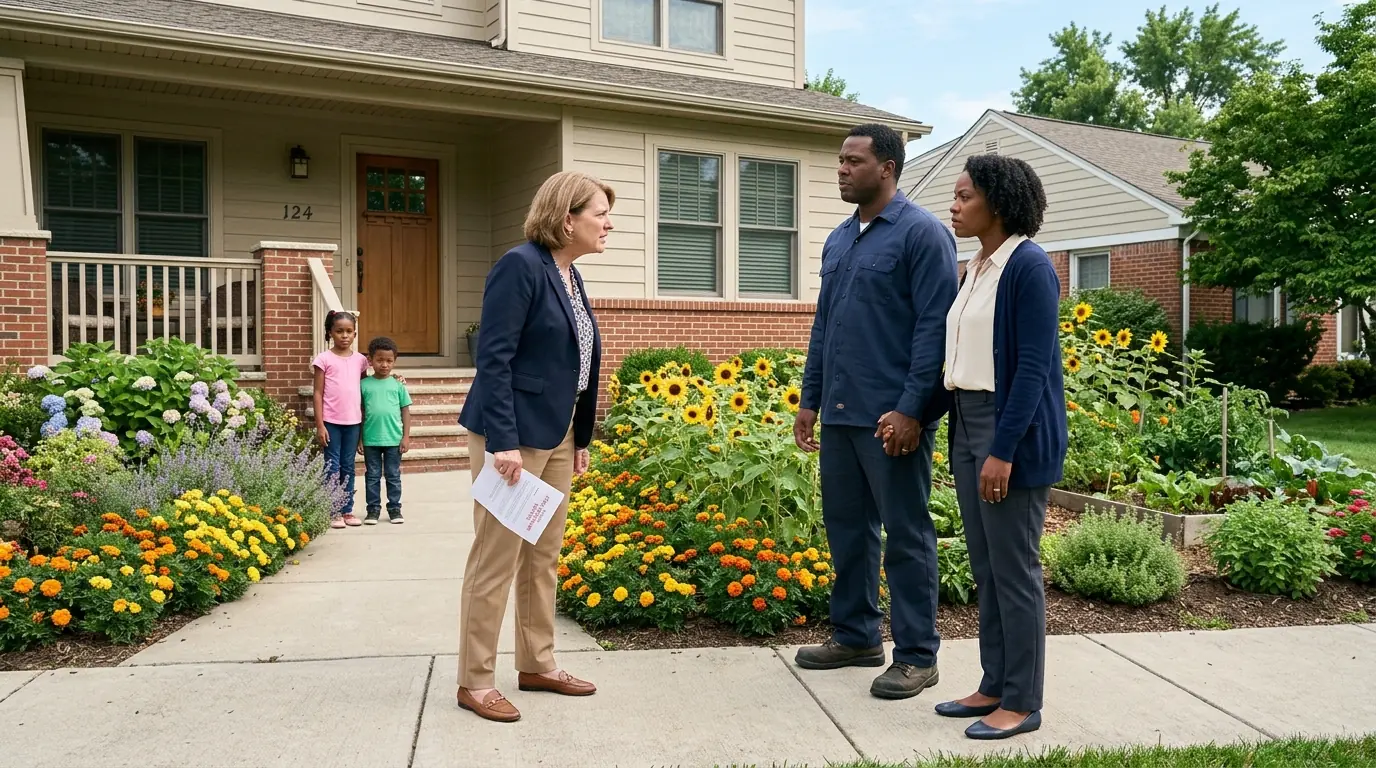
To the Johnson's, the garden was more than decoration. It was a symbol of hope and belonging. But not everyone shared their enthusiasm. Linda Barrett, a longtime resident and a member of the homeowners association HOA board, noticed the garden with a different eye. The meticulous rows of colorful blooms and the small vegetable patch did not fit her vision of order and uniformity.
She believed the neighborhood's aesthetic was a delicate balance that must be maintained, and any deviation, no matter how well-intentioned, was a threat to that balance. Within days, Linda made a call to the HOA office, voicing her concerns in a tone that left little room for discussion. She described the garden as boldly out of place, claiming it violated the community's strict aesthetic guidelines. Her call set a chain of events in motion that neither the Johnson's nor the neighborhood anticipated. The Johnson's received a letter from the HOA, formal and stern, warning them that their garden was in violation of community rules.
The letter demanded the removal of certain plants and the redesign of the garden to conform to an approved style, Mr. and Mrs. Johnson exchanged uneasy glances, but chose to respond with calm and courtesy, believing that a misunderstanding could be resolved through dialogue. Unbeknownst to their neighbors, Mr. Johnson was more than just a new homeowner. He was the newly appointed sheriff of the county, a man sworn to uphold the law and protect the rights and dignity of all citizens.
His role had taught him the value of measured response and quiet strength, qualities he now relied on as he faced this unexpected challenge. Linda, meanwhile, seemed emboldened by her complaint. At neighborhood gatherings, she spoke proudly of her influence within the HOA, unaware that she was challenging the authority of the sheriff's family. Her voice carried a note of superiority, the kind that comes from believing one has the community's best interests firmly in hand. The tension simmered beneath the surface, a quiet storm brewing behind polite smiles and small talk.
Mr. Johnson's face remained calm, but inside a resolve was hardening. This was not just about plants or rules. It was about respect, fairness, and standing firm in the face of unwarranted opposition. He gathered his family that evening, explaining gently but clearly the importance of standing their ground with dignity.
He spoke of his role as sheriff not only as an enforcer of laws but as a protector of community values and individual rights. The children listened wideeyed, sensing the gravity of the moment, even if they could not fully understand it. Mr. Johnson decided that the next step was to engage directly with the HOA. He would attend the upcoming board meeting, not with anger or confrontation, but with clarity and respect.
His goal was to explain how their garden complied with the community's guidelines and to assert their rights as residents seeking to contribute positively to the neighborhood. As the day of the meeting approached, the neighborhood buzzed with quiet speculation. Some residents admired the Johnson's garden and their calm response, while others whispered support for Linda's strict interpretation of the rules. The community was divided, a fault line appearing beneath the surface of suburban civility. On the evening of the meeting, Mr.
Johnson arrived early, dressed in a simple suit that spoke of professionalism rather than authority. The room was filled with familiar faces. neighbors, HOA members, and of course, Linda Barrett, whose sharp gaze sought to unnerve him. But Mr. Johnson remained steady, a pillar of quiet confidence. When it was his turn to speak, he addressed the board and attendees with a measured voice.
He explained the intentions behind the garden, highlighting how it respected the community's guidelines while adding beauty and life to their shared environment. He spoke not just as a homeowner, but as a servant of the community, committed to fairness and mutual respect. His words struck accord with many in the room, though some remained skeptical. The meeting stretched on. A delicate dance of perspectives and principles.
By the end, no immediate resolution was reached, but the tone had shifted. A dialogue had begun. As Mr. Johnson returned home that night. He felt the weight of the day, but also a quiet hope.
The garden outside glowed softly in the porch lighted testament, not just to plants and soil, but to the promise of standing firm with dignity. The road ahead might be challenging, but for the Johnson family, this was only the beginning of their journey in a neighborhood, learning to embrace change. Despite the undercurrents of tension from the HOA meeting, the Johnson's continued to nurture their garden with quiet determination. Each morning, Mr. Johnson would step out onto the dewy grass, trowel in hand, tending to the blooms and vegetables as if the future of their family's place in the neighborhood depended on every careful touch.
Johnson, equally steadfast, watered the maragolds and clipped the stray leaves, while the children flitted between sunflowers, their laughter a gentle counterpoint to the growing unease. The HOA's warnings arrived with increasing frequency, letters stacked on the kitchen counter, their tone growing more insistent. Linda Barrett's complaints seemed to echo louder each time, her voice amplified by the board's unwillingness to let the matter rest. Yet, the Johnson's maintained their composure, refusing to respond with anger or confrontation. Instead, Mr.
Johnson chose a path shaped by years of experience as sheriff a commitment to fairness, the law, and measured action. One afternoon, as sunlight spilled over the vibrant green of the garden, Mr. Johnson sat with his wife in the living room, the latest HOA correspondence spread out before them. "We can't let this become a battle of wills," he said quietly, his eyes steady. "This isn't just about a garden.
It's about our rights as residents and the example we set for our children. " Mrs. Johnson nodded, her hands folded in her lap. We need to show them who we are not through conflict but through respect and integrity. His role as sheriff had always been to protect the community while respecting individual freedoms. That balance was delicate, requiring patience and strength.
He reflected on the lessons learned on long patrol nights and community meetings. Justice wasn't served by force alone, but by careful dialogue and standing firm without aggression. With resolve, Mr. Johnson decided to take formal steps. He sought legal counsel to review the HOA's guidelines and the letters they had received.
The documents confirmed what he had suspected. The garden was within the bounds of the community's rules, though the language was vague enough to allow for differing interpretations. This ambiguity was the source of the conflict. Preparing for the next HOA meeting, Mr. Johnson crafted a clear, respectful statement.
He planned to present the facts, demonstrate compliance, and appeal to the board's sense of fairness. But beyond rules and regulations, he wanted to communicate something deeper. The importance of community, diversity, and acceptance. In the days leading up to the meeting, conversations with neighbors revealed a divided community. Some expressed quiet support for the Johnson's admiring the garden's beauty and the family's dignity.
Others, influenced by Linda Barrett's steadfast stance, remained wary or openly critical, fearing that bending rules would unravel the neighborhood's carefully maintained character. Mr. Johnson reached out to a few key residents, seeking to open lines of communication. He met with Mrs. Patel, whose own garden was a modest but colorful display, and Mr.
Prais Green, a retired teacher who valued community harmony above all else. These conversations enriched his understanding of the neighborhood's varied perspectives and reinforced his belief in dialogue as the path forward. Throughout these interactions, the sheriff's demeanor was consistent, calm, respectful, and inclusive. He spoke of the neighborhood as a tapestry of different stories and backgrounds, each contributing to the whole. His message was clear.
Diversity in appearance, ideas, and culture did not weaken the community. It strengthened it. The HOA board, meanwhile, wrestled with the dilemma. Some members sympathized with the Johnson's, recognizing the garden's compliance and the family's good faith efforts. Others felt bound by precedent and the strict letter of the rules, wary of setting a new standard that might invite further deviations.
Mr. Johnson sensed this division and saw an opportunity. His plan was not to confront, but to collaborate to find a middle ground that honored the community's character while welcoming individual expression. He believed that leadership was not about asserting dominance but about bridging differences. On the evening of the next HOA meeting, the room was thick with anticipation.
Residents filled the seats, eyes shifting between familiar neighbors and the board members. Linda Barrett was present, her posture rigid, her gaze sharp, but Mr. Johnson remained composed, a quiet authority in the midst of the gathering. When his turn came, he stood and addressed the assembly with measured confidence. He began by acknowledging the community's commitment to maintaining its unique charm and the importance of rules in preserving shared values.
Then, with clarity and respect, he explained how the garden complied with existing guidelines. He highlighted the garden's role in enhancing curb appeal, promoting environmental health through pollinator friendly plants, and fostering neighborly goodwill. More importantly, he spoke to the broader themes of acceptance and unity, urging the community to embrace diversity in all its forms. His words were deliberate and sincere, weaving together facts and heartfelt appeal. Our neighborhood is more than just a collection of houses, he said.
It is a community built on respect, kindness, and the willingness to see each other's humanity. This garden represents not just flowers, but our family's hope to belong and contribute. Some listeners nodded, moved by the eloquence and sincerity. Others remained cautious but attentive. The room settled into a thoughtful silence as Mr.
Johnson took his seat, his statement hanging in the air like a gentle challenge to reconsider. The meeting continued with questions and comments, revealing the range of opinions, but also a growing willingness to listen. The board postponed any immediate decision, choosing to deliberate further with the new perspective in mind. As the community dispersed that evening, conversations sparked in small groups neighbors discussing not just a garden, but the values that defined their neighborhood. Mr.
Johnson walked home alongside his wife and children, feeling the subtle shift in the air. At home, he gathered his family once more. "Tonight was important," he said softly. Not because of what was decided, but because we made our voices heard with respect and clarity. That's the kind of strength that lasts.
Mrs. Johnson smiled, her eyes reflecting pride and hope. We're building more than a garden. We're building understanding. The children, tired but brighteyed, drifted off to sleep as the house settled into quiet.
Outside the garden stood resilient under the moonlighter, living testament to patience, dignity, and the gentle power of standing firm without hostility. In the days that followed, Mr. Johnson continued to engage with neighbors, fostering conversations that transcended the garden dispute. He listened to concerns, shared stories, and encouraged a vision of community grounded in mutual respect. Though challenges remained, the sheriff's quiet leadership began to soften hardened attitudes.
The neighborhood was learning slowly but surely that true strength lay not in rigid enforcement, but in the courage to embrace change with dignity and grace. For Mr. Johnson, the journey was far from over. Yet, with each planted seed and every respectful conversation, he nurtured not only a garden, but the roots of a more inclusive, harmonious community. The neighborhood's atmosphere had shifted, but not without revealing the fractures beneath its polished surface.
In quiet conversations across fences and at weekend barbecues, the dispute over the Johnson's garden stirred deeper reflections about community, identity, and belonging. While some residents found themselves drawn to the family's calm resilience, others clung tightly to the familiar order, wary of change, and uncertain what it might bring. Mr. Johnson moved through this evolving landscape with thoughtful purpose. His role as sheriff extended beyond law enforcement.
It was a commitment to fostering trust and unity among diverse voices. He made a point of engaging with neighbors on both sides of the divide, listening as much as he spoke, seeking to understand the concerns that lay beneath the surface. One afternoon, he found himself sitting on a bench near the community park with Mrs. Rodriguez, a longtime resident known for her quiet wisdom and gentle demeanor. She spoke of the neighborhood's history, how it had grown from a small cluster of families into a mosaic of backgrounds and experiences.
"We've always been proud of our traditions," she said. "But sometimes that pride can make it hard to see the good that comes with change. " Mr. Johnson nodded. "Tradition is important. It gives us roots.
But growth, true growth requires openness and the willingness to evolve. In these conversations, he also encountered lingering skepticism. At a coffee gathering, Mr. Green, the retired teacher, voiced concerns shared by others. Rules are the glue that hold us together, he said.
Without them, what's to stop everyone from doing as they please? It's not about one garden. It's about the principle. Sheriff Johnson understood this viewpoint. Rules are essential, he replied, but they must be applied with fairness and flexibility, especially when they intersect with people's right to express themselves and feel at home.
Meanwhile, the HOA board found itself caught in an internal struggle. Some members impressed by the Johnson's respectful approach and the growing support from parts of the community advocated for a more inclusive interpretation of the guidelines. Others, including Linda Barrett, remained steadfast in their strict enforcement stance, fearing that any concession would erode the neighborhood's character. In board meetings behind closed doors, debates grew heated. Linda argued that the rules existed to protect property values and neighborhood aesthetics, claiming that bending them would invite chaos.
Her voice was firm, her conviction unwavering. Opposing her, board member Karen Louu, a younger resident who had recently joined the HOA, spoke of the need to reflect the neighborhood's evolving demographics and values. We can't be blind to the world around us, she urged. Our community should be a place where everyone feels welcome, where diversity is celebrated, not punished. As these discussions unfolded, Mr.
Johnson remained a steady presence, offering to mediate conversations between the board and residents. He understood that leadership required patience and the ability to navigate complexity without alienating either side. At a neighborhood gathering, he addressed a group that included Linda, Karen, and several other residents. "We all want what's best for this community," he began. "But best means different things to different people.
Our challenge is to find common ground, a way to honor our past while embracing the future. " Linda's eyes narrowed, but she listened. The conversation that followed was difficult, but necessary. Residents shared their hopes and fears, their visions for the neighborhood's future. Mr. Johnson facilitated the dialogue with a calm authority, redirecting heated moments toward understanding.
He reminded them that community was not a static place, but a living, breathing entity shaped by the people who called it home. "We have a choice," he said. We can allow fear to divide us, or we can choose to build bridges. As the weeks passed, more neighbors began to approach Mr. Johnson, some with apologies for their earlier skepticism, others with offers to help tend the garden or contribute to neighborhood projects.
Andrea Thompson, a new board member who had observed the events unfold, reached out privately, expressing her embarrassment over Linda's confrontational tactics and suggesting a meeting to discuss a path forward. Mr. Johnson welcomed the opportunity. Their conversations were candid, focused on finding solutions that balanced respect for community standards with the need for inclusivity and individual expression. The stage was set for a pivotal HOA meeting, one that promised to be a turning point.
The community had been listening, talking, and reflecting, and now it was time to confront the issues openly with the hope of healing and progress. On the evening of the meeting, the room was filled to capacity. Faces familiar and new, filled the chairs, eyes watching as Mr. Johnson stepped forward once again. This time his demeanor carried not only the quiet strength of authority, but the warmth of someone deeply invested in the well-being of his neighbors.
He began by acknowledging the diversity of opinions and the passion that each person brought to the conversation. Conflict is often uncomfortable, he said, but it is also an opportunity to learn, to grow, and to build a stronger community. He spoke candidly about his family's journey, the garden as a symbol of their desire to belong, and the broader themes of respect and accountability that underpinned the dispute. Our neighborhood is more than just a collection of houses and rules. He said, "It is a community of people with stories, hopes, and dreams.
We must hold ourselves accountable just to rules, but to each other. " His words resonated with many. Some nodded in agreement, others wiped away doubts previously held. The atmosphere shifted from confrontation to contemplation. Linda Barrett was present, but quieter than before. While she did not speak at length, her posture softened, and her gaze faltered when Mr.
Johnson addressed the importance of mutual respect. The meeting stretched late into the evening. Voices rose and fell as neighbors debated the future of their community. Proposals were made to revise the HOA guidelines, to clarify ambiguous language, and to incorporate principles of inclusivity and cooperation. By the end, while no final decision was reached, the tone had changed.
The community was no longer divided by rigid lines, but engaged in a shared effort to find balance. As the crowd dispersed, Andrea Thompson approached Mr. Johnson with a tentative smile. "Thank you for your leadership tonight," she said. "You've helped us see things differently. " He nodded, feeling the weight of responsibility, but also a quiet hope.
"This is just the beginning," he replied. "But it's a good beginning. " Walking home beneath the street lights, Mr. Johnson reflected on the journey so far. The garden outside glowed softly in the night, a symbol not just of beauty, but of resilience and the promise of a community learning to grow together. He understood that true leadership was not about imposing will, but about fostering understanding, bridging divides, and standing firm in the values of fairness and respect.
The neighborhood was on the cusp of change, and with patience and dignity, it could emerge stronger and more united than ever before. The night of the HOA meeting arrived with a charged energy that filled the community cent's modest hall. Rows of folding chairs were occupied by neighborsome, familiar faces, some knew each, carrying the weight of weeks of tension and hope. The air was thick with anticipation. The collective breath held as the gathering prepared to confront the heart of the dispute.
Mr. Johnson stood at the front, his posture steady, eyes scanning the room with a calm that belied the significance of the moment. He had prepared carefully, determined to speak not only for his family, but for the community's future. This was not just about a garden or a set of rules. It was about respect, inclusion, and the shared values that could bind neighbors together.
When called upon, he rose and addressed the assembly with deliberate clarity. Thank you all for being here tonight, he began. This gathering marks an important step for our neighborhood. We are here to listen, to understand, and to find common ground. He described the garden not simply as a collection of flowers and vegetables, but as a symbol of his family's commitment to the neighborhood, a visible expression of their desire to contribute beauty, life, and connection.
He emphasized that the garden complied with the community's guidelines, inviting the board to consider the spirit as well as the letter of the rules. More profoundly, Mr. Johnson spoke to the heart of the matter, the importance of embracing diversity and fostering a community where all residents could feel accepted and valued. "Our neighborhood is richer because of our differences," he said. "We must honor those differences while holding fast to the principles of respect and fairness. " Throughout his address, his tone remained respectful and composed, inviting dialogue rather than confrontation.
His words resonated with many, creating a palpable shift in the room's atmospheria movement toward understanding and unity. Following his presentation, the floor opened to discussion. Linda Barrett, who had been a vocal critic throughout the dispute, took the microphone. Her voice was measured, her usual sharpness softened by the evening spirit. I appreciate the Johnson's efforts to comply, and the civility with which they've handled this," she began.
"Perhaps it's time we revisit our guidelines to reflect the neighborhood's evolving character. " Her statement surprised many, signaling a willingness to move beyond past disagreements. Other residents echoed similar sentiments, calling for clearer, more inclusive rules that would prevent future conflicts and promote harmony. The HOA board, encouraged by the constructive dialogue, proposed revisions to the community guidelines. These revisions aimed to clarify ambiguous language and explicitly welcome diverse expressions of landscaping and home appearance, balanced by standards that preserved overall neighborhood appeal. Andrea Thompson, a newer board member who had grown close to the Johnson family during the dispute, outlined the proposed changes.
She emphasized collaboration and the importance of ongoing communication between residents and the board. Our goal is to build a community where everyone feels at home, she said. The mood in the room was hopeful, a collective willingness to embrace change without sacrificing the neighborhood's identity. Questions and comments continued with many expressing gratitude for the respectful tone and the opportunity to be heard. As the meeting drew to a close, the board agreed to formally adopt the revised guidelines after a period of review and feedback.
The decision was met with nods and quiet applause, a sign of progress, and a new chapter for the community. Outside, the evening air was cool, but charged with optimism. Mr. place in Johnson walked home with his family, the garden glowing softly in the porch light a beacon of perseverance, respect, and renewed connection. In the days that followed, neighbors approached the Johnson's with apologies for past misunderstandings and offers to assist with garden care and neighborhood projects. Andrea reached out to coordinate community efforts, eager to foster ongoing collaboration and goodwill.
Mr. Johnson reflected on the journey, recognizing that standing firm with dignity had been both a challenge and a catalyst for change. He understood that true respect was earned through actions grounded in integrity and empathy, not mere demands or resistance. The neighborhood, once divided by rigid views, was now moving toward unity and inclusivity. The revised guidelines and the spirit of cooperation signaled a future where differences were embraced and community was strengthened by mutual understanding.
As the Johnson family tended their garden under the morning sun, Mr. Johnson felt a profound sense of peace. The struggles had tested them, but they had emerged with their values intact and relationships renewed. He knew the path ahead would require continued effort and patience, but the promise of a more understanding and connected community was worth every challenge faced. In this new chapter, the neighborhood was learning that respect must be mutual, nurtured through dialogue and kindness, and that standing firm need not mean standing alone.