At 8:01 on a hot Thursday night in Lakewood Pines, ten-year-old Mason Reed stood on the wrong side of a locked pool gate with his sister’s purple goggles in one hand and a look on his face his father would remember for years. The community pool behind him was empty except for a few wet towels left on a chair and the soft hum of the filtration system. His father, Eric, stood outside the fence with seven-year-old Lily pressed against his side, while Karen Dalton held a padlock key and told everyone to stop overreacting. Mason wrapped his fingers around the metal bars and said the sentence that changed the night from an argument into something else entirely. “Dad, I can’t get out.”
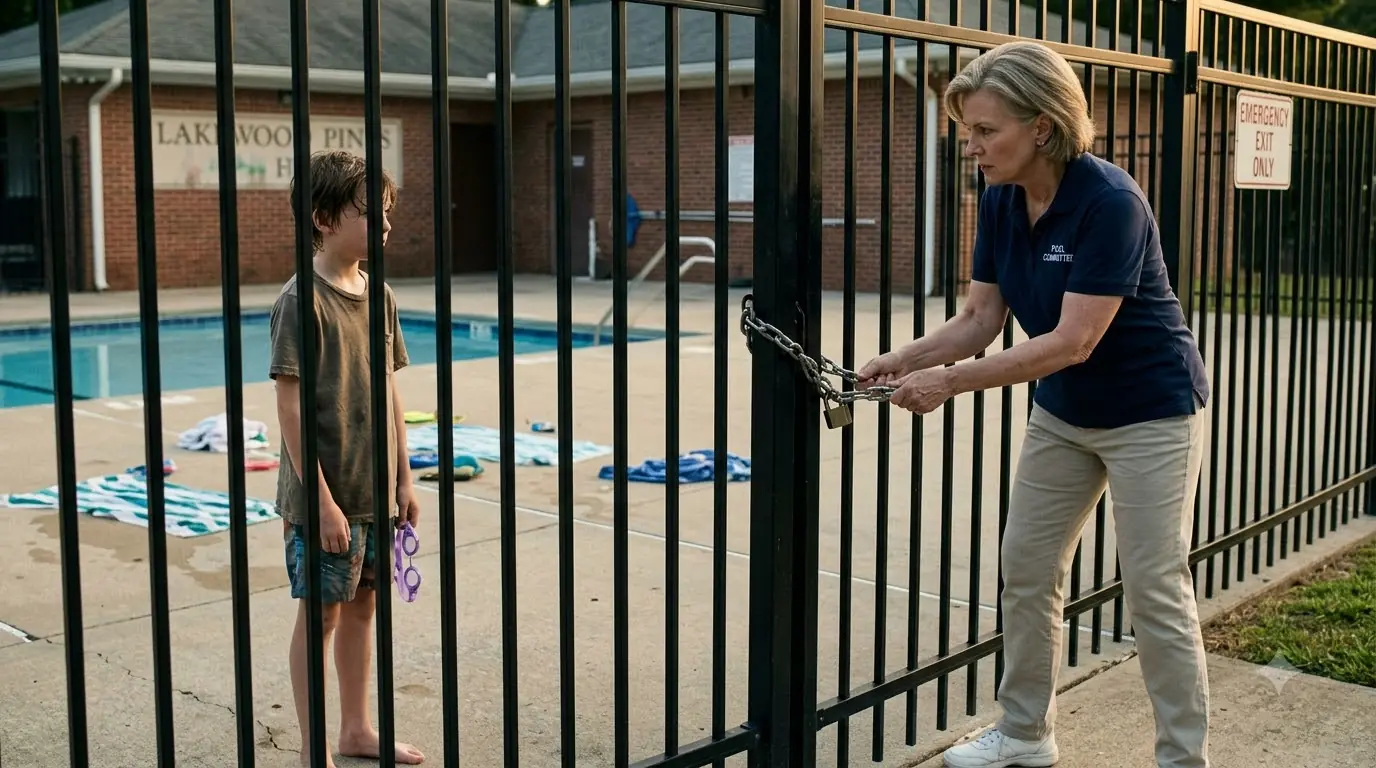
The frightening part was not that Mason had been trapped for an hour, because he had not. It was not that he was injured, because he was not. The frightening part was that Karen knew he was inside before she closed the chain, heard Eric tell her not to do it, and locked the gate anyway. She believed a child who was one minute late deserved a lesson, and for several minutes she was willing to let a locked fence teach it.
A week earlier, none of the Reeds would have imagined the situation could reach that point. Lakewood Pines was the kind of Texas subdivision where the community pool was less a luxury than a neighborhood living room during summer. The homes curved around quiet streets shaded by live oaks, and by late afternoon the pavement smelled baked and dusty while children crossed lawns in flip-flops carrying pool noodles twice their height. The pool itself sat beside a small clubhouse behind a black metal fence, with a shallow end, a deeper swimming area, restrooms, and two gates designed to let people out safely even if the electronic entry system failed.
On weekdays there was no lifeguard, so parents were responsible for supervising their children. The rule everyone knew was simple: the pool closed at eight. Most families began gathering towels around seven-forty-five, and by eight they were walking toward the parking lot under the glow of the clubhouse lights. For years, there had been the occasional family that lingered too long or a teenager who forgot a float in the water, but closing the pool had rarely become a neighborhood conflict.
Karen Dalton changed that slowly. At sixty-two, she had served on the Pool Committee for four years and had once been appreciated for it. She had pushed management to replace cracked anti-slip strips on the steps, helped organize a schedule for umbrella repairs, and once spent half a Saturday tracking down a contractor after a leak near the pump room. She was organized, punctual, and relentless, which were useful qualities when pointed at broken equipment. The trouble began when Karen started treating people as if they were another maintenance problem.
“Eight o’clock means out of the gate at eight,” she liked to say, “not start packing at eight.” At first, residents laughed because she was technically right. Then she began arriving at seven-fifty-five to clap her hands at families still drying children, and later at seven-forty-five, and finally at seven-forty as if fifteen minutes before closing were a countdown to an evacuation. She would collect pool noodles children were still using, switch off umbrella lights while parents searched for sandals, and stare at her smartwatch whenever someone took too long in the restroom.
Mason noticed her before he ever became one of her targets. He was the sort of kid who noticed systems: who always checked whether Lily had her shoes before they left, who returned stray goggles to the lost-and-found basket, and who knew which water bottle belonged to which family simply because he had seen people carrying them. He loved swimming, but what Eric appreciated most was the way Mason treated his younger sister. Lily followed him everywhere, and Mason made room for her even when other boys his age would rather race across the deep end without a seven-year-old tagging behind.
One Tuesday evening, Karen arrived at seven-fifty-five and clapped sharply from the gate. “Five minutes! Everybody out!” she called, though nearly every family was already packing. A boy near the shallow end shouted, “We know,” and Karen answered, “Then move faster.” She stacked three noodles against the fence, folded an umbrella early, and began walking the deck like an inspector.
Mason was rolling a towel when he murmured to Lily, “She acts like the pool explodes at eight.” He did not say it loudly, but Karen heard him. She turned immediately. “What did you say?”
Mason looked up, startled. “Nothing.”
“That’s what I thought.” Karen held his gaze for another second before moving on. Eric, who had been stuffing wet swimsuits into a tote bag, looked at his son and raised one eyebrow. Mason shrugged. Neither of them expected the exchange to matter.
Over the next few nights, Karen’s behavior sharpened. She began arriving at seven-forty and making announcements every five minutes. At seven-fifty, she turned off one bank of decorative lights near the picnic tables. At seven-fifty-five, she collected toys from a family whose children were still drying off. Residents complained to HOA president Martin Delgado, who spoke to Karen after a committee meeting and tried to keep the issue small.
“You can enforce closing time,” Martin told her. “You cannot create your own earlier closing.”
“I’m not creating anything,” Karen replied. “I’m helping people understand what eight means.”
“Then help them without harassing them.”
Karen heard the correction as criticism of her dedication. In her mind, she was the only person willing to insist that rules meant what they said. Every parent who lingered two minutes became proof the board was too soft, and every child who forgot a toy became evidence that families treated HOA property carelessly. She began describing the pool as “impossible to manage” even though management records showed no unusual problems beyond the usual summer mess.
One evening Lily was pulling a cover-up over her swimsuit when Karen stopped beside the Reed family’s chairs. “You people do this every night,” she said.
Eric looked around at the nearly empty deck. “We’re leaving.”
Karen’s eyes moved to Mason. “Some children apparently need the rule explained repeatedly.”