The first cricket hit the water six feet from Maya Turner and floated there for half a second before its legs started moving.
At first Maya thought it had fallen from one of the magnolia trees beyond the fence. Bugs landed in the Magnolia Creek pool all the time, especially in July, when the South Carolina heat made the air feel heavy enough to hold in your hands. But then another cricket dropped beside it, and another, and then a pale mealworm curled on the surface near the shallow-end rope. Within two seconds the water seemed to come alive with dozens of tiny bodies.
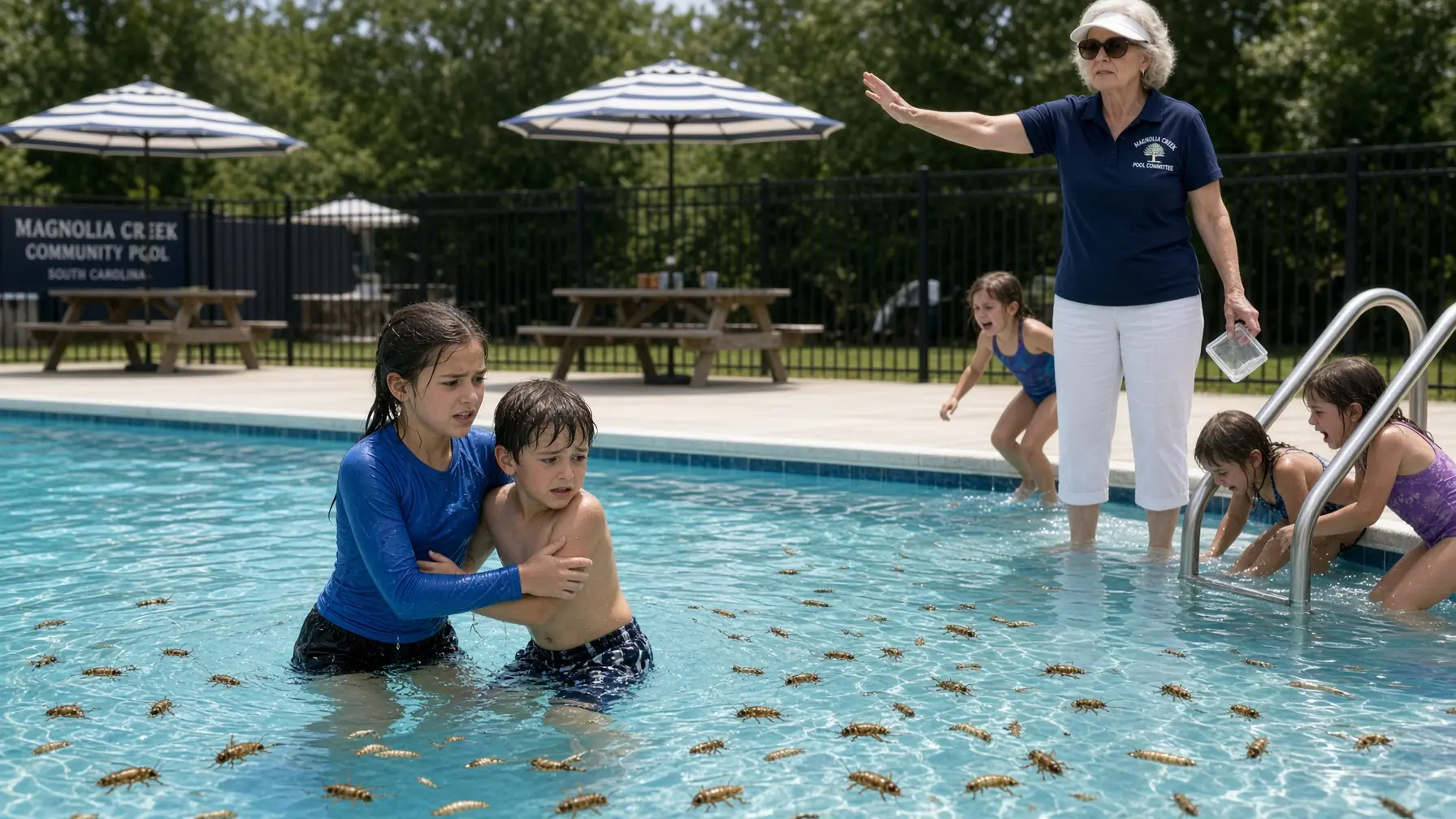
A girl near the steps screamed. A boy who had been practicing cannonballs slapped both hands over his mouth and tried to climb onto the deck without using the ladder. Seven-year-old Ben Turner grabbed Maya around the waist so hard his fingernails pressed through the fabric of her rash guard, and Maya felt his knees bang against hers under the water.
"Maya, what is that?" he gasped.
Before Maya could answer, Deborah Kline's voice cut across the pool deck.
"I TOLD YOU! GET OUT OF THE WATER!"
Deborah stood beside the fence in white capri pants and a navy pool-committee polo, one hand raised dramatically as if she had just discovered a chemical spill. Her silver-blond hair was stiff from hairspray despite the humidity, and her oversized sunglasses reflected the glittering blue surface. Parents turned toward her. Children scrambled for the ladders. The Saturday lifeguard blew his whistle and shouted for everyone to walk.
Deborah pointed toward the picnic tables. "This is what happens when people turn a community pool into a picnic ground! Food attracts pests. I've been saying it for weeks."
Maya's eyes left Deborah's face and dropped to the woman's right hand.
There was nothing in it now.
But Maya had seen the plastic container.
She had seen Deborah open it.
And she had seen her pour it into the pool.
"She put them in," Maya said.
The words were quiet, almost lost in the panic, but Sophie Ramirez heard her. Sophie, eleven, was already halfway up the ladder. She stopped with one foot on the deck.
"What?"
Maya looked directly at Deborah.
"She put them in. I saw her dump the box."
Deborah's head snapped around. Even behind the sunglasses, Maya could feel the force of the stare.
"Excuse me?"
"I saw you," Maya repeated.
Deborah took two fast steps toward the shallow end. "Don't you dare accuse an adult because you're embarrassed."
"I'm not embarrassed. I saw you."
"You are done here," Deborah said. "Get out."
Maya tightened one arm around Ben, who had begun trembling. She did not move. Not yet. She was twelve years old, and she knew better than to start screaming back at an adult, especially an HOA adult who loved writing things down. But she also knew what she had seen, and one thing her mother had always told her was that being calm did not mean pretending something had not happened.
The lifeguard, Eric Lawson, reached the waterline with a long-handled skimmer. He was twenty-two, home from college for the summer, with sun-browned shoulders and the permanent squint of someone who had spent half his life near chlorine. He scooped a cricket from the surface, stared at it for a moment, then caught two pale larvae drifting beside it.
"These look like feeder insects," he said.
Deborah frowned. "They're bugs."
Eric shook his head. "No. I mean pet-store feeder insects. Crickets and mealworms sold for reptiles."
The pool seemed to get quieter even though kids were still climbing out.
A little boy near the trash can pointed down. "There's the box."
Everyone looked.
A clear plastic container sat on top of the trash, the lid hanging open. Blue letters on the label read LIVE FEEDER CRICKETS.
Deborah's mouth tightened.
"That isn't mine."
Maya looked at Sophie. Sophie looked at Maya. Neither girl said anything, but they were remembering the same thing Maya had noticed twice that week: the clear container with air holes riding in Deborah's golf cart.
Ben buried his face against Maya's shoulder.
"Can we go home?"
Maya finally moved toward the steps. "Yeah."