The first family arrived at 8:47 on a Saturday morning.
Nathan Cole had just poured coffee when his doorbell rang.
A man and woman stood on the front porch with two children between them. The father carried a large cooler. The mother had three towels draped over one shoulder, and both children were already wearing swimsuits and flip-flops.
The little boy held up a neon-green wristband.
“Morning,” the father said. “Where should we put our things?”
Nathan stared at him.
“I’m sorry?”
“For the pool day.”
“What pool day?”
The woman’s smile faded.
“The HOA community pool event.”
Nathan looked past them toward the street.
A minivan had parked behind their SUV.
Another family was getting out.
The father lifted his wrist.
“We paid yesterday.”
Nathan’s coffee suddenly tasted bitter.
“Paid whom?”
“Victoria.”
The answer landed exactly where Nathan expected it would.
Victoria Harrow.
President of the Briar Hollow Homeowners Association.
Nathan stepped onto the porch.
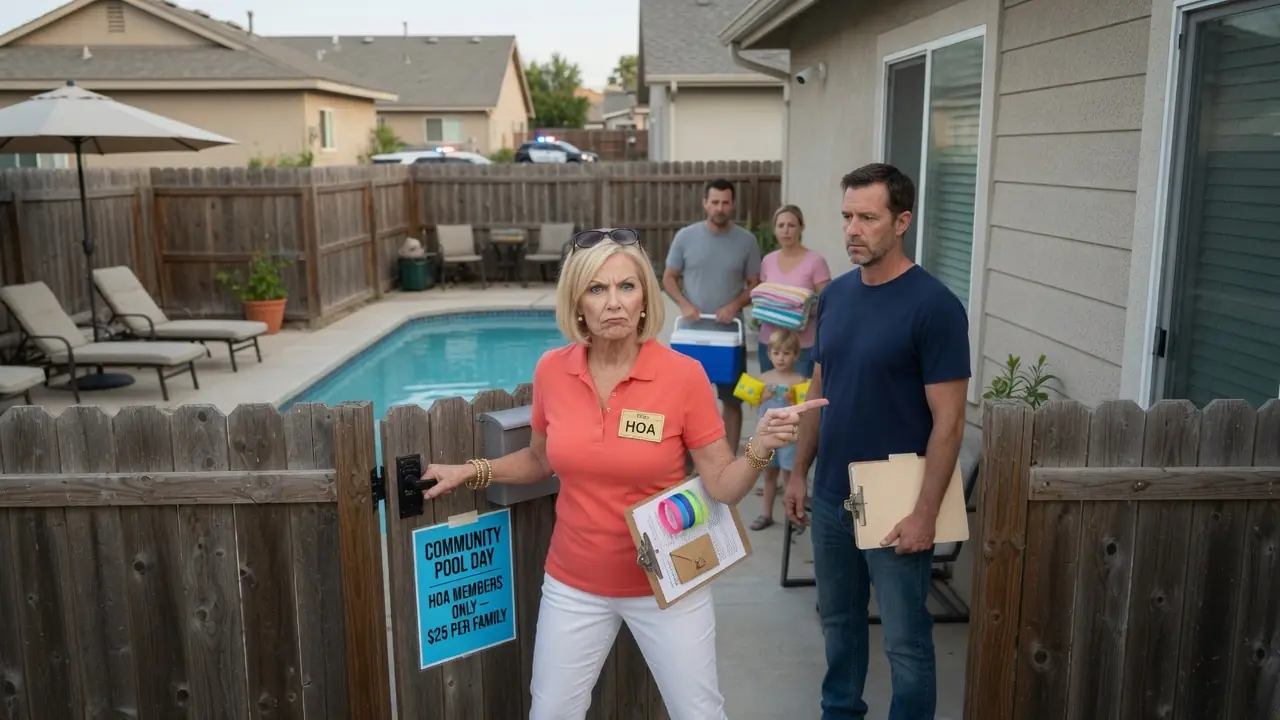
Across the street, more vehicles were turning into the cul-de-sac. Children carried inflatable rings. Parents unloaded folding chairs, coolers, sunscreen, and bags of food.
A bright flyer had been taped to Nathan’s mailbox.
He walked toward it.
COMMUNITY POOL DAY
BRIAR HOLLOW RESIDENTS ONLY
$25 PER FAMILY
EXTENDED ACCESS: $5 ADDITIONAL
1847 BRIAR HOLLOW LANE
WRISTBAND REQUIRED
His address appeared in bold beneath a picture of blue water.
At the bottom was the HOA logo.
Nathan slowly removed the flyer.
The mother on his porch looked uncomfortable.
“We were told you agreed.”
“I didn’t.”
The father glanced at the children.
“But we paid.”
“I understand.”
Nathan kept his voice calm.
“This is my private home. The pool is not an HOA facility.”
More people began walking toward the house.
By nine fifteen, almost twenty residents stood near the driveway.
By nine thirty, there were nearly thirty.
Then Victoria arrived.
She came around the corner wearing white trousers, large sunglasses, and a pale linen jacket over a blue blouse. A clipboard rested against one arm. Bright wristbands hung from the other.
She looked less like a neighbor and more like the director of a private resort.
“Good morning, everyone,” she called. “Please stay near the side path until we complete check-in.”
Nathan stood beside his mailbox holding the flyer.
Victoria saw him.
Her smile tightened.
“Nathan.”
“Victoria.”
She approached as though the gathering had been planned jointly.
“I was about to come speak with you.”
“You sold access to my backyard.”
“Let’s not use inflammatory language.”
“You collected money and sent people to my address.”
“This is a neighborhood community event.”
Nathan looked at the clipboard.
“How much have you collected?”
Victoria lowered her voice.
“That is an HOA matter.”
“My property is not an HOA matter.”
Several parents moved closer.
A woman holding a toddler asked, “Is the event canceled?”
Victoria turned toward her with the reassuring smile she used at board meetings.
“No. We’re simply resolving an access issue.”
Nathan almost admired the confidence.
Almost.
Victoria looked toward the side yard.
A six-foot cedar fence enclosed Nathan’s backyard. The gate stood beside the house, secured by a smart locking system mounted inside a weatherproof steel housing.
“You’ll need to unlock the gate,” she said.
“No.”
Her smile disappeared.
“You cannot embarrass these families because of a personal disagreement.”
“I did not invite them.”
“This community supported your pool application.”
“No, it didn’t.”
Nathan spoke clearly enough for everyone nearby to hear.
“The county approved the permits. I paid for every inspection, every contractor, every insurance requirement, and every foot of fencing.”
Victoria’s jaw tightened.
“You benefit from living in Briar Hollow.”
“That does not give Briar Hollow ownership of my backyard.”
A boy tugged his father’s shirt.
“Are we swimming or not?”
The father looked at Nathan.
“We were told this was approved.”
Nathan felt sympathy for him.
The families had not created the problem.
They had trusted an official-looking flyer carrying an HOA logo.
“Please give me a few minutes,” Nathan said. “No one should enter the side yard until this is resolved.”
Victoria stepped closer.
“The bylaws allow shared use of private improvements that enhance neighborhood value.”
“No, they don’t.”
“I have been president for three years.”
“And I have read the governing documents.”
She raised the clipboard.
“I’m not debating policy on your driveway.”
“Good. Then refund everyone.”
Several people began murmuring.
Victoria’s voice became colder.
“You are making a serious mistake.”
Nathan looked at her.
“That is what you said when I refused your first request.”
To understand why Nathan did not shout, why he did not argue longer, and why a folder was already waiting on his kitchen counter, it was necessary to understand how the pool had been built.
It was not a sudden luxury purchase.
It represented ten years of overtime, consulting work, canceled vacations, and weekends spent reviewing structural plans for small contractors who could not afford large engineering firms.
Nathan was forty-eight and worked as a structural engineer.
His career had been built around one central principle:
A structure failed long before it collapsed.
The visible disaster came last.
First came the overlooked stress.
The unsupported load.
The missing bolt.
The small decision someone dismissed because fixing it properly required time and money.
Nathan made his living finding those weaknesses before anyone was injured.
When he and his wife, Claire, purchased the Briar Hollow house fifteen years earlier, the backyard was hard Ohio clay surrounded by patchy grass.
Claire once stood at the kitchen window and said, “You spend your life telling everyone else how to build things correctly. You should build something for us.”
Nathan promised her a pool.
Then life interfered.
Their daughter, Emma, entered middle school.
Claire’s mother became ill.
College savings came before concrete.
The pool remained an idea sketched on graph paper inside a desk drawer.
Then Claire developed breast cancer.
For two years, hospitals replaced vacations.
Treatment schedules replaced weekend projects.
Nathan stopped talking about the pool because it felt foolish beside chemotherapy, surgery, and fear.
Claire never did.
During one of her better weeks, she sat on the back steps and looked across the yard.
“When this is over,” she said, “I want to float out there and do absolutely nothing.”
Nathan squeezed her hand.
“When this is over, I’ll build it.”
Claire died seven months later.
Emma was sixteen.
For almost three years, neither Nathan nor his daughter could discuss the backyard without remembering the promise.
Then, on Emma’s nineteenth birthday, she opened the old drawer and found the first pool sketch.
“Mom would be mad at us,” she said.
“For what?”
“For turning the yard into a memorial nobody can use.”
That spring, Nathan began building.
He did not cut corners.
The property was surveyed twice.
Every boundary pin was verified.
Plans went through county review.
The pool sat entirely inside Nathan’s lot, far beyond required setbacks.
He installed drainage to protect neighboring foundations.
He added a separate insurance policy.
The perimeter fence exceeded safety standards.
The gate used a coded magnetic lock with an alarm, exterior camera, and interior emergency release.
The release could always be opened from inside.
The lock existed to prevent children and unauthorized visitors from entering—not to trap anyone behind the fence.
Ownership, Nathan believed, was not merely the right to enjoy something.
It was the duty to carry its risks.
The HOA had contributed nothing.
Victoria still appeared on the day the final inspection passed.
She walked into the backyard without being invited, looked at the clear water, and smiled.
“This will be wonderful for property values.”
Nathan stood near the patio holding the inspection certificate.
“It will be wonderful for my family.”
“Of course.”
Victoria walked along the pool edge as though evaluating a hotel.
“You should consider community access.”
“No.”
She turned.
“I haven’t explained the proposal.”
“You don’t need to.”
“A few scheduled weekends each summer. Residents sign waivers. It would generate goodwill.”
“My insurance does not cover public use.”
“The HOA can provide a form.”
“A form does not replace insurance.”
Victoria smiled.
The expression contained no warmth.
“Private amenities can create resentment.”
“That is not a basis for access.”
“You may find the board less cooperative in the future.”
Nathan folded the inspection certificate.
“Are you threatening me over a swimming pool?”
“I’m reminding you that communities work through cooperation.”
“My answer is still no.”
She left without saying goodbye.
After that, enforcement around Nathan’s property became unusually enthusiastic.
A trash bin visible twenty minutes after the permitted time produced a warning.
A contractor’s trailer parked in the driveway during a bathroom repair generated a violation notice.
Emma’s car received a complaint because one tire rested against the edge of the grass.
Nathan responded to each notice calmly.
He cited the rules.
He corrected what required correction.
He saved everything.
Then, three days before the alleged community pool day, his neighbor Martin waved from across the street.
“Thanks for opening the pool Saturday.”
Nathan stopped at his mailbox.
“What?”
Martin laughed.
“The HOA event.”
“I’m not hosting an event.”
The laughter faded.
“That’s what the flyer says.”
Nathan found one taped to the community notice board.
Victoria did not deny it when he approached her house.
She stood in the driveway beside her white SUV, wearing sunglasses and holding a garden hose.
“The bylaws permit shared amenities that contribute to community value,” she said.
“No such clause exists.”
“That is your interpretation.”
“It is the plain language.”
“You are being unnecessarily difficult.”
“You printed my address.”
“The board approved the event.”
“Was it discussed at a public meeting?”
Victoria adjusted her sunglasses.
“The board has administrative authority.”
“Did the board vote?”
“I am not required to explain internal procedure to you.”
Nathan looked toward the flyer in his hand.
“You are collecting twenty-five dollars per family.”
“To cover administrative expenses.”
“What expenses?”
“Printing. Wristbands. Event coordination.”
“You’re selling tickets to my property.”
“You are exaggerating.”
Nathan nodded once.
Then he went home.
Victoria mistook that for surrender.
She did not know Nathan had learned long ago that arguments rarely improved bad foundations.
Documentation did.
By Thursday evening, residents were discussing payments on the HOA’s social-media page.
One woman commented that she had delivered twenty-five dollars in cash to Victoria’s house.
Another asked whether the five-dollar extended-access charge allowed families to remain after sunset.
Victoria answered yes.
Nathan saved every post.
Then he sat at his desk and opened the HOA declaration.
He had already read it when he submitted his pool plans.
Now he read it again.
The association controlled common property:
The entrance landscaping.
The mailbox pavilion.
The walking path.
The small playground.
It had authority to enforce exterior maintenance provisions affecting neighborhood appearance.
It had no right to operate, rent, manage, or sell admission to improvements located inside a privately fenced lot.
The language was direct.
The property survey was clearer.
Every inch of the pool, patio, fence, and access path belonged to Nathan.
The HOA owned no easement through the side yard.
Victoria had no authority to promise entry.
Charging money made the situation more serious.
This was no longer a misguided request for neighborly sharing.
Families had paid for something Victoria did not own and could not legally provide.
Nathan called his insurance agent.
The agent became serious immediately.
“Do not allow anyone into the yard.”
“I wasn’t planning to.”
“If this is being advertised as a paid public event, your residential policy may not cover incidents connected to it.”
“That was my concern.”
“Document everything and send me copies.”
Nathan photographed the flyers.
He saved the event page and payment comments.
He recorded the condition of the gate and backyard.
Then he called the non-emergency police number.
He did not accuse Victoria of fraud.
He stated only the facts.
An unauthorized paid event was being advertised at his private residential address.
A group might attempt to enter his fenced yard Saturday morning.
He requested that the report be logged and asked what he should do if people refused to leave.
The dispatcher told him to keep the gate secured, avoid confrontation, and call if trespass was attempted.
Nathan wrote down the incident number.
Then he contacted an attorney named Melissa Grant, who had previously reviewed contracts for his consulting business.
Melissa examined the flyer, bylaws, property plat, and screenshots.
“She cannot sell access to land she does not own.”
“What should I send her?”
“Nothing yet.”
Nathan looked surprised.
Melissa continued.
“You already told her no. The event is two days away. You have notified your insurer and police. Let her either cancel or create a complete record of what she intended.”
“What if families arrive?”
“Be polite. Do not let them enter. Make clear they were misled. Call the police if she attempts to force access.”
Nathan prepared a folder.
The deed.
Property survey.
Pool permit.
Final inspection certificate.
Insurance rider.
HOA declaration.
Screenshots.
Police incident number.
Then he waited.
Saturday arrived with clear skies and temperatures expected to reach ninety degrees.
By 8:47, the first family stood at his door.
By nine thirty, the street resembled the entrance to a municipal recreation center.
Victoria continued distributing wristbands.
Nathan noticed some were green and others orange.
“What do the colors mean?” he asked.
She looked annoyed by the question.
“Green is standard access. Orange includes the evening session.”
“You sold multiple sessions?”
“That is none of your concern.”
“It is occurring at my address.”
Victoria gestured toward the crowd.
“These people were promised a community event.”
“By you.”
“The HOA will hold you responsible for disrupting it.”
Nathan almost smiled.
“The HOA does not insure this pool.”
“We have general liability coverage.”
“Your carrier knows you sold tickets to private property?”
Victoria did not answer.
A man near the driveway said, “Can someone explain what’s happening?”
Nathan turned to the crowd.
“My name is Nathan Cole. This is my home. The pool is privately owned and insured for household guests only. I did not approve this event, and I did not receive any of the money you paid.”
The murmuring grew louder.
Victoria raised one hand.
“Please ignore the personal dispute. The board approved community use.”
“Show them the approval.”
She glared at him.
“The paperwork is not with me.”
Nathan held up the flyer.
“Then show them the bylaw authorizing you to sell access.”
“You’re grandstanding.”
“No. I’m asking for the document.”
A woman with two daughters stepped forward.
“Victoria, you told us the homeowner donated the pool for the day.”
Victoria’s expression did not change.
“It was presented to the board as a community resource.”
“By whom?” Nathan asked.
“This is inappropriate.”
“You printed the flyer.”
Another parent spoke.
“You said the twenty-five dollars paid for insurance.”
Nathan looked at Victoria.
“Did you tell them that?”
“It covered event expenses.”
“That’s not what she told me,” the parent said.
The atmosphere shifted.
Families who had arrived excited now began looking at their wristbands differently.
A few removed them.
Victoria turned toward the side yard.
“Open the gate.”
“No.”
“You are creating a safety issue by keeping people crowded in the street.”
“You invited them here.”
She walked toward the gate.
Nathan followed several feet behind.
The smart lock displayed a solid red indicator.
Victoria entered a four-digit number.
The panel rejected it.
She tried again.
The alarm emitted a brief warning tone.
Nathan stopped.
“Where did you get that code?”
Victoria turned.
“It was provided to the HOA during construction.”
“No access code was ever provided.”
“You submitted security information with your architectural application.”
Nathan felt the engineer in him become completely still.
His application had included a diagram showing the location of the gate and lock.
It had not contained the private access code.
“Did you attempt to obtain my code from the installation contractor?”
Victoria’s face tightened.
“Don’t be absurd.”
She tried the keypad a third time.
The system locked further attempts for five minutes and sent an alert to Nathan’s phone.
UNAUTHORIZED ACCESS ATTEMPT RECORDED.
The gate camera saved her face, time, and entered code.
Nathan held up his phone.
“Step away from the gate.”
“I am the HOA president.”
“You are attempting to bypass a safety lock on private property.”
“Because you refuse to cooperate.”
The first patrol car entered the cul-de-sac at 9:42.
Nathan had called when Victoria attempted the second code.
The officer parked without sirens and approached calmly.
Victoria immediately moved toward him.
“Officer, thank goodness. The homeowner is refusing access to an approved association event.”
The officer looked toward Nathan.
“Are you the property owner?”
“Yes.”
“Did you authorize the event?”
“No.”
Nathan handed him the prepared folder.
The officer reviewed the deed and plat first.
Then the HOA clause.
Then the flyer advertising paid admission.
He looked toward Victoria.
“You collected money?”
“To cover administrative costs.”
“For access to this property?”
“For an association event.”
“Do you have written permission from the owner?”
“The board has authority.”
“Do you have permission from the owner?”
Victoria did not answer.
The officer examined Nathan’s insurance document.
Nathan explained the gate system.
“The interior release is always functional. No one can be trapped inside. The exterior code controls entry because of child-safety and liability requirements.”
“Has anyone entered the backyard?”
“No.”
“Has anyone crossed the fence?”
“No.”
The officer nodded.
“Then the gate stays closed.”
Victoria removed her sunglasses.
“You do not understand HOA law.”
“I understand that this deed shows private ownership.”
He returned the folder to Nathan.
“This appears primarily civil, but no one has permission to enter. Anyone who climbs the fence or forces the gate may be arrested for trespass or property damage.”
Then he looked toward Victoria.
“If money was collected by representing that access had been authorized, you should speak with counsel and arrange refunds.”
A parent near the driveway raised his voice.
“I want my money back now.”
Another woman joined him.
“So do I.”
“Did the HOA even know about this?”
“Where did the money go?”
“What insurance did we pay for?”
Questions spread through the crowd.
Victoria attempted to speak over them.
“The event has been postponed because of the homeowner’s refusal to honor a community arrangement.”
Nathan interrupted.
“There was no arrangement.”
The officer looked at Victoria.
“I recommend you stop describing it that way unless you have proof.”
For the first time that morning, her confidence failed.
Not completely.
Only enough for everyone to notice.
Parents began removing wristbands and placing them on her clipboard.
Children complained as families loaded towels and coolers back into vehicles.
Nathan felt sorry for them.
He brought unopened bottles of water from the garage and offered them to the children while their parents waited for refunds.
Victoria stood beside her SUV writing names on the clipboard.
She did not have enough cash.
Some residents had paid electronically.
Others claimed she owed them thirty dollars because of the extended session.
By ten thirty, the street was nearly empty.
A small pile of neon wristbands remained on the pavement.
Nathan picked them up one by one.
The next day, he received an email from the HOA board accusing him of causing confusion and reputational harm.
He forwarded it to Melissa.
She replied within minutes.
Do not answer yet.
On Monday morning, Nathan contacted the association’s management company.
The property manager sounded surprised.
“We were not informed of a pool event.”
“Did the board approve one?”
“Not through our office.”
“Was the association insurer notified?”
“I cannot discuss coverage details.”
“Please send the flyer to the carrier.”
He did.
By Monday afternoon, an emergency board meeting had been announced.
Nathan attended.
The clubhouse was full.
Victoria sat at the front table beside four board members.
Two looked angry.
One looked frightened.
The final member, a retired accountant named Harold Price, had already placed a thick folder in front of him.
Victoria opened the meeting.
“Saturday’s event was unfortunately disrupted by a homeowner who reversed a prior verbal commitment.”
Nathan waited until public comment.
Then he stood.
“There was no verbal commitment.”
Victoria looked at him.
“You expressed willingness to consider community use during construction.”
“I said no the first time you asked.”
“I recall the conversation differently.”
“I recorded the second conversation.”
The room became quiet.
Nathan had not recorded the pool-completion visit.
But he had recorded the discussion at Victoria’s driveway after finding the flyer. Ohio permitted a participant to record a conversation.
He played it.
Victoria’s voice filled the clubhouse.
The bylaws allow shared amenities.
Nathan’s reply followed.
They do not.
Then Victoria said:
The board has administrative authority.
No claim of permission.
No reference to a prior agreement.
No suggestion Nathan had approved anything.
Harold Price looked toward her.
“Where is the board vote authorizing the event?”
Victoria straightened.
“It was handled administratively.”
“As president?”
“Yes.”
“Did the board approve the admission fee?”
“The fee covered costs.”
“Which costs?”
“Wristbands. Printing. Coordination.”
Harold opened a ledger.
“You collected eight hundred and seventy-five dollars.”
Several people murmured.
Victoria’s eyes narrowed.
“How did you obtain that number?”
“I reviewed electronic payments and the sign-in sheet you submitted after the event.”
Nathan calculated quickly.
Thirty-five standard family admissions would produce that amount.
But fewer than thirty families had appeared Saturday morning.
Some had apparently paid for later sessions that never occurred.
Harold continued.
“The wristbands and printing cost seventy-three dollars.”
“The remaining funds were intended for community programming.”
“Were they deposited into the HOA account?”
Victoria did not answer.
Another board member asked, “Where is the money?”
“I was holding it until the event concluded.”
“It concluded.”
“It was disrupted.”
The clubhouse erupted.
Residents demanded refunds.
One man asked whether the HOA had been operating unlicensed public events.
Another asked who would have been liable if a child had been injured.
Nathan said nothing.
The association’s attorney arrived twenty minutes into the meeting.
He had been called by the management company after the insurer reviewed Nathan’s documents.
The attorney spoke privately with the board.
When they returned, Victoria was no longer sitting in the center chair.
Harold announced the event had not been validly authorized.
Every payment would be refunded.
No HOA money could be used to defend Victoria’s personal actions unless coverage was confirmed.
Then he read a letter from the insurance carrier.
The carrier warned that unauthorized paid access to private residential property fell outside ordinary community operations and might have exposed the association to uncovered claims.
It required immediate policy changes.
The board placed Victoria on temporary administrative leave pending review.
She stared at Nathan.
“This is what you wanted.”
Nathan met her eyes.
“No.”
“What I wanted was for you not to sell my backyard.”
The review lasted three weeks.
It found that Victoria had created the event without a recorded board vote.
She had ordered the flyers.
Collected payments personally.
Purchased wristbands with her own credit card.
Represented to residents that the pool owner had consented.
Attempted to gain access through a gate code she did not possess.
Then she used the HOA mailing list to advertise the event.
The board also found earlier complaints.
Victoria had authorized vendors without competitive bids.
She had directed landscaping work toward a company owned by her cousin.
She waived violations for close friends while imposing immediate fines on others.
The pool incident had not created her abuse of authority.
It made the pattern impossible to ignore.
At the next membership meeting, a motion of no confidence passed by an overwhelming vote.
Victoria resigned before the board could formally remove her.
Her final statement accused several residents of misunderstanding the sacrifices required to maintain community standards.
No one applauded.
Harold Price became interim president.
His first action was to require that all future community events receive a recorded board vote, management-company review, and written confirmation that the association possessed legal authority over the location.
His second action was simpler.
No board officer could collect cash personally.
The neighborhood became quieter.
Violation notices began including the exact rule allegedly violated.
Homeowners received courtesy warnings before fines.
Board meetings ended in less than an hour.
Nathan’s pool returned to what it had always been.
A private place for family and invited friends.
Emma visited after college with two roommates.
They spent a Sunday floating beneath the summer sun.
Nathan sat near the patio holding the first sketch Claire had once kept in the kitchen drawer.
Emma noticed it.
“You still have that?”
“Of course.”
She looked across the water.
“Mom would have loved this.”
Nathan nodded.
“She would have complained that I made it too deep.”
“She would have complained until she got in.”
They laughed.
Later that afternoon, Emma floated alone near the center of the pool.
For a moment, with her eyes closed and sunlight across her face, Nathan could see Claire.
The pool had never been built to increase property values.
It was not a community amenity.
It was a promise completed years late.
It was grief turned into concrete, water, and a place where life could continue.
Victoria saw only something valuable behind a fence.
She believed visibility created access.
She believed her title allowed her to redefine private property as a shared resource.
Most of all, she believed Nathan’s quiet refusal meant he could be pressured into agreement.
She misunderstood the kind of man standing in front of her.
Structural engineers rarely defeated force with louder force.
They studied load paths.
They documented weak connections.
They waited for pressure to reveal where failure had already begun.
Victoria’s authority looked solid.
The clipboard.
The flyers.
The wristbands.
The title.
But none of it rested on a lawful foundation.
The first family did not destroy her position.
Neither did the police officer.
Nor the insurer.
Nor the board.
The collapse began the moment she sold something she did not own and assumed no one would ask where her authority came from.
Months later, Nathan found one neon wristband beneath a shrub near the driveway.
He carried it into the garage and placed it inside the folder containing the flyer, screenshots, police report, and final board findings.
Emma saw it during her next visit.
“You kept one?”
“It’s evidence.”
“The case is over.”
Nathan closed the folder.
“Engineers keep records.”
She smiled.
“Dad, you keep grocery receipts from 2018.”
“Those might become relevant.”
The wristband remained in the file.
Not as a trophy.
As a reminder.
Rules had value.
Communities needed structure.
Shared spaces required cooperation.
But titles did not create ownership.
A vote could not erase a deed.
A flyer could not create consent.
And no amount of neon plastic could turn one family’s backyard into something another person had the right to sell.
The gate still used the same magnetic lock.
The interior safety release still worked.
Nathan occasionally invited neighbors over.
Martin and his wife came for barbecues.
Harold brought his grandchildren one afternoon.
Even several families who had purchased wristbands returned later as personal guests.
They asked first.
Nathan said yes when he wanted to.
That distinction mattered.
The water was the same.
The patio was the same.
The difference was consent.
On quiet Saturday mornings, Nathan sometimes sat beside the pool with coffee before anyone else woke.
He listened to the pump.
Watched sunlight move across the surface.
Remembered Claire standing in the empty clay yard, telling him to build something correctly for once that belonged to them.
He had.
Every permit.
Every inspection.
Every boundary.
Every safety requirement.
Victoria believed she could sell access because she saw the finished pool and never understood the years beneath it.
The overtime.
The grief.
The promise.
The responsibility.
She had seen the water.
Nathan knew the foundation.
And when she attempted to claim what rested on it, he did not need to shout.
He only needed to keep the gate closed and let the documents speak.