I want you and this entire trash heap gone by the end of the month. That is not a request.
Ma'am, I'd appreciate it if we could talk about this calmly. Calmly. I sent three lawyers to your porch with a 90-day note. I remember you stood there in some ridiculous black robe like a crazy person. 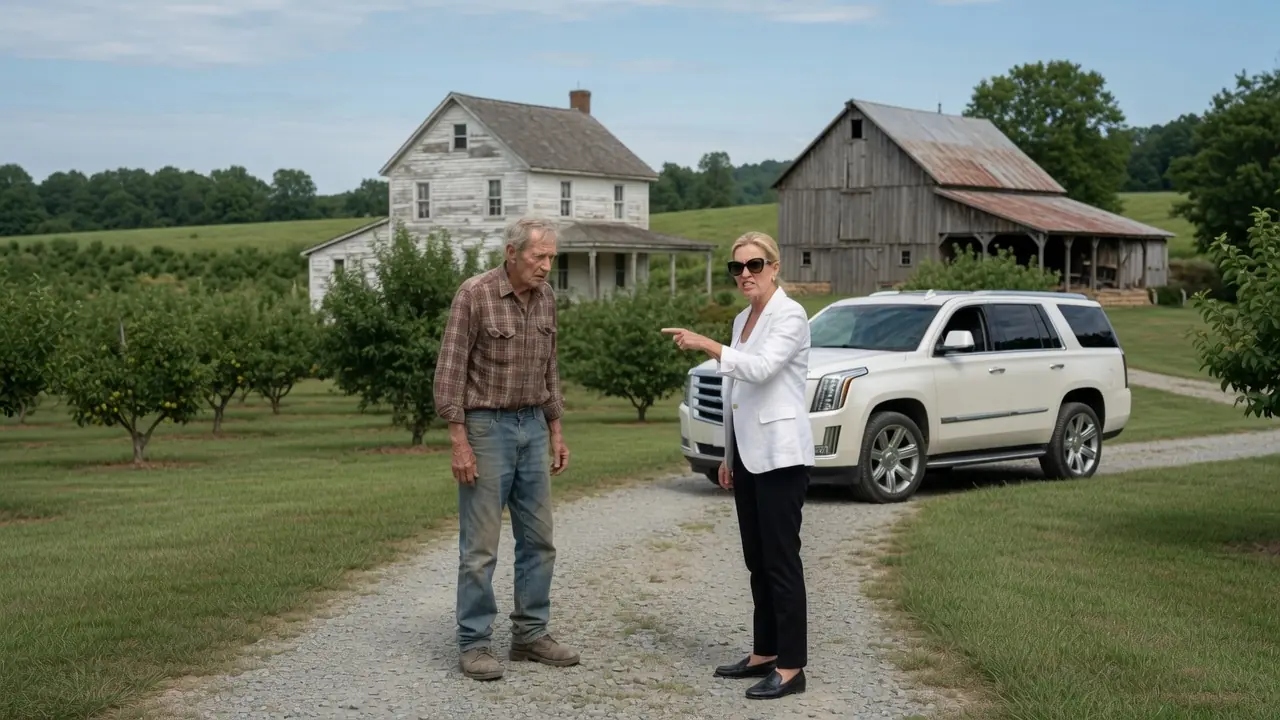
Didn't say a word. Now those lawyers won't even return my call. That wasn't a costume, ma'am. Then what was it? Dead silence.
I just looked at her. My judicial robes. She'd spent 6 months trying to bully me off my grandfather's land. You're what? 22 years on the Virginia Circuit Court bench.
One of your lawyers argued a case in front of me last year. He lost. She had no idea what I was about to do to her. My name is Garrett Hollowell, and the land under my boots has been in my family since before the Korean War started.
My grandfather, Everett, bought those 47 acres in the spring of 1946. He'd spent three years in Europe watching the world burn. And when he came home, all he wanted was quiet dirt and honest work. He found both in Albemarle County, Virginia.
He built the farmhouse himself. White clapboard, two stories, a wraparound porch that faces east so you catch the sunrise over the Blue Ridge. He planted apple trees along the south slope. The following year, Galas, Honey Crisps, and a row of Arkansas Blacks that still fruit every October like clockwork.
The bark on those trees is thicker than my arm now. The roots go deeper than any foundation in Sterling Ridge. I grew up running through those orchards. The smell of overripe apples rotting in the grass every September.
Sweet and sharp at the same time. That's the smell of my childhood. My dad took over the land in 1971. I left for UVA law, became a prosecutor, and eventually got appointed to the circuit court bench.
I served 22 years. I've seen every flavor of petty cruelty that one person can inflict on another through paperwork and process. My wife Eleanor loved this place more than I did. Every summer we drive out from Charlottesville and she'd kick off her shoes the second we hit the gravel driveway.
She planted lavender along the fence line. Said the smell reminded her of her grandmother's kitchen in North Carolina. The lavender still blooms every June. Eleanor doesn't.
She died of pancreatic cancer 4 years ago. 41 days from diagnosis to funeral. I retired the day after they lowered her casket, moved onto the land full-time, and started fixing what 75 years of weather had broken.
That's what I was doing when Sterling Ridge Estates arrived. 6 years ago, the dairy farm next to mine sold to a developer. Within 18 months, the pastures were gone. In their place, 93 houses, white vinyl fencing, an HOA rule book thicker than the county code, and a clubhouse that looks like a Marriott had a baby with a strip mall.
The kind of neighborhood where people pay $400,000 for a house and then complain about the sound of a tractor. Brenda Whitfield came with the development like mold comes with moisture. She was the HOA's first president and never let go.
54 years old, blonde hair that hadn't seen its natural color since the Clinton administration, and a body that suggested her morning yoga sessions weren't working as hard as she claimed. She drove a pearl white Cadillac Escalade the way some people carry a badge, like it gave her authority over everything in a 3 mile radius.
The first time I met her, I was fixing fence posts along the property line. The Escalade rolled up, window went down, and out came a voice that could curdle fresh milk. I need to talk to whoever owns this property.
She said property the way you'd say dumpster fire. She stepped out, Gucci sunglasses pushed up on her head, white linen blazer over black yoga pants, clipboard in her left hand. She handed me a piece of paper.
It had the Sterling Ridge logo at the top and the word violation in red block letters. My barn was an aesthetic disruption. My tractor was a noise hazard. My apple trees were attracting pest populations that threatened community wellness.
All from a woman whose jurisdiction ended at her own property line. I looked at the paper, looked at her. Ma'am, I'm not in your HOA. She smiled.
2 weeks after Brenda's first visit, a letter arrived in a cream colored envelope, heavy enough to double as a paper weight. The return address said Kesler Brandt and Associates, attorneys at law. The paper was thick, textured, the kind that costs more per sheet than most people spend on lunch.
It smelled like ambition and bad decisions. The letter was two pages of legal language that boiled down to one simple demand. Sell your property within 90 days or face litigation. They cited community standards, property value depreciation, and something called adjacent parcel aesthetic compliance.
A term I'm fairly confident was invented in that very letter because in 22 years on the bench, I'd never seen it in a single filing. I sat on the porch and read it twice. Not because it was complicated, because it was so poorly constructed that I wanted to make sure I wasn't missing something clever hidden underneath the bluster.
I wasn't. This was a scare letter, plain and simple. The legal equivalent of a Halloween mask designed to frighten people who don't know any better. I folded it neatly, slid it back into the envelope, and filed it in the kitchen drawer next to Brenda's violation notices.
The drawer was starting to get full. 3 days later, a black sedan pulled into my driveway. Not a county vehicle, not a neighbor. A Lincoln Town Car with tinted windows, and a fresh wax job, looking about as natural on my gravel road as a tuxedo at a pig roast.
Three men got out, gray suits, leather briefcases, shoes polished to a mirror shine. They walked up the path single file and their oxfords crunched on the gravel with every step. A sharp deliberate sound like they were trying to announce themselves as serious people.
The leader adjusted his tie. The one behind him checked his watch. The third one carried a folder thick enough to prop open a door. I was inside standing in my study holding the last piece of my old life, my judicial robes.
22 years of wearing them, and the fabric still felt heavy on my shoulders, heavier than any suit I'd ever owned. The black wool carried the faint smell of old courtrooms, wood polish, paper dust, and the particular staleness of rooms where people's lives get decided.
I was trying them on one final time before folding them into a box. The doorbell rang. I walked to the front door and opened it. Todd Hensley was standing in the middle, mouth already shaped around whatever rehearsed opening line he'd prepared in the car.
He was mid-30s, well-groomed, the kind of lawyer who practices his handshake in the mirror. His mouth opened, then his eyes moved from my face down to the robe, then back up to my face. The color drained out of him like someone had pulled a plug.
Pink to chalk in maybe 2 seconds. His briefcase hand dropped about 3 inches. Judge. Judge Hollowell. I remembered him.
12 months ago. Commercial property dispute, the Westover case. He'd represented a developer trying to push a family off a parcel using a manufactured code violation. I ruled against him.
The irony was so thick you could spread it on toast. The two lawyers behind Todd looked at him, then at me, then at the robe. Nobody spoke.
The only sound was wind moving through the apple trees and the distant hum of a lawn mower somewhere in Sterling Ridge, the neighborhood that was apparently funding this visit. I stood in the doorway, hands at my sides, and let the silence do the work.
10 seconds, 15. In a courtroom, silence is a tool. Most people can't handle it. They fill it with confessions, excuses, or retreats.
Todd chose retreat. I think there's been a misunderstanding, your honor. He closed his briefcase with a soft click. We apologize for the intrusion.
They walked back to the Lincoln in single file. Nobody looked back. The car reversed down my driveway and I watched the tail lights disappear past the oak tree that my grandfather planted the same year he laid the foundation for this house.
I wondered how much Brenda paid for that 45 second visit. Probably enough to repaint the barn she hated so much. That evening, I called Gil Norwood. Gil was 67, lived 2 miles down Route 7, and had been farming this valley since before Sterling Ridge was a line on a developer's napkin.
He picked up on the second ring. She sent lawyers Gil. He was quiet for a moment. She's done that before, Garrett.
Three families on this road sold because of her. The Pattersons, the Wellers, the Duns. You're the last one standing. I looked out the window at the orchard.
The sun was setting behind the ridge, painting the sky in shades of copper and rust. Eleanor would have called it God showing off. Then I guess I'd better stand well, I said.
Here's something most people don't realize. In Virginia, sending a legal threat letter with no factual basis can constitute abuse of process. A civil tort that allows the target to sue for damages. Brenda's lawyers had just hand delivered me a cause of action on cream colored stationery.
Some gifts come in expensive packaging. Brenda didn't slow down after the lawyer debacle. She shifted tactics the way a chess player switches from direct attack to positional warfare. If she couldn't scare me with legal threats, she'd weaponize the bureaucracy.
The first complaint hit two days after the lawyers left. The county health department called to inform me that an anonymous concerned citizen had reported a septic system leak on my property. They were required to investigate. Could I be available Thursday?
Thursday came. Two inspectors in khaki pants and rubber boots walked every inch of my septic field. They took soil samples. They tested the groundwater.
They poked probes into the earth like they were performing surgery on my yard. 4 hours later, the lead inspector shook my hand and said, Mr. Hollowell, your system is cleaner than most we see in new construction. Whoever filed this didn't have a clue what they were talking about.
One day of my life, gone for nothing. The second complaint arrived the following week. This time, it was building and safety. Brenda, or her anonymous proxy, had reported that my barn was structurally compromised and poses an imminent collapse risk to neighboring properties.
The inspector drove out, walked through the barn, knocked on the posts, checked the joists. He spent 40 minutes inside, breathing in the smell of dry hay and 75 years of honest work baked into the wood. When he came out, he was almost smiling.
Sir, this barn is built better than half the houses in Sterling Ridge. Your grandfather knew what he was doing. I wanted to frame that quote and mail it to Brenda. The third complaint was my favorite.
Agricultural services received a report that my apple orchard was harboring insect populations that present a clear and present danger to community health. I didn't make that language up. Someone actually wrote clear and present danger about apple trees. The inspector came out, walked through the rows, checked the bark, examined the fruit.
He pulled off a honey crisp, turned it over in his hand, and said, These are some of the healthiest trees in the county. Ma'am filed this. In six weeks, Brenda filed seven complaints with four different county agencies, seven inspections, seven cleared results, seven complete wastes of government resources paid for by taxpayers who had no idea their money was funding one woman's grudge against an apple orchard.
If Brenda had put this much energy into literally anything else, volunteer work, continuing education, competitive hot dog eating, she would have been nationally ranked by now. I started keeping a file. Every complaint, every inspection report, every date, every inspector's name. I bought a three-ring binder and labeled it Whitfield.
The binder got thick fast. I called the county clerk's office one afternoon. I'd like copies of every complaint filed against my property in the last 2 months. The woman on the other end paused.
All seven of them? She sounded tired. I didn't blame her. Here's something worth knowing. In Virginia, filing false reports with government agencies can constitute a misdemeanor under state code.
Penalties can include fines up to $2500 and up to 12 months in jail per complaint. Brenda had filed seven. I wasn't counting yet, but I was keeping the receipts. One evening after the fifth inspection, I sat on the porch with a glass of bourbon and watched the fireflies drift over the orchard.
The crickets were loud that night, a pulsing rhythmic chorus that Eleanor always said sounded like the earth breathing. She used to sit right here in the rocker next to mine, bare feet on the rail, reading whatever novel she'd found at the library sale. The rocker was still there. The cushion still held the shape of her.
I looked at the empty chair and said quietly, What would you do, Eleanor? I could almost hear her voice. She'd have laughed first, that low, warm laugh that started in her chest. Then she'd have said something like, Honey, she picked the wrong porch.
I finished the bourbon and went inside. Tomorrow there'd be another complaint, another inspector, another waste of everyone's time. But I was starting to see the pattern now. Brenda wasn't just harassing me for sport.
She was building a paper trail. Seven complaints, seven visits, the illusion of a problem property. She was constructing a narrative, a case. She wanted enough on file to go to court and argue that my land was a public nuisance.
The thing about paper trails is they work both ways. She was building hers. I was building mine. The difference was that mine had truth in it.
The letter from the Albemarle County Planning Commission arrived on a Tuesday. Plain white envelope, official seal, no perfume of expensive law firms this time, just cold bureaucratic paper. Notice of proposed rezoning. Parcel number 4471-02.
From agricultural to residential mixed use. I read it standing by the mailbox. The wind carried the cloying sweetness of chemical fertilizer from Sterling Ridge's golf course lawns. A smell that had nothing to do with nature and everything to do with people trying too hard to make things look perfect.
The financial implications hit me before the anger did. Agricultural zoning on 47 acres meant my property taxes ran about $800 a year. Residential mixed zoning would push that number to roughly 14,000. That's not a tax increase.
That's a financial eviction. An 18-fold jump designed to make the land too expensive to keep. I scanned to the bottom of the notice proposed by Commissioner Darren Whitfield. I almost laughed.
Almost. Brenda's husband, the man who sat on the county planning commission and also happened to own Whitfield and Sons Construction, the primary contractor for Sterling Ridge Estates. He wasn't even trying to hide it. In 22 years on the bench, I'd seen hundreds of conflicts of interest.
Most people at least had the decency to use a frontman or a proxy. Darren just signed his own name like he was ordering lunch. Gil Norwood called that afternoon. You see the rezoning notice Garrett?
I'm holding it. That's Darren's play. He did the same thing to the Henderson farm in 2019. Filed for rezoning, jacked up the tax estimate, and the Henderson sold within six months.
Couldn't afford to hold on. Gil's voice was flat, the way it gets when someone's telling you something they've seen too many times. He rezones it. His company builds on it, and Brenda gets to expand her little kingdom.
Same playbook, different victim. The public hearing was scheduled for a Thursday evening at the county government center. I drove over in my truck, parked between a Tesla and a Mercedes with a Sterling Ridge parking sticker, and walked into a room with fluorescent lights, plastic chairs, and the faint smell of floor wax and political ambition.
Darren sat at the front behind a curved desk with four other commissioners, navy suit, cufflinks that caught the light, cologne you could smell from the third row. He had the smile of a man who'd already counted his winnings before the cards were dealt. I signed in to speak during the public comment period. When my name was called, I walked to the microphone.
The room was maybe half full. A few Sterling Ridge residents, some county staff, a board reporter from the local weekly. I kept it simple. I stated the history of the parcel, 80 years of continuous family ownership.
I mentioned the conservation easement my father had filed in 1987 with the Virginia Outdoors Foundation. I cited the agricultural exemption and what the rezoning would cost me. I spoke clearly without notes in the same measured tone I'd used for 22 years from the bench. When I finished, Darren leaned into his microphone.
The county's growth plan requires us to consider all options for responsible community development, Mr. Hollowell. No one is trying to push anyone off their land. He said it with a straight face. I'll give him that.
I leaned back toward my microphone. Commissioner Whitfield, for the record, does your construction firm currently hold active contracts with Sterling Ridge Estates? The room went quiet. Not library quiet, courtroom quiet.
The kind of silence where you can hear someone swallow. Darren's jaw tightened. His eyes shifted to the commissioner on his left, then back to me. I don't see how that's relevant to this hearing.
I think it's extremely relevant, I said, but I'll let the record speak for itself. The commission chair cleared her throat and announced that the rezoning proposal would be tabled for further review. Translation: Someone just asked a question nobody wanted to answer in public. I drove home on the county road, windows down, the cool Virginia evening air washing through the cab.
The Blue Ridge was dark against the last strip of sunset. I'd been calm for 22 years on the bench. I could be calm for a few more months. But something had shifted.
I knew now that Brenda was just the face, the clipboard, the Escalade. She was loud and visible because that was her job. To distract, to intimidate, to make noise. Darren was the one behind the curtain.
His fingerprints were on the rezoning. His company stood to profit. His wife was the enforcer. And the HOA treasury was the war chest.
Brenda was the gun. Darren was the one pulling the trigger. I spent the next 3 weeks doing what I'd done for 22 years, reading documents, following money, and connecting dots that other people assumed would never be connected. A judge doesn't investigate.
A judge evaluates evidence that others bring. But I wasn't a judge anymore. I was a property owner being squeezed off his own land by a woman with a clipboard and a man with a construction company. So, I put on a different hat and started digging.
The Freedom of Information Act request was first. I filed for all contracts between Whitfield and Sons Construction and any entity associated with Sterling Ridge Estates. The county responded in 11 business days. Three contracts total value $4.2 million.
Pool construction, clubhouse expansion, road resurfacing. Darren had voted to approve every Sterling Ridge related proposal that came before the planning commission without ever disclosing his financial interest. That's a direct violation of Virginia Code section 2.2-3112, the state conflict of interest statute. Not a gray area, not an interpretation, a textbook violation.
I sat in my study that night, the desk lamp casting a warm circle over stacked file boxes. The room smelled like old paper and black coffee. The same smell that followed me through two decades of late nights at the courthouse. Some smells become comfort.
The HOA financial records came next. Virginia's Property Owners Association Act requires associations to make their books available to members upon request. I wasn't a member, but Tammy Griggs was. She requested the records and the HOA had 15 days to comply.
They took 14. Lydia Krenshaw, the forensic accountant I'd called in, spread the ledgers across her desk and started reading. 10 minutes in, she looked up over her glasses. Garrett, this isn't creative bookkeeping.
This is embezzlement. $87,000. That's how much had been moved from the HOA's legal reserve fund to pay for legal consultation regarding adjacent property compliance. No board vote on record, no membership approval, no minutes from any meeting authorizing the expenditure.
Brenda had taken dues money, money paid by her own neighbors for pool maintenance and landscaping and spent it on a personal vendetta against me. Then came the killshot. I read the CC and RS of Sterling Ridge Estates front to back. All 43 pages, article 2, section one.
This association shall have jurisdiction exclusively over lots within the recorded plat of Sterling Ridge Estates. My property was never part of that plat, not one square foot. Every violation notice Brenda had ever slid under my door, every letter, every demand, they were all legally meaningless. She'd been waving a badge that had no authority outside her own neighborhood.
And the conservation easement my father filed in 1987 with the Virginia Outdoors Foundation. It ran with the land permanently. Any owner, any decade, any commission vote, it didn't matter. The easement prohibited residential development on 20 of my 47 acres.
Darren's rezoning proposal wasn't just aggressive, it was legally impossible. I placed four folders on my desk and looked at them the way I used to look at a case file when the prosecution had just rested and the evidence was overwhelming. For the first time in months, I smiled. Not a happy smile, a courtroom smile, the one that comes when a defendant lies on the stand and doesn't realize the documentary evidence is already in the record.
Brenda and Darren had spent 6 months trying to push a judge off his land by violating at least four state statutes. That's the kind of strategy you come up with when you watch too much reality television and don't read enough law books. I didn't rush. In 22 years on the bench, I learned one thing that most people never figure out.
The person who moves first usually loses. The person who moves last with everything in order wins. My plan had five parts. Not because I'm dramatic, because the problem had five layers, and each one needed its own blade.
Lydia Krenshaw handled the money. I brought her every financial document Tammy had pulled from the HOA, plus the FOIA response on Whitfield and Sons contracts. Lydia worked out of a small office on Main Street in Charlottesville, the kind of place with frame certifications on the wall and a printer that never stopped running. She spent 4 days going line by line through the HOA's books.
When she called me back, her voice had that flat professional calm that accountants use when they found something ugly. Garrett, it's clean. By that I mean the embezzlement is clean. Simple transfers, no shell entities, no layering.
She moved the money directly from the legal reserve to a vendor account that she controls. 87,000 plus another 25 she just authorized without quorum. 112,000 total. A first year auditor could prove this in an afternoon.
I filed the first formal complaint with the Virginia Judicial Inquiry and Review Commission regarding Darren's undisclosed conflicts of interest. I didn't call any friends on the bench, didn't ask for favors. I walked the paperwork through the front door the same way any citizen would. The process exists for a reason.
When a public official uses his position to benefit his own company while punishing a private citizen, the system has a mechanism for that. I just knew where the front door was. The second complaint went to the Virginia State Bar concerning Kesler, Brandt, and Associates. The firm had sent a demand letter threatening litigation with no legitimate legal basis.
That's not aggressive lawyering. That's a potential ethics violation. The bar takes those seriously, especially when the complainant happens to be a judge who can cite the relevant rules of professional conduct from memory. Then I called Pete Salana.
Pete was an investigative reporter at the Charlottesville Daily Progress. Young, hungry, the kind of journalist who still believed the job meant something. I met him at a coffee shop downtown and slid a folder across the table. Read it, I said.
If there's a story, write it. If there isn't, don't. He opened the folder. His eyes moved fast.
He flipped pages, stopped, went back, read something twice. 20 minutes later, he closed the folder and looked at me. Judge, there's a story. There's a hell of a story.
The hardest part wasn't the filings or the forensics. It was the neighbors. I drove to Tammy Griggs's house on a Wednesday evening. She lived in a three-bedroom on Magnolia Court, one of the smaller lots in Sterling Ridge, the kind that backs up to the sound wall.
She opened the door looking tired, a toddler on her hip, and a 5-year-old watching cartoons behind her. Tammy had been fined $3,200 over two years. Trash cans left out past noon. $200.
Car parked 6 inches past the driveway edge. 150. Garage door open after 7:00 p.m. 100.
She'd paid everyone because she was afraid of Brenda. Afraid of the letters. Afraid of losing her house. I've been scared of that woman for 3 years, Tammy said.
The toddler grabbed her earring. She didn't flinch. Tell me what to do and I'll do it. I told her what I needed.
Signatures. Virginia Code section 55.1-1828 says that 25% of HOA members can demand a special meeting. Sterling Ridge had 47 households. I needed 12 signatures.
Over the next two weeks, I got them. Tammy helped. Gil spread the word to the old-timers along Route 7. One by one, residents came forward, each with their own Brenda story, their own stack of fines, their own quiet anger.
The Mercers got fined for a garden gnome. The Kohls got fined for a basketball hoop. The Proctors got a violation for having the wrong shade of beige on their shutters. 12 families signed.
13 actually. The petition was filed on a Monday morning. I prepared my presentation for the annual meeting the way I used to prepare for trial. Every exhibit numbered, every argument mapped, every possible objection answered before it could be raised.
The difference was that this time the defendant didn't have a good lawyer. She had a clipboard and a pearl white Escalade. Word travels fast in a neighborhood where everyone watches everyone else's trash cans. It took Brenda about 4 days to figure out that her residents were talking to me.
She did not take it well. I woke up on a Friday morning at 5:30 the way I always do. The air was cool, still damp with fog that hadn't burned off yet. I pulled on my boots, grabbed my coffee, and walked out to check the fence line the way I had every morning since moving back.
The routine was sacred. Boots, coffee, fence, cows, in that order. The first thing I noticed was the sound, or rather the absence of it. My six head of cattle are creatures of habit.
By 5:30, they're usually clustered near the north gate, waiting for feed. That morning, the north pasture was empty, silent, just mist hanging over flat grass. I walked to the fence. Three sections of wire had been cut clean, not snapped, not sagged, cut.
The ends were shiny and precise. The work of someone with a good pair of wire cutters and a reason to use them. I followed the tracks through the gap and onto Sterling Ridge property. My cattle had wandered across the development's back perimeter, across two manicured lawns and into the cul-de-sac on Birchwood Lane.
Six Herefords standing on a carpet of Kentucky bluegrass that someone paid a landscaping company $80 a week to maintain. The hoof prints were deep and symmetrical. The evidence they'd left behind was organic and abundant. Brenda called animal control before most people had finished their first cup of coffee.
I'll give her this. It was the earliest I'd ever known her to be awake for something other than sunrise yoga. I photographed the cut fence. Every angle, every clean edge.
I measured the distance from the cuts to the nearest Sterling Ridge property line, 42 feet. I noted the time, the weather, the direction of the tracks. Then I added it all to the binder. The cattle were rounded up by noon.
No damage to anyone's property beyond some lawn divots and a memorable smell, but Brenda had already sent a neighborhood-wide email calling it a dangerous livestock incident and demanding that the board take emergency action. She was just getting started. Over the next 10 days, a rumor began circulating through Sterling Ridge. Garrett Hollowell was experiencing cognitive decline.
He was unstable. He was a potential danger to the community. One resident told Tammy that Brenda had said, A man his age, living alone on that property with all those animals, someone should really check on him for his own safety. Let me be clear about something.
I spent 22 years evaluating the credibility of witnesses. I can tell you the exact tone of voice people use when they're genuinely concerned about someone's well-being. And I can tell you the exact tone they use when they're building a case to discredit a threat. Brenda wasn't worried about my health.
She was worried about her freedom. Then came the road. I drove home one afternoon to find two metal posts and a length of yellow nylon rope stretched across the dirt road that leads from Route 7 to my driveway. A hand-lettered sign hung from the rope.
Private property, Sterling Ridge, HOA. No unauthorized access. I stopped my truck, engine idling, and looked at the sign. The rope was new.
The posts were new. The audacity was timeless. That road has been there since 1952. My grandfather signed the original easement agreement with Albemarle County when they paved Route 7.
It's a recorded right-of-way, public access, legally guaranteed, documented in the county land records. Blocking a recorded easement isn't just rude. Under Virginia Code section 33.2-1232, it's obstruction of a right of way. If done intentionally, it's a misdemeanor.
I photographed the barricade. I called the county sheriff's office. Deputy arrived within an hour, confirmed the easement on his laptop, and had the posts pulled and the rope removed before dinner. That night, I sat in the living room.
The fire was low, just embers and the occasional pop of oak. On the mantle, Eleanor looked out from a silver frame, a photo from the summer we painted the kitchen, her hair tied back, paint on her chin, laughing at something I'd said. I couldn't remember the joke. I wished I could.
Almost there, sweetheart, I said quietly. Almost there. Every move Brenda made was a new page in my binder. Every lie, every fence cut, every fake sign.
She thought she was tightening the noose. She was tying it around her own neck. Brenda's second law firm lasted about as long as her first attempt at subtlety. The new letter arrived on a Thursday.
Thinner paper, cheaper envelope, different logo. Crawford Legal Solutions, not Kesler Brandt and Associates. That firm had quietly dropped the case after Todd Hensley spent an uncomfortable 45 seconds on my porch. The downgrade was telling.
When you fire your first lawyer and hire a cheaper one, you're not escalating, you're hemorrhaging. It's a pattern I saw a hundred times from the bench. The more desperate the client, the lower the quality of representation. Brenda had gone from a $100 steak to a gas station sandwich.
And the letter read like it. Final notice. Sell the property within 30 days or face a civil nuisance lawsuit. I held the paper up to the window light, thin, almost translucent.
I could see the shadow of the apple trees through it. There was a metaphor in there somewhere, but I didn't need metaphors. I needed three more days. Darren, meanwhile, was running his own clock.
He'd called an emergency session of the planning commission to vote on the rezoning, trying to ram it through before my formal complaint reached the review board. He scheduled it for Tuesday. The annual HOA meeting was Thursday. He wanted the rezoning approved before anyone in Sterling Ridge knew what was happening, but the judicial inquiry had already received my complaint.
Judge Clarice Peyton, a colleague from my years on the circuit, called me on Monday evening. We'd served together for 8 years. She was now chief judge of the appeals court, and she didn't call about personal matters unless something mattered. Garrett, I can't discuss specifics, but the inquiry received your filing and they're moving on it.
Darren has not been notified yet. Thank you, Clarice. That's all I needed to hear. That same week, Brenda held an emergency board meeting.
If you could call three people in a room a meeting, she voted along with her two loyal board members to authorize another $25,000 from the HOA Treasury for a community legal defense fund. There was no quorum, no proper notice, no minutes distributed to the membership, just three hands raised in a room with the blinds drawn, moving money that belonged to 47 families. Tammy called me that night. Her voice was tight.
She held a vote, Garrett. Three people. Nobody else was invited. Nobody else knew how much.
25,000. I was quiet for a moment. Good. Let her take it.
Good, Garrett. She's stealing their money. Every dollar she takes is another count on the indictment. Tammy let her dig.
On Wednesday, Pete Salana called. His investigation was complete. The story would run in the Charlottesville Daily Progress on Monday, 3 days after the HOA meeting, but the timing didn't matter for my purposes. The evidence existed whether the newspaper printed it or not.
Pete's story was the match. The fuel had been stacking up for months. I spent Wednesday night in my study assembling the final presentation. 32 slides, supporting documents copied and collated for every household.
47 packets each in a manila folder. Lydia's audit report. The CC and Rs with article 2.1 highlighted in yellow. The conservation easement from 1987.
FOIA responses showing Darren's contracts. Copies of every false complaint Brenda had filed. Photographs of the cut fence. Photographs of the illegal barricade.
The petition with 13 signatures. I called Sheriff Boyd Cassell on Thursday morning. Boyd was a straight shooter, 20 years in law enforcement, no political ambitions, the kind of man who arrests people because the law says so, not because someone asks him to. Boyd, I'm going to need you at the Sterling Ridge annual meeting tonight.
Is this about the Whitfield matter? It is. I'll be there. I'll bring the paperwork you filed last week.
I hung up and looked at the closet where my judicial robes hung behind the door. The heavy black fabric, the zipper I'd pulled up a thousand times before walking into court. I didn't need them tonight. Tonight, I wasn't a judge.
I was a plaintiff, a property owner, a grandson of a man who came home from war and built something that mattered. The evidence was airtight. The law was clear. And Brenda Whitfield was about to learn something that 22 years on the bench taught me.
The loudest person in the room is almost never the most powerful one. The Sterling Ridge Clubhouse smelled like cheap coffee and carpet cleaner. Fluorescent lights buzzed overhead, casting the kind of flat, unflattering light that makes everyone look tired. Rows of folding chairs faced a long table at the front of the room.
Brenda stood behind it in a fresh white blazer, hair freshly blown out, greeting people as they filed in with the enthusiasm of a homecoming queen running for reelection. I arrived at 6:45, 15 minutes before the meeting started. The parking lot was fuller than anyone expected. 38 of 47 households had shown up.
Word had spread. Something was happening tonight. Tammy and the 12 other signatories sat scattered throughout the room. Not clustered, not obvious.
They looked like regular residents attending a boring annual meeting. That was the point. Pete Salana sat in the back corner, reporter's notebook open on his knee, pen already moving. He dressed down khakis and a flannel to blend in.
He didn't need to take notes to remember. He was taking them so Brenda couldn't later claim the press wasn't present. Sheriff Boyd Cassell stood near the door in uniform, hat tucked under his arm. Brenda glanced at him when he walked in, but didn't seem concerned.
She probably assumed he was there for traffic or safety. She was half right about the safety part. Brenda opened the meeting at seven sharp. Agenda items: annual budget review, landscaping contract renewal, pool hours for summer, community standards update.
She moved through them briskly, confident, the clipboard in her hand like a scepter. When she reached new business, I stood up. Madame President, under section 4.7 of the Sterling Ridge bylaws, any member may raise a motion from the floor during new business. Brenda's smile tightened one degree.
We'll get to open comments at the end. Mr. Hollowell. I'm not a member, Mrs. Whitfield, but 12 of your members have signed a petition under Virginia Code Section 55.1-1828 requiring that this discussion happen now. Tammy stood up.
She walked to the front and placed the petition 13 signatures on the table in front of Brenda. The room went very quiet. Brenda looked at the signatures. Her jaw moved slightly like she was chewing on something bitter.
Fine, she said. You have 10 minutes. I didn't need 10 minutes. I connected my laptop to the projector and began.
Slide one. Article two. Section one of the Sterling Ridge CC and RS projected 8 feet wide on the wall. This association shall have jurisdiction exclusively over lots within the recorded plat of Sterling Ridge Estates.
My property had never been part of that plat. Every violation notice, every demand letter, every complaint legally void. I heard someone in the third row whisper, Are you kidding me? Slide two.
Seven false complaints filed with four county agencies. Seven inspections, seven cleared results. Estimated cost to taxpayers, $15,000. Slide three.
Lydia Krenshaw's forensic audit. $87,000 moved from the HOA legal reserve to fund the campaign against my property. No board vote, no membership approval, no recorded authorization. Slide four.
Emergency vote. Three people. No quorum. No notice.
25,000 additional dollars authorized and moved. Total misappropriated. 112,000. Slide five.
Whitfield and Sons construction. Three active contracts with Sterling Ridge totaling $4.2 million. Commissioner Darren Whitfield voted to approve every one without disclosing his financial interest. Slide six.
Conservation easement filed 1987 with the Virginia Outdoors Foundation. 20 acres permanently protected. Rezoning. Legally impossible.
The room was silent. Not uncomfortable silence. The kind of silence that happens when 40 people simultaneously realize they've been lied to for 6 years. Brenda stood behind the table, clipboard hanging at her side, mouth slightly open.
The blazer that had looked crisp an hour ago now looked like a costume. Darren shot to his feet from the second row. This is completely out of order. This is You can't just Sheriff Cassell stepped forward from the doorway.
Mr. Whitfield, I'd strongly recommend you sit down. Darren sat. I reached into my briefcase and pulled out a single piece of paper, yellowed, creased, 80 years old. The original deed to my property signed by Everett Hollowell in 1946 stamped with the seal of Albemarle County.
I held it up so every person in that room could see it. This land was here before your subdivision, before your HOA, before your ambition. My grandfather bled for this country and came home to build something real on this soil. It will be here long after your plastic fences, your fake violations, and your stolen money are forgotten.
The room erupted, not in anger, in applause. Chairs scraped. People stood. Sheriff Cassell walked to the front table.
Mrs. Whitfield, I have a warrant for your arrest on charges of embezzlement, fraud, and misuse of fiduciary funds. Brenda's face crumbled. The clipboard hit the floor. Darren fumbled for his phone, hands shaking so badly he dropped it on the carpet.
He was trying to call a lawyer, his third one. Under those cheap fluorescent lights, in a room that smelled like stale coffee and broken authority, the queen of Sterling Ridge finally learned something fundamental. A clipboard, an Escalade, and a white blazer are not armor. They're a costume, and costumes come off.
Pete Salana wrote faster than I'd ever seen anyone write. His story would be on the front page by morning. Brenda Whitfield was charged with embezzlement and fraud under Virginia Code Section 18.2-111. The penalty range, 2 to 10 years in state prison.
Her attorney, the fourth one if you're counting, entered a not guilty plea, but the evidence Lydia assembled was clean enough to frame on a wall. The forensic trail was short and stupid. Direct transfers from a fiduciary account to a vendor account Brenda controlled. With no vote, no authorization, and no attempt to hide it.
She'd stolen with the confidence of someone who genuinely believed no one was watching. Darren didn't fare much better. The judicial inquiry forced his immediate recusal from the planning commission pending investigation. The state bar opened a separate inquiry into his failure to disclose conflicts of interest.
Whitfield and Sons construction quietly withdrew from two pending Sterling Ridge contracts. The rezoning proposal died on the table like a fish pulled from water. It flopped once, then stopped moving. The HOA held a special election two weeks later.
Tammy Griggs won the presidency by a vote of 34-3. The first motion she introduced a full audit of all HOA expenditures over the previous six years. The second motion, immediate reimbursement of every questionable fine levied during Brenda's tenure. Over $40,000 went back into the pockets of families who'd been too afraid to push back.
The Mercers got their garden gnome fine refunded. The Kohls got their basketball hoop penalty back. The Proctors, the couple who'd been cited for having the wrong shade of beige on their shutters, received a formal apology from the new board. They repainted anyway, a nice defiant shade of blue.
I didn't sue Brenda personally, though I could have. Instead, I took the settlement from the HOA's insurance carrier and used it to establish the Eleanor Hollowell Community Legal Fund, a nonprofit that provides free legal consultation to homeowners facing HOA abuse anywhere in Virginia. The first call came in before the website was even finished. A retired teacher in Henrico County whose HOA had tried to force her to remove a wheelchair ramp.
The fund's attorney had the complaint dismissed in 4 days. That fall, I donated 5 acres along the property line to the county as a public easement. The Hollowell Community Trail now winds through a corridor of old growth oaks and ends at the southern edge of my apple orchard where anyone from Sterling Ridge or anywhere else can pick fruit every October. I built a small wooden sign at the trail head.
It reads, In memory of Eleanor Hollowell, who believed that land should bring people together. The first Saturday in October, I hosted the Hollowell Harvest Festival on the property. Long tables under the apple trees, fresh cider pressed that morning, a bluegrass trio from Staunton playing under a string of lights that Eleanor would have loved. Kids from Sterling Ridge chased each other through the orchard while their parents ate pie and talked to people they'd been too busy or too scared to know for 6 years.
Gil Norwood showed up with a bottle of bourbon older than Sterling Ridge itself. We sat on the porch after the last guests left, watching the stars come out over the Blue Ridge. The way people have watched them from this porch for eight decades. Everett would have been proud, Gil said.
I took a sip and thought about that. My grandfather who crossed an ocean and came back to build something from nothing. My father who preserved it. Eleanor, who loved it.
You would have told me I took too long, I said. Gil laughed. I did too. It felt good.
In the clubhouse parking lot that night, someone noticed a pearl white Cadillac Escalade sitting in the used car section of the Sterling Ridge Community Board listed for sale at a steep discount. The previous owner, it said, was relocating due to personal circumstances. I suppose that's one way to describe a pending felony trial.