The violation letter arrived on a Saturday morning.
One hundred and fifty dollars.
Official letterhead.
A photograph of Thomas Barrett’s open garage.
A citation for “unsightly storage conditions visible from the street.”
Thomas read it twice while standing beside his kitchen counter, a cup of coffee cooling in one hand.
Then he walked into the garage and looked at the items that had supposedly violated the neighborhood’s standards.
Seventeen cardboard boxes stacked nearly to the ceiling.
A dead elliptical machine with one cracked handle.
A plastic clothes rack leaning against his tool cabinet.
A rolled Persian-style rug that smelled of cat hair, cedar blocks, cheap wine, and something older that Thomas had never been able to identify.
None of it belonged to him.
Every box, every machine, every piece of furniture belonged to Lorraine Whitmore, president of the Maple Ridge Estates Homeowners Association.
She had stored the items in his garage eight months earlier.
No payment.
No written agreement.
No thanks.
Now she had fined him for keeping them there.
Thomas called her.
Lorraine answered in the sweet voice she used whenever she wanted cruelty to sound like good manners.
“Thomas, darling, the association has standards.”
“These are your things.”
“That doesn’t change the appearance of your property.”
“You asked me to store them for two weeks.”
“And you agreed.”
“That was eight months ago.”
“A man in your position should understand that community rules apply equally.”
Thomas stared through the kitchen window at the garage.
“A man in my position?”
“Yes.”
He smiled.
Lorraine could not see it.
“You’re right,” he said. “I’ll take care of it tonight.”
She hung up sounding pleased.
That was her first mistake.
Thomas Barrett was fifty-four years old, a retired industrial pipe fitter, a part-time handyman, and a full-time believer that Saturday mornings should begin with strong coffee and no certified letters from neighbors.
He lived alone in a one-story ranch house outside Columbus, Ohio.
His youngest daughter had left for college three years earlier. His wife had died nearly a decade before that, and although Thomas had learned to manage solitude, he had never learned to enjoy an empty house.
The garage made the place feel alive.
He had spent eleven years arranging it exactly the way he wanted.
Pegboard walls with outlines for every wrench.
Shelves labeled by fastener size.
A spotless workbench beneath a row of bright shop lights.
WD-40, sawdust, engine oil, and the honest smell of things being repaired.
On weekends, Thomas rebuilt lawn mower engines, sharpened tools for neighbors, and kept his 1998 Ford Ranger running through stubbornness and careful maintenance.
The truck had more than two hundred thousand miles.
Thomas trusted it more than most people.
Maple Ridge Estates contained eighty-seven homes, one community pool, three streets with decorative tree names, and a neighborhood social-media group where grown adults argued about garbage cans, leaf blowers, and whether children should be allowed to draw with chalk on sidewalks.
The north side of the development had large homes, three-car garages, and new vehicles parked behind decorative doors.
The south side had older ranch houses, work trucks, and people who repaired things rather than replacing them.
Thomas lived on the south side.
Lorraine Whitmore lived on the north.
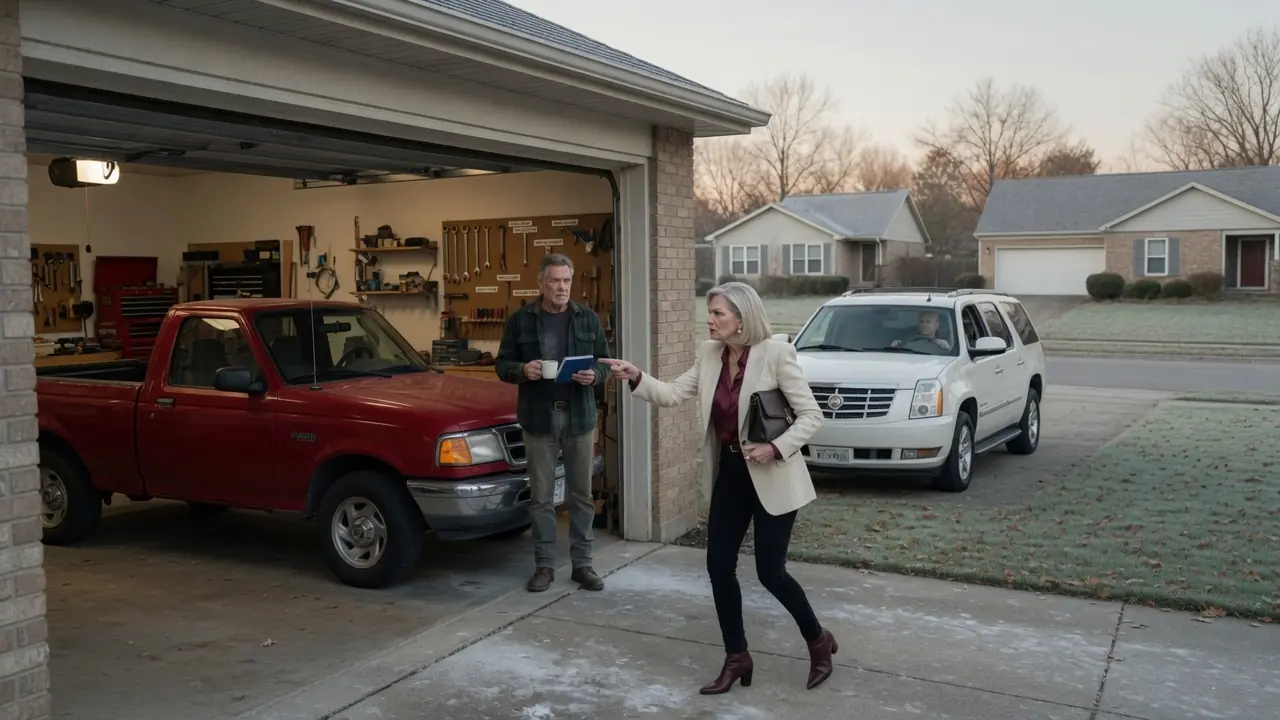
She was sixty-one, drove a spotless white Cadillac SUV, and wore linen blazers in weather that made linen seem like a personal threat.
Before becoming HOA president, she had worked in the county zoning office.
Retirement had not reduced her appetite for telling people what they could and could not do.
She did not speak to neighbors.
She processed them.
Her husband, Raymond, spent most afternoons tending roses with the hollow patience of a man who had stopped arguing several presidential administrations earlier.
Thomas respected Raymond.
Any man who could survive thirty-five years beside Lorraine deserved quiet admiration.
The HOA board consisted of five people.
Three voted exactly as Lorraine wished.
The fourth was Frank Kowalski, a retired electrician with thick forearms, a careful memory, and a growing suspicion that Lorraine had confused board leadership with private government.
Frank had been waiting three years for her to make a mistake too large to hide.
Thomas did not know it yet, but Lorraine had finally done exactly that.
Her system had always been simple.
Homeowners on the north side received courtesy calls.
A friendly knock.
A gentle reminder.
People on the south side received certified letters and administrative fees.
Six months before the garage dispute, Thomas helped a friend rebuild the transmission in an old pickup.
The work took four days.
The truck ran perfectly, but its body panels were mismatched and one fender had not yet been painted.
Lorraine did not call.
She did not ask when the repairs would be finished.
She issued a seventy-five-dollar fine for an “inoperable vehicle visible from the street.”
Thomas drove the pickup around the block simply to prove it operated.
Then he paid the fine.
That had been his first mistake.
People like Lorraine interpreted patience as permission.
Three months later, she appeared at Thomas’s front door holding a grocery-store cookie tray.
The plastic lid still carried half of the price sticker.
She wore a pale blazer and the smile of someone performing kindness for tactical reasons.
“We’re remodeling the bonus room,” she explained. “The contractor needs space. I only need to store a few boxes for two weeks. Three at most.”
Thomas looked at the cookies.
Then at Lorraine.
He had spent a career helping coworkers, neighbors, and relatives move objects they should never have bought.
He was fundamentally decent.
At times, that was the most expensive thing about him.
“All right,” he said.
He should have asked for a written agreement.
He should have asked how many boxes counted as a few.
He should have handed the cookies back and closed the door.
Instead, at seven the following morning, a commercial moving van arrived.
Its diesel engine rattled Thomas’s windows.
Seventeen boxes came off first.
Then the elliptical.
Then the clothes rack.
Then the rug.
The movers filled nearly two-thirds of the garage before leaving.
Two weeks became a month.
A month became four.
Thomas sent Lorraine two polite text messages.
Both were read.
Neither received a response.
By the fifth month, the Ford Ranger no longer fit inside.
Thomas began paying his friend Henry sixty dollars each month to park it beneath a metal shelter a few streets away.
Sixty dollars.
Every month.
The morning the fine arrived, Thomas did not shout.
He did not throw the letter.
He poured a second cup of coffee, put on his boots, and walked into the garage.
Cold November air moved beneath the partially open door.
His breath formed small clouds.
Lorraine’s boxes towered against the wall.
The elliptical sat where the Ranger belonged.
The rug leaned in the corner like an unwanted relative who had decided never to leave.
Somewhere beneath its smell, Thomas could barely detect the old scent of sawdust and machine oil.
He stood there for several minutes.
Then he made a decision.
No anger.
No reckless retaliation.
No mistakes.
He returned to the house and retrieved his phone.
He photographed everything.
Every box.
Every label.
Every damaged corner.
The cracked handle on the elliptical.
The clothes rack pressed against his tool cabinet.
The rug.
The open garage.
The fine.
The unanswered text messages with their read receipts.
Then he found a blue spiral notebook he had bought from a pharmacy for less than a dollar.
He sat at the kitchen table and began writing.
Dates.
Costs.
Names.
The transmission fine.
Lorraine’s Sunday visit.
The moving van.
The seventeen boxes.
Five months of parking charges.
Every conversation he could remember.
Thirty years in the trades had taught him one lesson repeatedly.
When two people argued about what happened, the person who wrote it down usually won.
That blue notebook became the most important object in Thomas’s house.
That afternoon, he hand-delivered a written notice to Lorraine.
It was polite and only one page long.
He explained that the HOA’s own violation required immediate removal of the stored items.
He requested repayment of the one-hundred-fifty-dollar fine and the accumulated parking expenses.
He gave her fourteen days.
Lorraine did not respond directly.
Instead, she sent an email to the entire HOA board and copied Thomas.
She wrote that he had become hostile.
Uncooperative.
Disruptive.
She claimed he was refusing to honor a verbal community agreement.
She mentioned neither the eight months of free storage nor the fine caused by her own belongings.
Thomas printed the email and placed it inside the notebook.
Then he circled the date of the next HOA meeting.
It would be his first in eleven years.
The Maple Ridge community center smelled of burnt coffee and institutional disappointment.
Fifteen homeowners sat on folding chairs beneath humming fluorescent lights.
Lorraine occupied the center seat at the board table.
She wore another linen blazer.
Thomas had never seen so much linen used with so little warmth.
When public comments began, he stood and read from a prepared statement.
Eight months of storage.
Seventeen boxes.
One elliptical.
One rug.
One clothes rack.
Four hundred and eighty dollars in displaced parking costs.
A one-hundred-fifty-dollar fine issued by the board president whose own belongings had created the violation.
He placed copies on the board table and sat down.
For three full seconds, the only sound in the room came from the dripping coffee maker.
Frank Kowalski leaned forward.
He looked toward Lorraine with the calm expression of a man watching a long-expected crack appear in a dam.
Lorraine thanked Thomas for his comments.
She said the board would review the issue internally.
Then she moved to the next agenda item.
No discussion.
No apology.
No visible concern.
But after the meeting, she approached Thomas in the parking lot.
The cold air smelled of dead leaves and vehicle exhaust.
“I would hate for a property like yours to be selected for a county reassessment,” she said quietly.
“Those things sometimes happen unexpectedly.”
Thomas studied her face.
“Good to know.”
He drove home in the Ranger and thought about the moving van.
He remembered the logo on its side.
The name had meant nothing eight months earlier.
Now he searched for it.
The van belonged to Whitmore Interiors LLC.
The registered owner was Lorraine Whitmore.
The company provided interior design and property-staging services.
Thomas sat at the kitchen table and stared at the public registration.
There had never been a bonus-room renovation.
The boxes were not personal belongings.
They were business inventory.
Lorraine had used his private residential garage as a commercial storage facility without disclosure or payment.
Then she fined him for the appearance of her inventory.
Thomas wrote the discovery in capital letters.
He underlined it twice.
Then he called Peter Dawson, an old high-school friend who worked as a paralegal.
“Peter, what happens when someone uses your property as commercial storage without permission and costs you money?”
There was a pause.
“That,” Peter said slowly, “is an interesting question.”
He called back the next morning.
Thomas sat at the kitchen table with coffee and the blue notebook.
Peter explained that abandoned or stored property could create certain lien or civil-remedy rights if proper notice was given and documented expenses remained unpaid.
The exact process depended on the nature of the arrangement, local law, and the type of property involved.
Peter advised Thomas not to act casually.
He drafted a formal demand letter.
It listed the unauthorized commercial storage.
The parking charges.
The fine.
The fourteen-day cure period.
It warned that failure to remove the property and repay the documented costs would result in legal action and lawful disposition remedies.
Thomas sent it by certified mail.
The green delivery receipt went into the notebook.
Three days later, Frank texted him.
Emergency board meeting tonight. Improperly noticed. I’m attending.
Thomas went too.
Lorraine had called the meeting without the advance notice required by the association’s own rules.
No public agenda.
No legitimate emergency.
Only her three reliable votes.
She proposed a resolution granting herself authority to negotiate and settle property disputes on behalf of the HOA.
In plain language, she wanted the board to give her power over Thomas’s claim against her.
Frank objected immediately.
He cited the notice requirement.
The quorum provisions.
The rule prohibiting emergency sessions without documented cause.
Lorraine overruled him.
Her three supporters approved the resolution.
Frank recorded the meeting on his phone.
“I’ve kept the battery charged before every meeting for two years,” he told Thomas outside. “I assumed she would eventually say something worth preserving.”
Thomas saved a copy.
Two days later, Lorraine came to his house.
Raymond waited inside the Cadillac at the curb.
She told Thomas to stop the legal nonsense.
The stored items were protected personal property, she claimed.
She threatened to involve her “actual attorney.”
Thomas’s phone recorded the conversation from his shirt pocket.
Ohio permitted a participant in a conversation to record it.
He had checked.
“I understand,” Thomas said. “I’ll be in touch.”
Lorraine left satisfied.
Thomas listened to the recording twice.
Then he read the HOA’s governing documents.
All sixty-two pages.
Section Nine, Paragraph Four contained the sentence that changed everything:
No board officer shall initiate, escalate, vote upon, or adjudicate any dispute in which that officer holds a direct personal or financial interest.
Lorraine had signed Thomas’s fine herself.
She had acted as board president in a dispute caused by her own property and connected to her own business.
The fine had not merely been unfair.
Under the HOA’s rules, it appeared invalid from the moment she signed it.
Thomas copied the clause into the notebook and underlined it three times.
The fourteen-day deadline passed.
No payment.
No removal.
At 11:20 on the thirteenth night, Lorraine sent one message.
I’ll be in touch soon.
Thomas wrote down the date and time.
Beneath it, he added:
She still believes this is her game.
Peter confirmed that the notice period had expired.
But Thomas did not move immediately.
Trades work had taught him that leverage often increased when an impatient person believed she still controlled the schedule.
Lorraine soon made another mistake.
At the next properly announced HOA meeting, she introduced a “community property standards initiative.”
The proposal required homeowners to obtain board approval before hosting outdoor gatherings.
Barbecues.
Graduation parties.
Birthday celebrations.
Any event visible to neighbors.
Lorraine described it as a small administrative step to protect property values.
When public comments opened, Thomas stood.
He asked whether Lorraine was required to recuse herself from matters connected to their dispute.
Then he read Section Nine, Paragraph Four aloud.
One of Lorraine’s usual supporters, an insurance agent named Martin Hale, looked down at his agenda as if he had just discovered the table was not stable.
Lorraine thanked Thomas for his procedural observation.
Then she pushed the vote through anyway.
Four to one.
Frank opposed it.
Something changed in the room.
The initiative passed, but the confidence surrounding Lorraine no longer seemed solid.
Two weeks later, the county assessor’s office called Thomas.
His property had been selected for reinspection.
No reason was provided.
Thomas remembered Lorraine’s threat in the parking lot.
His neighbor, Earl Jensen, had seen Lorraine’s white Cadillac parked outside the county offices several days earlier.
Earl was seventy-one and had spent three decades delivering mail.
Retirement had not reduced his ability to remember who went where and when.
Thomas called the assessor and asked whether the inspection had been triggered by a complaint.
The employee would not provide a name.
She paused before calling it routine flagging.
Thomas recorded the date, time, employee’s name, and pause.
Every attempt Lorraine made to pressure him produced more documentation.
By mid-November, Thomas possessed:
The certified demand letter.
Photographs of all stored items.
The business registration.
Parking receipts.
The invalid fine.
The HOA conflict-of-interest rule.
The recording of Lorraine’s threat.
The recording of the unauthorized meeting.
The assessor’s notice.
The unanswered messages.
The late-night text.
Lorraine had one thing.
Confidence.
Then Earl heard her telling another neighbor that she needed her staging inventory before Thanksgiving.
She had a client delivery scheduled.
She planned to rent a van, enter Thomas’s garage, retrieve everything, and leave without paying a dollar.
Thomas called Peter again.
They reviewed the situation carefully.
Peter reminded him that civil law punished unjust enrichment.
Lorraine’s company had received eight months of commercial storage at Thomas’s expense.
Comparable storage cost money.
Thomas had also paid to move his truck.
He had written notice.
He had proof.
He filed a small-claims case for the most clearly documented expenses: the wrongful fine and the parking charges.
Then he prepared to reclaim the garage.
He did not act without caution.
He recorded a complete video walkthrough.
Every box label.
Every object.
Every existing defect.
He stored copies online.
He notified Frank.
He asked Earl to watch the street.
At 9:17 that Wednesday night, Thomas posted a listing online.
FREE PICKUP TONIGHT.
Household furniture, framed art, decorative items, exercise equipment, clothing rack, and miscellaneous boxes.
First come, first served.
No holds.
The responses began within minutes.
At 9:45, two college students arrived for the rug.
They rolled it into a pickup truck and left grinning as though they had discovered buried treasure.
The elliptical went to a woman recovering from knee surgery.
The clothes rack went to a young couple furnishing their laundry room.
Framed art, decorative pillows, tile samples, baskets, and staging accessories went to families who believed they had found the best free giveaway in Columbus.
One woman held up a watercolor lighthouse.
“This is actually beautiful.”
Thomas nodded.
Lorraine had good taste.
He could admit that.
By 11:35, the garage was empty.
Thomas stood beneath the bare bulb.
The Ranger’s place was clear.
The workbench was visible.
The smell of the rug was gone.
Sawdust and machine oil returned slowly, as though the garage itself had finally exhaled.
Thomas turned off the light.
He went inside and slept better than he had in months.
Earl texted at 7:22 the next morning.
She just arrived.
Thomas sat at the kitchen table with coffee and the notebook open.
The white Cadillac stopped outside.
Lorraine walked through the side gate.
She opened the garage.
For three minutes, Earl sent nothing.
Thomas imagined her standing in the clean space, trying to understand an absence too large for her expectations.
Then Earl’s messages resumed.
She went back to the Cadillac.
She typed rapidly on her phone.
She returned to the garage.
She stared again.
At 7:33, she drove away.
She didn’t look good, Earl wrote.
At 7:44, Lorraine’s messages began arriving.
The first were formal.
What happened to the property stored in your garage?
Then the tone changed.
Where are my things?
What have you done?
By the ninth message, she threatened arrest.
Thomas screenshotted everything and sent it to Peter.
Peter replied:
Do not answer. Let her continue documenting the dispute.
A police officer arrived at nine.
Thomas invited him inside and placed the blue notebook on the table.
He showed him the notices, photographs, receipts, recordings, business registration, expired deadline, lawsuit filing, and Lorraine’s messages.
The officer examined the documents.
“This appears to be a civil matter.”
Thomas nodded.
“That’s what I believed.”
Across the street, Lorraine sat inside her Cadillac.
Four minutes after the officer left, she drove away.
By noon, she posted in the neighborhood group.
She did not name Thomas.
She claimed a neighbor had exploited a vulnerable situation and removed valuable property without consent.
She used the word predatory twice.
Frank replied calmly.
He explained that extensive documentation existed and that the public had not heard the complete story.
He offered to provide context privately to interested homeowners.
Within minutes, several people responded.
Lorraine deleted the post.
Frank had already captured it.
So had Thomas.
Six days later, a letter arrived from a real-estate attorney.
It demanded forty-two hundred dollars for the missing property and threatened immediate civil action.
The stationery was heavy.
The language was dramatic.
Peter checked the attorney’s record.
“He handles closings,” Peter said. “This is theater.”
“What should I do?”
“Nothing yet.”
Thomas entered the letter into his notebook.
Then he began building a binder.
Tab One: Photographs.
Tab Two: Certified notices.
Tab Three: Text messages.
Tab Four: Parking receipts.
Tab Five: Recording transcript.
Tab Six: Emergency-meeting audio.
Tab Seven: Conflict-of-interest rule.
Tab Eight: Whitmore Interiors business registration.
Tab Nine: Assessor timeline.
Tab Ten: Social-media post.
Forty-seven pages.
Four days before the annual HOA election meeting, Lorraine came to Thomas’s door.
Raymond stood behind her with his hands in his coat pockets.
She held an envelope containing three hundred dollars.
“There has been misunderstanding on both sides,” she said. “I would like to move forward as neighbors.”
Three hundred dollars.
Less than half of Thomas’s direct expenses.
Nothing for the commercial storage.
Nothing for the threats.
Nothing for the attorney’s letter.
“I’ll think about it.”
He closed the door and added the offer to the notebook.
That evening, Thomas called Shelby Monroe, a reporter for the local newspaper who had previously covered HOA disputes.
He gave her the documents.
She asked whether she could attend the annual meeting.
“It’s public,” Thomas said.
Forty-one homeowners appeared on a cold Tuesday night in December.
Nearly half the neighborhood.
People stood along the walls.
Someone brought an extra folding chair.
The coffee tasted burned.
The fluorescent lights hummed.
Shelby sat in the second row with a notebook and recorder.
Lorraine noticed her immediately.
“Who invited the press?”
Frank answered.
“It’s a public meeting.”
Lorraine straightened her linen blazer.
Then she called the room to order.
She moved through the treasurer’s report, maintenance schedule, and committee updates with her usual control.
She did not look at Thomas.
When the meeting reached board elections and governance comments, Thomas stood.
He carried the binder.
He spoke without anger.
The cookie tray.
The moving van.
The seventeen boxes.
The eight months.
The parking fees.
The fine.
The demand letters.
The commercial business.
The conflict of interest.
Date by date.
Dollar by dollar.
Like a tradesman reading measurements from a work order.
When Thomas described the emergency board session, Frank played the recording.
Lorraine’s voice filled the room, overruling a bylaw objection and forcing through a vote that benefited her.
People exchanged glances.
Thomas placed the business registration beside photographs of the box labels.
MASTER SUITE STAGING.
FARNSWORTH ACCOUNT.
CLIENT INVENTORY.
The room became quieter.
When Thomas described Lorraine’s parking-lot threat and the later assessor call, she finally interrupted.
“That is not accurate.”
Her voice was tight.
Someone in the back said, “Let him finish.”
Thomas finished.
Then he placed a short summary in front of every board member and gave one copy to Shelby.
“I’m not asking for revenge,” he said.
“I want the fine reversed.”
“I want repayment of the documented expenses.”
“And I want a governance review so this cannot happen to another homeowner.”
He sat down.
The room applauded.
Not loudly.
Not theatrically.
But honestly.
Lorraine attempted a response.
She spoke of personal vendettas and community standards.
Then Martin Hale, one of her most dependable votes, looked down at the summary.
“I think we should postpone the election and conduct an independent review.”
Frank seconded the motion before Lorraine could answer.
That was the moment her control ended.
The election was postponed.
An outside governance review was approved.
Three weeks later, Thomas received judgment in small-claims court for six hundred thirty dollars plus filing costs.
Lorraine had not appeared.
He placed the judgment in the blue notebook.
The review took six weeks.
Its conclusions were written in dry official language.
The emergency meeting had been improperly conducted.
The resolutions passed during that meeting were void.
The fine issued against Thomas violated the conflict-of-interest clause and was reversed.
The board was ordered to establish a formal recusal policy.
Meeting notices and complaint procedures had to be rewritten.
Shelby’s article appeared the following week.
The headline read:
HOA PRESIDENT FINED NEIGHBOR FOR CLUTTER CREATED BY HER OWN BUSINESS.
It was accurate.
It was not kind.
Lorraine declined to comment.
At the next board meeting, she announced that she was stepping down to focus on her business.
She read from a prepared statement.
She did not apologize.
She folded the paper and left before the meeting ended.
Raymond followed her.
Several neighbors later said he looked relieved.
Whitmore Interiors closed the following spring.
Frank Kowalski became interim board president.
His first action was to send every homeowner a complete copy of the association rules.
His second was to reduce minor administrative fines and require a courtesy call before any violation letter could be issued.
The changes were small.
But neighborhoods were built from small things.
So were abuses.
The Ford Ranger returned to Thomas’s garage in February.
He parked it exactly where it belonged.
Then he stood for a while beneath the shop lights.
Clean concrete.
Tools in their outlines.
The workbench clear.
The familiar smell of WD-40 and sawdust.
Eleven years of work remained.
Lorraine had occupied the space for eight months.
She had not destroyed it.
Not permanently.
That spring, Earl suggested holding an informal Saturday gathering in Thomas’s garage.
A few neighbors came for coffee.
Thomas demonstrated how to repair a small engine.
Frank explained basic household wiring safety.
A retired nurse taught first aid.
Someone else taught furniture refinishing.
The gatherings became monthly.
They moved from garage to garage.
They called it the Maple Ridge Skills Exchange.
Nine people attended the first session.
Sixteen attended the second.
By April, there was a waiting list.
The HOA provided money for tools and supplies.
Neighbors began sharing knowledge that once passed naturally over fences and workbenches.
Plumbing.
Electrical repairs.
Food preservation.
Small engines.
Basic carpentry.
The garage smelled of coffee, chili, engine grease, and sawdust.
It was the best thing Maple Ridge had created in years.
Later, the group established a scholarship for a graduating student pursuing trade certification.
The first award went to a seventeen-year-old named Caleb who planned to become an HVAC technician.
Thomas shook his hand at the ceremony.
Then he thought about the blue notebook stored inside his filing cabinet.
Lorraine believed power came from titles.
From letterhead.
From controlling meetings.
From assuming ordinary people would not read the rules, keep receipts, or show up.
Thomas had not defeated her because he shouted louder.
He did not have more money.
He did not hold a position.
He began with an eighty-nine-cent notebook.
He wrote down every date.
He kept every receipt.
He saved every message.
Frank recorded the meeting.
Earl watched the street.
Peter explained the process.
Shelby reported the facts.
Thomas did not win alone.
He simply became the first person willing to document what everyone else had quietly endured.
Years later, new residents occasionally heard the story.
They usually laughed at the image of Lorraine opening the garage and finding nothing but clean concrete.
Thomas did not laugh as much anymore.
The empty garage was satisfying.
But it was not the most important part.
The important part was what filled the space afterward.
Neighbors.
Tools.
Lessons.
Coffee.
A scholarship.
A place that had once been taken from him became a place where people helped one another.
Petty authority depended on exhaustion.
It depended on people deciding the fight was not worth the trouble.
Lorraine assumed Thomas would pay the fine as he had before.
She assumed he would continue storing her things.
She assumed her title would matter more than his records.
She was wrong.
The night Thomas posted the listing, he did not know exactly how the story would end.
He knew only that the garage belonged to him.
That the notice period had passed.
That the facts were documented.
And that he was finished allowing another person’s belongings, business, and authority to occupy a space he had built with his own hands.
By midnight, the boxes were gone.
By morning, Lorraine understood that the neighbor she had dismissed as a quiet handyman had finally begun paying attention.
And once Thomas Barrett began writing things down, her blazer, her title, and her threats never stood a chance against the truth.