The first hammer strike shattered the passenger-side headlight.
The second cracked the windshield.
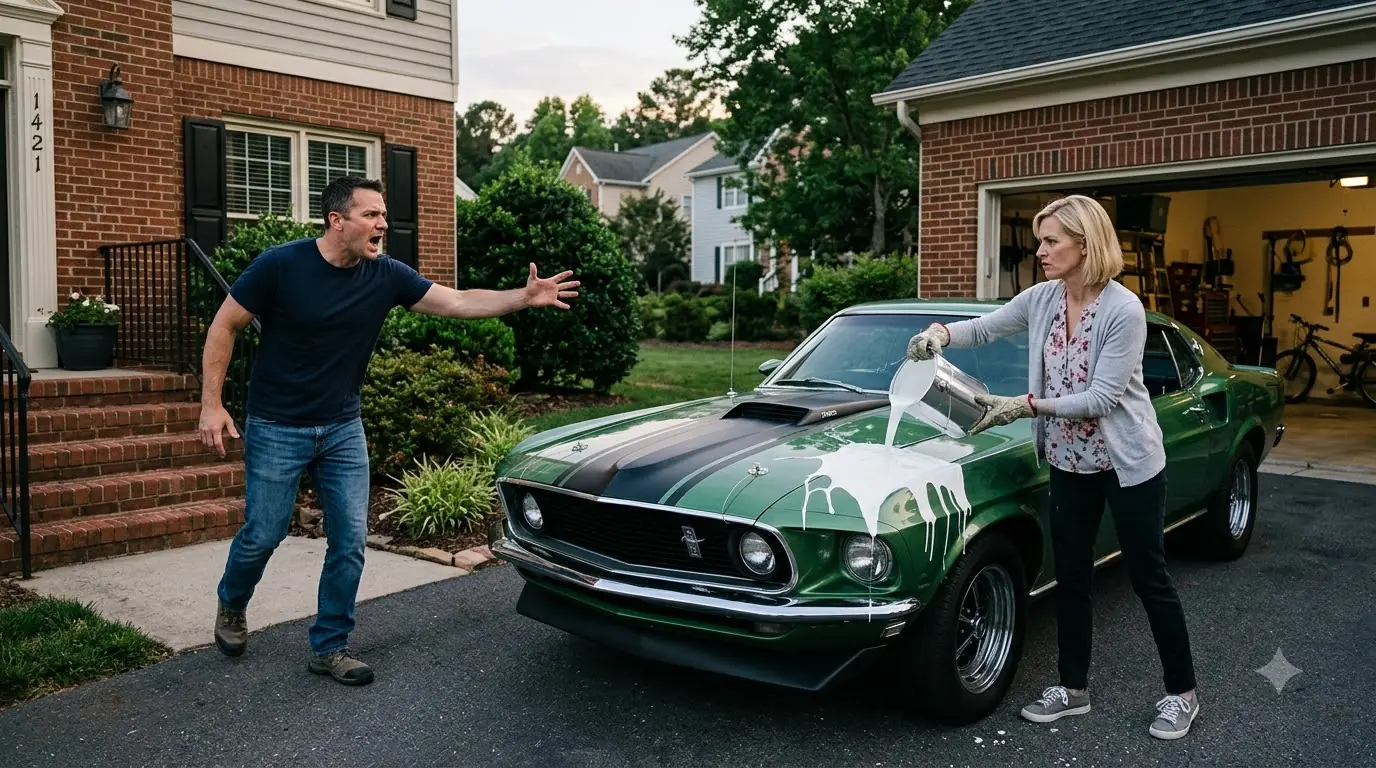
By the time Susan Whitmore lifted the metal tire iron for a third swing, white paint was already dripping down the hood of Daniel Brooks’s restored 1969 Ford Mustang Fastback, running over the black racing stripes in thick, ugly rivers and pooling beneath the front bumper.
She was breathing hard.
Not because the work was difficult.
Because she was furious.
“You don’t get to make this neighborhood look like a junkyard,” she shouted at the empty driveway, as if the car itself had insulted her.
Then she swung again.
The tire iron hit the chrome trim.
Metal snapped loose.
A porch light came on across the street.
Susan froze.
For one second, she looked toward the neighbor’s house.
Then she reached for the second paint bucket.
She never saw the tiny backup camera hidden inside Daniel’s garage light.
She never saw the red recording indicator reflected in the window.
And she certainly did not know that the car she was destroying was worth far more to Daniel than money.
Three months earlier, Maple Ridge Estates had looked peaceful enough.
It was one of those planned suburban neighborhoods outside Charlotte, North Carolina, where the lawns were trimmed within an inch of perfection and every mailbox came from the same approved catalog. The homes were large but not extravagant. The sidewalks curved around young maple trees planted at identical distances. Decorative stone walls marked both entrances, and the community clubhouse sat beside a small pool that was open from Memorial Day through Labor Day.
Daniel Brooks had moved there because he wanted quiet.
At thirty-seven, he had spent most of his adult life working long hours as a civil engineer, saving money, paying off student debt, and helping his mother after his father died. He was not married. He did not throw loud parties. He did not leave trash cans in the street. He cut his grass every Saturday morning and usually finished before most of his neighbors came outside.
For the first year, he barely noticed the HOA.
Then Susan Whitmore became president.
Susan was forty-six, polished, energetic, and deeply convinced that rules were more important when she was the one interpreting them. She wore bright workout clothes during morning walks, designer sunglasses even on cloudy days, and carried a tablet everywhere as if she were managing a major corporation instead of a neighborhood of two hundred homes.
Her favorite phrase was “community standards.”
She used it for everything.
A basketball hoop left too close to the curb.
A trash bin visible from the street.
A wreath still hanging three days after the holiday deadline.
A child’s chalk drawing that remained on a sidewalk overnight.
Most neighbors found her exhausting but survivable.
Daniel found her mildly ridiculous.
Then the Mustang arrived.
The car came on a flatbed one Saturday morning in early April.
It was not running.
It was not shiny.
It did not look impressive.
The body was faded Highland Green beneath decades of oxidation. The rear quarter panel carried a long dent. The chrome had gone dull. The interior smelled like dust, old vinyl, and time.
But when Daniel saw it roll into his driveway, he stood perfectly still.
The Mustang had belonged to his father.
Robert Brooks bought it in 1977 when he was nineteen years old and working nights at a machine shop. He did not buy it new. He could never have afforded that. He found it behind a repair shop with a seized engine and saved for almost a year to buy it.
Robert rebuilt the engine himself.
Then rebuilt it again eight years later.
Daniel grew up in the passenger seat.
He remembered being six years old, barely tall enough to see over the dashboard, while his father taught him the names of tools.
Socket.
Ratchet.
Breaker bar.
Torque wrench.
He remembered summer evenings in the garage while old soul music played from a radio balanced on a shelf.
His father would hand him a flashlight and say, “Don’t point it where I’m looking. Point it where my hands are going.”
Daniel had thought that was wisdom about flashlights.
It took him years to realize his father meant more than that.
Robert died of a heart attack when Daniel was twenty-eight.
The Mustang disappeared afterward.
Daniel’s mother could not bear looking at it, so she stored it in an old building behind his uncle’s farm in South Carolina.
For nearly nine years, it sat under a cover.
Then Daniel turned thirty-seven and decided he was finally ready.
Not to sell it.
To finish what his father never had time to finish.
The restoration became his evenings, weekends, and almost every spare thought.
He removed the interior.
Rebuilt the suspension.
Replaced rusted floor sections.
Had the original 351 Windsor professionally machined but assembled most of it himself.
He refinished the dashboard.
Restored the gauges.
Tracked down period-correct trim.
And when the time came for paint, he kept the original green but added two black racing stripes his father had once talked about adding and never did.
The project took nearly fourteen months.
Most of the work happened in Daniel’s garage with the door open.
Neighbors stopped to watch.
Kids asked questions.
Greg Miller from across the street occasionally brought beer and held parts.
Mrs. Alvarez from two houses down told Daniel the engine was too loud, then immediately asked him to start it again because her grandson wanted to hear.
Even Susan came by once.
She stood at the end of the driveway while Daniel was installing the restored front grille.
“That’s quite a project,” she said.
Daniel wiped his hands.
“Almost done.”
Susan walked closer.
Her eyes moved over the car.
“What year?”
“Sixty-nine.”