The bucket struck Daniel Mercer before he heard anyone enter the backyard.
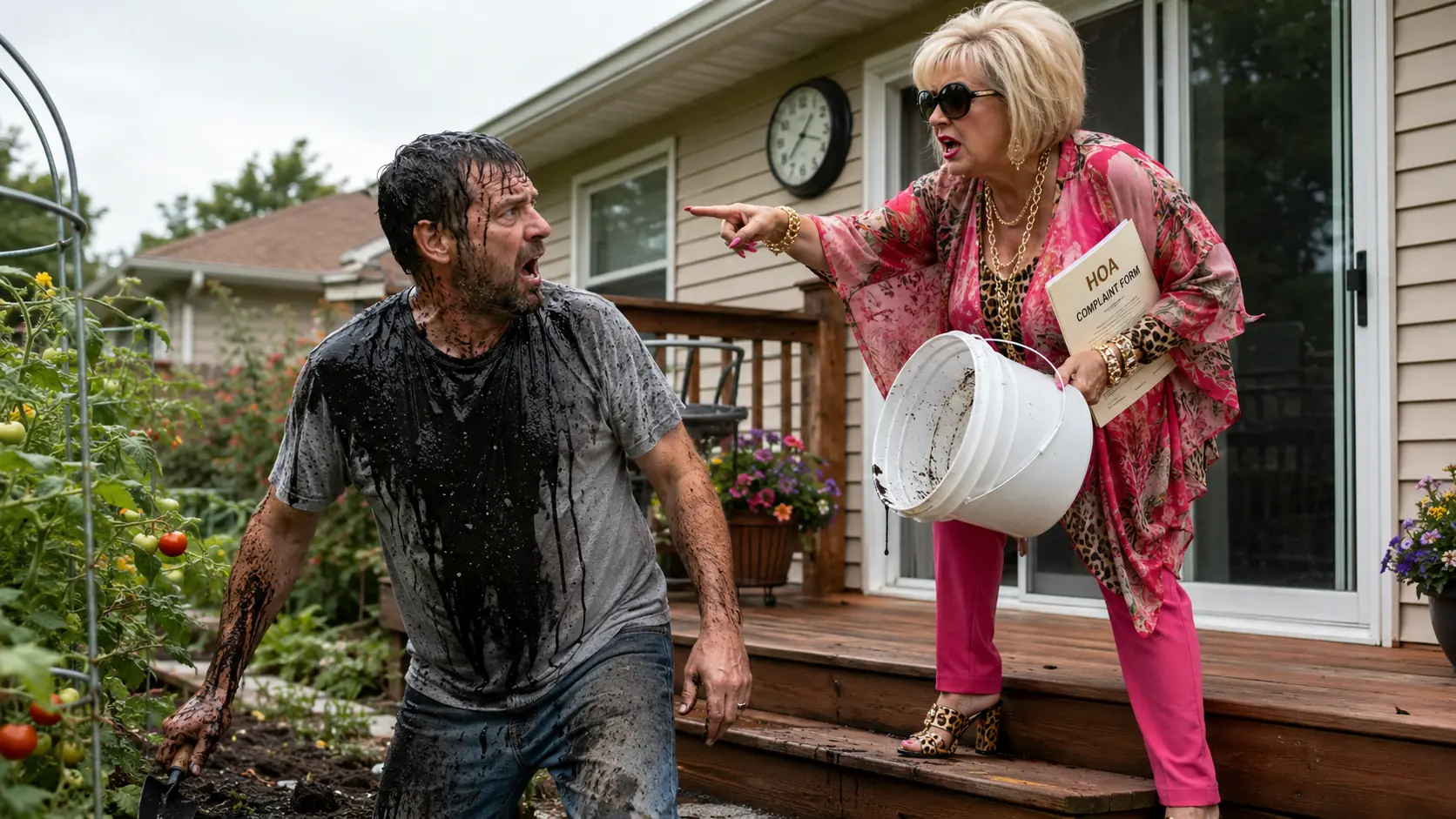
One second he was kneeling beside a row of tomatoes, trimming dead leaves and loosening damp soil with a hand trowel. The next, something cold and foul crashed across the back of his head.
Black liquid flooded over his shoulders.
It ran down his neck, soaked through his gray T-shirt, splattered across the raised garden bed, and struck the small cut on his forearm with an immediate, stinging burn.
Daniel dropped the trowel.
“What the hell?”
He stumbled away from the plants and wiped both hands across his face.
The smell hit him next.
Oil.
Rotten vegetation.
Something sharp and chemical beneath it.
He blinked through watering eyes and looked toward the deck.
Sharon Whitmore stood three steps above him holding an empty white bucket.
President of the Westbrook Hills Homeowners Association.
Fifty-eight years old.
Perfect blonde bob.
Oversized sunglasses.
White blouse.
White slacks.
White shoes somehow untouched by the mess she had just poured over him.
For perhaps two seconds Daniel could not process the scene.
Then anger arrived.
“What the hell is wrong with you?”
Sharon lowered the bucket.
“You wanted to ignore my warnings.”
Daniel stared at her.
“So I handled the problem.”
“You dumped something on me.”
“You’ve been contaminating the drainage corridor for months.”
Daniel looked down at his shirt.
Thick black fluid dripped from the hem.
“My skin is burning.”
“That’s because you shouldn’t be handling chemicals without proper protection.”
Daniel actually laughed.
Not because anything was funny.
Because the sentence was so insane his mind had nowhere else to put it.
“You carried that in here.”
Sharon lifted her chin.
“I found this container behind your shed.”
“No, you didn’t.”
“I did.”
“You broke into a locked backyard carrying it.”
“The association has inspection authority.”
“Not like this.”
Daniel stepped toward the deck.
His right hand still held the muddy trowel.
Sharon immediately looked at it.
Her expression sharpened.
“There.”
“What?”
“That threatening behavior.”
Daniel followed her eyes.
Then slowly lowered the trowel.
Understanding replaced rage.
She had expected this.
Not necessarily the exact movement.
But anger.
A reaction.
Something she could later describe.
Daniel placed the trowel deliberately on the ground.
Then he saw the beige form tucked beneath Sharon’s left arm.
Westbrook Hills HOA letterhead.
ENVIRONMENTAL COMPLIANCE COMPLAINT.
He could read the heading from six feet away.
Daniel pointed.
“What’s that?”
Sharon tightened her arm.
“Association business.”
“About me?”
“You know exactly what it’s about.”
He moved just enough to see the upper-right corner.
A printed timestamp.
SUBMITTED: 1:42 P.M.
Daniel looked toward the digital clock mounted beside the sliding patio doors.
2:11 P.M.
He looked back at Sharon.
The rage inside him suddenly became very quiet.
“When did you file that?”
She said nothing.
Daniel pointed again.
“That complaint was submitted twenty-nine minutes ago.”
“So?”
“What time does it say I dumped chemicals into the garden?”
Sharon’s mouth tightened.
Daniel could see more of the form now.
One line read:
Observed approximately 2:10 p.m.
Daniel stared at her.
“You filed a report at 1:42 describing something you claim I did at 2:10.”
“The system timestamps can be unreliable.”
“No.”
“You don’t know that.”
“I do.”
“How?”
“Because the association portal synchronizes to the county-hosted server.”
Sharon’s confidence flickered.
Daniel continued.
“And I know who built the drainage-data interface that server uses.”
She stared.
“I did.”
Sharon recovered quickly.
“You’re trying to distract from the violation.”
“No.”
Daniel pointed toward the bucket.
“You filed the future before you came here to create it.”
For the first time, Sharon said nothing.
Daniel reached for his phone.
She took one step down.
“What are you doing?”
“Calling 911.”
Her expression changed.
“Oh, please.”
“My skin is burning.”
“It’s an organic treatment.”
“What treatment?”
Sharon hesitated.
Daniel saw it.
“What’s in the bucket?”
“Nothing dangerous.”
“Then tell me what it is.”
“You’re being dramatic.”
Daniel unlocked his phone.
Sharon moved toward him.
“Give me that.”
He stepped backward.
“Do not touch me again.”
“I’m not going to stand here while you manufacture some ridiculous criminal complaint.”
Daniel glanced upward.
“You should probably look at the patio roof.”
Sharon followed his eyes.
A small black security camera sat beneath the eave.
Her face became still.
Daniel watched recognition arrive.
Then he nodded toward the garage.
“And that corner.”
A second camera covered the side gate.
The last trace of confidence disappeared from Sharon’s mouth.
“You record your neighbors?”
“I record my property.”
“This is an HOA community. You can’t just—”
“The cameras comply with the bylaws.”
Sharon hated that answer.
Daniel knew because he had used it before.
Every fight with Sharon Whitmore eventually ended the same way.
She invoked authority.
Daniel read the rule.
That was why she despised him.
He pressed the call button.
When the dispatcher answered, Daniel spoke carefully.
“My name is Daniel Mercer. I’m at 417 Laurel Crest, Westbrook Hills. An individual entered my locked backyard without permission and poured an unknown chemical mixture over my head and body.”
Sharon laughed loudly enough for the phone to hear.
“An individual? Tell them I’m the HOA president.”
Daniel continued.
“My eyes are irritated, my skin is burning, and I don’t know what the substance contains. Please send medical assistance and police.”
The dispatcher asked whether the person was still there.
“Yes.”
“Are there weapons?”
Daniel looked at the trowel.
“No.”
Sharon picked up the bucket.
Daniel turned.
“Leave that.”
“It belongs to the association.”
“No, it doesn’t.”
“I’m removing contaminated material.”
“You’re removing evidence.”
Sharon walked toward the side gate.
Daniel did not block her.
He only said:
“The camera covers the gate too.”
She stopped.
Daniel held the phone near his chest.
“If you want to carry the bucket out after I called police, go ahead.”
Sharon stared at him.
“The officers can decide what it means.”
Slowly, she put the bucket down.
That frightened Daniel more than if she had continued shouting.
Because it proved she understood exactly what she was doing.
Three months earlier, Daniel Mercer had believed his biggest problem in Westbrook Hills was standing water.
He was forty-six, divorced, and had spent nearly twenty years designing municipal drainage systems before opening a small civil-engineering consultancy of his own.
He bought the Laurel Crest house because it was quiet.
That was the theory.
The property backed against a narrow wooded drainage easement, and the backyard sloped slightly toward the house. During hard Georgia thunderstorms, runoff from three higher properties crossed the rear boundary and collected beside Daniel’s foundation.
The previous owner had solved the problem with an electric sump pump connected to a flexible discharge hose.
Daniel hated it immediately.
The pump failed during outages.
The hose sent concentrated water toward the street.
And the whole arrangement treated rainfall as something to throw away instead of something to manage.
So Daniel designed a rain garden.
Nothing exotic.
A shallow landscaped depression.
Native grasses.
Coneflowers.
Blue flag iris.
Milkweed.
River stones at the inlet.
Engineered soil underneath.
During storms, runoff spread into the garden, slowed, soaked into the ground, and released gradually toward the existing drainage corridor.
Daniel obtained the county permit.
Submitted the landscape plan to the HOA architectural committee.
Received written approval.
Built it himself over six weekends.
The first serious storm arrived in April.
For the first time since moving in, no water reached his foundation.
Mrs. Alvarez next door loved it.
“So many butterflies.”
Daniel smiled.
“That’s the idea.”
Her seven-year-old granddaughter began calling it “Mr. Daniel’s butterfly pond,” even though there was rarely standing water.
Most residents barely cared.
Sharon Whitmore cared immediately.
She appeared one Tuesday morning carrying a clipboard.