The first bag of garbage hit the grass beside the grill just as Marcus Bryant lifted a rack of ribs from the smoker.
It burst open with a wet slap, spilling coffee grounds, spoiled lettuce, torn paper plates, chicken bones, and something that smelled sour enough to make his eight-year-old daughter cover her nose with both hands. For one stunned second, nobody in the backyard moved. The music kept playing softly from the speaker near the patio, Marvin Gaye floating over the fence while trash slid across the clean lawn Marcus had spent the morning mowing.
Then a second bag came over.
This one struck the folding table.
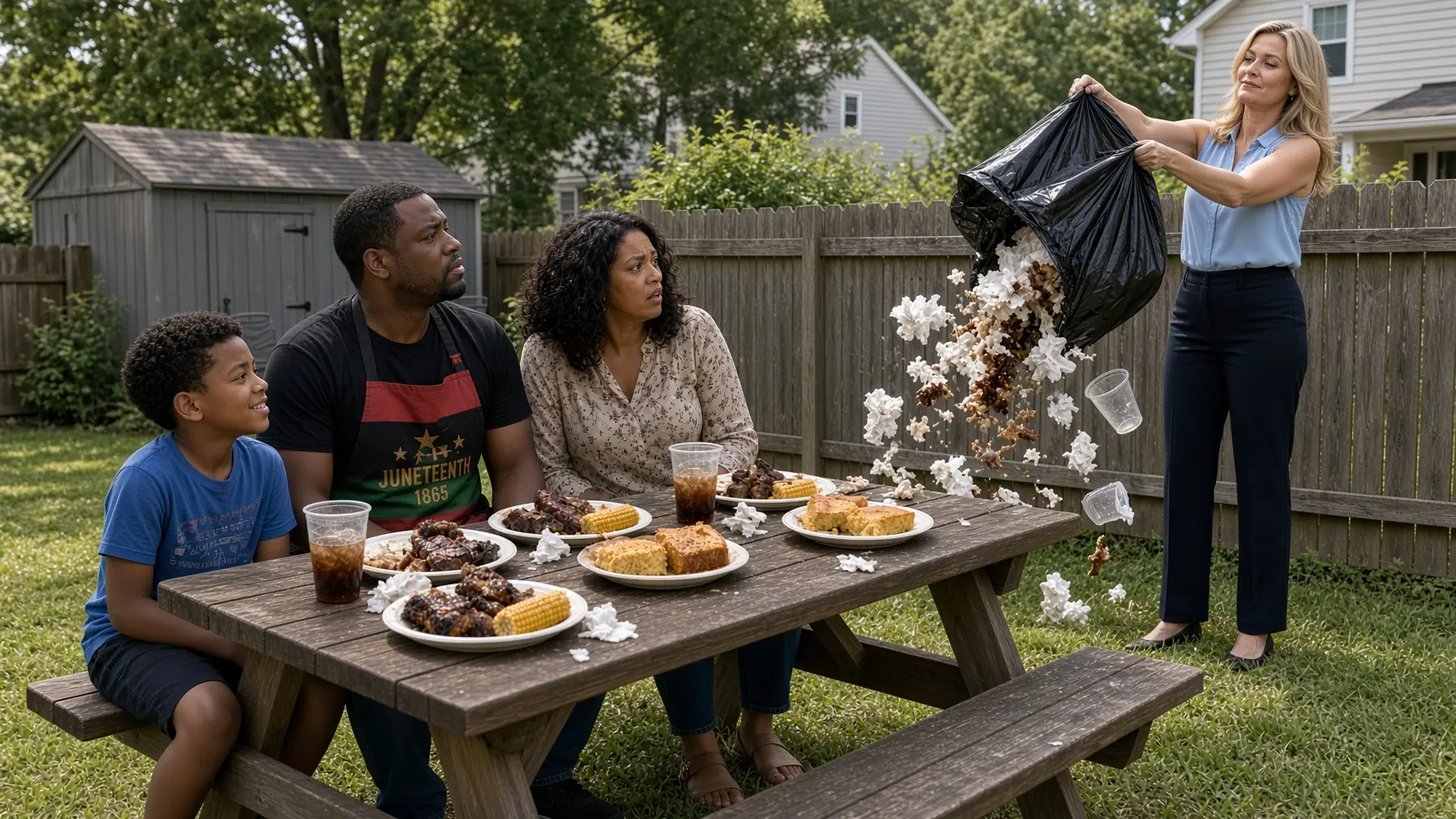
A bowl of potato salad flipped onto the deck. Plastic cups scattered. Marcus’s wife, Lena, jumped back with a gasp as old takeout containers and used paper towels rolled between the children’s feet. Their son Isaiah, twelve years old and still holding a paper plate with half a burger on it, stared toward the fence as if his brain could not accept what his eyes had just seen.
From the other side came a woman’s voice.
“There,” she snapped. “Maybe now they’ll understand what this neighborhood looks like when people don’t respect rules.”
Marcus set the ribs down slowly.
He did not shout.
He did not curse.
He removed the black barbecue gloves from his hands one finger at a time and placed them beside the smoker. His guests looked at him, waiting to see which version of him would appear. The man who laughed easily at family cookouts, or the man they knew existed underneath that smile because no Black man in a neighborhood like Oakridge Heights reached forty-three without learning how quickly joy could be mistaken for a threat.
Across the yard, Lena took one step toward their daughter, Maya, who had started crying quietly.
“Everybody stay where you are,” Marcus said.
His voice was calm enough that people obeyed before they understood why.
Another shape appeared above the fence.
Not a garbage bag this time.
A paint-stained plastic bucket.
It tipped over the top rail and dumped a gray, greasy mess directly across Marcus’s patio stones. The liquid ran toward the grill mat, carrying bits of rotten fruit and cigarette ash in a slow, filthy stream. The laughter on the other side of the fence was young, male, and proud of itself.
“Mom,” the young man said, loud enough for everyone to hear, “you should’ve seen their faces.”
A few guests reached for their phones.
Lena’s cousin Tamara whispered, “Marcus, I’m recording.”
“Good,” Marcus said.
The gate latch clicked.
Karen Whitmore came around the side of the fence as if she had been invited. She wore white capri pants, wedge sandals, and a sleeveless coral blouse that looked chosen for a neighborhood magazine photo rather than a confrontation beside spilled garbage. Behind her walked her nineteen-year-old son, Preston, tall and smirking, wearing mirrored sunglasses and carrying the empty trash bucket like a trophy.
Karen stopped at the edge of Marcus’s lawn and looked at the ruined barbecue table with satisfaction disguised as concern.
“My goodness,” she said. “This is what happens when people let outdoor gatherings get out of control.”
Marcus looked at her.
“Did your son just throw trash into my yard?”
Karen lifted one hand, palm out, as if calming an unreasonable child.
“Don’t start with accusations.”
Preston laughed.
Marcus’s eyes moved to him.
The boy’s shoes were wet with the same gray sludge now spreading across the patio.
“You should probably stop laughing,” Marcus said.
Preston pushed his sunglasses onto his head.
“Or what?”
Lena stepped beside her husband, her face tight with anger but her voice measured.
“Karen, our children are here.”
Karen’s eyes flicked toward Maya and Isaiah, then back to Lena with a smile that made the apology before it even arrived feel impossible.
“Then maybe you should teach them consideration. This whole street has been listening to your music and smelling smoke for hours.”
“We started at four,” Lena said. “It’s not even seven.”
“And you invited half the city.”
Marcus looked around his yard.
There were fourteen adults, six children, one grill, two folding tables, and a speaker that had never risen above conversation volume. It was Father’s Day weekend, one day before Juneteenth, and the Bryants had invited family and close friends to celebrate both. The ribs had been marinating since Friday night. Lena had made peach cobbler from her grandmother’s recipe. Isaiah had helped hang string lights along the pergola. Maya had drawn a sign on poster board that said, “Welcome Family,” with lopsided hearts around the words.
That sign now had coffee grounds stuck to one corner.
Marcus looked at it longer than he looked at Karen.
That was what finally made his chest ache.
Not the trash.
Not the smell.
Not even the disrespect.
It was the fact that his daughter had spent an hour coloring that sign because she believed their backyard was a safe place to be joyful.
Karen stepped closer.
“You know, Marcus, I tried to handle this politely.”
“No, you didn’t.”
Her face hardened.
“I sent a message to the HOA group chat reminding everyone about community standards.”
“You sent that at 5:12,” Lena said. “We saw it.”
“And you ignored it.”
“Because you’re not the police, and we’re not violating anything.”
Karen’s nostrils flared.
“This is exactly the attitude I’m talking about.”
Marcus reached into his pocket and took out his phone.
Karen’s eyes narrowed.
“What are you doing?”
“Calling the police.”
Preston grinned.
“Go ahead. Tell them we threw trash. Nobody saw anything.”
Three people in Marcus’s yard lifted their phones higher.
Tamara said, “I did.”
Preston’s grin wavered.
Karen turned on her.
“You people love recording everything.”
The sentence landed across the backyard like a match dropped into gasoline.
Marcus heard the silence after it. He felt the shift in his guests, the collective tightening, the same old recognition. Karen had not said the ugliest version of what she meant, but everyone understood the shape of it.
Lena moved closer to Maya and put a protective hand on her shoulder.
Marcus pressed the phone to his ear.
When the dispatcher answered, his voice stayed even.
“This is Marcus Bryant at 1227 Willow Bend Lane in Oakridge Heights. My neighbor and her adult son just threw several bags of garbage over my fence into my backyard during a family barbecue. There are children present. We have video. The son is still on my property line, and the mother is in my yard refusing to leave.”
Karen’s face changed when she heard the words adult son.
Preston was not a child.
He was nineteen.
Old enough to vote.
Old enough to be charged.
Old enough that what he had done could not be covered by the phrase “kids being kids.”
Karen stepped toward Marcus.
“Do not exaggerate this.”
Marcus took one step back and kept speaking to the dispatcher.
“No weapons seen. No one is physically injured. But I want officers here, and I want a report.”
Karen hissed, “You’re making a mistake.”
“No,” Marcus said, ending the call. “You made one.”
Oakridge Heights was the kind of neighborhood that treated silence as a form of manners. People noticed everything, discussed most things, and admitted almost nothing. The lawns were clipped into compliance. Trash bins disappeared by noon on pickup day. Garage doors stayed down. Holiday decorations came down on schedule. The HOA newsletter used phrases like “shared pride” and “community excellence,” which sounded pleasant until someone like Karen Whitmore decided she was the person responsible for enforcing both.
Marcus and Lena had moved there nine months earlier.
They had saved for years.
Marcus owned Bryant Legal Strategies, a small but respected consulting firm that helped nonprofit organizations, municipal agencies, and civil rights groups understand policy, contracts, and compliance. Lena was a pediatric occupational therapist who worked three days a week at a clinic and two days from home. They had chosen Oakridge Heights because the school district was strong, the house had enough room for Marcus’s mother to visit comfortably, and the backyard had a magnolia tree that reminded Lena of her childhood in Georgia.
They knew some neighbors were curious about them.
They knew some were friendly in the careful way people become friendly when they are trying to decide whether you are a story they understand.
Marcus had no desire to force closeness.
He waved.
He mowed.
He paid dues on time.
He joined no committees.
That last choice offended Karen more than anything.
She had been HOA president for four years and considered participation a sign of obedience. Her husband, Robert, mostly stayed out of her way. Her son, Preston, had returned from his first year at college under vague circumstances that changed depending on who asked. Sometimes he was “taking time to refocus.” Sometimes “the university wasn’t the right environment.” Sometimes Karen simply said he was “too bright for all that bureaucracy.”
Marcus had met Preston twice.
The first time, Preston sped down Willow Bend in a black Jeep with music shaking the windows and nearly clipped Isaiah on his bike.
The second time, Marcus asked him not to park half across the sidewalk because Lena’s patients sometimes used mobility equipment when visiting the house.
Preston had looked Marcus up and down and said, “You the sidewalk police?”
Marcus had smiled.
“No. Just a neighbor asking you not to block the sidewalk.”
Preston moved the Jeep ten minutes later.
Karen sent Marcus an HOA warning the following morning about “commercial foot traffic” because Lena had one patient visit the house for a consultation.
That was how Karen operated.
She did not attack directly if paper would do the work first.
Before the barbecue, she had already complained about Marcus’s smoker, Lena’s flower beds, Isaiah’s basketball hoop, and the color of the Bryants’ front door. Every complaint collapsed once Marcus asked for the specific rule, page number, prior board approval, and enforcement history. He had spent much of his adult life reading documents written by people who assumed no one else would.
Karen hated that.
Preston hated that more.
So when the Bryants hosted their cookout, Karen saw an opportunity.
She had stood behind the second-floor curtains watching Marcus’s friends arrive. She watched families carry foil trays through the gate. Watched children run across the lawn with sparklers that were not yet lit. Watched Lena hug people too warmly. Watched Marcus laugh too freely.
That was how she described it later in her first version of events.
Too freely.
As if joy itself could trespass.
At 6:41 p.m., she texted Preston.
They’re doing it again.
Preston texted back from the garage.
Want me to handle it?
Karen stared at the backyard lights glowing over the fence.
She should have said no.
She should have remembered that her son’s idea of handling things usually involved damage someone else had to clean up.
Instead she wrote:
Maybe they need to see how unpleasant it is when neighbors don’t respect boundaries.
Preston did not need more instruction than that.
He dragged two garbage bags from the side of their house, added a half-rotted bag of yard waste from the community cleanup pile, found the gray bucket of sludge left over from cleaning the garage floor, and carried everything to the shared fence.
Karen followed him.
She would later insist she had tried to stop him.
The first camera would prove otherwise.
The police arrived eleven minutes after Marcus called.
By then, the barbecue had transformed from celebration into something colder. Guests stood in clusters on the patio, children inside with Lena’s sister, food covered with foil, music turned off. The trash remained where it had fallen because Marcus had told everyone not to touch it until officers saw the scene.