Celeste Voss was floating across my swimming pool on a giant pink flamingo when I came home from a fourteen-hour shift and found six strangers jumping off my deck. She held a stemmed glass above her head to keep the white wine from spilling. A man I had never seen before stood at the shallow end and shouted for someone to throw him another beer. Two women had spread towels across the lounge chairs my sister had given me as a housewarming present. Somebody had dragged a cooler into the shade of my lemon tree, and crushed ice was melting across the stones.
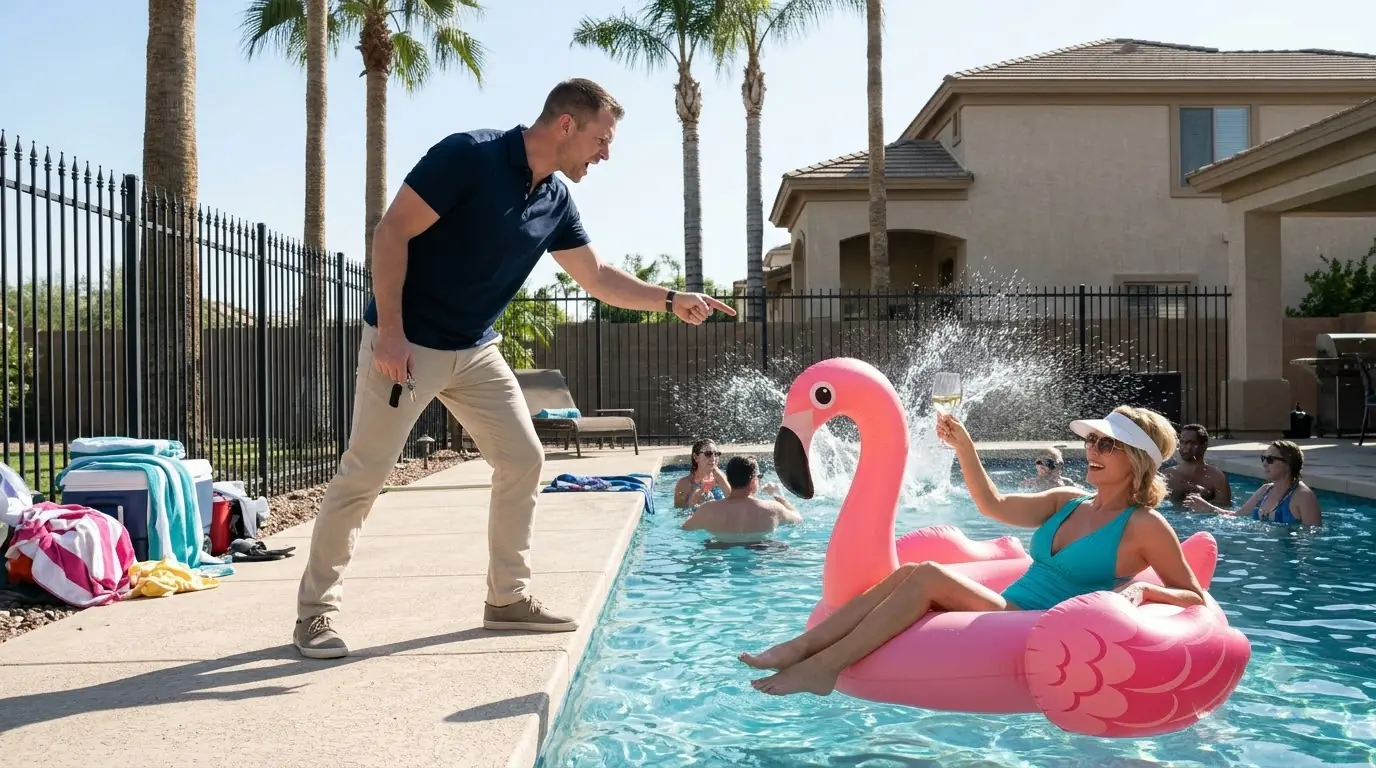
For a moment, I remained on the patio with my keys in my hand, convinced exhaustion had made me misunderstand what I was seeing. There was a wrought-iron gate between my driveway and this backyard. There was a lock on the gate, and a keypad that required a code. The pool sat on land I owned, behind a house whose mortgage had my name on it, and I had spent eleven years working night shifts as a paramedic to afford precisely this kind of quiet. Yet the president of our homeowners association was entertaining paying guests in the middle of it.
Celeste noticed me before anyone else. She raised her glass in greeting, as though I had arrived late to a party I was hosting. “Oh, Nathan, relax,” she called. “The homeowners association owns the water views, sweetheart. Everybody gets to enjoy them.” One of the strangers laughed, not because the remark was funny, but because Celeste had laughed first. I looked past them to the swimming pool, its blue surface broken by the splashing of people who had no idea whose home they had entered.
I remember that instant more clearly than the meeting that came later, or the lawyers, or the bank records spread across a clubhouse table. I remember the smell of sunscreen and grilled onions. I remember thinking about the ambulance I had just left, about the old man whose heart had stopped in a supermarket aisle, and about how carefully I had controlled my hands while helping to bring him back. At work, panic could kill someone. At home, I had always assumed I would be allowed to put that discipline down.
Three weeks earlier, I had turned the key in the front door of the house for the first time. I was forty-two, divorced, and carrying everything I owned in a rented moving truck that smelled of cardboard and diesel fuel. The house stood on a corner lot in Desert Ridge Estates, a development on the northern edge of the Phoenix metropolitan area where newer roofs climbed gradually toward a ridge of bare desert hills. It was not a mansion. The kitchen cabinets needed refinishing, and the upstairs air-conditioning unit sounded like an elderly tractor whenever it started. But the backyard had three palms, a lemon tree, and a pool that seemed to catch whatever sky was left at the end of the day.