Emma Collins had been living in Cedar Brook for six months when she finally stopped thinking of every morning as proof that her old life was gone. At first, the school bus stop near the entrance of the subdivision had felt like one more unfamiliar place she had to stand in before being carried to another unfamiliar place. She would arrive with her blue backpack pulled tight over both shoulders, curly brown hair escaping whatever clip her mother had used that morning, and wait without saying much. Then Lucy Harper started crying on the second Monday of September, and the bus stop changed.
Lucy was six and had decided with absolute certainty that the yellow school bus was a machine designed to separate children from their mothers forever. Her father, Daniel, had tried jokes, snacks, a new lunchbox, and even a stuffed rabbit small enough to fit inside her backpack, but Lucy still dug her sneakers into the sidewalk whenever the bus rounded the bend. Emma had watched this happen three mornings in a row before stepping beside her and opening the little umbrella she carried even when the sky was clear. “You can stand with me until it gets here,” she said, as if that settled everything.
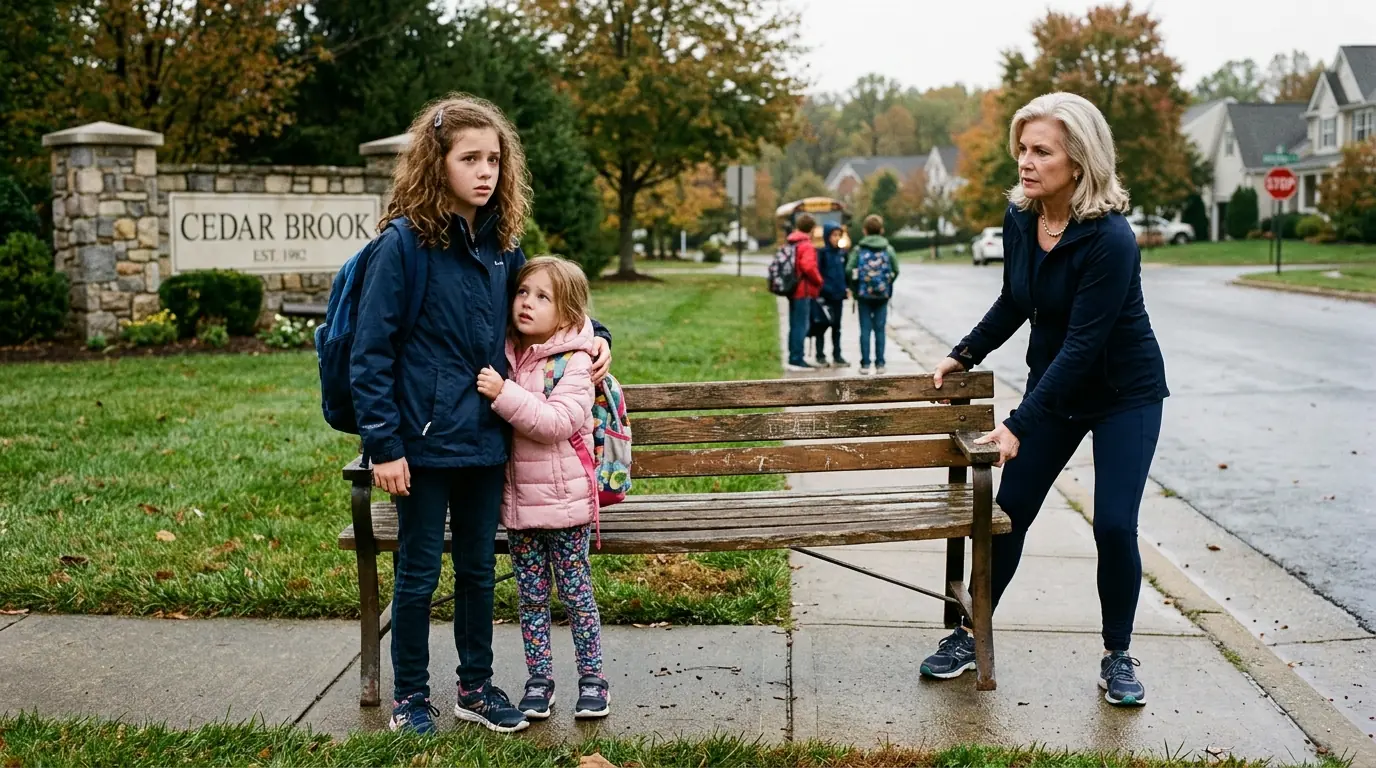
It did not settle everything, but it gave Lucy something to hold on to. The next morning, Lucy stood beside Emma instead of behind her father. By Friday, Emma was zipping the coat of a kindergartner whose fingers were too cold to work the zipper, picking up a lunchbox someone dropped in the grass, and reminding two boys not to balance their shoes on the curb while they waited. Nobody appointed her to anything. She simply noticed when someone needed help, and after a year full of adults making decisions she could not control, noticing small things became one way she could make the world feel steadier.
Cedar Brook itself looked steady from a distance. The subdivision sat beneath rows of maple trees in suburban Virginia, with wide sidewalks, trimmed lawns, a community pool, and a gray stone monument at the entrance carved with the neighborhood’s name. Families had moved there for the school district, the walking trails, and the promise that children could ride bicycles without their parents worrying every second. The school bus stop occupied a strip of grass beside the entrance sidewalk, where fourteen to eighteen children gathered each weekday morning with parents, backpacks, umbrellas, scooters, and the shifting noise of people who knew they had only a few minutes together.
Beside the sidewalk sat an old wooden bench that did not quite match anything else in Cedar Brook. The boards had faded silver-gray, the arms were smooth from years of hands, and one leg had been reinforced with a metal bracket that looked older than Emma. Younger children sat there when they were tired, parents set coffee cups on one arm, and on rainy mornings people crowded beneath umbrellas around it. Emma liked the bench because it did not look new. Everything else in Cedar Brook seemed designed to pretend nobody had ever spilled anything, scratched anything, or lived too loudly.
One morning in early October, while Lucy leaned against her shoulder and waited for the bus, Emma reached under the seat and found a brass screw beneath the wood. She rubbed it with her thumb and felt the edge of something flat. Dirt had collected around it, and from where she sat she could not see more than a dull strip of metal. “What’s under there?” Lucy asked. Emma bent lower, but the bus appeared around the corner and the children surged toward the curb, so she only shrugged and stood.
Across the street, Patricia Wells watched them from her breakfast room window.
Patricia was sixty, silver-blonde, always carefully dressed even when the clothes were expensive activewear meant to appear casual. She had served on Cedar Brook’s HOA Safety and Appearance Committee for five years and carried herself with the certainty of someone who had spent enough time correcting small problems that she no longer believed anyone else noticed them. Her tumbler of coffee was usually in one hand and her phone in the other. If a bicycle leaned against the stone monument, she photographed it. If chalk marks appeared near the sidewalk, she photographed those too.
She did not think of herself as unreasonable. In the luxury community where she had lived before Cedar Brook, uniformity had been treated almost as a moral virtue: the same mailbox style, the same approved paint palette, the same standard for landscaping. Patricia had watched neighbors there fight over fence heights and trash cans, and she had absorbed one lesson more deeply than she realized. A beautiful neighborhood required discipline, and discipline required someone willing to be disliked.
For years, that belief had sometimes helped. Patricia had pushed the county to replace a damaged stop sign. She had badgered a landscaping contractor until a broken irrigation head stopped flooding a crosswalk. She had once persuaded the HOA board to fund better lighting near the pool after parents complained that teenagers walking home after evening swim practice could not be seen clearly. Those victories became evidence, in Patricia’s mind, that she was the person who noticed danger before other people did.
Lately, however, the entrance bothered her in a different way. Her corner house faced the stone monument, and a realtor had told her that the approach to the property was one of its best selling features. “Buyers decide how they feel before they walk through the door,” the woman had said while standing in Patricia’s kitchen. “The cleaner the sightline, the better.” Since then Patricia had begun seeing backpacks, minivans, bicycles, children, and the old bench not as ordinary pieces of morning life but as visual clutter in the frame of a photograph.
She had not yet put a sign in the yard. The listing photographer had come twice, though, and a white post marked with the realtor’s company logo rested against the wall inside Patricia’s garage. She had asked the landscaper when the entrance flower beds would be refreshed. She had also begun opening the blinds in the breakfast room earlier than usual.
On the first Monday after daylight-saving darkness began creeping into the mornings, Emma and Lucy stood near the bench while two older boys laughed over something on a phone. A toddler sibling chased a red mitten across the grass, and three parents talked beside a minivan idling near the curb. Patricia crossed the street with her tumbler and phone, stopped in front of the group, and looked at them as though they had assembled for an inspection.
“You’re blocking the entrance again,” she said.
Daniel Ruiz, Lucy’s father, glanced around. Nobody was blocking a car or driveway. “The bus will be here in five minutes.”
“That doesn’t make this a playground.”
The conversation went quiet. Emma looked at Patricia but did not say anything. She was still new enough to Cedar Brook that adults like Patricia made her feel as though belonging could be revoked if she used the wrong tone.
Patricia lifted her phone and took a photograph of two bicycles leaning against the stone monument. “We have community standards for a reason,” she said. “People entering Cedar Brook shouldn’t have to navigate around this.”
One of the bicycles belonged to a fourth grader named Miles, who immediately wheeled it farther into the grass. His mother started to say something, then stopped. The bus arrived before the argument could become anything more, and the children climbed aboard while Patricia stood with her arms folded. Emma took the window seat beside Lucy and watched Patricia shrink behind the yellow glass.