The first thing Owen Parker learned about fishing was that catching a fish was not the point.
His grandfather had told him that on a cool Saturday morning in April, when the fog still floated above the small lake at the center of Lake Briar Community and the grass along the bank was wet enough to soak through sneakers.
Henry Parker had placed an old spinning rod in Owen's hands, guided his fingers around the grip, and said, "Anybody can want the fish. The better question is whether you leave the place better than you found it."
At eleven, Owen had not fully understood what that meant. He understood the easier parts. Use the right hook. Keep the line tight without jerking. Wet your hands before touching a fish.
Take a quick picture if you wanted one, then ease the fish back into the water. Henry taught him how to pinch the barb on a hook flat with pliers and how to cut tangled line into small pieces before throwing it away so birds would not get caught in it. Those lessons became part of the routine, like tying shoes or looking both ways before crossing a street.
By the beginning of summer, Owen could tie a simple knot without help and cast far enough to land a bobber beyond the patch of reeds near the walking trail. His eight-year-old sister Ruby still needed help baiting a hook, and their friend Devon mostly liked guessing what kind of fish lived under the dock, but the three of them had grown comfortable around the lake.
They never fished near the swimming dock. They never left hooks in the grass. And Henry, at sixty-eight, always stayed close enough to watch even when he pretended to be more interested in the newspaper folded across his lap.
The lake itself was not large. A paved walking trail circled it, shaded in places by sycamores and maples. There was a wooden dock on the eastern side, a picnic shelter, two benches facing the water, and a strip of open grass where residents spread blankets in spring. Lake Briar's HOA allowed catch-and-release fishing for residents, and the rules were posted on a weathered sign near the dock. Children under twelve needed an adult nearby. Fishing was prohibited near the swim area. Anglers were expected to collect their line and trash.
Owen liked the last rule best because it gave the three kids something to do even when the fish were not biting. Henry had given them a small white bucket with the word CLEANUP written across it in black marker. Into it went old line, rusted hooks, bottle caps, torn plastic wrappers, and anything else they found along the bank. Some days they came home with no fish pictures at all but a bucket half full of somebody else's garbage.
"Still counts," Henry always said.
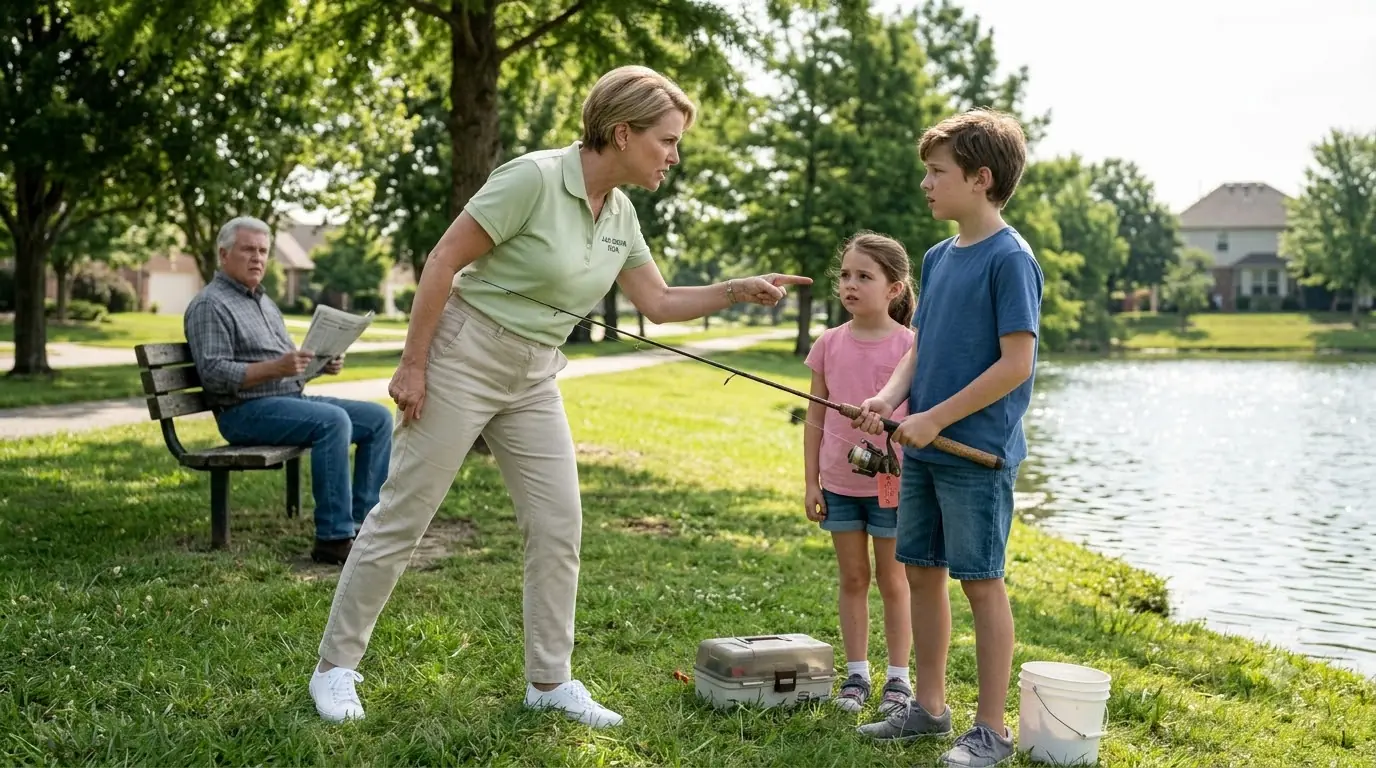
The rod Owen used had belonged to Henry for years. It was old enough that the cork handle had darkened where hands had held it, and there was a shallow scratch along the reel seat. Just above the grip hung a small red plastic tag, faded on the edges from sunlight. Tiny letters had been stamped into it: LBCA — YOUTH WATER DAY 2009.
Owen had asked Henry what it meant once.
"Old neighborhood thing," Henry said.
"Were you a kid in 2009?"
Henry laughed so hard he had to lower the newspaper. "Not unless I had a very rough childhood."
Then he changed the subject, and Owen forgot about the tag.
Colleen Price noticed the children long before she noticed the tag.
Colleen was fifty-five and chaired Lake Briar's Lake and Landscape Committee, a volunteer role that had slowly become the center of her life. She was not an unreasonable person in every situation. In fact, for years residents had appreciated her attention to details nobody else wanted to handle. She had pushed the HOA to replace broken benches, pressured a landscaping company to stop blowing grass clippings into the lake, and organized a volunteer morning to replant native grasses around an eroded corner of the trail.
But success had done something to her sense of proportion. The more the board accepted her recommendations, the more she began treating preferences as policies and policies as personal authority. That summer she had become obsessed with what she called the Beautification Initiative, a plan to make the lake feel less like a neighborhood recreation area and more like what she described in meetings as a "quiet reflection environment."
Her proposal included new ornamental grasses, decorative stone near the benches, uniform picnic furniture, and signs encouraging people to keep noise low. None of those ideas were terrible by themselves. The problem was that Colleen's version of beauty did not include tackle boxes on the grass, children crouched near the bank, muddy sneakers, bait containers, or the faint earthy smell of fish.
She wanted the lake to look like the photograph on a luxury community brochure.
The children made it look lived in.
The first confrontation happened on a bright Tuesday afternoon while Owen was helping Ruby free her line from a low branch. Devon was sitting cross-legged beside the cleanup bucket, separating a length of abandoned monofilament from a clump of weeds. Henry sat about fifty feet away on a bench with the newspaper folded in his lap, his eyes lifting every few moments whether the kids noticed or not.
Colleen came down the path in white sneakers and a pale green polo with LAKE BRIAR HOA embroidered over the chest. She slowed when she saw the rods, then stopped completely.
"Pack it up," she said.
Owen looked over his shoulder. "Why?"
"Because fishing isn't allowed here."