The first thing Ethan Rowe heard when he answered his daughter's call was screaming. Not crying, not the frightened little gasp a child makes when something breaks in the kitchen, but full-throated panic layered beneath a violent buzzing that seemed to fill the entire house. For three seconds he could not understand what he was hearing, because he was standing in a hardware supplier twenty miles away and the ordinary world around him had not changed at all. Then fourteen-year-old Lily shouted, "Dad, there are wasps in the kitchen," and Ethan dropped the box of copper fittings in his hands.
"Where are Ben and Sophie?" he asked. His truck keys were already out before Lily answered. Ben, eleven, had locked himself and eight-year-old Sophie in the downstairs bathroom, and Lily was crouched inside the pantry with a dish towel wrapped around her head because the hallway between her and the bathroom was full of angry insects. She said a paper nest had landed on the kitchen floor through the open patio door and burst against the edge of the island. She also said she had seen Karen Whitfield standing outside the fence when it happened.
Ethan was moving before she finished. He told Lily not to cross the kitchen, not to try to swat anything, and to stay on the phone while he called emergency services from another line. The dispatcher told the children to seal the bottoms of the doors with towels if they could do it safely and wait for firefighters, who were closer than Ethan. By the time his truck hit the highway, his hands were gripping the steering wheel so hard that the old scar across his right palm had turned white.
Ethan Rowe was forty-six, broad through the shoulders, prematurely gray at the temples, and the kind of man who had learned to become calm because panic had never once made a bad situation better. He had raised the three children alone since his wife, Mara, died five years earlier from an aneurysm no doctor had seen coming. He ran a small commercial electrical business, paid his bills, fixed what broke, packed lunches at six in the morning, and had built a life that depended on routines holding together. That afternoon, someone had carried a live wasp nest to the edge of that life and thrown it through his back door.
The fire department reached the house before he did. Two firefighters in protective gear entered through the front, shut interior doors, and helped the children out through a side bedroom window while a county-contracted pest technician handled the nest. Lily had been stung once on the forearm. Ben had two welts on his neck from insects that slipped under the bathroom door before he blocked the gap. Sophie had not been stung at all, but she was shaking so badly that the paramedic had wrapped her in a blanket despite the August heat.
Ethan arrived to find all three children sitting inside an ambulance with the doors open. The moment Sophie saw him, she came off the bench and hit him hard enough around the waist to make him stumble. Ben tried to look older than eleven and failed when Ethan touched the swelling near his neck. Lily was the one who kept saying she was sorry because she had left the patio door open to let the dog in before their old Labrador decided the heat was not worth it and stayed under the dining table.
"You did nothing wrong," Ethan told her. He repeated it until she stopped apologizing. Then a deputy named Carla Nguyen asked whether the house had exterior cameras. Ethan looked toward the eaves, where four black housings covered the driveway, patio, side gate, and rear yard, and felt something cold replace the fear in his chest.
The patio camera showed everything.
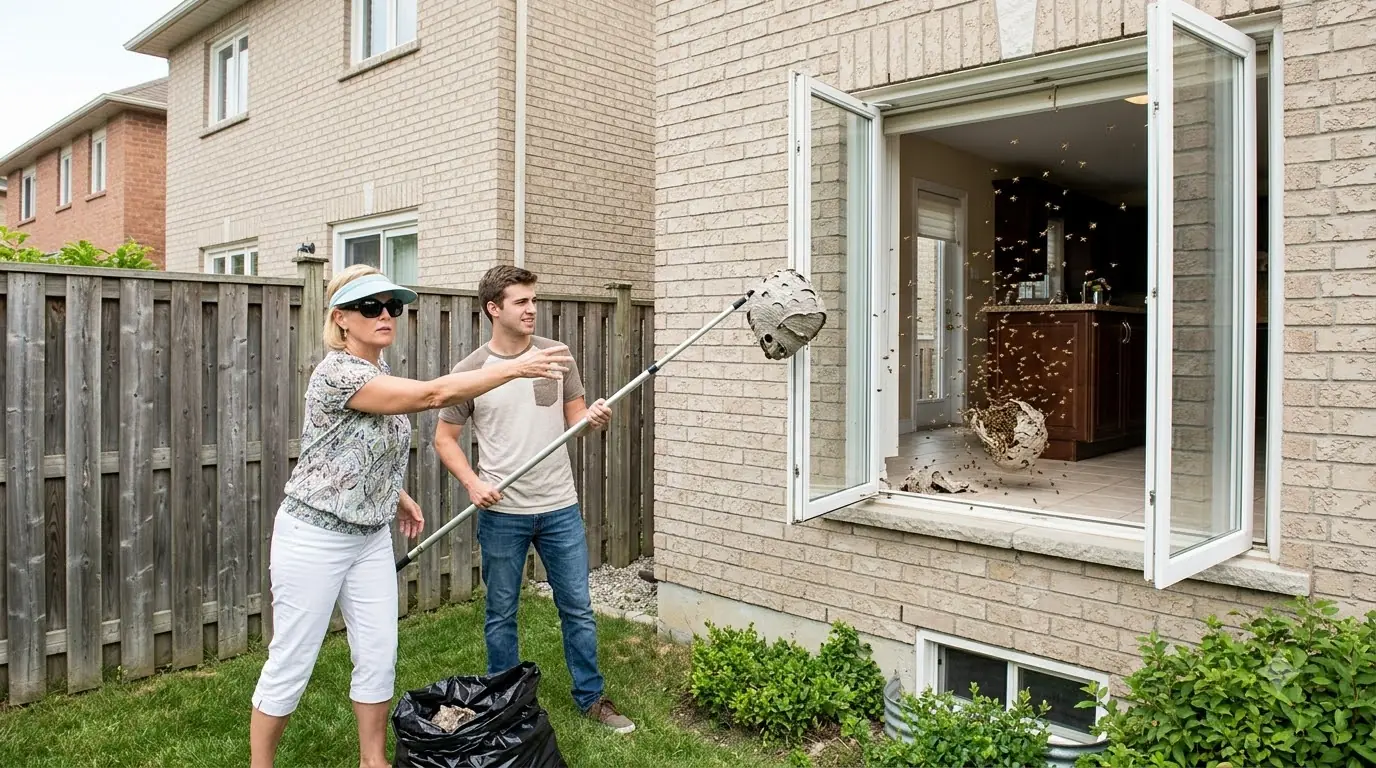
At 2:18 p.m., a white golf cart rolled into the rear utility lane beyond Ethan's cedar fence. Karen Whitfield sat behind the wheel in oversized sunglasses and a pale blue visor, while her twenty-two-year-old son Tyler stood on the passenger side holding a long telescoping pole and a contractor trash bag. The camera had no trouble capturing them because Karen had spent the past year insisting that residents keep vegetation trimmed low along the drainage corridor for "security visibility." Her own rule gave Ethan an unobstructed view.
The nest hung from a low branch just outside Ethan's legal fence line, inside a strip Karen had spent months claiming belonged to the Homeowners Association. Tyler extended the pole and knocked the nest into the contractor bag, but he did not close the top. Karen pointed toward Ethan's patio and said something the microphone caught clearly enough for everyone in the living room to hear later.
"If he wants to keep his little habitat, he can keep it in his house."
Tyler laughed. He asked whether she was serious. Karen replied, "Maybe he'll finally learn that ignoring association notices has consequences," then took the bag from him, walked to the side gate, reached over the latch, and entered Ethan's yard without permission. The patio door stood open six inches for the dog, exactly as Lily had described.
Karen carried the bag to the door, tilted it, and shook.
The nest hit the kitchen tile at 2:21 p.m.
Even on video, the sound was terrible. The paper shell cracked against the island base, Tyler swore, and Karen jumped backward as the insects poured out. Instead of warning anyone inside, she and her son ran to the golf cart, drove away, and left three children in the house.
Deputy Nguyen watched the clip twice. The first time, her jaw tightened. The second time, she paused on the frame where Karen's face was clearly visible as she tipped the bag. Then she asked Ethan to make a formal statement and requested copies of the footage before he had the chance to ask whether Karen could somehow call this another HOA enforcement action.
That was the word Karen used when she arrived twenty minutes later.
She came down the sidewalk on foot, carrying a leather folder against her chest, and tried to walk straight past the yellow tape. Deputy Nguyen stopped her near the driveway. Karen looked surprised to see police, then offended, as though emergency vehicles had violated a neighborhood aesthetic standard.
"I was conducting nuisance abatement," she said. "The homeowner refused repeated notices about hazardous insects on association-controlled property."
Ethan had spent two years listening to Karen use official-sounding phrases the way other people used locks. She was fifty-four, polished, organized, and permanently convinced that a title on a committee transformed preference into law. She chaired the Willowmere Residential Association, or at least claimed to, and drove through the neighborhood in a white golf cart with a clipboard, photographing trash cans left out too long, basketball hoops turned the wrong direction, planters placed too close to sidewalks, and cars she considered visually inappropriate.