"Pack it up." Owen Parker looked up from the dark green water of Lake Briar and saw Colleen Price standing at the top of the fishing dock with one hand on her hip and the other wrapped around the handle of a black trash bin. She wore the pale visor she always wore when she inspected the lake path, even though the Saturday morning sun had barely climbed above the line of sycamores. Behind her, the retention pond lay flat and silver-blue, broken only by a ring of ripples where Ruby had dropped a worm too close to shore.
Owen did not move. His rod rested across his knees, the cork handle worn almost smooth from years of use. A faded red fabric tag was tied just above the reel seat, its white letters nearly rubbed away. LBCA - YOUTH WATER DAY 2009. He had read those letters so many times that he no longer really saw them. To him they were simply part of the rod, like the scratches on the reel and the tiny groove where his grandfather's thumb always rested.
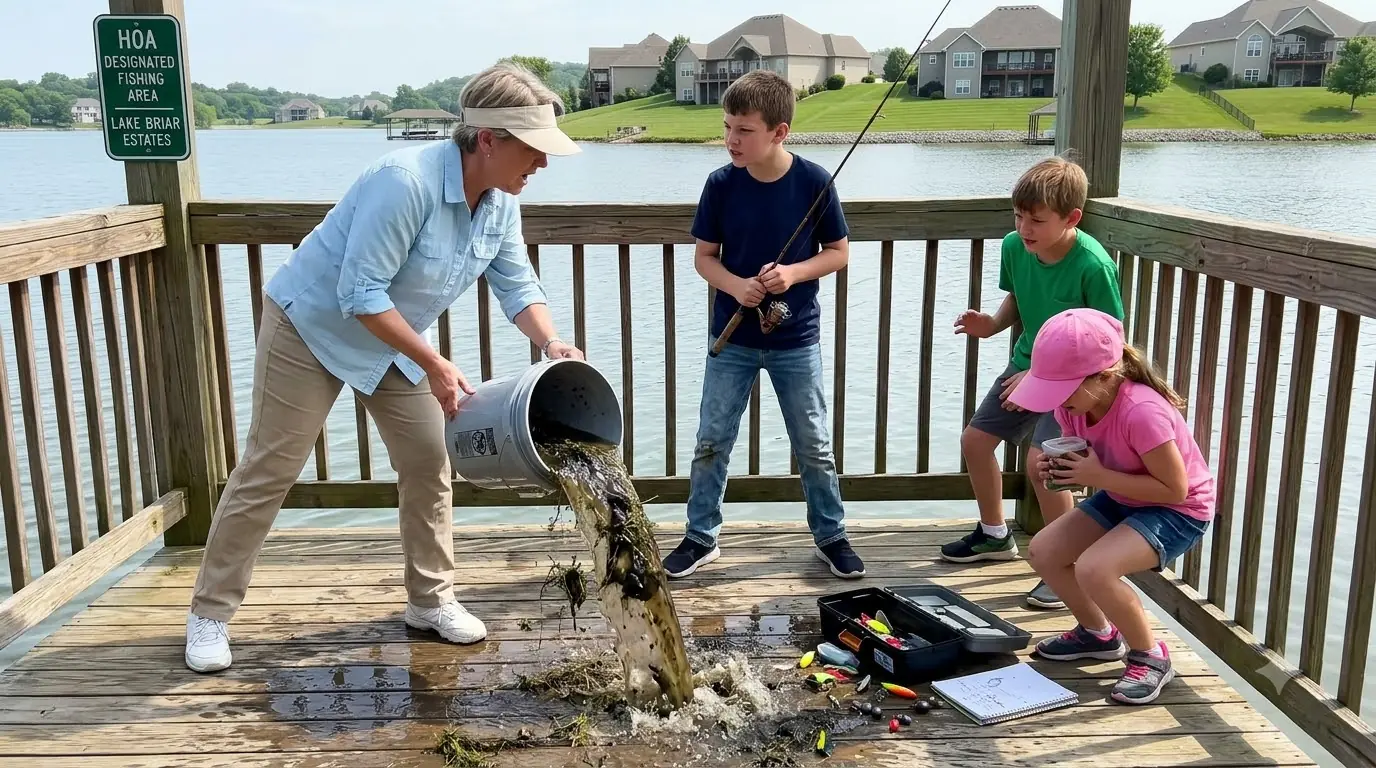
"Why?" Owen asked. Colleen pointed toward the water as though the lake itself had answered for her. "Children are no longer allowed to fish from this side." Ruby, eight years old and wearing a pink baseball cap two sizes too large, stopped writing in the little spiral notebook balanced on her thigh. Devon Ellis, eleven, held his line still. Thirty feet away, Owen's grandfather Henry lowered his newspaper at the picnic table but did not stand yet.
Owen looked left, then right. The dock sign still read CATCH AND RELEASE ONLY. The smaller sign below it listed the usual rules: residents and guests, supervised children, no swimming, no unattended lines, clean up bait containers and fishing line. There was no new notice. No orange cone. No temporary closure sign. Nothing. "Since when?" Owen asked. Colleen's mouth tightened. "Since I told you."
The answer bothered Owen more than if she had simply lied about a rule. He was not naturally argumentative. Usually, if an adult told him to move, he moved. If Henry said reel in, Owen reeled in. If his mother said he had ten minutes, he started packing at nine. He liked fishing partly because it did not require fast decisions or loud voices. You waited. You watched. You learned what the water was actually doing before you reacted.
This felt different. Henry folded his newspaper, set it beside his coffee, and finally stood. At sixty-nine, he moved slower than he had when Owen was younger, but he had a way of making slow movements look deliberate rather than weak. He walked toward the dock and stopped beside the sign. "Morning, Colleen," he said. "What rule changed?" "The fishing use is under review." "Under review isn't closed." "I'm asking them to leave." Henry glanced at Owen, then at Ruby and Devon. "And I'm asking what rule you're enforcing."