The first scream came from inside the bounce house.
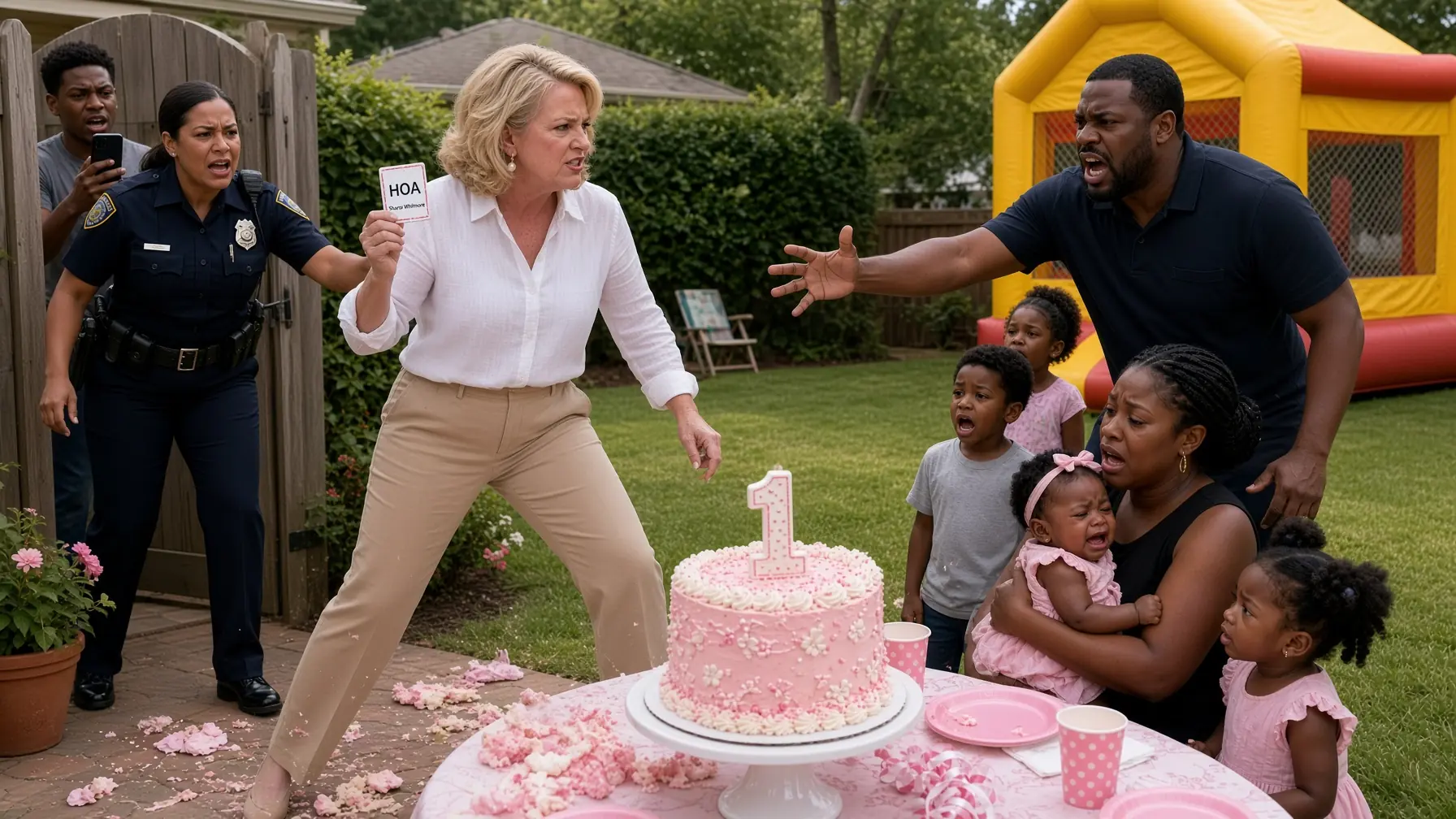
Marcus Reed turned away from his daughter’s birthday cake just as the bright yellow roof began folding inward.
The blower had stopped.
Six children were still inside.
“Everybody out!” Marcus shouted.
His brother Darnell dropped the paper plate in his hand and ran toward the inflatable. Two parents grabbed the entrance flap while Marcus reached inside and pulled his nine-year-old nephew toward daylight. The children were not trapped for more than a few seconds, but that was long enough for panic to spread through the backyard.
A little girl began crying.
Someone knocked over a tray of lemonade.
The photographer Marcus and his wife had hired lowered her camera.
And one-year-old Amara Reed, sitting in a decorated high chair beneath an arch of pink and gold balloons, burst into tears while twenty-seven relatives and friends turned toward the side of the house.
Standing beside the outdoor electrical outlet was Sharon Whitmore.
President of the Briarwood Lakes Homeowners Association.
Fifty-eight years old.
White linen blouse.
Pearl earrings.
HOA badge clipped to her belt as though she were carrying police credentials.
And in her right hand was the extension cord she had just pulled from the outlet.
“There,” Sharon said. “Now perhaps everyone will listen.”
For a moment, Marcus simply stared at her.
He had spent forty-three years learning how dangerous anger could become when somebody else was waiting for him to display it.
So he did not shout.
He did not charge across the yard.
He walked.
Slowly.
Behind him, his wife Tasha lifted Amara from the high chair and held the crying baby against her chest.
Marcus stopped several feet from Sharon.
“Plug it back in.”
“No.”
“There were children inside.”
“And I warned you that commercial inflatables are prohibited.”
Marcus’s jaw tightened.
“You were told to leave my property.”
Sharon raised a clipboard.
“As HOA president, I have inspection authority.”
“No, you don’t.”
“Yes, I do.”
“Show me.”
Her expression hardened.
“I do not have to debate governing documents with you during an active violation.”
Marcus looked toward the open side gate.
Behind Sharon stood a nervous twenty-three-year-old security guard wearing the uniform of Briarwood’s contracted patrol service.
He looked as if he wanted to disappear.
Marcus pointed toward the gate.
“Leave.”
Sharon laughed.
“You don’t give me orders.”
“This is my backyard.”
“This property is inside Briarwood Lakes.”
Marcus’s voice remained controlled.
“That is the argument we have been having for eight months.”
“And you have lost it.”
“No.”
“You have simply ignored the letters from my attorney.”
Sharon’s mouth tightened.
“That lawyer of yours is wrong.”
“Then prove it somewhere that isn’t my daughter’s birthday party.”
Amara continued crying against Tasha’s shoulder.
The pink cake sat untouched.
A large white number 1 leaned slightly in the frosting.
Sharon looked at the family gathered around the yard.
At Marcus’s mother.
At Tasha’s parents.
At Darnell.
At neighbors.
At children.
Most of them were Black.
Then she looked back at Marcus.
“This is exactly the sort of event our rules are designed to prevent.”
The sentence changed the air.
Tasha stopped rocking Amara.
“What sort of event?”
Sharon glanced toward her.
“An oversized gathering.”
“There are twenty-seven people.”
“Exactly.”
Tasha stared.
“Last month the Lawsons had nearly forty people here for their daughter’s graduation.”
Sharon looked irritated.
“That was different.”
“How?”
“It was a recognized family event.”
Marcus almost laughed.
“My daughter turning one isn’t?”
“That isn’t what I said.”
Darnell spoke from behind Marcus.
“Sounded pretty close.”
Sharon turned.
“And who are you?”
Marcus raised one hand toward his brother.
“Don’t.”
Darnell backed away.
Marcus looked at Sharon again.
“You need to leave.”
She reached for her phone.
“No. I think the police can explain this to you.”
Marcus nodded.
“Call them.”
The confidence in his answer surprised her.
“You think I won’t?”
“I hope you do.”
Sharon stared at him.
Then dialed 911.
Eight minutes later, red and blue lights reflected across the pink balloons hanging above Amara’s birthday table.
But by then, the damage had already been done.
Not to the bounce house.
Not to the decorations.
Not even to the cake.
To the children.
Marcus’s nephew had started asking whether the police were coming because they had been “bad.”
Tasha’s seven-year-old cousin wanted to go home.
And Jordan Reed, Marcus and Tasha’s eleven-year-old son, stood beside the back door watching his father with a question he was not yet ready to ask.
Why could somebody walk into their yard, stop his baby sister’s birthday party, and then call police as though the Reed family had done something wrong?
The answer had begun eight months earlier.
And it had almost nothing to do with birthdays.
Marcus and Tasha Reed bought 14 Willow Crest Lane the previous autumn.
The house sat along the eastern edge of Briarwood Lakes, a suburban development outside Atlanta built in three phases between 2004 and 2011. Most homes inside the neighborhood were governed by mandatory covenants administered through the Briarwood Lakes Homeowners Association.
Most.
Not all.
Number 14 occupied a strange piece of land.
The original parcel had belonged to an elderly couple named Henry and June Carter before the development existed. When a builder purchased the surrounding acreage, the Carters sold most of their land but kept a narrow rectangular tract containing their house.
Years later, after Henry died, June sold the home.
That history meant almost nothing to Marcus when he first toured it.
He saw a four-bedroom brick house.
Tasha saw the large kitchen.
Jordan saw the basketball hoop.
And six-month-old Amara saw absolutely nothing because she slept through the entire showing.
The first strange detail appeared during closing.
The title attorney, Evelyn Cross, had looked through the documents twice.
Then she asked:
“Did the seller tell you this house is in the HOA?”
Marcus nodded.
“The listing says Briarwood Lakes.”
“That isn’t quite what I asked.”
Tasha leaned forward.
“What does that mean?”
Evelyn rotated the deed packet toward them.
“Your mailing address is within the neighborhood. You’re surrounded by HOA property. But I’m not finding a recorded supplemental declaration that legally annexed this parcel into the association.”
Marcus frowned.
“So we don’t have an HOA?”
“I’m telling you what the title record shows.”
She tapped the page.
“The original Briarwood declaration does not include this legal description.”
“What about later?”
“I searched the supplemental filings. Nothing.”
Tasha asked:
“Could the seller have joined voluntarily?”
“Possible.”
“Did she?”
“Not that I can establish.”
Marcus looked at the stack of documents.
“The listing showed HOA dues.”
Evelyn nodded.
“That happens when listing information is copied from nearby properties.”
“Could the HOA still have rules over us because we’re inside the neighborhood?”
“Geography alone doesn’t create restrictive covenants.”
She leaned back.
“But before you start a war with anyone, let me verify everything again.”
She did.
Two days later, Evelyn called.
Same answer.
No recorded mandatory membership instrument.
No deed restriction incorporating the Reed parcel into Briarwood’s declaration.
The house appeared visually inside the subdivision.
Legally, it remained the old Carter tract.
Marcus thought the issue would end there.
That was his first mistake.
Three weeks after moving in, an envelope appeared in the mailbox.
WELCOME TO BRIARWOOD LAKES.
Inside was a bill for $840 in annual dues.
Marcus emailed management.
He attached Evelyn’s letter.
The response came from Briarwood’s president.
Sharon Whitmore.
All homes located within Briarwood Lakes are subject to community standards. Failure to pay assessments may result in late fees and collection activity.
Marcus replied:
Please provide the recorded declaration or annexation instrument that applies to our parcel.
No document arrived.
Another bill did.
Then a violation notice.
Trash cans visible from street.
Marcus corrected it even though he did not believe the HOA had authority.
Then came another.
Basketball hoop placement.
Then another.
Exterior garden hose improperly stored.
Tasha began laughing every time she opened the mailbox.
“Maybe they’ll regulate cloud formations next.”
Marcus was less amused.
He sent another certified letter.
Again:
Please identify the recorded covenant granting Briarwood Lakes HOA authority over Lot 14 Willow Crest Lane.
Sharon answered with a twenty-eight-page handbook.
Rules.
Pool hours.
Fence colors.
Mailbox standards.
Architectural review procedure.
No recorded instrument tying Marcus’s property to any of it.
Evelyn sent a formal attorney letter.
The language was simple.
Our title review does not establish mandatory membership. Please cease representing that the Reed property is bound by association covenants unless you can produce the applicable recorded instrument.
That should have ended enforcement.
Instead, Sharon escalated.
Because Sharon Whitmore had been president of Briarwood Lakes for six years.
She did not think of herself as a tyrant.
That would have required recognizing that disagreement with her could be legitimate.
She thought of herself as the person willing to enforce standards when everyone else was too weak.
Grass too long?
Sharon noticed.
Garbage bin visible?
Sharon photographed it.
Car parked overnight on the street?
Sharon emailed management before sunrise.
She knew which homeowners rented instead of owned, which teenagers drove too fast, whose dog barked, whose fence paint was fading, and which families had received architectural exceptions before she became president.
Then the Reeds arrived.
They did not argue loudly.
That bothered her more.
Marcus simply kept asking for the document.
Tasha smiled politely at meetings and said:
“We are happy to cooperate with rules that legally apply to us.”
Sharon heard only challenge.
It became personal.
By spring, the board had voted to pause active collection against the Reed property until the association attorney reviewed the old subdivision filings.
Sharon was furious.
She told two board members Marcus was “trying to create a loophole.”
He was not.
He was asking whether the law applied.
Those are different things.