The afternoon sun was sliding behind the rooftops of Willow Creek, turning the sidewalks gold and laying long shadows across the little neighborhood park at the center of Hawthorne Ridge. It was the kind of evening that made people open their windows, fire up grills, and let their children stay outside a little longer than usual. Birds moved through the maple trees, sprinklers clicked in tidy front yards, and the polished sign beside the entrance to the subdivision read, Welcome to Hawthorne Ridge, A Community of Standards.
Daniel Carter had never cared much for signs like that. He had seen enough of the world to know that standards could mean kindness, order, and safety, or they could become an excuse for people to control anyone who made them uncomfortable. All he wanted that evening was simple. He wanted his seven-year-old son, Noah, to learn how to ride his new skateboard without feeling embarrassed every time he fell.
Noah stood on the smooth concrete path near the playground, knees bent, helmet slightly crooked, one hand gripping Daniel’s fingers for balance. His skateboard was bright blue with orange wheels, a birthday gift Daniel had saved for by taking extra repair jobs at the small auto shop where he worked. Noah had been talking about it for three straight weeks, but now that the board was under his feet, courage was a little harder to find.
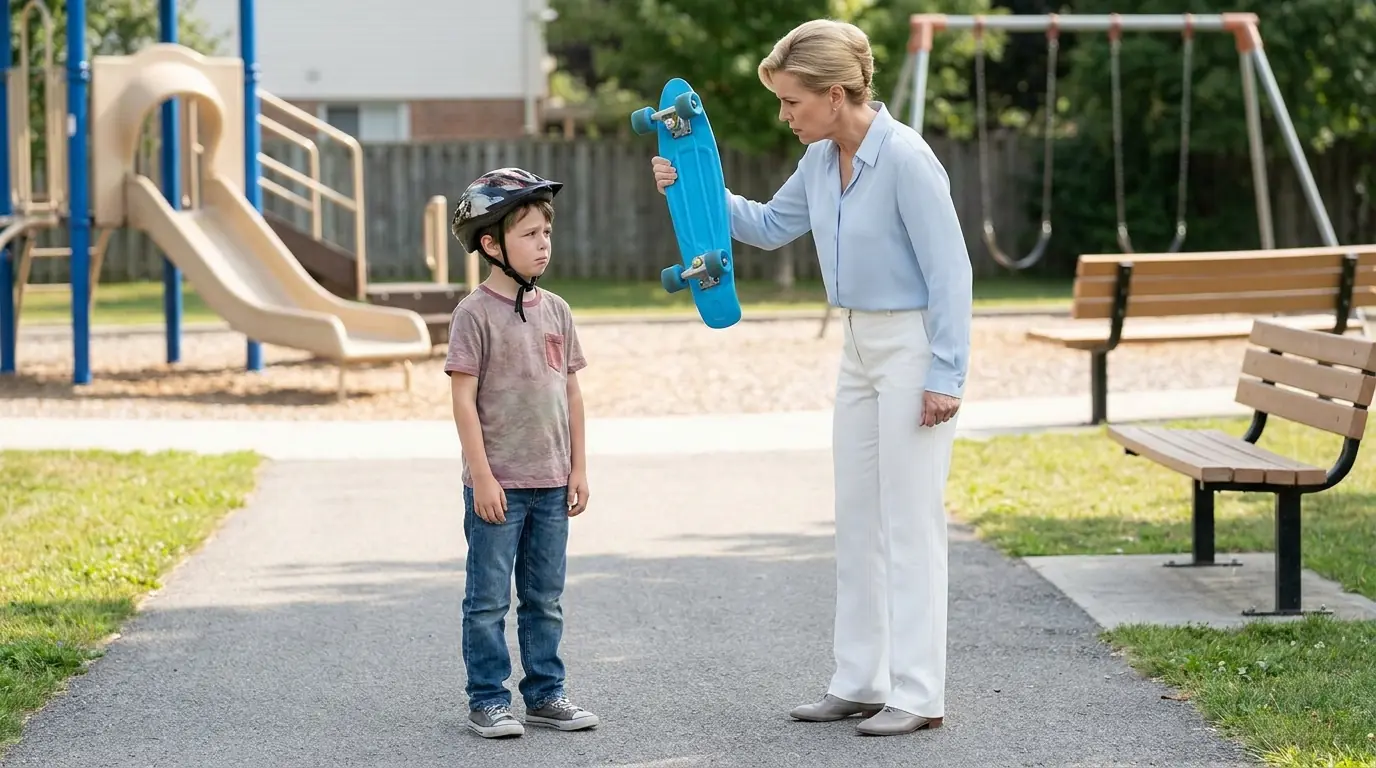
“You’ve got it,” Daniel said, his voice gentle. “Look ahead, not down. The board follows your fear if you stare at it too long.”
Noah swallowed and nodded. “What if I fall again?”
“Then you get up again.” Daniel smiled. “That’s the whole sport.”
Noah pushed off. For three seconds, he looked like he was flying. Then one wheel caught a pebble, the board shot sideways, and Noah landed on his hands with a sharp little grunt. Daniel was beside him before the boy could decide whether to cry.
“You okay?” Daniel asked.
Noah looked at his scraped palm, then at his father’s face. Daniel did not panic. He never did. He had a calmness that made Noah believe the world could fall apart and still be handled one breath at a time.
“I’m okay,” Noah said, though his lower lip trembled.
“That’s my boy.” Daniel brushed dust from Noah’s jeans and checked the scrape. “Small one. We clean it when we get home.”
What Daniel did not notice at first was the woman watching them from the other side of the park. She stood near the clubhouse walkway in white slacks, a pale blue blouse, and a straw hat with a ribbon tied too perfectly beneath the brim. Her name was Marlene Whitaker, president of the Hawthorne Ridge Homeowners Association, though she introduced herself as the guardian of the community whenever she wanted to sound more important than she was.
Marlene knew every mailbox by number, every lawn by height, and every neighbor by whether they had ever disagreed with her. She carried a clipboard even when she had no meeting to attend. She photographed trash cans that stayed out past pickup day. She left violation notices for porch chairs, children’s toys, holiday decorations, and once, famously, a garden gnome she claimed had an aggressive expression.
To Marlene, the park was not a park. It was a display piece. It was the little green heart of her perfect subdivision, a place that looked best when children were laughing softly from a distance and not actually using anything too loudly.
When Noah’s skateboard rolled across the path and tapped the leg of the wooden community noticeboard, Marlene’s mouth tightened as though someone had insulted her personally. She marched toward them, heels clicking against the concrete with a sharp, angry rhythm.
“Excuse me,” she called.
Daniel looked up. Noah stepped closer to his father.
Marlene stopped a few feet away and pointed at the skateboard with the end of her pen. “That cannot be used here.”
Daniel straightened slowly. He was forty-one, lean and tired-looking in faded jeans, a gray T-shirt, and work boots with oil stains near the toes. He looked like an ordinary single father because that was what he had chosen to become. Years earlier, he had worn uniforms, moved through dangerous places, and completed missions that were still locked behind classified files. But here in Willow Creek, he was simply Daniel, the dad who packed school lunches, fixed engines, and never missed a bedtime story.
“I’m sorry?” he said.
“Skateboards are not allowed in the central park area,” Marlene said. “They damage property, create noise, and encourage reckless behavior.”
Daniel glanced around. The path was wide, empty, and smooth. No signs mentioned skateboards. Two teenagers were tossing a football near the grass. A little girl rode a scooter by the swings.
“I don’t see a sign,” Daniel said evenly.
“That is because residents are expected to understand the spirit of the rules.” Marlene lifted her chin. “We maintain a certain standard here.”
Noah’s fingers tightened around the skateboard. “I’m sorry,” he whispered. “I didn’t mean to hit the board.”
Marlene looked down at him. Her expression did not soften.
“You should be sorry,” she said. “A child your age should know better than to throw toys around like that.”
Daniel’s face changed only slightly. To most people, it would have looked like nothing. But Noah knew his father well enough to recognize the stillness that entered his body.
“He didn’t throw it,” Daniel said. “He fell. He’s learning.”
Marlene let out a short laugh. “Then maybe he should learn somewhere else. This is a family neighborhood, not a skate park.”
Daniel looked at Noah, then back at Marlene. “We live two blocks from here. This is our neighborhood, too.”
Marlene’s eyes narrowed. “You rent the blue house on Alder Lane, correct?”
“Yes.”
“That explains quite a bit.”
The words landed quietly, but they landed hard. Daniel had heard tone like that in a hundred different rooms. It was the voice of someone who dressed contempt as concern and control as community service.
“Marlene,” a woman called from a nearby picnic table, “leave them alone. The boy’s not bothering anyone.”
Marlene did not turn around. “Please do not interfere, Carol. This is an HOA matter.”
Daniel took a slow breath. “Ma’am, my son and I are going to keep practicing for a little while. We’ll stay on the path and be careful. If there’s an actual written rule, I’ll read it.”
“There is no need for your attitude,” Marlene snapped.
“I don’t have an attitude.”
“You absolutely do.” She looked at the few neighbors who had begun watching. “This is exactly the problem. People move in here and think the rules don’t apply to them.”
Noah’s face reddened. He bent down to pick up his board, but Marlene reached first and snatched it from the ground.
“Hey,” Noah said, his voice small.
Daniel’s eyes moved to the skateboard in Marlene’s hand.
“Please give that back,” he said.
Marlene held it away from Noah as though the board were evidence in a trial. “This will be returned to you after your father learns how to cooperate.”
Noah looked up at Daniel, terrified. That look did something to Daniel that no insult could have done. He had survived ambushes, explosions, and nights cold enough to make breathing painful. But watching his son shrink under a stranger’s cruelty was a different kind of wound.
“Marlene,” Daniel said, his voice lower now, “give my son his skateboard.”
Instead of answering, Marlene turned toward the small crowd. “Does everyone see this? I am simply enforcing community standards, and now this man is trying to intimidate me.”
A few neighbors exchanged uncomfortable looks. Some pulled out phones. Not because they knew what side they were on, but because everybody seemed to record everything now.
Daniel did not move toward her. “I’m not intimidating you. I’m asking you to return property that doesn’t belong to you.”
“This is HOA property if it is being used in violation of rules.”
“That is not how property works.”
Marlene’s face flushed. She had never liked being corrected in public. “Do not lecture me. I have managed this community for eleven years.”
“Managed isn’t owned.”
A nervous murmur moved through the watchers.
Marlene stepped closer, her voice sharpening. “You think because you’re some tired mechanic with a sad little boy and a bad attitude, you can come in here and tell me how things work?”
Noah lowered his head. Daniel’s jaw tightened.
“That’s enough,” he said.
“No, what’s enough is this.” Marlene pointed at Noah. “Children like him become problems when their parents refuse to correct them. First it’s skateboards, then vandalism, then police calls. I have seen it before.”
Daniel stepped between Marlene and his son.
“You will not talk about my child like that.”
Marlene laughed, but the sound was brittle. “Or what? You’re going to threaten me in front of witnesses?”
“No.” Daniel held out his hand. “You’re going to give him the board. Then we’re going to walk away.”
Marlene looked at his open hand as if it offended her. Then she made the mistake that changed everything. She tossed the skateboard hard toward the trash can beside the path. It struck the metal rim with a sharp bang and fell to the concrete.
Noah flinched like he had been hit.
The park went silent.
Daniel walked over, picked up the board, and inspected it. One edge had chipped. A thin crack ran across the blue paint. It was not destroyed, but it was damaged, and Daniel knew exactly how many hours of labor had paid for it.
Noah whispered, “Dad?”
Daniel handed him the board. “Go stand by Mrs. Carol for a second.”
“I don’t want to leave you.”
“I know. But I need you safe.”
Carol, the neighbor at the picnic table, opened her arms gently. “Come here, sweetheart. You can stand with me.”