The first thing Diane Foster said about the ramp was, "Absolutely not." Mateo Cruz had just finished tightening his helmet strap when she stopped at the end of the driveway, one hand on her hip and the other holding the leather folder she carried whenever she walked through Redwood Park Estates.
The Arizona afternoon was still bright and hot, even though the worst of the sun had begun to slide behind the tile roofs, and the plywood wedge sat exactly where Mateo and his father had placed it: eighteen inches high, pointed toward the garage, well inside the private driveway, with the sidewalk completely clear. Elena, Mateo's ten-year-old sister, stood beside her scooter with both hands on the grips, trying not to look nervous.
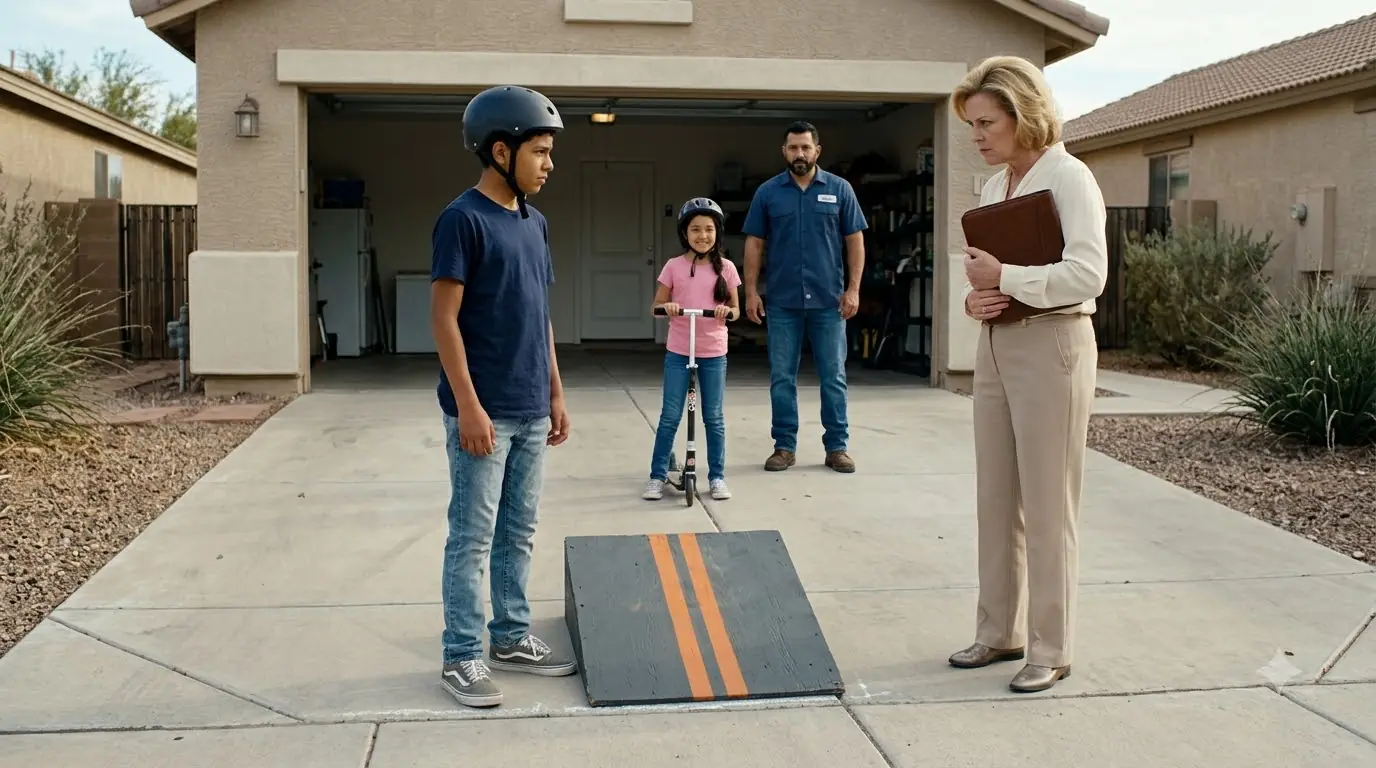
"What?" Mateo asked, because for a moment he genuinely did not know what Diane meant. She looked at the small ramp as though someone had dropped a wrecked car onto the concrete. "That ramp," she said. "It is a liability." Elena glanced at the helmet on her own head, then at the chalk stop line Mateo had drawn several feet beyond the ramp, as if checking whether some invisible danger had appeared since the last time she looked.
Diane was fifty-eight and served on the HOA Compliance Committee, although she had a way of introducing herself simply as "with the HOA," which made the role sound larger than it was. A month earlier, a teenager from another street had clipped a decorative planter while skateboarding on a sidewalk, leaving a cracked pot and a bruised elbow. Diane had treated the accident like a warning shot. Since then, scooters, skateboards, bikes, and anything that looked even slightly like a ramp had moved to the top of her private list of things Redwood Park Estates would be better without.
"If you fall and crack your head open, guess who pays?" she asked Elena. Elena blinked and answered before Mateo could stop her. "My dad?" The honesty of it made Mateo laugh once under his breath, and Diane's face tightened immediately. "This isn't funny," she said, her voice flattening into the tone she used whenever a child accidentally exposed how dramatic she sounded.
It was not a skate park. The nearest real skate park was far enough away that the Cruz family would have to load scooters into the truck and drive there, and most weekdays Carlos Cruz got home too late for that. The ramp was a portable plywood wedge with a braced wooden frame, rubber feet, and two recessed carrying handles. Carlos, an appliance technician who fixed dishwashers and refrigerators for a living, had helped Mateo cut the boards, drive the screws, sand every edge smooth, and test whether the frame rocked under weight.
The kids had painted the sides themselves. Mateo chose dark gray because it would not show tire marks; Elena added two narrow orange stripes that were not quite straight; Noah and Lucas painted a tiny white arrow near the bottom that pointed toward the garage. They had rules too: helmets every time, one rider at a time, no jumping toward the street, no music blasting from a speaker, and the ramp always faced inward so a bad landing carried a rider toward the garage instead of toward traffic.