The ball rolled across the warm asphalt and stopped less than a foot from Vivian Sloan’s driveway. Before thirteen-year-old Mateo Rivera could jog over to retrieve it, Vivian stepped out from beside her stucco garage, planted one white sneaker on top of the ball, and folded her arms.
“Game’s over,” she said. Mateo slowed, keeping his hands at his sides. “Can we have the ball?” Vivian glanced at the five kids spread across the wide Cedar Ridge cul-de-sac and said, “Can I have a quiet afternoon?”
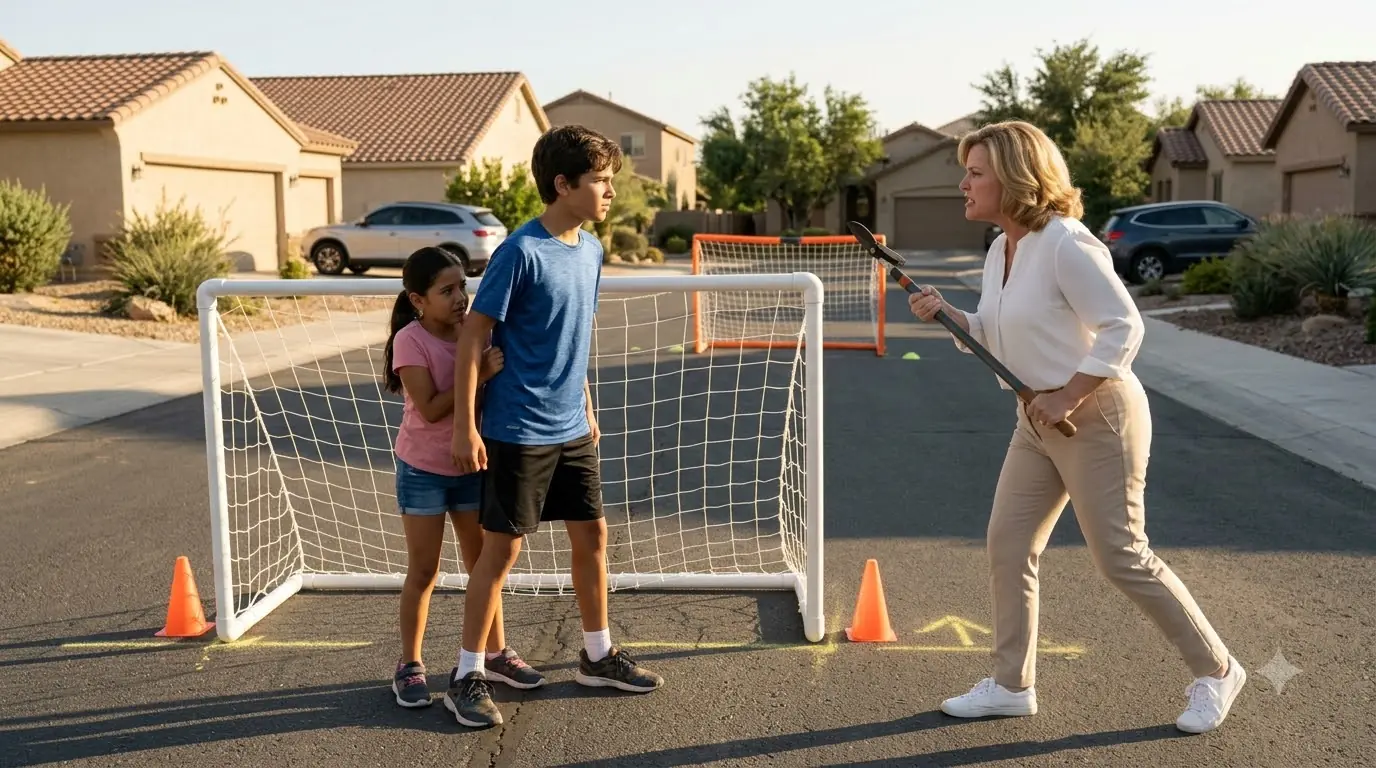
For a second, nobody answered. The Arizona sun had baked the street pale and dusty, and the only other sounds were an air conditioner humming behind a block wall and the soft rattle of a mesquite tree in the dry breeze. Mateo’s younger sister Sofia stood beside one of the homemade PVC goals, her ponytail stuck to the back of her neck.
Nine-year-old Eli Torres waited near the other curb with his foot resting on a second ball, while two other neighborhood kids, Noah and Priya, watched Vivian with the wary stillness children learned around adults who expected immediate obedience.
Mateo finally said, “We’re almost done anyway.” He did not point out that it was only four thirty, or that Cedar Ridge’s rules allowed temporary play equipment in the street so long as it did not block traffic and was removed when the kids finished. He did not mention that the goals were so light two children could lift each one in seconds. Mateo had already learned that facts rarely made Vivian less annoyed. Sometimes they made her more annoyed, because facts sounded to her like arguments.
Vivian lifted her foot just enough for Mateo to take the ball, then tapped one of the white PVC goals with the toe of her shoe. “These things are street obstructions,” she said. “They don’t belong out here.” Mateo looked at the six-foot opening between the goal and the yellow chalk line his group had drawn twelve feet out from the curb. “We leave the middle open,” he said. “If a car comes, we move them.” Vivian gave him a flat smile. “That doesn’t make them legal.”
The goals had begun as three ten-foot lengths of PVC pipe on the Rivera garage floor. Mateo’s father, Daniel, had helped him measure and cut the pieces, but Mateo and the other kids had built most of the frames themselves. They used elbow joints for the corners, zip ties for the nets, and small sand-filled fabric sleeves along the bottom so the goals would not tip in the wind. The whole design had one important rule: nothing could be heavy enough that a child had to struggle to move it.
That rule came from Daniel Rivera’s job. He worked as an emergency medical services dispatcher for the county, where his shifts were spent listening to the difference between panic and information. He was not an EMT in the field, not a police officer, and not someone with any special authority inside Cedar Ridge. But after years of hearing ambulance crews call for clear approaches, blocked gates, and cars parked badly on narrow roads, Daniel had given Mateo one piece of advice the first afternoon the kids asked to play soccer in the cul-de-sac. “If you play in the street, the street still has to work like a street,” he had said. “Emergency vehicle, delivery truck, neighbor coming home—doesn’t matter. You clear the lane first.”
Mateo took that more seriously than Daniel expected. He measured a twelve-foot center corridor with a tape measure, marked it with small yellow chalk lines, and taught the younger kids a routine. Anyone who spotted a vehicle yelled, “CAR!” Both goals went up onto the lawns, balls came under control, scooters moved to the sidewalk, and everyone stood still until the vehicle passed. They practiced the drill so often that Sofia could clear her side before Mateo finished the word.
Vivian had seen the routine at least three times. She had also seen the kids stop play whenever an elderly neighbor walked through, collect their water bottles, and carry the goals into the Rivera garage before dinner. None of that changed how she viewed the scene. To Vivian, the white pipes, orange cones, chalk marks, and shouting made the cul-de-sac look disorderly, and disorder had become almost personal to her since she joined the HOA Compliance Committee two years earlier.