The sound of breaking glass came before Andre Mitchell understood that Diane Whitmore had actually done it. One second she was standing on his front lawn in white capri pants and a navy HOA polo, shouting that he had “ignored his final warning.” The next, a decorative landscaping stone left her hand and crashed through the lower corner of his living-room window. The pane exploded inward, scattering safety glass across the hardwood floor while Andre’s ten-year-old daughter, Nia, screamed from somewhere behind the couch. Diane froze with her arm still extended. Andre stared at the jagged opening in his house. For several seconds, nobody said anything. Then Diane straightened her shoulders, as if smashing a neighbor’s window were merely the final stage of an inspection she had been authorized to conduct. “Maybe now,” she said, “you’ll understand that community rules are not optional.”
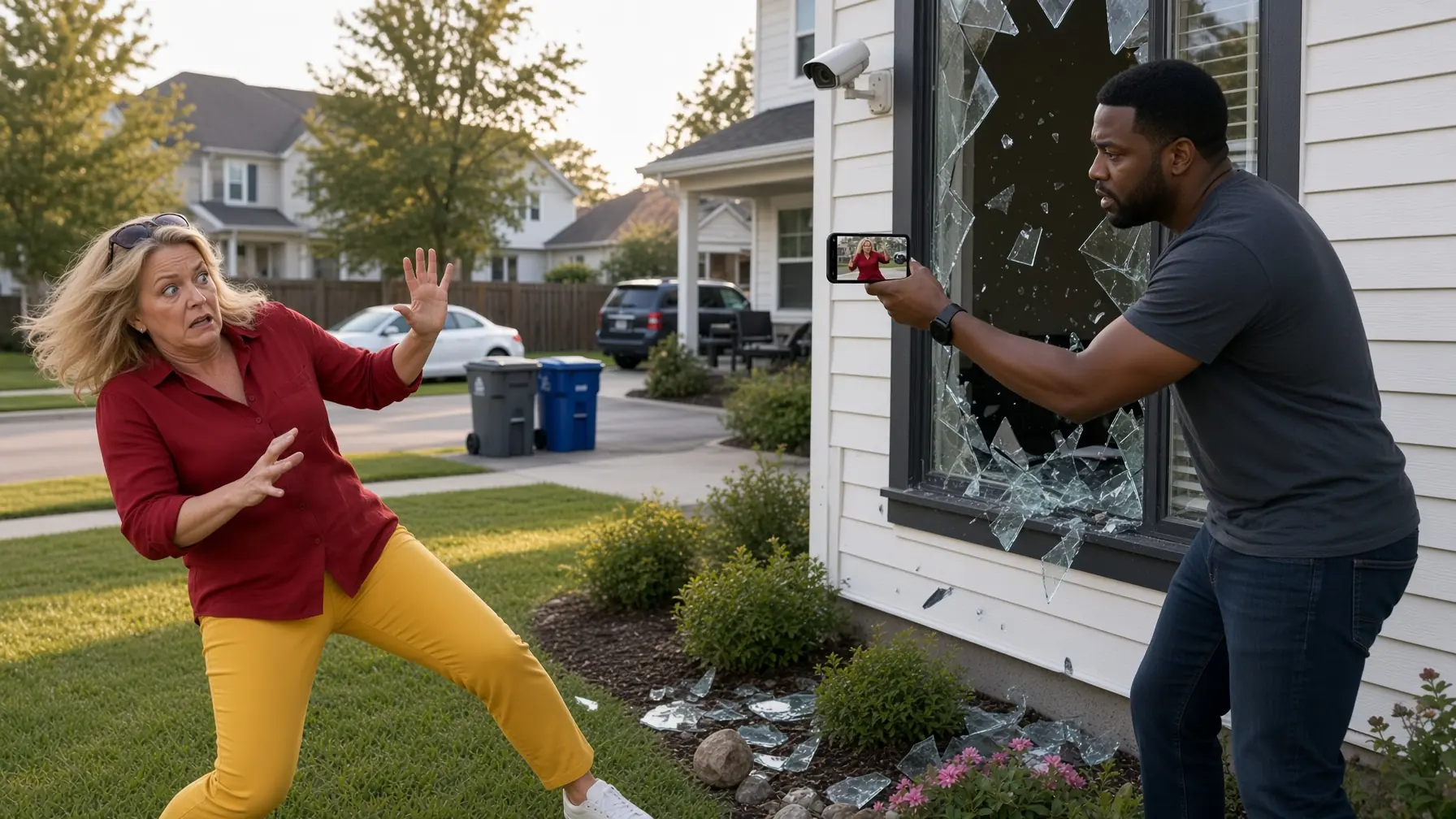
Andre did not answer her immediately. He turned toward the house instead. “Nia?” His voice was sharp enough that his daughter appeared from the hallway almost at once, barefoot and wide-eyed. “I’m okay,” she said. “I was in the kitchen.” Andre crossed the porch, stepped carefully around the glass, and checked her arms, face, and feet before he looked at anything else. Nia had been doing homework at the dining table less than fifteen feet from the window. One piece of glass had landed on the sofa. Another had skipped across the floor near the entrance to the hallway. Nobody was hurt, but that fact did not make Andre feel relieved yet. It made him aware of how easily the afternoon could have ended differently.
Behind him, Diane called, “You’re being dramatic.” Andre turned slowly. “Stay where you are.” Something in his voice made her stop. Andre was thirty-eight, Black, a widowed father, and the owner of a small commercial electrical company that employed eleven people. He was not physically imposing in the theatrical sense. He was lean, usually soft-spoken, and known by most neighbors as the man who carried extra jumper cables because somebody on the block was always discovering a dead battery on the wrong morning. But Diane had spent the better part of eight months trying to make him angry, and she had never managed it. Now she had finally succeeded. The difference was that Andre’s anger did not make him louder. It made him precise.
“Did you throw that rock?” he asked.
Diane folded her arms. “I removed an unauthorized obstruction.”
Andre looked at the shattered window.
“By throwing a landscaping stone through my house?”
“You refused access.”
“To my house?”
“To inspect the interior light spill.”
Andre stared at her. “Do not move.”
She laughed. “You cannot order me around.”
“I’m calling the police.”
That took some of the confidence out of her face.
“Go ahead.”
Andre pulled out his phone.
Diane raised her chin. “Tell them I’m the HOA president.”
“I’m sure you will.”
The dispute had begun with a porch light. Not loud music. Not a fence built across an easement. Not a swimming pool without permits. A porch light. Andre had installed two downward-facing LED fixtures beside his front door after the old brass sconces failed during winter. They were warm white, shielded, and connected to a timer that switched them off at midnight. The fixtures were sold as “dark-sky compliant” and had already passed city inspection because Andre had replaced the exterior wiring at the same time. Diane Whitmore, president of the Briarwood Glen Homeowners Association, decided they were “commercial in appearance.”
Andre asked where the covenants prohibited them.
Diane sent him a photograph of the architectural guidelines.
Andre asked again for the provision.
She responded that HOA boards had “broad aesthetic authority.”
Andre asked for the page.
That was the mistake, at least in Diane’s mind.
She had lived in Briarwood Glen for twenty-two years and served on the board for eleven. During the last six, she had been president. She spoke about the neighborhood the way some people spoke about family land, even though the first house in the development had been built only thirty years earlier. Diane knew which homeowners replaced their roofs without approved shingle samples, which college students parked overnight on cul-de-sacs, and which families used their garages for storage instead of vehicles. She believed order required vigilance, and after so many years of nobody seriously challenging her, she had begun to confuse being familiar with the rules with being the source of them.
Andre had moved into 218 Briarwood Lane fourteen months earlier with Nia. His wife, Camille, had died from cancer two years before the move. The old house they shared carried too many memories for both father and daughter, so Andre purchased the quieter property in Briarwood Glen, close to Nia’s school and ten minutes from his shop. The first months were uneventful. Then Diane objected to his work van being visible in the driveway. Andre checked the covenants. Commercial vehicles over a specified weight were prohibited overnight, but his van fell below the limit. Diane called it a “technical interpretation.” Andre called it reading.
Then came a complaint about Nia’s basketball hoop.
Portable.
Allowed.
Then Andre’s Saturday morning pressure washing.
Started at nine.
Allowed.
Then the porch lights.
Diane sent three notices.
Andre answered all three in writing.
Finally, she issued a five-hundred-dollar architectural fine.
Andre refused to pay.
Not because five hundred dollars would ruin him. Because Diane had still never cited a rule giving her authority to impose it.
At the next board meeting, Andre attended with a folder.
He did not make a speech.
He handed the board secretary copies of the electrical permit, manufacturer specification sheet, and photographs showing the lights angled downward.
Then he asked, “Can somebody show me where these violate the declaration?”
Diane answered immediately. “Section 7.2, exterior alterations.”
Andre opened the covenants.
“That says structural alterations require approval.”
“Lighting is part of the structure.”
“Then where is the standard I violated?”
Diane’s face tightened.
“You changed the exterior appearance without approval.”
Andre handed over another paper.
“Here is my architectural request. Submitted sixty-two days ago.”
The secretary checked the association portal.
The submission existed.
No response.
Andre pointed to Section 7.4.
“If the committee doesn’t approve or deny within forty-five days, the request is deemed approved.”
The room became quiet.
Diane said, “That is not how we interpret that provision.”
The board’s attorney, Nathan Cole, was present for another matter.
He looked at the paragraph.
Then at Diane.
“That is what the provision says.”
The fine was withdrawn.
Diane smiled throughout the rest of the meeting.
Andre understood the smile.
She had not conceded.
She had memorized him.
After that, the notices became more frequent. “Improper refuse container placement.” “Unapproved hose reel.” “Excessive driveway activity” because Andre had helped a neighbor replace a starter motor. “Potential business use of residence” because two employees stopped by one morning to pick up paperwork. None survived review. Andre answered each one calmly. He saved everything.
Nia noticed.
“Why does she keep sending letters?”
Andre was cooking spaghetti when she asked.
“Because she thinks I’m difficult.”
“You are difficult.”
He looked at her.
“Thank you.”
“You make people show you stuff.”
“Yes.”
“Teachers hate when you do that too.”
“I’m paying taxes for your education. I need evidence.”
Nia laughed.
Then she became serious.
“Does she not like us because we’re Black?”
Andre stopped stirring the sauce.
He had expected the question eventually.
“I don’t know.”
“She doesn’t bother Mr. Riley about his truck.”
That was true.
Tom Riley parked a large work pickup two houses away.
“She doesn’t complain when Mason plays basketball.”
Also true.
Andre turned off the burner.
“There may be things we’re not seeing.”
Nia frowned.
“You always say that.”
“Because sometimes being sure too early makes you stupid.”
“Can I still think she’s racist?”
“You can think whatever you want.”
“Do you?”
Andre looked at her.
“I think she watches us harder than she watches some other people.”
“Isn’t that the same?”
“Maybe. Maybe not.”
Nia rolled her eyes.
“You make everything complicated.”
“Most things are.”
That answer would matter later.
The window incident began on a Thursday afternoon when Diane arrived without notice. Andre was replacing a broken dimmer switch in the hallway while Nia did homework. The doorbell rang. Andre saw Diane through the glass and considered pretending he was not home. Then she rang again.
He opened the door halfway.
“Diane.”
“I’m here for an inspection.”
“No.”
Her expression changed.
“You haven’t heard what I’m inspecting.”
“That won’t change the answer.”
She held up a clipboard. “We received a complaint that your exterior lighting is still producing excessive illumination onto neighboring property.”
“The lights are off.”
“They’re off now.”
“It’s three in the afternoon.”
“I need to inspect the fixtures from inside the home to confirm the mounting and wattage.”
Andre almost laughed.
“No.”
“I have HOA inspection authority.”
“Show me.”
Diane’s mouth tightened.
“I am not standing on your porch debating documents again.”
“Then you’re not coming inside.”
She stepped closer.
Andre did not move.
“Mr. Mitchell, failure to permit inspection can result in fines.”
“Send the notice.”
“Your attitude is exactly why this keeps escalating.”
Andre looked at her.
“No, Diane. It keeps escalating because you think asking for authority is disrespect.”
She stared at him.
“People in this neighborhood cooperated before you arrived.”
Andre’s expression changed slightly.
“What people?”
“You know what I mean.”
“No.”
Diane glanced toward the street.
Andre waited.
She said, “People who understand community living.”
He nodded.
“That’s what I thought.”
Her face reddened.
“You think everything is about race.”
“I didn’t mention race.”
Diane opened her mouth.
Closed it.
Andre continued, “Leave my porch.”
Instead, she stepped off the porch and walked toward the side of the house.
Andre followed.
“What are you doing?”
“Documenting the violation.”
“You can take photographs from the sidewalk.”
“The fixtures are on private-facing walls.”
“Yes. Private.”
She walked across his lawn toward the large living-room window.