The woman who had ordered six security cameras ripped off my house was sitting on my porch, asking me to accept a check, when my phone buzzed with another alert from the equipment shed. She was halfway through explaining how much the homeowners association regretted its recent misunderstanding. Her two fellow board members sat beside her with the strained expressions of people waiting for a difficult medical diagnosis. I looked at the alert, set my phone facedown, and asked her to repeat the last sentence.
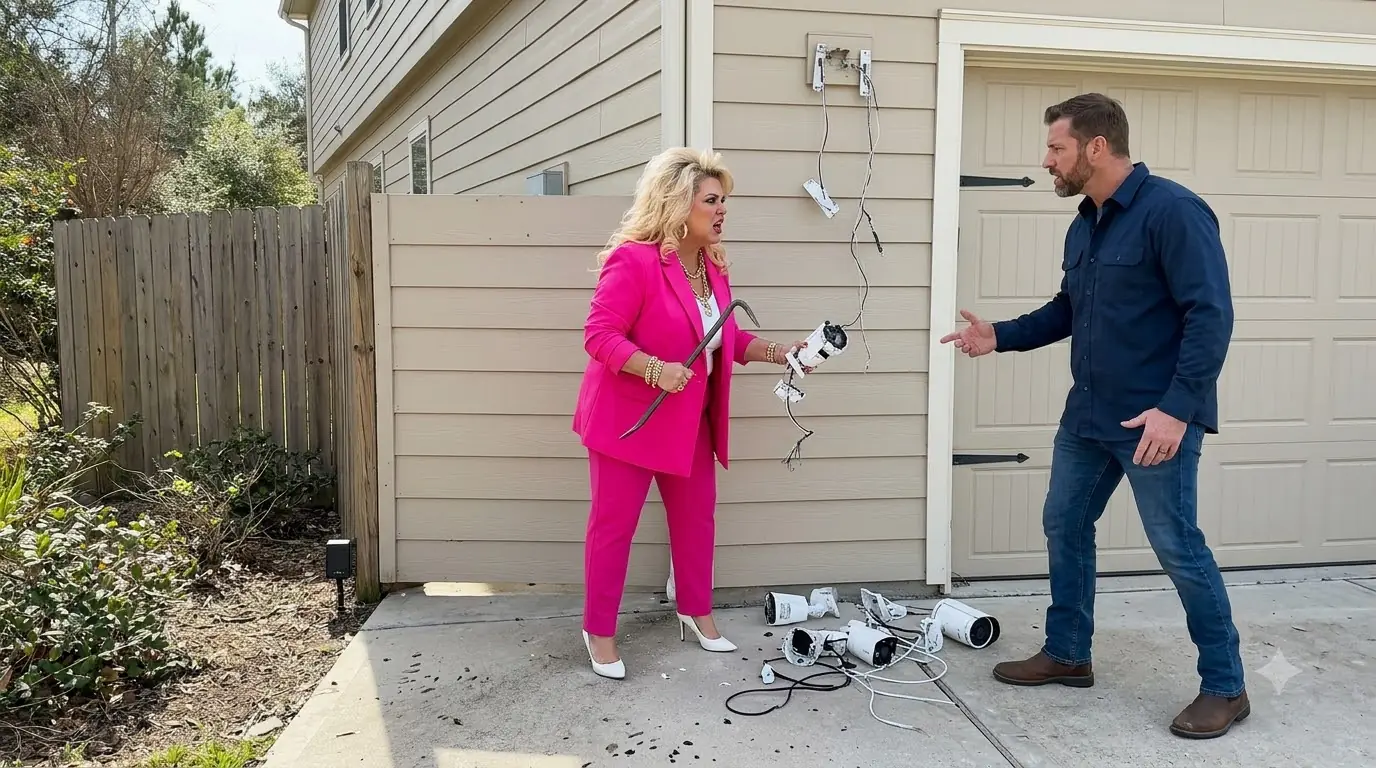
"We are prepared to cover the replacement cost," she said. "Provided we can all agree this matter is closed."
Her name was Patricia Weller, and for almost seven years she had been president of the Silver Creek Estates Homeowners Association in northern Idaho. She was fifty-six, well dressed, careful with her words, and accustomed to having people become uncomfortable before she did. That afternoon she looked uncomfortable enough for all four of us. The mistake she was trying to buy her way out of had happened on land she did not own, to a man whose name did not appear anywhere on her association's membership rolls.
What she did not know was that the security system she had destroyed was no longer the system protecting my property. The replacement was not hanging beneath the eaves where she could complain about it. Some of it was concealed in ordinary gate hardware, and some of it sat inside equipment that had been there before Silver Creek Estates existed. None of it watched her house or recorded a neighbor's private yard. All of it was telling me that someone had entered my equipment shed while she was sitting on my porch pretending she wanted peace.
I had not yet told her about that alert. I had not told her what the records from the previous month were beginning to show, either. Until then, I had believed the story was about a few broken cameras and a woman who thought an HOA badge gave her jurisdiction wherever she could see a roof. It took one locked gate, a stack of construction invoices, and a frightened young contractor to convince me the cameras had been only the first part of something much larger.
My name is Daniel Mercer. I was forty-eight that autumn, a widower for six years, and the owner of eleven acres on the eastern edge of Silver Creek Estates, a subdivision built in phases outside Coeur d'Alene. I worked as a construction project manager, mostly on commercial renovations and municipal water facilities. It was the kind of job where you learned early that a pretty drawing was worth nothing if the actual bolts did not line up. I liked schedules, accurate measurements, and written approvals. I did not like people who treated a confident voice as a substitute for any of the three.
My wife, Rebecca, used to say I was born wanting a clipboard and a level. She had been a physical therapist with more patience than anybody deserved, including me. We bought the property when our daughter was seven because Rebecca wanted space for a garden, a workshop, and a dog that could run without frightening its own neighbors. She died five years later, leaving me with the house, an unfinished greenhouse, and a daughter named Lily who learned at thirteen to speak gently to adults who were having harder days than she was.