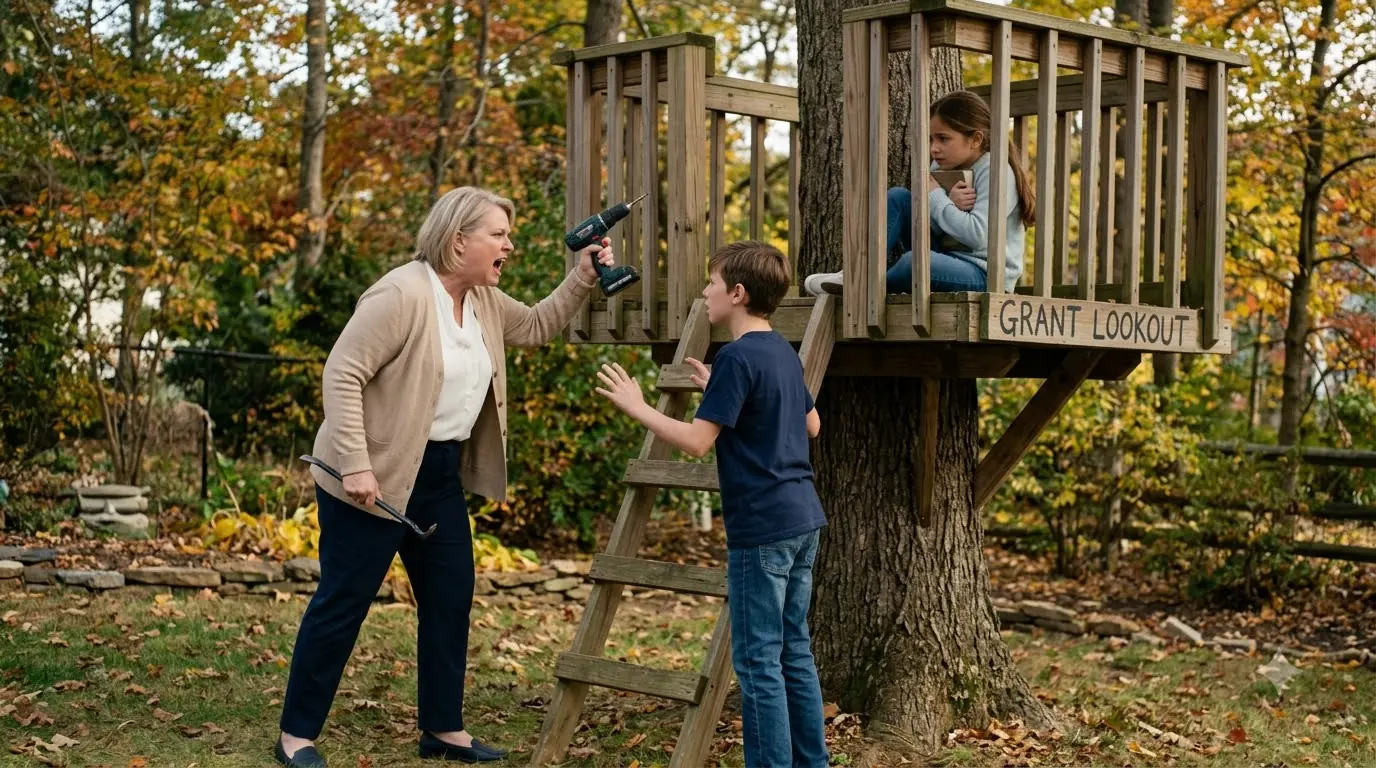
The treehouse was not the sort of structure children bragged about at school. It sat only about five feet above the ground, supported by a simple frame Daniel Grant had built with his twelve-year-old son Oliver after work and on weekends. There was a short ladder, sturdy guardrails, a plain roof stained a muted brown, and no electricity, rope bridge, zip line, or sleeping loft. Oliver had wanted to add a pulley basket for snacks, but his father had laughed and told him they should finish the approved version before inventing anything else.
That word—approved—mattered to Daniel. He was a high-school science teacher who had enough experience with forms, permissions, and district paperwork to know that rules were easiest to live with when everyone could point to the same page. Before he bought the first board, he submitted an ARC application to Cedar Hollow Estates with dimensions, height, stain color, and a site sketch showing the platform near the rear of the property but outside the common trail easement. The previous Architectural Review Committee chair approved it in writing with conditions about setback, height, neutral color, and visibility from the street, and Daniel built it exactly that way.
Oliver had measured nearly everything twice. He liked woodworking because wood rewarded patience in ways people sometimes did not, and because a board cut half an inch too short could not argue about what had happened. He helped sink posts, hold levels, mark bolt holes, and sand the ladder rungs until Sophie could climb barefoot without catching a splinter. When they finally finished, he burned a small wooden sign with a borrowed engraving pen and screwed it beneath the roofline: GRANT LOOKOUT.
Sophie pretended she hated the name. She said it made the place sound like a military tower, even though most afternoons she was the one defending it from Oliver when he came up with muddy sneakers. After the family moved to Cedar Hollow that spring, Sophie had struggled more than anyone expected. She missed the narrow hallway in their old house, the night-light outside her former bedroom, and the certainty of knowing every creak in the floor. The treehouse did not cure homesickness, but it gave her one place she had helped choose, furnish, and claim.
Cedar Hollow Estates was the kind of neighborhood that looked loose from the road and controlled on paper. The lots were bigger than in newer developments, and many yards backed into mature woods or the HOA walking trail, but there were still rules for sheds, fences, play structures, and setbacks. Permanent play structures over a certain height needed architectural approval. Nothing could intrude into common easements. Treehouses and platforms had to stay within placement and height limits, which Daniel considered reasonable enough.
For the first few months, no one complained. Sophie read in the treehouse. Oliver used the platform to sketch little woodworking projects he wanted to try next. Their mother, Laura, sometimes sat below with coffee while the children argued about whose turn it was to choose the battery lantern. People walking the trail occasionally saw part of the roof between leaves, but from the street the structure was almost invisible.
Then Evelyn Markham became chair of the Architectural Review Committee. Evelyn was sixty-one and had lived in Cedar Hollow longer than the Grants. She liked clean sightlines, mature plantings, and backyards that blended into what she called the natural character of the community. She disliked bright plastic playsets, above-ground trampolines, and anything that looked improvised. At meetings she often said, “Backyards are still part of the community landscape,” and most people understood what she meant even when they did not agree with how broadly she applied it.
Her first encounter with Grant Lookout happened on an ordinary Wednesday morning. She was walking the trail behind the Grants’ property with her phone in one hand when she noticed the roof through the trees. She stopped, stepped closer to the trail edge, and took several photographs. By the next afternoon, Daniel received an email marked POSSIBLE SETBACK VIOLATION. He read it twice, then forwarded the old approval letter and the site plan. “The platform was approved before construction,” he wrote. “We built according to the submitted dimensions and placement.” Evelyn responded within an hour: “The prior approval appears to have been based on inaccurate placement information. The structure may be inside the required setback and possibly within the common easement.”
Daniel printed the email and carried it into the kitchen, where Oliver was eating cereal after school. “Did we put it in the wrong place?” Oliver asked immediately. Daniel shook his head. “I don’t think so. But I’m not going to guess. If they want to question the line, we’ll get it surveyed.” The argument started with an old wooden stake near the walking trail. Evelyn believed the stake marked the back property boundary because it had stood there for years and lined up with two other weathered pieces of wood farther down the trail. According to her measurements from that stake, the treehouse was too close to the boundary. Daniel told her the stake had no survey cap, no recorded marking, and no reason to be treated as a legal corner.
“It has marked the edge for years,” Evelyn said when they spoke beside the fence one evening. “People have relied on it.” Daniel kept his tone even. “People can rely on anything they want. That doesn’t make it a survey monument.” Evelyn gave him a thin smile. “That sounds convenient.” Daniel called a local survey company the next morning. The earliest appointment was almost two weeks away. He sent the confirmation to HOA management and the board president, who replied with a simple instruction: wait for the survey before enforcement. Daniel thought that should have ended the argument for the moment.
It did not. Two days later, Oliver and Sophie were in the backyard when Evelyn stopped on the walking trail. Sophie was sitting cross-legged on the platform with a book while Oliver was tightening one of the little hooks they used for a lantern. Evelyn rested a hand on the fence and called, “That structure may be coming down.” Sophie looked over the rail. “Why?” “It may have been built where it doesn’t belong.”
Oliver leaned down from the platform. “My dad has approval.” “Adults make mistakes,” Evelyn said. Oliver, who was old enough to understand tone but young enough not to always avoid it, answered, “So do HOAs.” Evelyn’s expression hardened. “Do not get smart with me.” Oliver said nothing after that, but Sophie closed her book. The sentence bothered her more than the possibility of a survey. That evening she asked Daniel whether an HOA could really make them tear the treehouse down even if the approval letter said yes. Daniel explained setbacks, easements, and the difference between a rule and a disagreement about facts, but what Sophie heard was uncertainty.
Over the next week, Evelyn found more reasons to dislike the structure. She photographed it from the trail almost every day. She complained that the children’s voices were audible from the path. She raised a privacy concern, then a visual-impact concern, then suggested the roof might create “an undesirable elevated sightline into adjacent lots.” Daniel began to suspect that even if the survey proved the setback was fine, Evelyn would simply move on to the next objection.
At an ARC meeting, Evelyn told two committee members that the real danger was precedent. “If this stays, the next family builds one ten feet high,” she said. “Then someone adds a bridge. Then someone paints one bright red. You control standards before they become impossible to control.” One member reminded her that the Grant structure had already been approved. Evelyn answered, “By a previous committee under different leadership.”
That distinction mattered to her more than it should have. To Evelyn, the old approval felt like somebody else’s mistake she had inherited. Each time Daniel produced a document, she treated it not as proof the Grants had followed process but as evidence that the process had once been too permissive. By the end of the week, the treehouse had stopped being a wooden platform and become a symbol of authority she believed the committee had lost.
Oliver noticed something else while clearing leaves around the oak. Near one exposed root, half covered by soil, he found a small metal cap with faded orange plastic around its top. He brushed loose dirt away with his glove, then stopped. “Dad,” he called. “Is this one of those survey things?” Daniel crouched beside it and studied the cap without touching it. “Could be.” “Is that the real line?” Sophie asked.
“Maybe,” Daniel said. “And if it is, we leave it exactly where it is until the surveyor confirms it.” Oliver resisted the urge to measure from the cap himself. He could see immediately that if the pin was the actual boundary, the treehouse sat farther inside their lot than Evelyn claimed. But Daniel was firm. “We don’t turn guesses into facts just because the guess helps us,” he told him. “That’s the whole problem right now.”
The board president seemed to agree. On Monday afternoon, he emailed the ARC, the Grants, and management: “No self-help removal, no contractor access, and no structural alteration pending the survey. Any setback dispute will be evaluated after the survey is received.” Evelyn was copied. She did not reply. For Daniel, silence meant the matter was paused. For Evelyn, it became something else. Thursday afternoon was bright and cool, the kind of Virginia fall day when the woods behind Cedar Hollow smelled like dry leaves and sun-warmed bark. Daniel and Laura left shortly after four for a parent-teacher conference at the middle school, expecting to be gone less than two hours. Their seventeen-year-old babysitter, Maya Chen, stayed inside finishing homework at the kitchen table while Oliver and Sophie went out back.
Sophie climbed into Grant Lookout with a paperback and a blanket. Oliver sat on the lowest ladder rung, trying to draw a better bracket for the little shelf inside. The surveyor was supposed to come the next morning, and Oliver had already imagined the moment when a professional measurement ended the argument. He wanted the adults to stop talking about the treehouse as if it were a problem waiting to happen.
He heard Evelyn before he saw her. The walking trail ran beyond the rear edge of the property, separated from the Grant lawn by trees and a low section of fence, and the sound came first as a metallic clink. Oliver looked up. Evelyn was standing near the trail entrance to the yard with a cordless drill in one hand and a small pry bar tucked under her arm. “What are you doing?” he called.
Evelyn stepped through the side opening used for maintenance access and walked toward the treehouse. “Correcting an unsafe encroachment.” Oliver stood. “My dad said wait for the survey.” “Your father has delayed this long enough.” Above him, Sophie leaned over the rail. “Please don’t touch it.” Evelyn looked up. “Get down.” Sophie froze. Oliver moved to the ladder and put one hand on a rung. “She’s reading.” “GET DOWN NOW.”
The sharpness in Evelyn’s voice carried across the yard. Sophie’s face changed immediately, not into defiance but into the old anxious look she had worn during their first weeks in the new house. Oliver climbed two rungs and held his hand up to her. “Come on,” he said quietly. “Just come down.” Sophie descended carefully, one sneaker at a time. When she reached the grass, Oliver stepped beside her. Evelyn pointed toward the house. “Move away from the structure.”
“You can’t take it down,” Oliver said. “I can remove a hazard from an easement.” “It’s not on the easement.” “You are twelve years old,” Evelyn replied. “You do not determine property boundaries.” Oliver almost said that neither did she, but he remembered his father telling him not to turn arguments into contests. Instead he pulled Sophie a few steps back. “Then wait for the surveyor.” Evelyn set the pry bar on the grass and knelt by the ladder brackets. The drill whined as she backed out the first bolt. Oliver stared, stunned by the sound. It was one thing to hear an adult threaten enforcement and another to watch a screw actually spin out of a structure his family had built with permission.
“Stop,” he said. Evelyn removed a second bolt. Sophie stepped forward. “That’s our ladder.” “Stay back.” The lower bracket came loose, and the ladder tilted. Sophie instinctively grabbed one side. Evelyn stood and reached for it. “LET GO.” Sophie held on for half a second longer, more because she was scared than stubborn. Evelyn pulled the ladder sharply from her hands. Sophie stumbled backward one step, caught herself, and stared as the wooden ladder struck the grass. One rung hit at an angle and cracked near the edge.
Oliver’s chest tightened. “You broke it.” “It should not have been here.” “That doesn’t make it yours.” Evelyn ignored him and picked up the pry bar. She moved to the front of the platform where the small GRANT LOOKOUT sign was screwed beneath the rail. Oliver realized what she intended and stepped forward. “That isn’t even part of the structure.” “Everything attached to it is coming down.” She wedged the pry bar behind the sign and pulled. One screw held while the wood around the other split. The sign twisted and cracked through the corner. Sophie made a sound like she had been punched in the stomach.
Maya burst through the back door. She had heard the drill and shouting from inside. “Mrs. Markham, stop.” Evelyn turned as if interrupted during ordinary maintenance. “Go call their parents.” “I already did.” “Good.” Maya lifted her phone. “Mr. Grant said nobody is supposed to touch the structure before the survey.” Evelyn’s jaw tightened. “This is an HOA enforcement matter. Stay out of the work area.” “There is no work area,” Oliver said. “This is our yard.”
Evelyn set the broken sign on the ground and grabbed a railing board with both hands. She pulled against it, then used the pry bar at one end. The board did not come free cleanly. Instead the outer edge cracked with a dry snap. Sophie covered her mouth. Oliver moved toward the sign on the grass. Evelyn stepped sideways and blocked him with her forearm. “Leave it.” “It’s ours.” “Stay back.”
She pushed lightly but firmly enough to move him a step away. Oliver’s face flushed. “Get out of our yard!” Evelyn pointed toward the back boundary. “This portion may not be your yard.” For a second no one spoke. That sentence changed the feeling of the entire confrontation. Until then, Evelyn had been damaging something. Now she was using an unresolved boundary dispute as permission to decide where the Grants’ own backyard ended.
Maya raised her phone higher. “I’m recording this.” “Record whatever you like.” Evelyn bent for the drill again. A white pickup slowed on the street side of the Grant property, then turned into the driveway. The magnetic sign on the door read FELDMAN LAND SURVEYING. Maya looked toward the house, confused. A man in a reflective vest got out carrying a field bag and tablet. Daniel had forgotten to text the children. The survey office had called him during the drive to the school to say a cancellation opened that afternoon. Daniel told them they could begin exterior work if access was available and promised to meet them as soon as the conference ended.
Mark Feldman walked around the side of the house and stopped when he saw the scene. One ladder lay on the grass. Two children stood near a broken sign. Evelyn held a cordless drill beside the partially dismantled platform. “Afternoon,” he said slowly. “Who owns the property?” Maya pointed toward the house. “The Grants.” Evelyn lifted her chin. “I’m with the HOA.” Mark nodded once. “Okay. I’m here for the Grants.”
Evelyn immediately began explaining that there was a suspected encroachment based on an established boundary marker near the trail. Mark listened without interrupting, then asked to see the marker. She led him to the old wooden stake near the walking path. He looked at it for less than a minute. “This isn’t a survey monument.” Evelyn frowned. “It has marked the line for years.” “It can have stood here for fifty years and still not be a survey monument.”
“What is it, then?” “I don’t know yet.” Mark glanced toward the Grant lot. “But property corners are not established by weathered landscaping stakes unless the recorded survey says they are. I need to locate the monuments.” Oliver hesitated, then said, “There’s a metal thing by the oak.” Mark looked at him. “Show me without touching it.” Oliver led him to the spot where the orange-capped pin sat beneath a thin layer of soil. Mark crouched, cleared debris carefully, checked his records, and set up his equipment. The process was not dramatic. There was no instant declaration, no cinematic laser proving everyone wrong in ten seconds. He took measurements, checked another corner, walked toward the front, returned, and entered numbers into his tablet.
Evelyn waited with folded arms. Sophie sat on the back step beside Maya, holding the cracked GRANT LOOKOUT sign across her knees. After nearly forty minutes, Mark returned to the oak. “This pin is consistent with the recorded corner,” he said. “I still need to finish the survey and prepare the drawing, but the wooden stake by the trail is not the rear property marker.” “How far off?” Maya asked.
Mark looked at his screen. “Roughly six feet, depending on exactly which point you’re comparing.” Oliver looked at Evelyn. She did not look at him. Mark continued, “Preliminarily, the platform appears entirely inside the Grant lot. It also appears outside the common easement. I’ll confirm setback dimensions in the signed survey, but I’m not seeing the encroachment you described.” Sophie hugged the broken sign tighter. Evelyn’s first response was not an apology. “The committee also has visual and privacy concerns.”
Mark blinked. “I can’t help you with architectural policy. I’m only telling you where the property line is.” That distinction should have ended things. Instead, it exposed how far the argument had moved. Evelyn had arrived with tools because she believed the treehouse stood where it did not belong. The moment that premise collapsed, she reached for different reasons. Daniel arrived twenty minutes later, still wearing the collared shirt he had put on for the conference. Laura was behind him. He crossed the yard, saw the ladder, the split sign, and the damaged railing, then looked at Oliver and Sophie before he looked at Evelyn.
“Are you both okay?” he asked. Sophie nodded. Oliver said, “She pushed me back with her arm, but I’m fine.” Daniel’s expression changed, though his voice stayed controlled. “Evelyn, you were told in writing not to alter this structure.” “I believed it was in the easement.” “You believed that before the survey. That was the reason for waiting.” “I was preventing an unsafe condition.” Daniel pointed at the ladder on the grass. “What unsafe condition required you to remove a ladder after you had already ordered the children off the platform?”
Evelyn did not answer directly. “The structure should never have been approved in this location.” Mark closed his field case. “For what it’s worth, my preliminary measurements put it on the owners’ side of the line.” Laura walked to Sophie and knelt beside her. “You okay?” Sophie handed her the broken sign. “She broke the lookout.” Laura ran a thumb across the split wood. “We can fix wood.” Then she looked at Evelyn. “What we should not have to fix is our children thinking an HOA volunteer can walk into their yard with tools whenever she disagrees with paperwork.”
Evelyn gathered the drill and pry bar. “The board can sort it out.” Daniel looked at the damaged treehouse. “That is what we were trying to let the board do.” The signed survey arrived the next afternoon. It confirmed what Mark had said in the yard: the rear boundary followed the metal monuments, not the wooden stake, and Grant Lookout sat entirely on the Grant property with enough room to satisfy the minimum setback. The common walking-trail easement remained several feet beyond it. Daniel sent the survey to management, the board president, and the full ARC before repairing anything.
Then the records became more uncomfortable for Evelyn. Cedar Hollow’s maintenance manager, Paul Reyes, recognized the old wooden stake in one of Daniel’s photographs. It had been placed years earlier during drainage work behind several homes. The contractor used temporary stakes to mark a trench alignment before regrading a section beside the trail. Most had been removed, but a few had remained because nobody considered them important. Paul forwarded an old maintenance drawing that showed the trench reference clearly. He also remembered mentioning the stakes to Evelyn months earlier when she questioned a different homeowner’s landscaping near the trail. “Those are not property markers,” he had told her then. He could not say whether she had simply forgotten the conversation or ignored it, but it weakened her claim that the stake had always been a reasonable basis for emergency action.
A second document made the situation worse. The old ARC minutes from the Grant application showed that Daniel originally proposed the platform several feet closer to the opposite side of the yard. The previous committee asked him to move it toward the oak specifically to increase privacy from the nearest neighboring house. Daniel revised the plan and built in the location the HOA requested. The privacy concern Evelyn raised after the setback issue began was therefore backwards. The Grants had not chosen the current spot despite HOA guidance. They had chosen it because of HOA guidance.
Oliver understood only parts of the paperwork, but he understood enough to feel angry in a new way. At first he had thought Evelyn made a mistake about the line. Mistakes could be corrected. What bothered him now was that she had acted before the correction was allowed to happen, then changed reasons when the facts stopped supporting her. He spent the weekend helping his father cover the exposed bolt holes and brace the damaged railing so no one could use the platform until repairs were complete. Sophie did not climb it. She stayed on the patio with her books, even after Daniel told her the structure itself remained stable.
“Do you want to sit up there while I’m working?” Oliver asked. Sophie shook her head. “What if she comes back?” “She can’t.” “She did before.” That answer stopped him. The worst damage Evelyn had caused was not the cracked rung or the split sign. Those could be replaced in an afternoon. She had made Sophie look at the backyard differently, as if ownership and permission could disappear whenever a louder adult arrived with a tool.
The board scheduled a special hearing for the following Thursday. The room in the clubhouse was not dramatic: folding chairs, a long table, a coffee machine in the corner, and a wall calendar still showing last month. Yet the meeting drew more residents than an ordinary ARC dispute because news of the incident had spread along the trail and through neighborhood group chats. Evelyn sat at one end of the table with a binder. Daniel and Laura sat together across from her. Oliver and Sophie were not required to attend, but Sophie wanted to bring the broken GRANT LOOKOUT sign, and Oliver refused to let her go alone.
The board president began with the narrow facts. “This is not a hearing about whether the HOA may regulate play structures,” he said. “It may. This is a hearing about whether committee authority was exercised properly in this case.” Evelyn opened her binder. “I acted based on what I believed was an encroachment into common property and an associated safety concern.” “You were instructed not to act before the survey,” the president said.
“I believed delay increased liability.” Daniel leaned forward. “My children were not on the structure when you started dismantling it because you ordered them off. What emergency remained?” The room went quiet. Evelyn replied that unauthorized structures could create continuing exposure even when temporarily unoccupied. Management asked whether she had contacted an emergency contractor, the board president, or the property owner before entering the lot. She had not. She said there was no time for another round of delay.
Then Maya’s video played. It showed Sophie climbing down. It showed Evelyn backing bolts out of the ladder while Oliver repeatedly asked her to stop. It showed the ladder falling, the rung cracking, the sign splitting, and Evelyn blocking Oliver with her forearm when he tried to retrieve it. The clearest moment came when Oliver yelled, “Get out of our yard,” and Evelyn answered, “This portion may not be your yard.”
The board president paused the video there. “But you did not know that.” Evelyn stared at the screen. “I believed the old marker was reliable.” The maintenance manager raised a hand from the side of the room. He explained the drainage stakes and produced the old trail drawing. He was careful not to accuse her of lying. He simply said the wooden stake had never been intended to mark a legal property line.
Mark Feldman’s signed survey was entered next. The treehouse was on the Grant lot, outside the common easement, and beyond the required setback by a small but sufficient margin. The ARC approval was valid. The board secretary then read the old meeting note directing the Grants to place the platform exactly where it now stood. For the first time that evening, Evelyn stopped taking notes. One ARC member asked the question everyone had been circling. “If the structure complied with the approved plan, what exactly were you enforcing?”
Evelyn answered after a pause. “I still believe the structure is inconsistent with the wooded character of that section.” “That may be an opinion,” the member said. “It is not the violation you claimed when you entered the property.” Evelyn looked around the room and seemed to realize that the issue had narrowed beyond her ability to broaden it again. She could discuss aesthetics, precedent, privacy, or risk, but none of those arguments authorized what the video showed. The board had told her to wait, the family had scheduled a survey, and she had chosen to act anyway.
The president turned to Sophie. “You brought something with you?” Sophie lifted the cracked wooden sign onto the table. One corner had been glued temporarily so the two pieces would not separate. GRANT LOOKOUT was still readable across the grain. “What did you use the treehouse for?” he asked. Sophie looked at her parents, then at Oliver. “Reading.” The president smiled faintly. “Anything else?” “And hiding from my brother.” Oliver leaned toward the microphone. “She doesn’t hide very well.”
A few people laughed, not at Evelyn but because the room finally had somewhere to put the tension. Sophie smiled too. For a moment the treehouse was not an easement dispute or a liability file. It was again what it had always been: a small place where a nine-year-old took books and avoided her brother when he annoyed her. The board voted that night to remove Evelyn as ARC chair. She remained a homeowner with the same rights as everyone else, but she no longer had authority to represent the committee or issue architectural directives. A formal reprimand was entered into the committee record, and the HOA agreed to reimburse the Grants for repair materials, then seek repayment from Evelyn under the association’s volunteer misconduct procedures.
The board also adopted a policy that should have existed already. Committee members could not enter private lots, alter structures, confiscate property, or perform “self-help enforcement” without written authority from management or a true emergency involving immediate danger. Disputed setback cases would require either an existing survey or a new survey before enforcement based on a boundary claim. More quietly, management reviewed several pending ARC disputes to make sure homeowners had been given exact rule citations instead of vague statements about “community standards.” Daniel appreciated that change more than the punishment. He did not want an HOA where children got to ignore every rule; he wanted one where adults had to follow rules too.
Evelyn did not deliver a dramatic apology. Two days after the hearing, she sent Daniel a short email saying, “I regret that the enforcement action caused distress to your children.” Daniel read it once, then archived it. Laura called it the most Evelyn sentence imaginable. Oliver wanted to replace everything that had broken with brand-new lumber. Daniel stopped him before they made the hardware-store list. “We fix what needs fixing,” he said. “We don’t rebuild the whole thing just because somebody damaged part of it.”
They installed a new ladder rung and reinforced the lower attachment points. The cracked railing board was replaced because Daniel refused to compromise on load-bearing safety. But when he offered to make a new GRANT LOOKOUT sign, Sophie shook her head. “Can we keep that one?” “It’ll always show the crack.” “I know.” Oliver looked at her. “You hate crooked stuff.” “I hate your crooked stuff.” So Daniel glued the sign properly, added a hidden brace behind the split, and mounted it back where it had been. The fracture remained visible if sunlight hit the grain at the right angle. Sophie traced it with one finger the first day she climbed back up.
The broken ladder rung became something else. Oliver sanded the edges and mounted it inside the treehouse as a narrow shelf for paperbacks. Sophie immediately filled it with three books, a pencil cup, and a tiny flashlight. “That is the most expensive bookshelf we own,” Daniel told her. “The HOA reimbursement paperwork alone was six pages.” Sophie laughed, but the first week after the repair she still looked toward the trail whenever footsteps passed behind the fence. Oliver noticed and began sitting with her longer than usual. He pretended he needed the platform to work on sketches. She pretended not to know why.
Eventually the trail became ordinary again. Dog walkers passed. Joggers passed. A woman pushing a stroller waved through the trees. No one came through the yard with a drill. One afternoon Evelyn walked the trail herself. She slowed slightly when she reached the Grant property. Oliver was on the platform, and Sophie was stretched out on a cushion with a book open on her knees. Evelyn looked toward the roof, then at the orange-capped survey pin that had now been flagged by the surveyor with a small witness marker farther inside the lot.
She did not stop. She did not call out. She simply kept walking. Oliver waited until she disappeared around the bend before looking at Sophie. “You okay?” Sophie turned a page. “She’s on the trail.” “Yeah.” “We’re in the yard.” “Yeah.” That was enough. The next ARC inspection was deliberately boring. Two committee members came by at a scheduled time, rang the doorbell first, and walked the backyard with Daniel while he held the approved plan. They measured height, checked the rebuilt ladder, confirmed the neutral stain, and compared the survey to the original setback condition. One of them finally said, “Everything matches,” and Daniel answered, “That is all I wanted anybody to establish before touching it.”
Oliver watched from the patio. The visit taught him something the confrontation had obscured: enforcement itself was not the enemy. The same kind of committee that had caused the problem could also work properly when people stayed inside their authority, documented what they were doing, and allowed facts to be checked. That distinction mattered because Oliver had begun talking about the HOA as if it were one giant person named Evelyn. Daniel corrected him every time.
Several neighbors who used the walking trail also reacted in quieter ways. One older couple told Daniel they had always assumed the weathered stake was a boundary marker and were glad the survey clarified it. Another homeowner scheduled a survey before replacing a rear fence because he realized he had been relying on the same line of old stakes. What began as a fight over one treehouse exposed a small neighborhood habit of treating visual markers as legal facts simply because they had been there a long time.
The board posted a short notice explaining that landscaping stakes, utility flags, fence lines, and trail markers should not be treated as property monuments unless verified by recorded documents or a survey. It did not mention Evelyn by name. Daniel preferred it that way. The point was not to turn her mistake into permanent neighborhood entertainment; it was to make the next dispute harder to mishandle.
Sophie cared much less about any of that than the adults did. What helped her was a Saturday afternoon when three children from two houses down came over with books and snacks and asked if they could see the lookout. At first Sophie hesitated, then climbed up first and showed them the little shelf made from the broken ladder rung. Within twenty minutes the platform was crowded with paperbacks, whispered jokes, and an argument over who got the corner cushion.
Daniel watched from below until Laura nudged him. “Stop inspecting,” she said. “I’m not inspecting.” “You are absolutely inspecting.” He looked up again anyway. The guardrails were secure, the ladder was solid, and the children were laughing. For the first time since the confrontation, Sophie did not look toward the trail when footsteps passed behind the fence. The space had stopped waiting for something bad to happen. By late autumn, Grant Lookout blended into Cedar Hollow exactly as Daniel had promised on the original application. The neutral roof darkened slightly with rain, the surrounding leaves thinned, and from the street almost nothing could be seen. The structure never became bigger, brighter, or more elaborate simply because the family had won the dispute.
That mattered to Daniel. He did not want the children to learn that being wronged entitled them to ignore every limit afterward. When Oliver suggested adding a second platform between two trees, Daniel handed him the ARC guidelines and said, “Design it if you want. Then we’ll see whether the rules allow it.” Oliver groaned. “Seriously?” “Especially seriously.” Sophie laughed so hard she nearly dropped her book from the repaired shelf.
Winter came, then a wet spring. The small treehouse survived wind, rain, and a thin layer of snow without trouble. Daniel checked the bolts after every hard storm, not because Evelyn had been right to dismantle it, but because maintenance was part of owning anything made of wood. By the next summer, Sophie no longer referred to it as the place where “Mrs. Markham broke the ladder.” She called it the lookout again. The backyard had returned to being a backyard instead of evidence.
One warm evening, Oliver climbed up carrying a small box of screws for a birdhouse he was building. Sophie was already there reading with her feet propped against the rail. “You’re blocking my light,” she said without looking up. “It’s my treehouse too.” Sophie lowered the book. “No. The survey says it’s on our property. It doesn’t say it’s yours.” Oliver stared at her, then laughed despite himself. “You have been waiting months to use that joke.”
“Maybe.” He sat beside her anyway. Beyond the fence, the walking trail curved through the trees. From that path, a passerby could see only a portion of the neutral roof between leaves, no towering platform, no bright fortress, no structure spilling into common land. Near the oak, the small orange-capped survey pin remained where it had always been, almost hidden unless someone knew to look for it. Above it, the repaired GRANT LOOKOUT sign hung slightly crooked. Sophie had refused to let Oliver straighten it.