The first thing Noah Bennett noticed was not the sound of wood breaking. It was the way the little girl beside him stopped breathing for a moment, as though someone had turned the whole bright Saturday afternoon into a photograph. Lucy Bell stood beside the cedar book cabinet with a picture book pressed to her chest, her mouth open and her eyes fixed on the woman in white trousers.
A second later came the dry, terrible crack of a joint giving way, followed by books spilling over the grass and into the water running along the curb. Noah had spent two weekends building the cabinet with his father, and until that moment he had never understood how quickly another person's anger could reduce something carefully made to splinters.
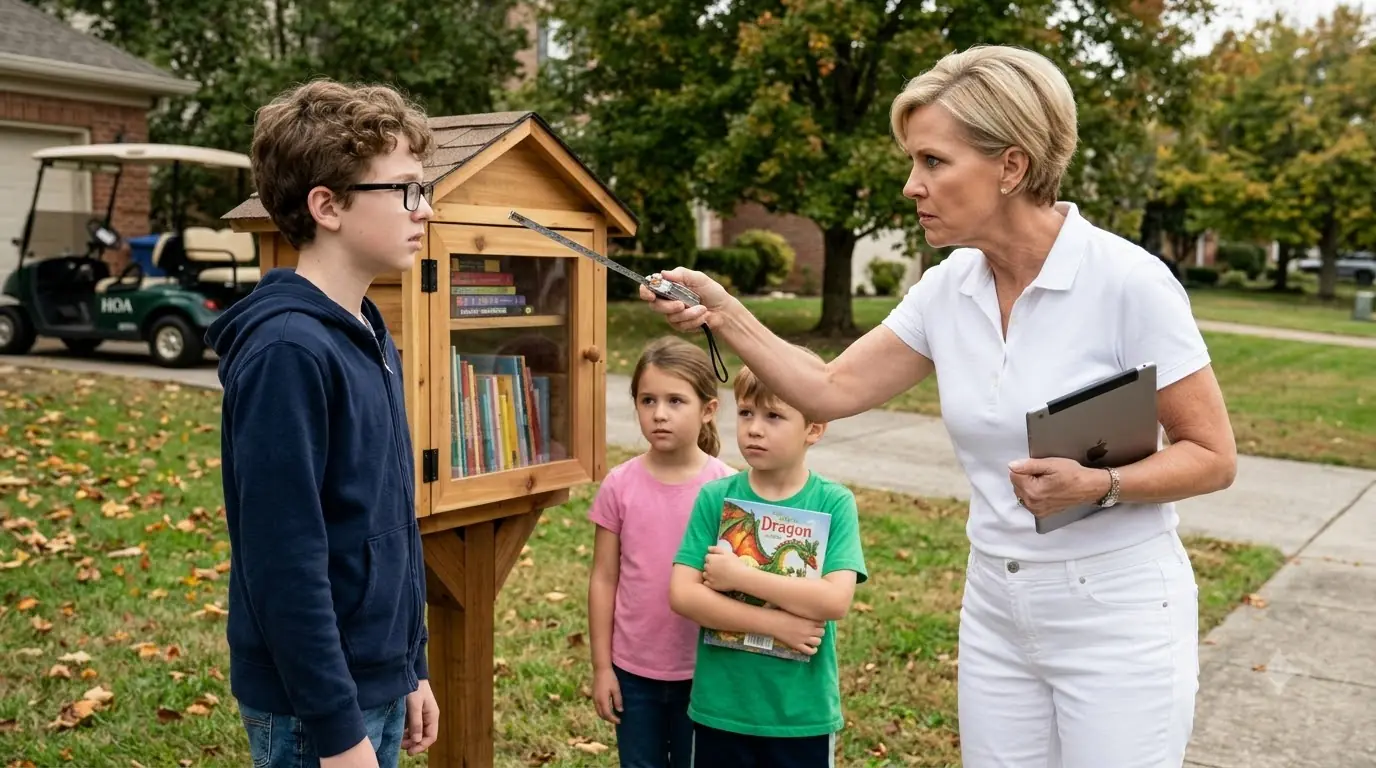
Patricia Whitcomb, chairwoman of the neighborhood's Architectural Review Committee, stood over the wreckage with one hand braced against her hip. She was fifty-seven, always perfectly dressed, and used to having people stop talking when she arrived. She had pushed twelve-year-old Noah aside moments earlier and now looked from the cracked roof to the scattered books as though an unpleasant but necessary duty had been completed. "There," she said, still breathing fast. "Now your father can build it according to the rules."
Noah did not answer. He knelt beside a battered copy of The Secret Garden, whose swollen pages had fallen open against the wet grass. A folded sheet of paper lay beside it, the edges catching water from the sprinkler runoff. He knew the slanted handwriting even before he picked it up. It belonged to Mrs. Margaret Finch, the retired school librarian who had given him the books that made the little cabinet possible, and who had moved away before she could ever see it standing in his yard.
He read the first line once, then again, while the adult voice above him blurred into meaningless noise. To the first child who feels alone: a good book is proof that somebody else has felt that way too. Pass it on. Noah had guarded that note without opening it for weeks because he believed it was meant for another child. Now, with his handmade library broken around him, he began to understand that Mrs. Finch might have known more about loneliness than he had ever guessed.
Before there was a broken cabinet, before the board meeting and the angry letters and the videos that would later circulate through Cedarbrook, there had been an ordinary boy who liked the quiet end of the school library. Noah was twelve and slight, with thick brown curls, black-framed glasses, and a habit of pulling his sweatshirt sleeves over his hands whenever a conversation became too loud. His teachers called him bright, which was true, and shy, which was easier to say than explaining that he often understood everything people said while never knowing when he was supposed to speak. At lunch he chose a seat near the window and opened a book before anyone could decide whether to invite him to join them.