The first thing Jamal Ellison lost that afternoon was not the birdhouse.
It was the feeling that the park belonged to him, too.
Veterans Green had always been his favorite place in Stone Ridge, a soft square of grass and old trees tucked between the library, the hardware store, and the small brick city hall where grown-ups argued about taxes and parking permits. In spring, the sycamore leaves opened like hands over the walking path. Sparrows hopped through the mulch around the benches. Retirees played chess beneath the pavilion, toddlers chased bubbles near the playground, and the whole town moved through the park as if it had been made for everyone.
That was why Jamal had chosen it for his project.
He was nine years old, small for his age, with serious eyes, careful hands, and the kind of quiet focus adults often mistook for shyness. His father, Darius Ellison, said Jamal had an engineer’s patience and an artist’s heart. His mother, Nia, said he could turn a cereal box into a city if someone gave him tape, paint, and enough time.
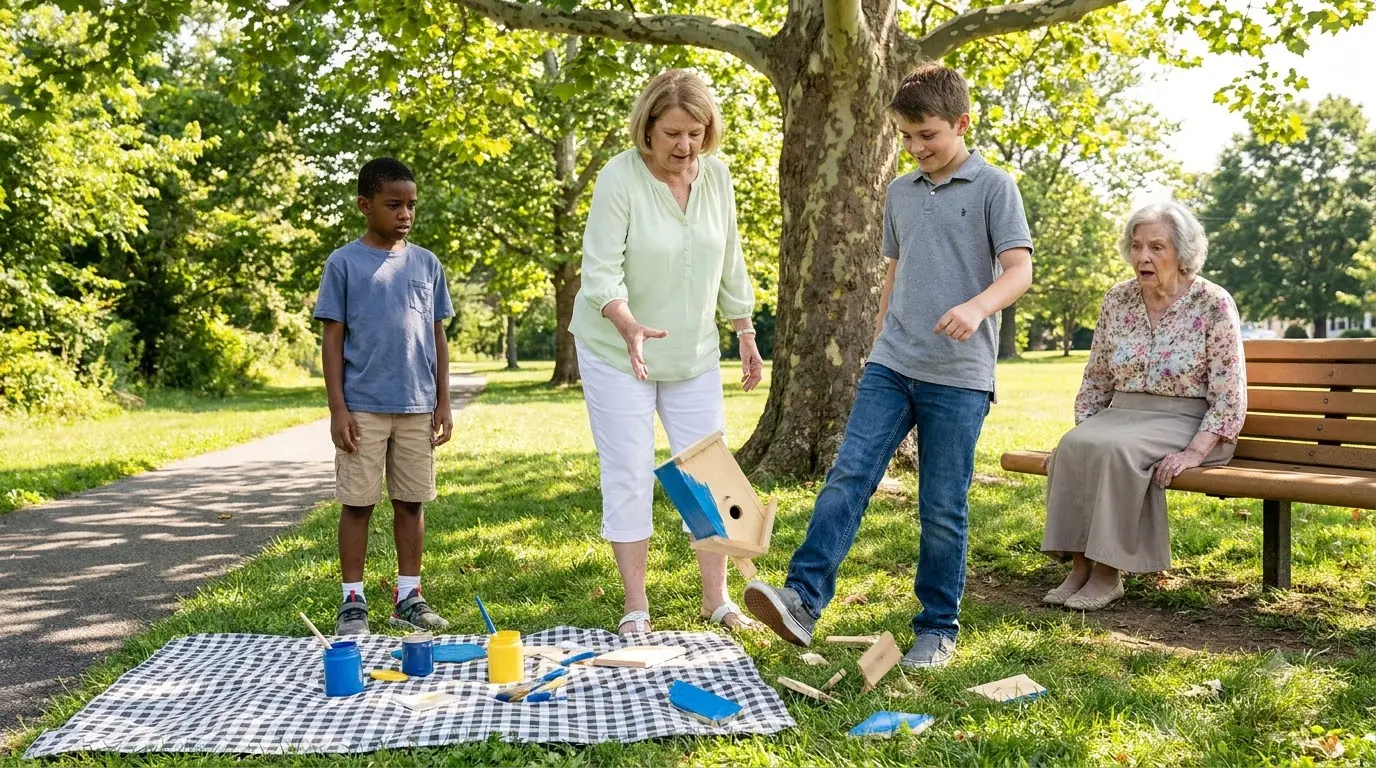
That Saturday, Jamal sat cross-legged beneath the big sycamore near the center path with a checkered blanket spread out around him. On the blanket lay everything he needed: a wooden birdhouse kit, tiny nails in a plastic cup, a small bottle of wood glue, blue and yellow paint, a brush, twine, and a folded instruction sheet he had already read six times.
Beside him, Miss Clara Whitfield watched from her usual bench with a ball of yarn in her lap and knitting needles clicking steadily between her fingers. Miss Clara was seventy-four, a retired elementary school teacher, and the closest thing Veterans Green had to an official guardian. She had taught half the town to read, including Darius, and she remembered every child’s handwriting better than most people remembered birthdays.
“Now, what’s the next step, young man?” she asked without looking up from her knitting.
Jamal lifted the instruction sheet and squinted at the diagram.
“It says I put the roof on after the glue dries,” he said.
“Then we wait.”
“I don’t like waiting.”
Miss Clara smiled. “That is why waiting is good practice.”
Jamal sighed in the dramatic way only children can sigh, then carefully adjusted one of the wooden panels so the edges lined up perfectly. His father had helped him sand the pieces the night before at the kitchen table. Darius had shown him how to hold the brush, how to spread glue without using too much, and how to keep his work area neat because careful work was a kind of respect.
The birdhouse was for the park’s spring community display. Stone Ridge had announced a small volunteer project asking residents to build temporary birdhouses for the trees around Veterans Green. The city parks department had even posted instructions online: no nails into trees, no permanent fixtures, only twine or removable hooks. Jamal had printed the rules and highlighted the part about temporary displays because he liked doing things the right way.
Darius had promised to buy extra twine from the hardware store across the street. He had walked over twenty minutes earlier, leaving Jamal in Miss Clara’s care.
“You sure you’ve got him?” Darius had asked.
Miss Clara had looked over her glasses. “Darius Ellison, I kept twenty-six third graders alive during a thunderstorm field trip in 1989. I believe I can watch one polite boy building a birdhouse.”
Darius had laughed, kissed the top of Jamal’s head, and crossed toward Maple Street.
Now the afternoon sat calm and bright around them.
Jamal dipped his brush into the blue paint and touched it gently to the front wall of the birdhouse. He wanted it to look like the sky. He wanted yellow around the entrance hole because Miss Clara said birds liked cheerful colors, even if science had not officially confirmed it. He wanted to write **Welcome Home** on the bottom, small enough that only someone looking closely would see it.
A jogger passed and waved.
“Looking good, Jamal.”
“Thank you, Mr. Bell.”
A mother pushing a stroller slowed near the path.
“That’s beautiful,” she said.
Jamal smiled without looking up. Compliments made him embarrassed, but not unhappy.
For almost an hour, the park remained exactly what it was supposed to be: public, peaceful, ordinary.
Then a white golf cart rolled onto the path.
It came from the direction of Oakridge Estates, the private subdivision bordering the north side of the park. The cart had cream-colored seats, a small HOA emblem on the front, and a little orange flag mounted on the back like it was a parade vehicle. At the wheel sat Marjorie Whitcomb, president of the Oakridge Estates Homeowners Association and a woman who had never accepted the difference between a neighborhood rule and a law.
Marjorie was in her late fifties, sharply dressed in white capri pants, a pale green blouse, and sunglasses so large they made her face look permanently suspicious. Her hair was stiffly sprayed into place. Her lips were pressed together in the expression of someone who had smelled something unpleasant and intended to form a committee about it.
Two people sat beside her. One was her son, Preston, twenty-one years old, broad, bored, and wearing the permanent smirk of someone whose mother had solved every consequence before it could reach him. The other was Kyle Drayton, Oakridge’s part-time compliance assistant, a thin man with a clipboard and a neon vest he wore with far more pride than it deserved.
Miss Clara’s knitting slowed.
“Oh, dear,” she murmured.
Jamal looked up.
“Is something wrong?”
“Not if manners arrive before trouble.”
The golf cart stopped at the edge of the grass. Marjorie stepped down first, scanning the park as if she owned the soil beneath it. Preston followed, cracking his knuckles. Kyle adjusted his clipboard and tried to look official.
Marjorie’s eyes landed on Jamal’s blanket.
Then on the paint.
Then on the birdhouse.
Then on Jamal.
Her mouth tightened.
“Well,” she said, loud enough for nearby people to hear, “what exactly is going on here?”
Jamal sat up straighter.
“I’m building a birdhouse, ma’am.”
“I can see that. I asked what is going on.”
Miss Clara set her knitting neatly beside her. “Marjorie, the city invited residents to make temporary birdhouses for the park display. Jamal is participating.”
Marjorie did not look at Miss Clara. Her gaze remained fixed on the boy.
“Is he a resident?”
Jamal blinked.
“Yes, ma’am. I live on Cedar Lane.”
“That is not Oakridge Estates.”
“No, ma’am.”
“Then this is exactly the problem.”
Miss Clara stood slowly. “Veterans Green is a city park, not an HOA amenity.”
Marjorie finally turned toward her. “With respect, Clara, the north perimeter is maintained partly through Oakridge beautification funds.”
“With respect, Marjorie, mulch money does not make you the mayor.”
A few people nearby hid smiles.
Marjorie’s eyes sharpened. “This park reflects on our community. We cannot allow unsupervised children to clutter it with homemade junk.”
Jamal looked down at the birdhouse.
“It’s not junk.”
Preston snorted.
Marjorie’s head snapped toward the boy.
“What did you say?”
Jamal’s shoulders hunched, but he did not lower his eyes all the way.
“I said it’s not junk. I’m doing it for the birds.”
Preston laughed. “For the birds. That’s cute.”
Marjorie stepped closer, heels pressing into the grass. “Where are your parents?”
“My dad went to the hardware store. Miss Clara is watching me.”
“So you were left here alone.”
“No, ma’am.”
“That is not what I asked you to agree with.”
Miss Clara’s face changed. “Do not twist his words.”
Marjorie lifted a hand without looking at her. “I am addressing a violation.”
“A violation of what?” Miss Clara asked.
“Unauthorized installation of exterior structures, unapproved use of paint in a shared aesthetic zone, and possible damage to public-adjacent trees.”
Jamal quickly reached for the printed city rules.
“It says we can use twine,” he said, holding out the paper. “See? No nails. I’m not hurting the tree.”
Marjorie looked at the paper as if he had offered her trash.
“I don’t need a child explaining regulations to me.”
“I wasn’t trying to—”
“Stand up when an adult is speaking to you.”
Jamal froze.
Miss Clara took a step forward. “He is sitting on his blanket working quietly. You will not order him around like that.”
Marjorie’s face reddened.
“Clara, I have tolerated your interference for years because people find it charming, but this is not your classroom.”
“No,” Miss Clara said. “It is a public park. That means children do not need your permission to be children in it.”
Preston’s smirk faded into irritation. He stepped onto the edge of Jamal’s blanket, grinding his sneaker into the fabric.
“Mom, just take the thing,” he said. “This is stupid.”
Jamal’s eyes dropped to Preston’s shoe.
“Please don’t step on my blanket.”
Preston looked down, then deliberately dragged his shoe across the corner, smearing wet grass and dirt onto the checkered cloth.
Jamal’s mouth tightened, but he said nothing.
That quiet dignity seemed to bother Marjorie more than a tantrum would have.
She bent down and picked up the half-painted birdhouse.
“Hey,” Jamal said, reaching for it. “Please don’t.”
Marjorie held it above his reach.
“This structure is confiscated pending review.”
“You can’t take it. It’s mine.”
“You brought it into a regulated space.”
“It’s a park.”