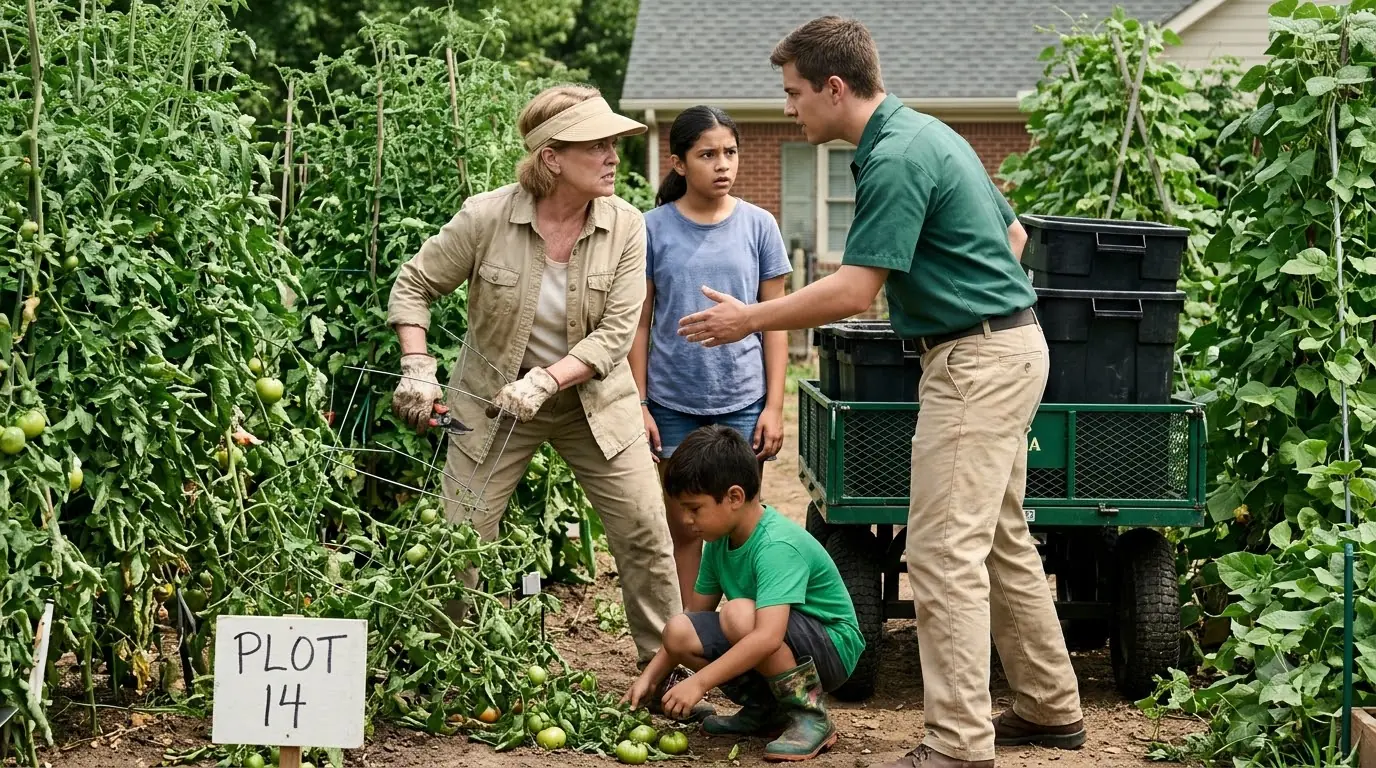
By the time Margaret Hollis first called Plot 14 a failure, there were already three green tomatoes hanging from the crooked cage she hated, two rows of beans climbing the trellis Jordan Kim had built from scrap cedar, and a strawberry plant that Milo Martinez had named after a cartoon detective for reasons nobody understood. The garden was not pretty in the way Marge meant the word. It was muddy after rain, uneven around the edges, crowded with handwritten labels, and busy with children who were still learning the difference between watering a plant and drowning it. But it was alive, and to twelve-year-old Ava Martinez that mattered more than almost anything.
The summer had begun with a very different kind of emptiness. Brookfield Meadows was the third place Ava had lived before middle school, although her parents insisted the first move hardly counted because she had been four. To Ava, moves counted if they required new hallways, new lunch tables, and the strange month when every face belonged to somebody who already knew where to stand. Her family had been in Brookfield Meadows for eighteen months, long enough to know the pool rules and the shortcut past the detention pond, but not long enough for Ava to stop thinking of their house as the place they lived instead of the place they belonged.
She liked things that changed slowly because she could understand them. Seeds did not ask where she had lived before. Tomato seedlings did not care whether she knew the right people. If a leaf curled, there was a reason somewhere. Too much sun, too little water, too much water, insects, heat, bad soil. Not every problem was easy, but problems in a garden at least agreed to leave clues. Her eight-year-old brother Milo preferred problems that could be poked with a stick. He spent the first Saturday in June squatting beside a puddle behind the Brookfield Meadows clubhouse, rescuing earthworms one at a time while Ava tried to straighten a tomato cage that had leaned overnight in heavy rain. Milo wore one green rubber boot and one blue rain shoe because he had lost the other boot somewhere between breakfast and the community garden, and he had dirt up both forearms.
“You know they live in dirt,” Ava told him as he moved another worm from the puddle to the mulched strip beside Plot 14. “They don’t live in puddles,” Milo said. “That one was drowning.” “Worms breathe through their skin.” “Exactly. He was having a skin emergency.” Ava gave up on the conversation and pushed the cage upright again. The community garden sat behind the clubhouse on a long rectangle of open ground bordered by a walking path and a line of young maples. It held twenty-four plots separated by gravel lanes, each one edged with low treated boards and marked by a numbered stake. There was a tool shed, two shared spigots, a compost bin that always smelled worse than signs claimed it should, and a narrow bench under a shade sail where older gardeners sat to talk about weather as if they had been assigned to monitor it.