The first thing Diane Mercer said to Malik Carter that afternoon was not hello. It was, “Stop.” The basketball left Malik’s hands in a soft arc, struck the backboard, and dropped through the rim before anyone on the court understood who she was talking to. Ethan slapped both palms against his thighs and shouted, “Bank is open,” while Jayden chased the ball toward the free-throw line. Malik grinned and turned his chair for the next possession, one hand on the push rim, the other already reaching for a pass that never came. “Stop the game,” Diane repeated.
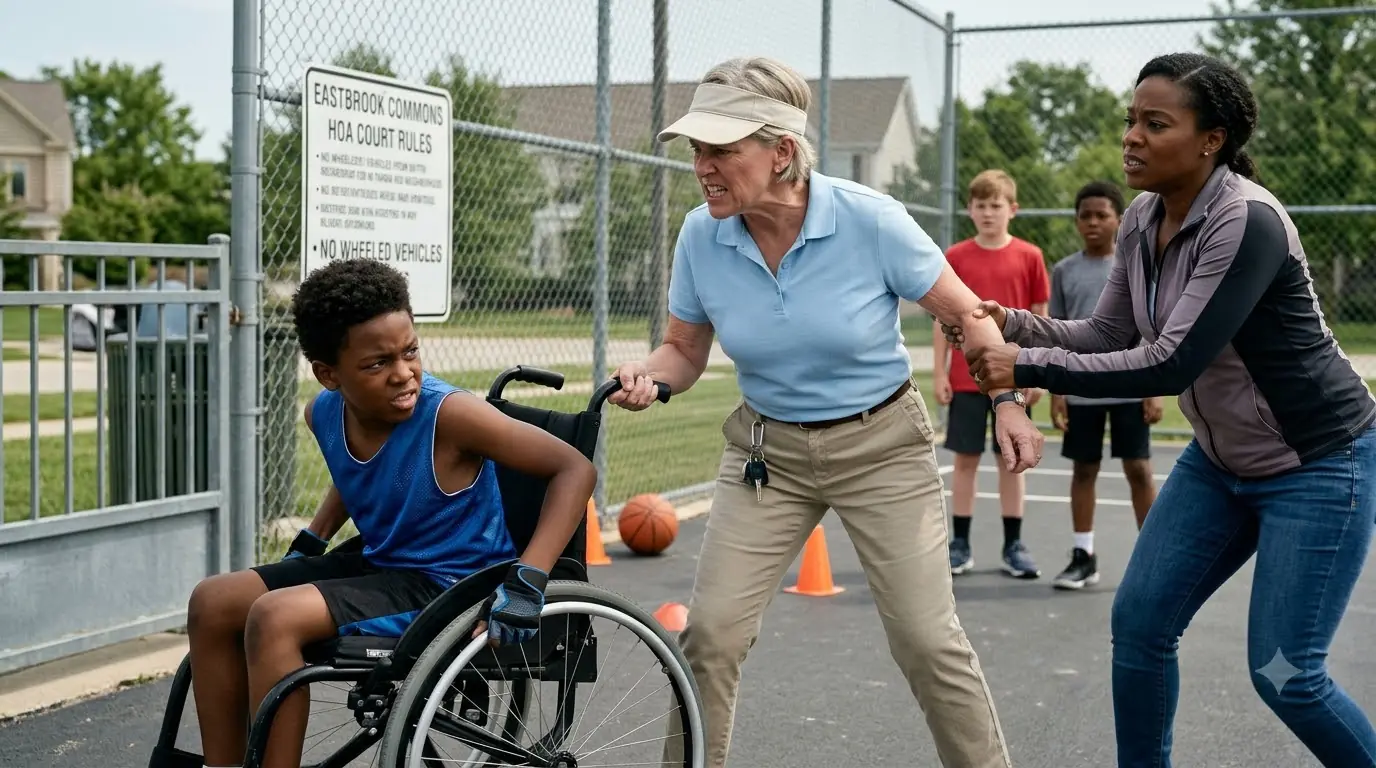
This time everyone heard her. She stood just inside the gate of the Eastbrook Commons multi-use court with a ring of maintenance keys clipped to her belt, a pale visor pulled low over her forehead, and the expression of someone who had discovered a leak before anyone else smelled the water. She looked at the faint black marks near the sideline, then at Malik’s wheels, then back at the marks. “Your chair is not supposed to be on this surface,” she said.
For a second Malik thought he had misheard her. He was eleven, funny when he was comfortable, sharp when he was irritated, and competitive enough to argue over whether a ball had grazed the rim even when nobody was keeping score. What he hated most was the tone adults sometimes used when they had already decided he was fragile. Diane’s tone was different, which somehow made it worse. She was not treating him as fragile. She was treating him as a maintenance problem. “It’s a basketball court,” Malik said. “For basketball shoes.” Ethan looked down at his own sneakers as if checking whether they had recently become official sports equipment. Jayden held the ball against his hip. Sophie and Luke, who had been waiting near the baseline for the next rotation, went quiet.
Diane pointed toward the fence where a white rules placard had been mounted after the court was resurfaced eight months earlier. “No bicycles. No scooters. No skateboards. No wheeled recreational equipment.” “This isn’t recreational equipment,” Malik said. “I can see what it is.” “Then why are you calling it equipment?” Ethan asked. Diane’s eyes moved to him. “Don’t make this difficult.” That was the moment the game changed. Until then, it had been what it always was: four kids on a half court after school, making small adjustments without discussing them much because discussing them made everything feel more complicated than it was. They lowered their passes when Malik was in the lane. Nobody crashed into his wheels. They rotated teams when Luke got tired. If Malik missed a rebound because the ball sailed high, he complained about the pass, not about basketball. He was simply one kid in the game.
Diane made him the reason the game had to stop. “You can keep playing when he leaves the court,” she told the others. The sentence landed harder than the rule itself. Malik felt every face turn toward him, even though nobody blamed him. He hated that part most—the sudden