Officer Nathan Pierce had been standing on Willow Bend Drive for less than four minutes when Pamela Wexler told him, for the third time, that the street belonged to her homeowners association.
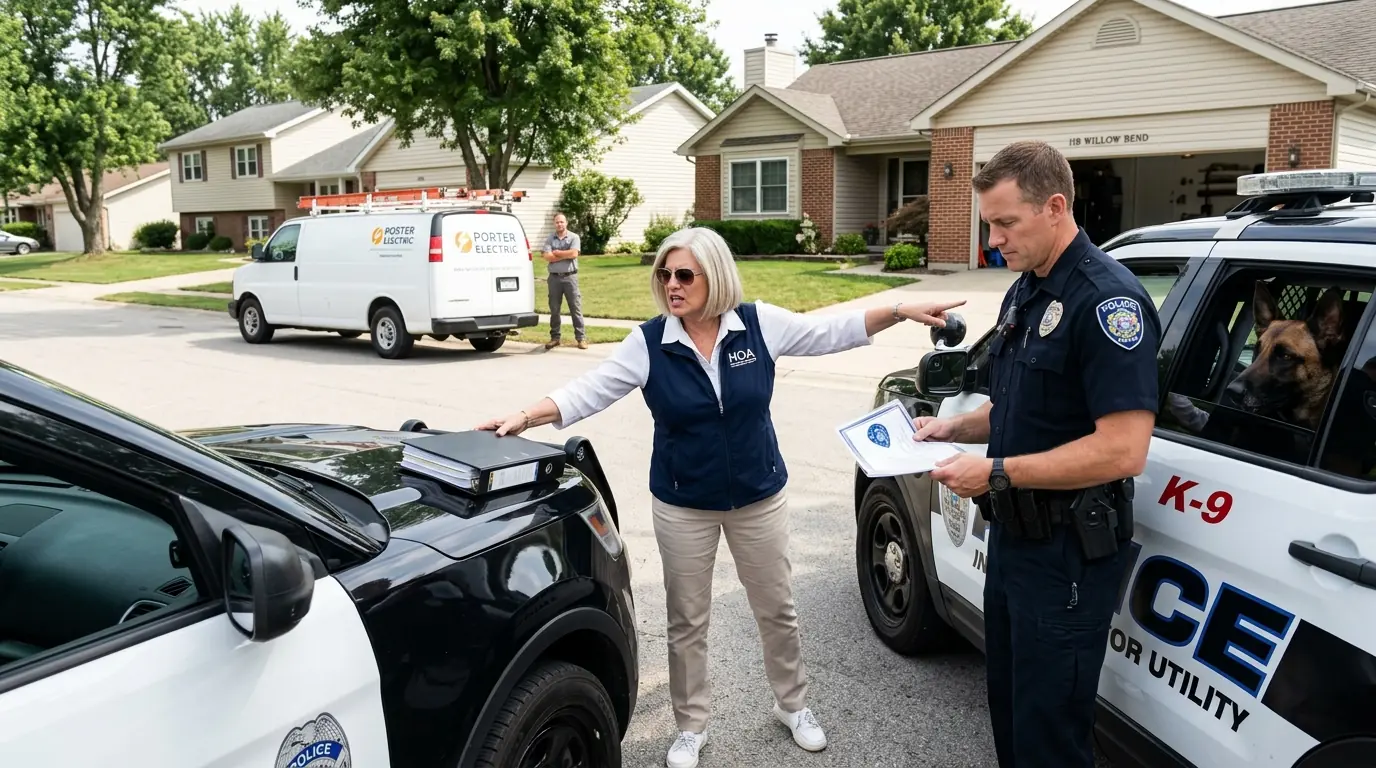
Nathan looked past her toward the white electrical-service van parked against the curb in front of 118 Willow Bend. The van was clean, registered, facing the correct direction, and positioned well away from the fire hydrant at the corner. It blocked neither driveway nor mailbox, and unless the city had rewritten its parking code since Nathan’s shift began, nothing about it gave him a reason to touch his citation book.
His K-9 partner, Atlas, waited inside the climate-controlled rear compartment of the patrol SUV. Atlas was a six-year-old Belgian Malinois trained in tracking, article recovery, and narcotics detection, though Nathan had learned over fifteen years in law enforcement that knowing when not to use a police dog mattered just as much as knowing when to deploy one.
Pamela seemed to have a different understanding.
“I told dispatch this vehicle has been here repeatedly,” she said. “We have rules against commercial vehicles. He has been warned nine times.”
Nathan glanced toward the house.
A man in work pants stood beside the garage with his arms crossed. He had not interrupted once since Nathan arrived.
Pamela continued. “You can ticket him, tow the van, or tell him to move it. I really don’t care which.”
Nathan looked back at her.
“Ma’am, I’m still trying to establish whether there’s a violation.”
“There is.”
“Under city code?”
“Under the Briarwood Ridge covenant.”
“That’s not the same thing.”
Pamela’s jaw tightened.
She was fifty-seven, president of the Briarwood Ridge Homeowners Association, and carried herself with the particular confidence of someone who had spent years watching other people become quiet whenever she opened a binder. Her silver-blonde hair was cut to the same length at every angle. She wore white walking shoes, beige slacks, and a navy vest embroidered with the association logo as though HOA president were an emergency-response position.
Nathan had met her once before.
Three months earlier, she called because a resident placed trash cans at the curb fourteen hours before pickup instead of twelve.
The police did not handle that one either.
Pamela opened the thick black binder tucked beneath her arm.
“You apparently are not familiar with our enforcement agreement.”
Nathan held out his hand.
“Let me see it.”
She hesitated.
Only briefly.
Then she removed a laminated sheet.
At the top appeared the seal of the City of Cedar Grove Police Department.
That immediately got Nathan’s attention.
The heading read:
COMMUNITY ENFORCEMENT COOPERATION AUTHORIZATION
Below it was language claiming that Briarwood Ridge HOA representatives could request police enforcement of association parking restrictions on “all internal residential roadways” and that officers were “authorized to remove offending vehicles upon HOA certification.”
Nathan read the paragraph twice.
Then he looked at the signature.
Capt. Robert Ellison
Community Services Division
The authorization was dated May 16 of the previous year.
Nathan knew Robert Ellison.
Everybody in the department did.
Ellison retired almost three years earlier.
Nathan looked at Pamela.
“Where did you get this?”
“From our management company.”
“Who specifically?”
“I don’t know. It’s part of our governing file.”
Nathan read the document again.
The police seal was slightly wrong.
Close enough that most citizens would never notice, but the outer ring used the department’s older motto. Cedar Grove changed that design six years earlier.
Nathan folded the page back toward Pamela.
“I need you to wait here.”
Her eyebrows rose.
“For what?”
“I’m checking something.”
“This is not complicated, Officer.”
“It just became more complicated.”
Nathan walked to his SUV.
Pamela followed.
He turned.
“Please stay on the sidewalk.”
“This is HOA property.”
Nathan looked down.
The concrete sidewalk had a municipal utility stamp from 2011.
He said nothing.
Pamela interpreted his silence as reluctance.
“You need to understand something. The association owns and maintains these internal streets. We have every right to control who parks here.”
Nathan opened his mobile computer.
“That is what I’m checking.”
“You don’t need to check it. I just showed you the agreement.”
“That is exactly why I need to check it.”
Behind Pamela, the neighbor finally spoke.
“Officer?”
Nathan looked toward him.
“My name’s Evan Porter. I own 118.”
Nathan nodded.
“I’ll speak with you in a minute.”
Pamela turned toward Evan.
“You have been instructed not to interfere during enforcement actions.”
Evan almost smiled.
“Pam, you called the police to my house.”
“Because you continue violating association rules.”
“The van’s on a public road.”
“It is not.”
Nathan lifted one hand.
“Both of you, give me a minute.”
He returned to the computer.
The call had originally been dispatched as a neighborhood dispute involving “a suspicious commercial vehicle repeatedly left in an HOA-controlled roadway.” Pamela had also told dispatch that the owner had become “confrontational” in previous encounters and that she was concerned about “unknown materials” being transported inside the vehicle.
That last part bothered Nathan.
He keyed his radio.
“Dispatch, K-12. Can you confirm street classification for Willow Bend Drive between Ashcroft and Laurel?”
A pause.
“Stand by.”
Pamela heard.
“You are wasting time.”
Nathan looked at her.
“No, ma’am.”
“I know this community better than someone sitting at dispatch.”
“That may be true.”
She looked almost satisfied.
Nathan continued.
“But they have records.”
The satisfaction disappeared.
Dispatch returned.
“K-12, Willow Bend Drive appears municipal. City-maintained roadway, acceptance ordinance 08-417. You need anything else?”
Nathan looked toward Pamela.
“Yes. Check whether we have any active enforcement agreement with Briarwood Ridge HOA regarding private parking restrictions.”
“Stand by.”
Pamela crossed her arms.
“You’re going to embarrass yourself.”
Nathan had been called worse things by people holding considerably more authority than an HOA binder.
He waited.
The radio crackled again.
“Negative on any Briarwood Ridge agreement. Community Services says no active MOU, no contract, no parking enforcement authorization beyond standard city code.”
Nathan looked at the laminated page.
Then at Pamela.
“Who gave you this?”
“I already told you.”
“Your management company.”
“Yes.”
“What’s the company?”
“Hearthstone Residential Management.”
“Contact person?”
“Richard Vale, regional director.”
Nathan wrote the name down.
Pamela noticed.
“Why are you writing that?”
“Because this document uses our department seal and names an officer who was retired before the date shown.”
For the first time since Nathan arrived, Pamela stopped speaking.
Evan uncrossed his arms.
Nathan continued.
“Captain Ellison left the department nearly three years ago.”
Pamela stared at the laminated sheet.
“That’s impossible.”
“I worked his retirement detail.”
“Well, perhaps the authorization was renewed under an existing signature.”
“That isn’t generally how signatures work.”
Pamela’s face reddened.
“This still doesn’t change the vehicle violation.”
Nathan looked toward Evan’s van.
“Under city law, I don’t see one.”
“The HOA covenant prohibits commercial vehicles.”
“That may create a civil association issue between you and Mr. Porter.”
“Then enforce it.”
“I cannot use police authority to enforce a private covenant just because you ask me to.”
Pamela glanced at Atlas’s compartment.
“Then run the dog around the vehicle.”
Nathan went very still.
“What?”
“You’re K-9, aren’t you?”
“Yes.”
“You have a narcotics dog.”
“Among other certifications.”
“Then check the van.”
Evan looked at Pamela in disbelief.
Nathan asked, “Do you have information suggesting narcotics are inside that vehicle?”
“I told dispatch he moves containers in and out at odd hours.”
“What containers?”
“Boxes. Cases. Bags.”
Evan laughed once.
“They’re electrical tools.”
Pamela turned.
“You don’t get to answer for me.”
Nathan ignored that.
“Mrs. Wexler, have you personally observed narcotics?”
“No.”
“Drug transactions?”
“No.”
“Any odor?”
“I’m not walking up to his vehicle to smell it.”
“Any person entering the van for a brief exchange consistent with a drug transaction?”
“No, but—”
“Any specific fact related to narcotics?”
She hesitated.
“He leaves early.”
Evan stared.
“I’m an electrician.”
Pamela raised her voice.
“That does not mean you can turn a residential street into commercial storage.”
Nathan shut the computer.
“Atlas is staying in the vehicle.”
Pamela looked stunned.
“You are refusing to investigate.”
“No. I investigated what you reported.”
“You haven’t searched anything.”
“A search isn’t the starting point.”
The sentence came automatically.
Nathan had said versions of it to younger officers for years.
A police dog was not a fishing pole.
A badge was not permission to transform irritation into suspicion.
Nathan walked toward Evan.
“Mr. Porter, is the van yours?”
“Company-owned. Assigned to me.”
“Registration current?”
“Yes.”
“Permission to park it here?”
Evan looked confused.
“It’s a city street in front of my house.”
“Fair answer.”
Nathan checked the plate anyway.
Valid.
No stolen vehicle entry.
No warrants connected to the registered company.
Nothing remarkable.
Pamela watched the entire process with growing frustration.
Then she pulled another document from her binder.
“This is the actual violation notice.”
Nathan read it.
Nine separate incidents were listed.
Parking of prohibited commercial vehicle.
Failure to comply with landscaping directive.
Unauthorized storage.
Obstruction of community roadway.
Nuisance activity.
Each violation had a date.
Each had an HOA case number.
Three included references to police incident numbers.
Nathan recognized the format immediately.