The first thing Jacob Reed noticed about the wind that Saturday was that it had no patience. It tugged at the hem of his T-shirt, rattled the pavilion roof at Windmere Estates, and kept snapping the cloth tail of his dark-blue kite against his shoulder before he could even get the reel ready.
Jacob loved wind like that because it made a homemade kite feel alive, as if every knot and crooked stitch suddenly had an opinion of its own. His father, calling from another state over video, had laughed when Jacob turned the phone toward the field and said, “That’s good flying weather. Just don’t let the tail wrap around the spine again.”
The kite had taken nearly two weeks to build. Jacob’s father had mailed him two thin bamboo spars and an old piece of dark-blue ripstop fabric left over from a camping repair, but almost everything else Jacob had done himself on their nightly video calls. He had measured the frame, tied the crossing joint, cut strips from an old shirt for the tail, and redone the bridle three times after the kite kept leaning left. The finished thing was not store-perfect, and that was part of why Jacob liked it.
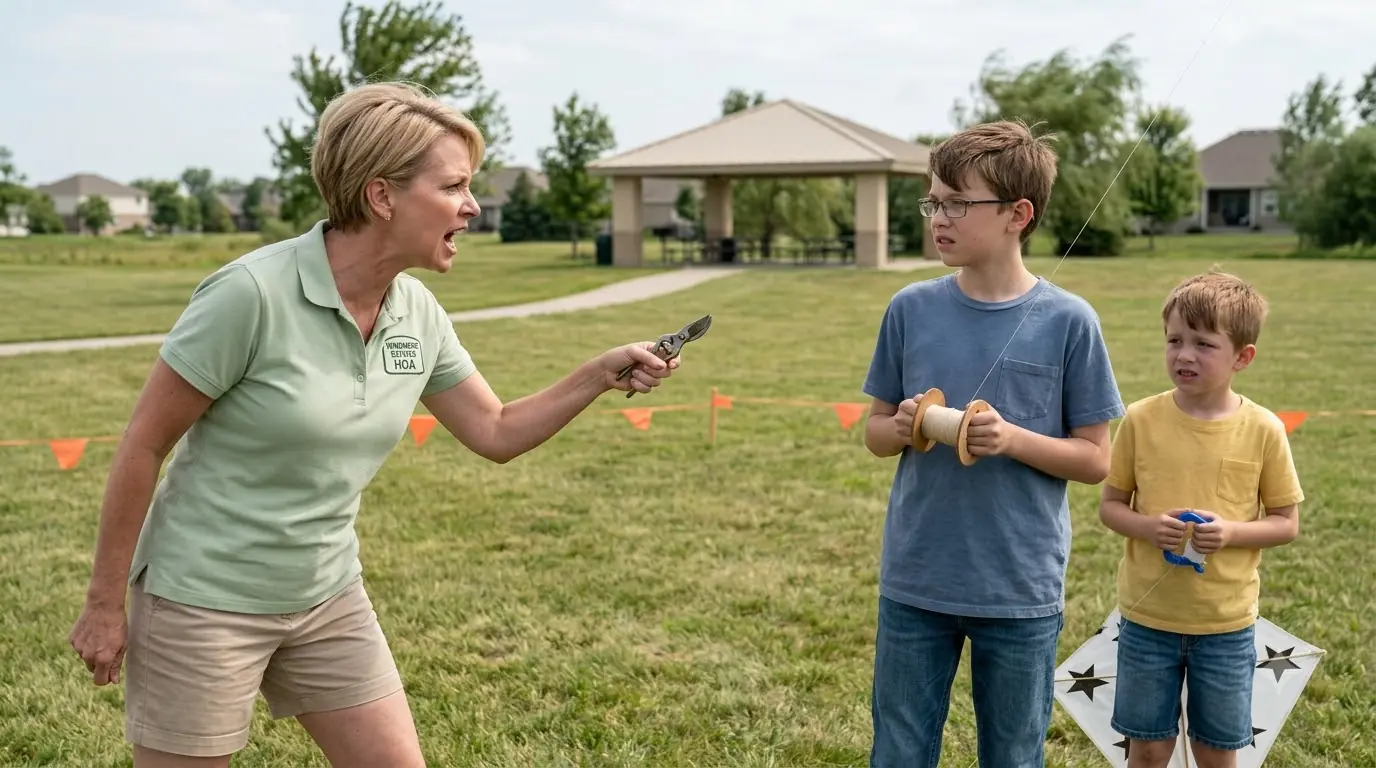
His friends were already spreading across the central grass field by the time he arrived. Lena, ten, had a bright orange diamond kite from a hardware store; Marcus, twelve, had built a white-and-red kite from plastic sheet and dowels; and Theo, eight, carried the smallest one, a paper kite decorated with black marker stars. They had rules of their own and treated them more seriously than most adults would have guessed: fly only in the middle of the field, stay well away from the playground and power lines, reel down whenever walkers crossed close to the grass, and stop immediately if the wind became too sharp.
Windmere’s park was one of the few places in the neighborhood that seemed made for that kind of afternoon. The walking path looped around the outside, the pavilion sat on the eastern edge, the playground stayed toward the street, and the middle field was a broad acre of trimmed grass with almost no trees. Families used it for soccer, picnics, Frisbee, and whatever game could be packed into a trunk. Nothing in the HOA rules banned kites, and until recently no one had imagined that was something the rules needed to say.
The trouble had started a month earlier with a drone. A teenager visiting his cousins had flown one low around the pavilion during a birthday picnic, startling an older resident and nearly clipping a paper banner tied between two posts. Diane Mercer, the chair of the HOA Parks Committee, had pushed through a clear policy afterward: no drones during community events without approval, no powered aircraft over the common park, and no activity that endangered walkers. Most residents considered that reasonable, and at first Jacob’s mother had agreed with Diane completely.
Then Diane began broadening the language on her own. In emails she referred to remote-control planes, model gliders, kites, and sometimes even tethered balloons as “airborne recreational devices,” a phrase that appeared nowhere in the adopted rule. To Diane, the distinction no longer mattered. If something rose above head level, moved with the wind, or carried a line somebody might trip over, she saw the same problem she had seen in the drone.
Jacob’s kite climbed cleanly on the second launch. Marcus held it overhead while Jacob ran backward, the fabric filled, and then the blue shape rose above the field in a fast diagonal until the reel began singing in his hands. Jacob grinned and tilted his phone upward so his father could see. “Still pulling left?” his father asked through the speaker. “A little,” Jacob said, “but less than yesterday.”