At four o'clock on the hottest Saturday of July, Leo Martin was standing in the middle of Pinecrest Village's community lawn, trying to save a cardboard fire station from a woman who kept calling it trash.
The station was only a painted moving box with a paper tube chimney, a red marker door, and a hand-lettered sign that said FIRE STATION #1, but Leo had spent most of the morning measuring the little road in front of it so a pretend fire truck could make the turn. Janice Ward, chair of the HOA Common Areas Committee, gripped the box by one corner and pulled. "Let go," Leo said, trying to keep his voice steady. "We are taking everything down at five."
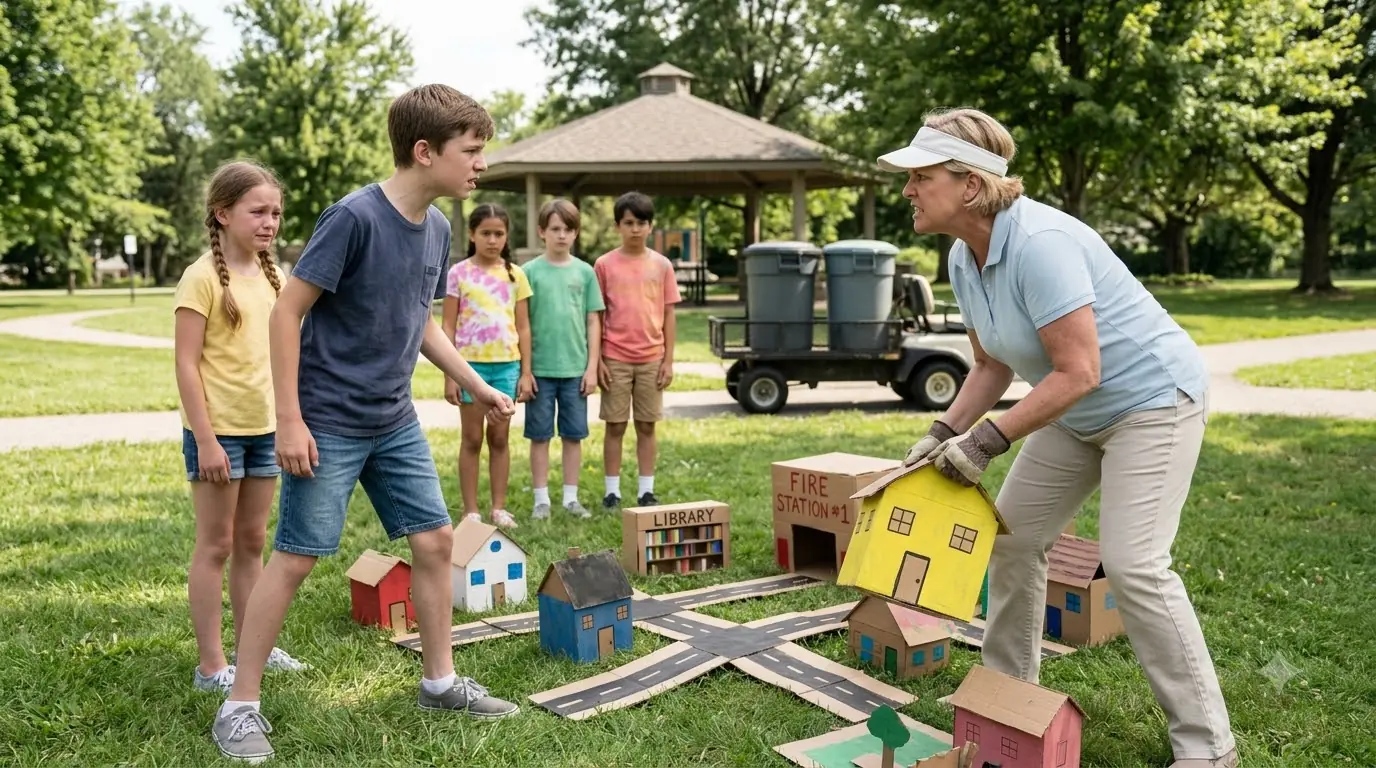
Janice looked at him as if he had announced that he owned the park. "Mr. Harris is not here," she snapped, referring to the board member who had stopped by earlier and told the kids they could keep building as long as they cleaned up before dinner.
Around Leo, Mia, Noah, Grace, and Sam stood among crooked cardboard houses and painted paper signs, all of them suddenly quiet. The little city had been noisy an hour earlier, full of arguments about where to put the library and whether a grocery store needed a parking lot. Now the only sounds were cicadas, a distant basketball bouncing near the half-court, and Janice's voice getting sharper.
"That does not mean the permission disappeared," Leo said. He was thirteen, thin, dark-haired, and usually much better at explaining ideas on paper than saying them out loud to adults. He liked maps because streets did not interrupt, buildings stayed where you placed them, and every empty space could have a reason.
Janice did not seem interested in reasons. "Children do not grant themselves permission," she said, and with one hard yank she tore the fire station out of Leo's hands.
The box hit the grass roof-first. The cardboard folded with a soft, ugly crunch, and the paper sign ripped through the center. Grace made a noise that was half gasp, half sob. Leo stared at the broken station, then at the wide strip of painted cardboard road still lying across the lawn. He did not know yet that, less than five minutes later, a real fire captain would stand over that road and ask the question Janice had never bothered to ask: who designed these streets?
That question had begun weeks earlier, when Pinecrest Village announced that Family Build Saturday was canceled. The event had been a modest summer tradition for years, usually a morning of donated craft supplies, folding tables, cardboard forts, paper bridges, and children trying to turn cereal boxes into things they had no business resembling. The HOA newsletter blamed the cancellation on a tight recreation budget and higher pavilion maintenance costs. Most adults shrugged. Leo did not.
Family Build Saturday was one of the few HOA events he actually liked because nobody expected him to be good at a sport, perform on a stage, or make conversation with people he barely knew. The previous year he had built a model bridge from craft sticks and then spent twenty minutes explaining to a six-year-old why triangles made the sides stronger. When the cancellation notice appeared, Leo's mother, Rachel, found him reading it twice at the kitchen table. "You could still build something," she said. "An event being canceled does not cancel cardboard."
Leo looked at the empty side of a grocery delivery box beside the recycling bin. By dinner he had drawn a rough map. By the next afternoon Mia had named the project Pinecrest Mini City, Sam had volunteered to make a grocery store, and Grace had insisted there needed to be a library because "every real town has somewhere quiet." Noah wanted a park inside the park, which everyone agreed made no sense and then decided was funny enough to keep. They collected flattened boxes from neighbors, rinsed old paint cups, borrowed washable tempera from two parents, and stacked paper tubes in Leo's garage like construction material.