The police officer looked at the blue cooler, then at Leo Ramirez, then at the hand-painted sign taped crookedly across the lid. COLD WATER — $1. His eyes moved to Maya sitting in a folding chair beneath a beach umbrella, then finally to Evelyn Vance, who stood at the curb with her phone clutched in one hand and the expression of someone waiting for an arrest she had already rehearsed in her head. The afternoon heat shimmered above the asphalt, cicadas screamed from the maple trees, and every window on the cul-de-sac seemed to have a person standing behind it.
Officer Daniel Price took off his sunglasses. “Ma’am,” he said to Evelyn, “dispatch already explained this to you twice.” Evelyn’s mouth tightened. “Then dispatch was wrong twice. These children are conducting an unauthorized commercial operation in a residential zone, and I am asking you to enforce the law.” Price glanced back at the cooler, where twenty bottles of water sat under melting ice, and then at the two teenagers who looked more embarrassed than criminal.
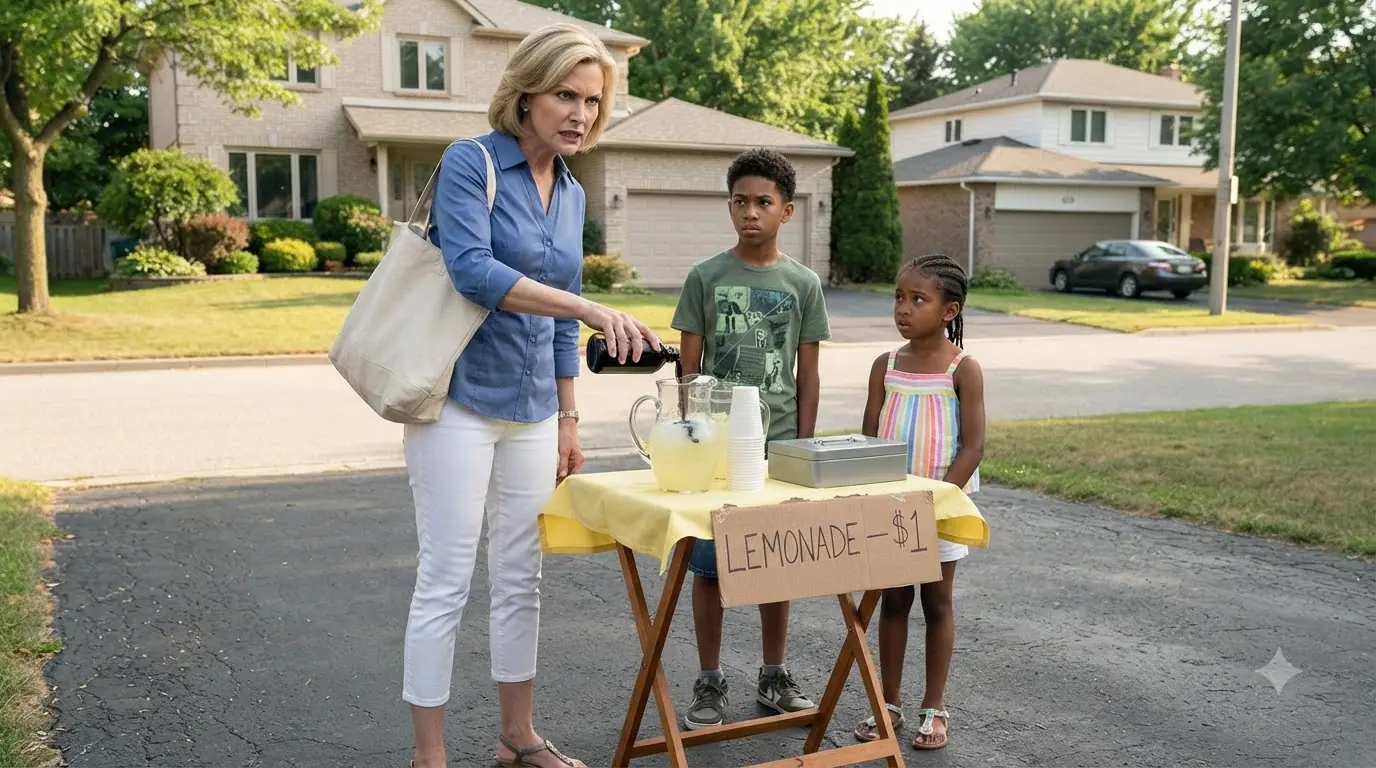
“They live here?” he asked.
Maya pointed over her shoulder. “That house. Number eighteen.”
“And you’re selling bottled water from your own driveway?”
“Yes, sir.”
Price exhaled slowly through his nose. “That is not an emergency.” Evelyn started to interrupt, but he raised one finger. “You called 911 three times in forty-seven minutes after dispatch told you to use the non-emergency number if you believed there was an ordinance issue. The first two calls tied up operators during heat-related medical calls.”
Evelyn stared at him as though he had just spoken in another language. “I am the compliance chair for Hawthorne Glen.”
“That does not change how 911 works.”
The citation pad came out next.
Leo did not smile. That surprised Maya more than anything, because she had spent the previous ten minutes imagining the exact expression she would make when Evelyn discovered that a clipboard did not outrank a police officer. But Leo only looked down at the cooler, pulled another bottle from the ice, wiped the water from it with a towel, and placed it beside the others. He had known Evelyn Vance for eleven months, which was long enough to understand that humiliation did not make her smaller. It made her dangerous.
Evelyn had lived at the top of Hawthorne Glen’s little hill for nearly fifteen years, in the largest house on the cul-de-sac, a two-story brick place with white columns and a circular driveway nobody else had. Her lawn looked cut with scissors. Her hedges sat at exact right angles. Even her trash bins seemed to roll to the curb in formation. She wore clean tennis shoes, pale linen shirts, and the kind of permanent frown that made every conversation feel like a hearing.
For most of those fifteen years, neighbors had accepted her as simply “the rule person.” She joined the homeowners association board, took over compliance letters, volunteered to photograph repeat violations, and began carrying a black leather ledger everywhere she went. At first people appreciated the order. Cars stopped blocking fire hydrants. Trash cans stopped sitting at the curb for days. One abandoned lot finally got cleaned after Evelyn called the county enough times that someone became tired of hearing her voice.
Then the rules stopped being about obvious problems and became about everything. A basketball hoop left down overnight. A chalk drawing on a sidewalk. A delivery van parked for twenty-two minutes instead of the twenty Evelyn believed was acceptable. A little girl’s birthday balloons tied to a mailbox after sunset. Evelyn had a way of making small things sound like the first symptom of neighborhood collapse.
Leo’s family had learned that quickly after moving into number eighteen the previous fall. Their mother, Teresa, was a respiratory therapist at Mercy South and worked long hospital shifts that often started before dawn. Their father had died four years earlier after a construction accident, leaving Teresa with two teenagers, a modest life-insurance payout, and a determination to buy a house where the children could stop feeling temporary. Hawthorne Glen was not fancy, but it was quiet, close to good schools, and just within what she could afford.
The first letter from Evelyn came fourteen days after they moved in. It complained about a moving pod sitting in the driveway beyond the permitted unloading period. The second mentioned that Leo’s old pickup, inherited from his father, had a mismatched tailgate. The third was about Maya’s roller skates being left beside the garage for part of an afternoon. None of the letters resulted in actual fines because the board kept telling Evelyn the issues were not violations, but the letters kept coming anyway.
By June, Leo had stopped reading them. Maya collected the funniest ones and pinned them inside her closet door like bad reviews. Teresa hated that, not because she respected Evelyn’s authority, but because she worried the woman would eventually find something real. “People who need control don’t get tired,” she told Leo once. “They just change targets.”
The water stand began because the heat index reached 103 degrees on the last Friday of July and Maya complained she was bored. Leo had planned to spend the afternoon replacing a cracked belt on his truck. Maya dragged the cooler from the garage, found three cases of bottled water in the pantry, and announced they could sell them to landscapers, delivery drivers, runners, and anybody else walking through the neighborhood. “One dollar,” she said. “Cold enough to hurt your teeth.”
Leo told her nobody would buy water on a street where every house had a refrigerator. Maya ignored him and made the sign anyway. Their first customer was a postal carrier who bought two bottles. Then a roofing crew working three houses away bought eight. A woman walking a golden retriever bought one for herself and gave Maya five dollars because she said the kids reminded her of her sons.
By one-thirty they had made twenty-seven dollars.
At one-forty, Evelyn appeared.
She did not walk up like a neighbor. She crossed the cul-de-sac with her phone already recording, black ledger tucked under her arm, and sunglasses reflecting the blue cooler back at them. “What exactly do you think you’re doing?” she asked. Maya looked at the sign. “Selling water.”
“I can see that.” Evelyn turned the phone slightly, making sure the cooler and sign were in frame. “Do you have a neighborhood vending permit?”
Maya blinked. “A what?”
“A vending permit. Commercial activity is restricted.”
Leo leaned back against the garage wall. “We’re on our driveway.”
“That does not make it legal.”
He had already heard that tone from her dozens of times. It was not the tone of someone checking a rule. It was the tone of someone enjoying the idea that a rule might belong to her. Leo opened his phone and pulled up the city page he had checked after Maya made the sign, because Teresa had raised exactly the same concern before leaving for work.
“Temporary youth stands on private residential property don’t need a permit if they meet the size and duration limits,” he said. “We’re fine.”
Evelyn gave him a thin smile. “You found something on the internet.”
“The city website.”