"You don’t get to tear down the only thing keeping my husband alive."
Margaret Greene said it from the top of her front porch, one hand wrapped around the wooden railing, the other pressed against the shoulder of the man beside her. Thomas Greene, seventy-six years old and stubborn enough to make a mule look flexible, stood with his cane planted against the first board of the wheelchair ramp their daughter had paid to have installed after his second stroke. His knees shook under his khaki pants. His left hand trembled against the railing. But his eyes stayed fixed on the woman standing at the foot of the steps with an orange violation notice in one hand and a satisfied little smile on her face.
Oakwood Estates had gone quiet around them. It was the kind of quiet that only happens in American suburbs when every neighbor is watching but nobody wants to be seen watching. Porch curtains moved. Blinds bent. A sprinkler ticked across a perfect square of lawn two houses down. Somewhere a dog barked once, then stopped as if even he understood that the evening had turned into something people would later pretend they had not witnessed.
Vanessa Whitmore, president of the Oakwood Estates Homeowners Association, lifted the violation notice like it was a court order instead of a piece of paper printed from a cheap office printer. She was fifty-four, sharp-shouldered, pearl earrings, blonde hair sprayed into place, dressed in a white blazer even though Oklahoma dust had a way of punishing anyone who wore white before sunset. She had spent six years running the HOA like a private government and had confused compliance with morality somewhere along the way.
"Mrs. Greene," Vanessa said, drawing out the title with false patience, "no one is saying your husband can’t have assistance. We are simply saying this structure is unapproved, unattractive, and inconsistent with the architectural character of Oakwood Estates."
Thomas gave a dry laugh that turned into a cough. Margaret held him steady before he could wave her away. "It’s a ramp," he said. "Not a casino."
A few houses away, someone behind a screen door made a sound that might have been a laugh. Vanessa’s head snapped toward it. The sound disappeared.
"It is a permanent exterior modification," Vanessa said. "And it was installed without final approval from the board."
Margaret’s face tightened. "We submitted the paperwork. You know we did. We sent medical documentation, the contractor’s drawings, the county permit, and the letter from his doctor."
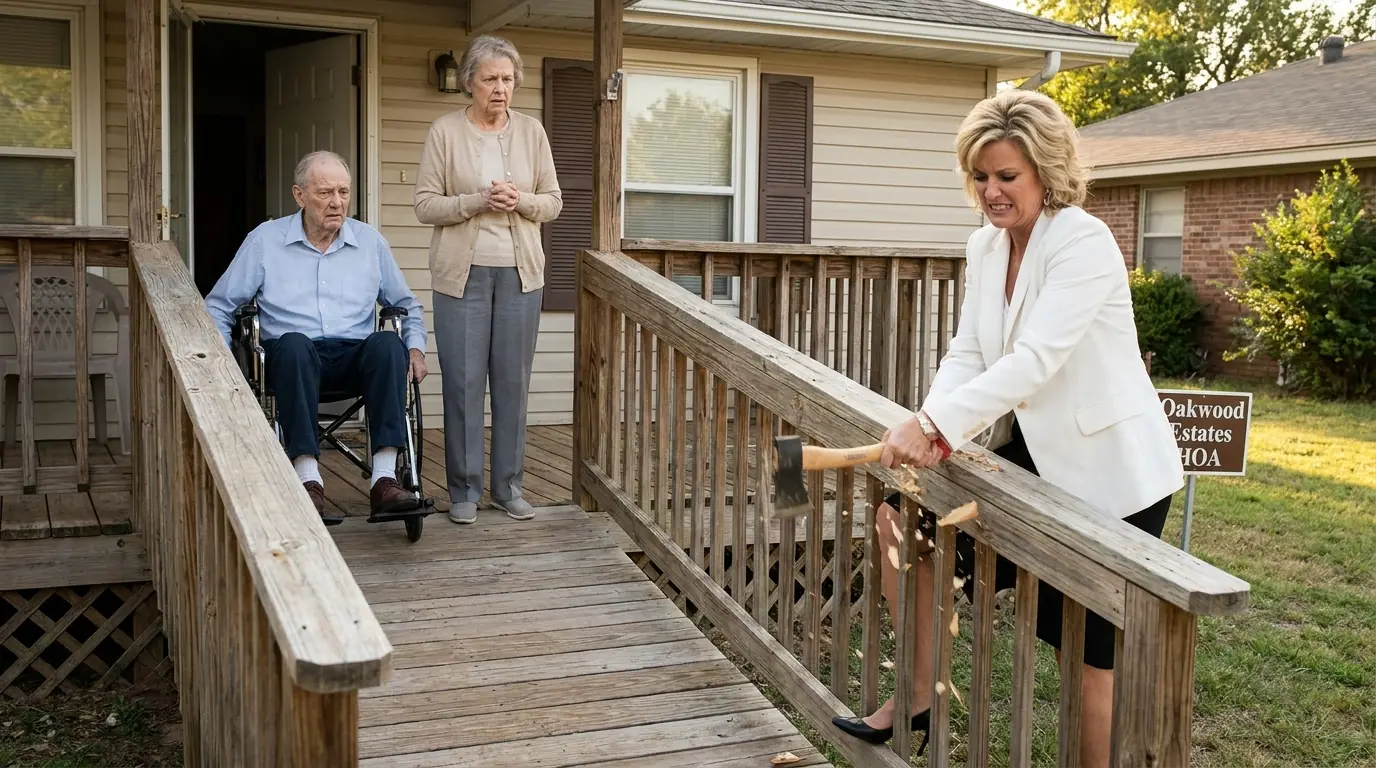
"You submitted incomplete paperwork."
"You called it incomplete because the board didn’t like the color of the railing."
Vanessa smiled. "Details matter."
Thomas leaned forward slightly. "So does breathing after climbing stairs."
For a second, Vanessa’s expression flickered. Not with compassion. With irritation at being made to look cruel in front of an audience. She stepped closer, her heels clicking against the driveway, and pointed the orange notice toward the ramp. "You have seventy-two hours to remove it. After that, the HOA will hire a contractor to remove it and charge the cost to your account. If you refuse payment, we can place a lien on the property."
Margaret stared at her. "You would put a lien on our home over a ramp for a disabled man?"
"I would enforce the rules equally."
"Equally?" Thomas said. His voice had gone low. "The Millers built a stone fire pit without approval. The Brennans painted their shutters navy instead of black. You didn’t call the police on them."
Vanessa’s mouth tightened. "Those are not comparable."
"No," Margaret said. "They’re not. Because those people invited you to their Christmas party."
That one landed. Vanessa’s face went still in the way a face goes still when anger steps behind it and locks the door. "I came here as a courtesy," she said. "But if you want to make this hostile, I can handle it differently."
Thomas’s cane scraped against the ramp board as he tried to straighten. "This is our house. We bought it in 1989. Raised two children here. Paid the mortgage off before your first HOA newsletter ever told anybody how tall their grass could be. You don’t get to stand in my driveway and tell me I don’t belong because my legs don’t work the way they used to."
The cul-de-sac held its breath. It should have been enough. A decent person would have heard the exhaustion in his voice. A decent person would have noticed Margaret’s hand shaking against his shoulder, the careful way she angled her body in case his knees gave out. But Vanessa Whitmore was not interested in decency. She was interested in victory.
She pulled out her phone.
Margaret’s eyes widened. "Who are you calling?"
"The police."
"For what?"
Vanessa raised her voice just enough for the neighborhood to hear. "For trespassing, threats, and refusal to comply with lawful community enforcement."
Thomas stared at her as if she had started speaking another language. "Trespassing? On my own porch?"
Vanessa put the phone to her ear. "Yes, dispatch? My name is Vanessa Whitmore. I’m the HOA president for Oakwood Estates. I need officers at 214 Briar Hollow Lane. Two residents are becoming aggressive during an enforcement action. There is an illegal structure on the property, and they are refusing to cooperate."
Margaret closed her eyes for half a second. When she opened them, they were wet but not weak. "You know exactly what you’re doing."
Vanessa lowered the phone, still connected, and smiled. "So do you, apparently."
Inside the house, on the kitchen counter beneath a magnet shaped like a peach, Margaret’s cell phone buzzed with a missed call from their daughter. Neither of them heard it. The phone screen lit again seconds later with a text message.
Landing now. See you in 40. Don’t let Dad lift anything.
Then, after a pause:
Mom? You okay?
No one answered.
Agent Naomi Greene had been awake since four that morning. She had flown from Washington, D.C. to Oklahoma City after three straight weeks of work she was not allowed to discuss in detail with her parents. They knew she worked for the FBI. They knew she carried a badge. They knew not to ask about certain cases. To Thomas, she was still the little girl who once stole his tool belt and tried to build a birdhouse using roofing nails and Elmer’s glue. To Margaret, she was still the child who hated peas, loved mystery novels, and called every Sunday even when she was exhausted.
Naomi was forty-one now, tall, composed, with her mother’s eyes and her father’s stubborn chin. She wore a dark blazer over a charcoal blouse, jeans because she had planned to change at her parents’ house, and boots polished enough to look professional but comfortable enough to run in. Her FBI credentials were clipped inside her bag. Her service weapon remained locked in a travel case according to policy until she reached the rental car and secured it properly.
She had come home because Thomas had not told her how bad the recovery was getting. He had joked on the phone, minimized the falls, claimed the ramp was "overkill" because old men were supposed to have something to complain about. Margaret had eventually called Naomi privately and confessed that Thomas had nearly fallen backward down the steps two weeks earlier. Naomi paid the contractor the same day. She reviewed the county permit, checked the HOA rules, and made sure the ramp design complied with federal and state accessibility protections before a single board was cut.
Vanessa Whitmore had already sent four emails.
Naomi had read every one of them on the plane.
The first was polite. The second was condescending. The third used the phrase "visual disruption." The fourth claimed the board was "concerned about precedent," as if disabled residents being able to enter their own homes might spread like a disease through the neighborhood. Naomi had planned to address it calmly after dinner. She had even promised herself she would not bring work home, would not turn a family visit into a legal lecture, would not become the version of herself who made people nervous simply by asking where they got their authority.
Then Margaret did not answer.
Naomi called twice from the rental car. No response. She called the house phone. Nothing. She checked the doorbell camera app she had installed for her parents after a string of package thefts the year before. The feed loaded slowly, then showed red and blue lights washing across the porch.
Naomi’s hand tightened around the steering wheel.
"No," she said softly.
Then she saw a police officer step toward her father with handcuffs in his hand.
Oakwood Estates was thirteen minutes away.
She made it in eight.
By then, the situation had sharpened into something dangerous. Officer Briggs had arrived first, followed by Officer Camden Miller, younger and visibly uncertain. Vanessa had met them at the curb and talked quickly, using words like aggressive, noncompliant, illegal, and unstable. She pointed toward Thomas’s cane. She pointed toward the ramp. She pointed toward Margaret as if Margaret’s anger was proof of guilt instead of proof that her husband was being humiliated in his own yard.
Briggs did what bad officers often do when they mistake confidence for truth. He chose the first person who spoke to him like she belonged in charge.
"Sir," he told Thomas, "I need proof you live here."
Margaret let out a disbelieving sound. "Proof?"
Thomas lifted his chin. "My name is on the deed."
"Do you have the deed on you?"
"It’s in a file cabinet. Inside my house. The house you’re standing in front of."
Vanessa crossed her arms. "He’s being evasive."
Officer Miller looked toward the mailbox, where GREEN was engraved on a brass plate beneath the numbers. "Briggs, maybe we should check county records before—"
"Stay out of it," Briggs muttered.
Margaret heard him anyway. "No, let him check. Please check. That is exactly what a reasonable officer would do."
Briggs’s jaw tightened. "Ma’am, you need to lower your voice."
"My voice is not the problem."
"It will become one if you keep interfering."
Thomas moved one step forward and nearly buckled. Margaret caught his arm. The sight should have stopped everything. Instead, Vanessa used it.
"See?" she said. "This is unsafe. That ramp is clearly unstable."
Thomas turned toward her with a look of pure disgust. "My legs are unstable. The ramp is the only thing doing its job."
Briggs pulled out his cuffs. "Sir, I’m giving you one last chance. Step away from the structure and come down to the sidewalk."
Margaret’s voice broke. "He can’t come down the stairs without the ramp. That is the point."
"Then he can sit down until we sort this out."
"On his own porch? Like a suspect?"
Vanessa stepped closer to Briggs. "Officer, he has threatened me twice."
Thomas barked a humorless laugh. "The only thing I threatened was your confidence."
Briggs pointed at him. "That’s enough. Turn around."
A teenager across the street whispered, "Oh my God," and kept recording. Curtains shifted harder. At least eight phones were up now, but no neighbor stepped forward. The whole cul-de-sac had become a jury hiding behind glass.
Margaret put herself between Briggs and Thomas. She was seventy-two, five foot four, and had arthritis in both hands, but in that moment she looked taller than everyone on the porch. "If you put cuffs on him, you will have to go through me first."
Briggs reached for her arm.
That was when the black rental SUV turned into the cul-de-sac without slowing.