The first thing Dr. Talia Monroe heard was the side gate striking the brick wall. The second was a man's voice ordering her to raise her hands. She was barefoot beside her own swimming pool on a Saturday afternoon, wearing a navy swimsuit and a black smartwatch, with a half-finished glass of lemonade on the patio table. Three sheriff's deputies rushed into the yard. The tallest pointed at her as if he had already decided what she had done. "Hands up. We got a report of a break-in." Talia lifted both hands. "This is my backyard. My identification is inside." The deputy with the handcuffs ordered her to the ground. She asked why he was treating her like a criminal. His answer was to reach for her arm.
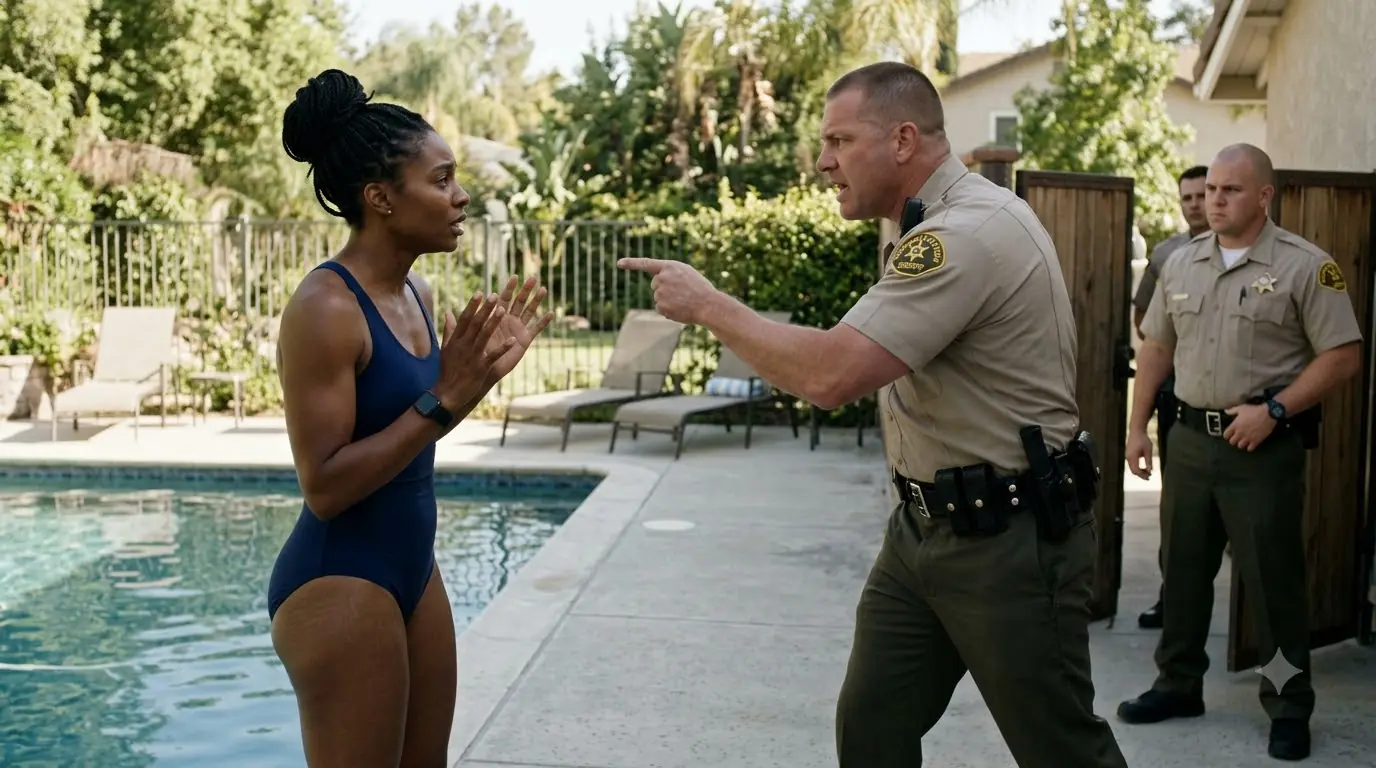
What happened next occupied less than twenty seconds, though afterward Talia would remember each movement separately. The first deputy caught her right wrist. The second stepped between her and the house. She turned toward the patio camera, trying to tell them where they could verify her identity, and the first deputy forced her face-down onto the concrete. Her cheek struck the rough surface. One knee pressed against her back while another officer secured her hands. "Stop resisting," the first deputy shouted. "I am not resisting," she managed. The pressure made breathing difficult. "Please get off my back. I can't breathe." Her voice was loud enough for the camera microphone beside the patio door to record it.
The third deputy was standing near the gate, looking from Talia to the others with mounting uncertainty. She saw his boots at the edge of her vision and concentrated on keeping still. Her left wrist was pinned at an awkward angle against the deck, but one finger could reach the recessed control on her watch. The device had been issued under a confidential safety arrangement several months earlier. It did not turn her into a law enforcement officer, and it could not protect her from someone already kneeling on her back. It could, however, send an alert to a monitored emergency service and a designated federal liaison. She held the control until she felt two short vibrations. Then she stopped moving. The officers did not notice.
At the side gate, a woman in white tennis clothes appeared with one hand over her heart. Celeste Whitmore, the president of the Sycamore Bend Estates homeowners association, stared at the woman on the ground as though she had never seen her before. "Oh, thank goodness," Celeste said. "I was terrified somebody had broken into Judge Lowell's house." Talia lifted her head a fraction. "You know I live here, Celeste." The lead deputy pressed her down again. "Quiet." Celeste looked at the camera over the patio door, then back at Talia. A strange calculation passed over her face. That look frightened Talia more than the handcuffs. It was the expression of a person who had planned for one result and discovered an unexpected witness.
Three weeks earlier, Talia had believed Sycamore Bend Estates would be the first quiet place she had lived in a decade. The community stood in Westlake Village, California, where broad streets curved past stucco homes, mature oaks, and slopes that turned golden in the dry months. Her house was a pale two-story residence