The HOA Fined Him $500 for Plowing Their Only Road — Three Days Later, Seventy-Three Families Were Trapped in the Snow
The letter arrived on thick cream-colored paper.
Even the violation notices at Ridgecrest had been designed to look expensive.
Dalton Reeves stood at his kitchen counter and read the first line twice.
NOTICE OF VIOLATION
UNAUTHORIZED SNOW REMOVAL OPERATIONS
Below it was a demand for five hundred dollars.
Payment was due within fourteen days.
Failure to comply could result in additional penalties and a lien against his home.
Three color photographs had been stapled to the back.
Each showed the same thing.
Tire tracks in the snow.
His tire tracks.
Tracks left after Dalton used his own plow truck to clear the only mountain road serving seventy-three families.
For free.
His wife, Marcy, read the notice over his shoulder.
“They fined you for plowing?”
Dalton turned the page.
“They fined me for helping.”
Outside their kitchen window, the Colorado mountains stood beneath a hard blue January sky. Snow covered the roofs, pine branches, and steep switchbacks leading down to the highway.
At nine thousand two hundred feet, winter was not a season.
It was a force.
Ridgecrest consisted of seventy-three homes built along a mountainside outside Pinewood Summit, a town small enough that most maps ignored it.
The views were extraordinary.
Elk crossed the yards.
At night, the stars appeared close enough to touch.
But Ridgecrest had one serious weakness.
There was only one road in and one road out.
Two-point-three miles of steep private pavement twisting through grades that reached more than twenty percent in several places.
The county did not maintain it.
The homeowners association owned it.
Between November and April, the area could receive more than three hundred inches of snow.
If the road was not plowed immediately after a storm, school buses could not enter.
Ambulances could not climb.
Residents could not leave.
Dalton knew that better than anyone.
He was fifty-two years old and a third-generation heavy-equipment operator. He had spent thirty years moving earth, clearing rock, cutting fire roads, and pushing snow through the Colorado Rockies.
He owned a Ford F-450 fitted with a ten-foot commercial plow.
The truck was not beautiful.
Its red paint had faded.
The driver’s seat was cracked.
The engine carried the permanent smell of diesel and cold metal.
But it had never failed Ridgecrest.
For seven winters, Dalton woke at four thirty whenever snow fell.
He put on insulated coveralls, made coffee, kissed Marcy goodbye, and cleared the entire road before most residents woke.
He charged nothing.
The previous HOA president, Bill Hendricks, once tried to reimburse him for fuel.
Dalton refused.
Bill was a retired firefighter who believed mountain communities survived only when neighbors took care of one another.
Dalton agreed.
Before he volunteered, the HOA paid an outside contractor nearly eighteen thousand dollars each winter.
The company often took six hours to arrive after moderate storms.
Dalton reduced that cost to almost nothing.
The association still paid for salt, gravel, and insurance, but residents saved thousands.
More importantly, the road remained open.
For seven years, nobody complained.
Then Bill’s wife developed cancer.
They moved to Grand Junction for treatment, and Bill resigned.
The woman elected to replace him was Vivian Ashford Crane.
Vivian was fifty-nine and newly retired from pharmaceutical sales.
She had moved from Connecticut because she wanted what she called an authentic mountain lifestyle.
She loved the views.
She loved expensive hiking clothes.
She loved posting photographs of snow from inside her spotless white Lexus.
What she did not love was anything that made mountain life inconvenient.
Vivian won the presidency by four votes.
At her first meeting, she arrived with a color-coded binder and quoted parliamentary rules as if she were prosecuting a criminal case.
“We need to discuss liability exposure,” she announced.
Her vanilla perfume competed with the smell of burned coffee inside the community room.
Dalton sat beside Marcy.
He felt her hand tighten around his.
Vivian tapped one manicured finger against the binder.
“We have residents operating heavy machinery on association property without formal contracts, direct board oversight, or approved vendor procedures.”
She did not say Dalton’s name.
Everyone knew she meant him.
Trevor Kowalski, a carpenter who had lived in Ridgecrest for almost twenty years, leaned forward.
“Dalton is licensed and insured.”
Vivian smiled.
“Capability is not accountability.”
“He has cleared that road for seven winters,” Rosa Burke added.
Rosa was seventy-eight and usually avoided conflict.
“He has never asked us for anything.”
“That is precisely the problem,” Vivian replied.
“Unregulated services create hidden liability.”
“He is a professional operator,” Trevor said.
“Then he may submit a bid like any other vendor.”
Vivian proposed requiring formal board approval for all service providers.
Her three allies supported the motion.
The vote passed four to three.
Two weeks later, Dalton received written instructions to cease all unauthorized snow removal.
No replacement contractor had been hired.
He was still required to pay full HOA dues.
The new letterhead included a pine-tree logo Vivian commissioned.
Dalton left the notice on the counter.
“What are you going to do?” Marcy asked.
“Follow the rules.”
She studied him.
“Exactly?”
“Exactly.”
The first serious storm arrived on January fourth.
Snow began around eleven at night.
By four in the morning, twenty-two inches covered Ridgecrest.
Normally, Dalton would have been warming the truck.
Instead, he stood at the kitchen window holding coffee.
Snow fell through the porch light.
Marcy joined him.
“You’re really staying inside?”
“The board ordered me to stop.”
By seven, the main road was buried.
The calls began immediately.
A young mother named Amanda Schuster asked whether Dalton could clear enough space for the school bus.
He told her to contact Vivian.
Another resident needed to reach work.
Someone else had a medical appointment.
By nine, fourteen people had called.
Dalton gave the same answer.
Then he saw Marcus Flynn standing in his driveway.
Marcus was seventy-four and diabetic.
He received dialysis twice a week.
He stared toward the buried road with the exhausted posture of someone who already knew he was trapped.
Dalton set down his coffee.
“I can’t leave him like that.”
Marcy nodded.
“I know.”
Dalton fired up the F-450.
He made one pass.
Forty-five minutes later, a narrow lane connected the neighborhood to the highway.
The school bus reached the children.
Marcus reached his appointment.
Dalton believed that would be the end of it.
Four days later, the certified letter arrived.
Five hundred dollars for unauthorized operation.
The photographs had been taken from three angles.
Someone had watched him.
Documented the tracks.
Waited for evidence that he had helped.
Dalton requested an emergency meeting.
He arrived carrying insurance records, licenses, fuel receipts, and seven years of maintenance logs.
Vivian sat at the head table with her allies.
“I am contesting the fine.”
“It is valid,” she replied without looking up.
“I cleared the road because residents were trapped.”
“You violated a direct board order.”
Dalton placed the documents on the table.
“Two million dollars in commercial liability coverage.”
Vivian did not touch them.
“My contractor’s license. Equipment records. Safety logs.”
She finally looked at him.
“What are you requesting?”
“Rescind the fine.”
He paused.
“Or reimburse me for seven years of service.”
Trevor leaned over the documents.
Rosa nodded.
Vivian’s smile became thin.
“Your vigilante snow removal was never formally requested.”
“Bill approved it.”
“There is no current contract.”
Dalton stared at her.
Vivian closed her binder.
“The board has hired Cascade Mountain Services.”
Her tone was too pleased.
“May I review the contract?”
“Vendor agreements are discussed in executive session.”
“Homeowners have the right to inspect association expenditures.”
“Submit a formal records request.”
She gathered her papers.
“This meeting is adjourned.”
Outside, Dalton noticed a white van parked near the community center.
Fresh vinyl lettering read:
CASCADE MOUNTAIN SERVICES
He had seen the same van parked at Vivian’s house several times.
Dalton photographed the license plate.
At home, he searched the Colorado business registry.
Cascade Mountain Services had been created eight months earlier.
The owner was Derek Crane.
Thirty-four years old.
Former pharmaceutical sales representative.
Recently relocated from Connecticut.
Dalton found a photograph.
Same eyes as Vivian.
Same narrow chin.
Marcy leaned over his shoulder.
“Her nephew.”
“Her nephew.”
“She forced you out to give him the contract.”
Dalton looked at the violation notice.
Then he paid the five hundred dollars.
Marcy stared.
“Why?”
“So they cannot place a lien on our house.”
He closed the laptop.
“And because I am finished arguing politely.”
He sent an email to every homeowner.
Effective immediately, I am ceasing all volunteer snow removal services on HOA common property. Per board directive, Cascade Mountain Services will handle future snow events. Thank you for seven good years.
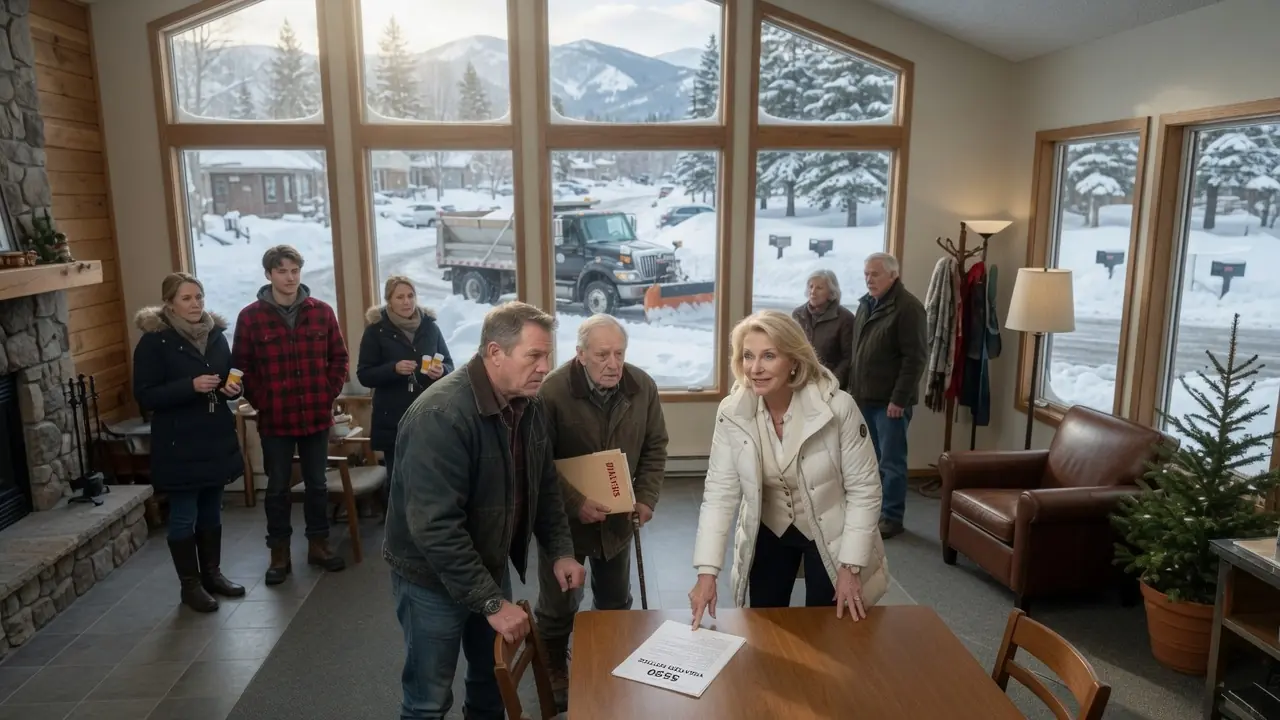
Dalton Reeves.
He pressed send.
Two weeks later, the National Weather Service issued a blizzard warning.
Thirty-six to forty-eight inches of snow were expected over three days.
Marcy looked at the forecast.
“You’re not helping?”
“Cascade has the contract.”
Snow began on January nineteenth.
By the following morning, two feet had fallen.
No plow came.
At eleven, the Cascade van appeared near the bottom of the road.
Dalton watched through binoculars.
Derek climbed out with two young employees wearing light jackets and football sweatshirts.
Their truck carried a residential-grade plow.
It was suitable for driveways.
Not mountain switchbacks.
They made it four hundred yards.
The blade struck a frozen rut and snapped from its mounting frame.
The sound of twisting metal echoed across the valley.
Derek stared at the broken equipment.
Fifteen minutes later, the crew left.
By afternoon, Cascade sent an email claiming unexpected road conditions had made operations unsafe.
The road remained almost completely buried.
The storm intensified.
Forty inches fell.
Wind created drifts five and six feet high.
Then Marcus Flynn fell on the ice outside his home.
He may have fractured his hip.
The ambulance reached the bottom of the mountain but could not climb.
The fire department attempted the road and turned back.
A medical helicopter came through the snow.
Dalton watched as rescuers secured Marcus inside a basket and lifted him into the gray sky.
The evacuation would cost tens of thousands of dollars.
Marcy stood beside Dalton.
“This is not your fault.”
“I could have cleared it.”
“You were ordered not to.”
“That does not make watching easier.”
When the storm ended, all seventy-three families remained trapped.
Twelve children missed school.
The district notified the HOA that failure to guarantee bus access could trigger daily penalties.
Three families began a petition to recall Vivian.
Within six hours, forty-eight homeowners signed.
Vivian rejected it as procedurally invalid.
Then she proposed a forty-percent increase in monthly dues to pay for enhanced snow removal.
The existing dues were four hundred fifty dollars.
Her proposal raised them to six hundred thirty.
Residents erupted.
Vivian responded with an association-wide email.
She blamed Dalton.
Some residents have suggested that former volunteer Dalton Reeves could assist. Mr. Reeves has chosen personal grievances over community welfare and has refused repeated requests to help.
Dalton read it three times.
She had created written proof that she knew he was qualified, available, and capable of solving the emergency.
He saved the email inside a folder marked EVIDENCE.
In February, Vivian published another newsletter.
It claimed Dalton’s years of unregulated plowing may have damaged the road and created eighty-five thousand dollars in hidden infrastructure repairs.
There was no inspection.
No engineering report.
No evidence.
Dalton understood what she was doing.
She needed a scapegoat for the missing reserve money.
He contacted Gregory Hammond, the previous HOA treasurer.
They met at a coffee shop.
Gregory slid a folder across the table.
“When Vivian took office, reserves contained one hundred twenty-seven thousand dollars.”
Dalton reviewed the latest statements.
“Now there is sixty-four thousand.”
“Sixty-three thousand vanished.”
“Where?”
Gregory pointed toward several entries.
Administrative consulting fees.
Three thousand dollars each month paid to Mountain Property Consulting.
Dalton searched the business registry.
The company belonged to Vivian Ashford Crane.
Gregory’s face changed.
“She is paying herself.”
Dalton obtained the full Cascade contract through an official records request.
The HOA paid Derek twelve thousand five hundred dollars each month during snow season.
Additional maintenance, overtime, equipment, and emergency fees were billed separately.
Vivian had replaced free service with a family contract worth nearly ninety thousand dollars annually.
Dalton hired an attorney named Bill Ortiz.
Bill reviewed the documents.
“Textbook self-dealing.”
“Can we remove her?”
“Yes.”
“Now?”
Bill considered it.
“If we expose her today, she claims an accounting mistake and delays everything.”
“What do you recommend?”
“Let her commit to the lies publicly.”
Another major storm was forecast for March.
Dalton serviced the F-450.
Changed the fluids.
Inspected the hydraulics.
Sharpened the blade.
Filled the tank.
Then someone slashed two of the truck’s tires.
Dalton heard movement outside at two in the morning.
By the time he reached the driveway, the person had disappeared.
A doorbell camera showed a bundled figure.
The face was covered.
Dalton could not identify the person.
But he saved the footage and police report.
He installed spare tires before noon.
In early March, the HOA finally delivered three hundred forty-seven pages of financial records.
Dalton and Marcy spread them across the kitchen table.
Marcy had worked as a bookkeeper before becoming a teacher.
She noticed what others missed.
The Cascade contract did not merely guarantee a monthly fee.
It allowed Derek to add equipment charges, emergency surcharges, and overtime at his discretion.
In three months, the HOA paid fifty-one thousand dollars.
Most of that period involved roads that remained blocked.
Then Marcy found the insurance certificate.
Cascade carried only five hundred thousand dollars in coverage.
Commercial snow-removal work required at least twice that amount.
Worse, the policy excluded operations on grades above fifteen percent.
The Ridgecrest road averaged eighteen.
Some portions reached twenty-two.
Cascade’s insurance did not cover the work it had been hired to perform.
If a vehicle was damaged or a resident was hurt, every homeowner could be exposed.
“She risked the entire neighborhood,” Marcy whispered.
Dalton organized the evidence.
Payments to Vivian.
Payments to Derek.
Insurance exclusions.
Missing reserve funds.
Undisclosed family connections.
He contacted Rosa, Trevor, Amanda, Gregory, and several longtime residents.
They rented the Pine Ridge town hall.
Fifty-two of seventy-three households attended.
Dalton presented the facts on a screen.
Reserve funds dropping from one hundred twenty-seven thousand to sixty-four thousand.
Three-thousand-dollar monthly payments to Vivian’s consulting company.
Cascade’s contract.
Fifty-one thousand dollars in actual invoices.
The insurance exclusion.
The room erupted.
Dalton waited for the anger to settle.
“Colorado law requires board members to disclose financial interests in vendors.”
He looked around the room.
“Vivian disclosed nothing.”
Trevor stood.
“What happens now?”
“She may be personally responsible for returning every dollar.”
Rosa raised one hand.
“What do we need?”
“A formal recall.”
“We already tried.”
“This time we follow every procedure.”
That night, sixty-eight homeowners signed.
A recall election was scheduled.
Amanda, who worked in public relations, contacted a local newspaper and a Denver television reporter.
Dalton wanted evidence and consequences to appear together.
The new storm would give them both.
Three days before it arrived, Vivian came to Dalton’s home.
Her white Lexus stopped in his driveway.
She carried an embossed envelope.
“I want to resolve our differences.”
She offered fifteen thousand dollars.
The HOA would rescind all fines if Dalton signed a release and stopped challenging the board.
“Fifteen thousand to stay quiet about nearly one hundred thousand dollars?”
Vivian’s smile tightened.
“That is a serious accusation.”
“Mountain Property Consulting belongs to you.”
Her face changed.
“Cascade belongs to your nephew.”
She extended the envelope again.
“This offer expires Friday.”
Dalton nodded toward the doorbell camera.
“This conversation is being recorded.”
Vivian lowered the envelope.
“I have every contract and payment record.”
He looked at her.
“I am not signing.”
For one moment, he saw fear behind her eyes.
Then she returned to the Lexus.
That night, someone smashed Trevor’s truck window.
Nothing was stolen.
The next morning, Rosa found her mailbox knocked down and her mail scattered across the snow.
Amanda received anonymous legal threats.
The weather forecast worsened.
Thirty-eight to forty-two inches.
Whiteout conditions.
Cascade announced it would not operate until after the storm.
Vivian sent residents an email calling the road closure an act of God.
Dalton’s phone filled with messages.
Medical appointments.
Children needing school.
Residents running low on fuel and medication.
He wanted to start the plow.
Every instinct told him to help.
Marcy found him at the window.
“This is hard.”
“People are going to suffer.”
“Tomorrow, you clear the road.”
She placed a hand on his shoulder.
“Tonight, they finally understand who prevented you.”
The storm struck on March eighteenth.
Snow fell sideways beneath powerful winds.
By morning, thirty inches covered the mountain.
Six-foot drifts erased the road.
Two families attempted to drive out and became stuck within two hundred yards.
Emergency vehicles could not enter.
Cascade remained silent.
Marcus Flynn missed dialysis and required another helicopter evacuation.
At three in the afternoon, Vivian called.
Dalton let it go to voicemail.
She called again.
“People are suffering,” she said. “Put the community first.”
At five, she called through the official HOA line.
Dalton answered.
“I need you to plow the road.”
He allowed the silence to stretch.
“You need unauthorized snow-removal operations?”
“This is an emergency.”
“The same emergency I prevented for seven years?”
Vivian’s voice cracked.
“What do you want?”
“In writing.”
“What?”
“Full board authorization.”
Dalton counted each condition.
“The five-hundred-dollar fine refunded.”
“Fuel reimbursement.”
“Written indemnification.”
“An open financial review at the next meeting.”
Vivian hesitated.
“Why does that matter right now?”
“Transparency matters.”
“I need to discuss it.”
“No.”
Dalton looked through the window at the buried road.
“Yes or no.”
Voices sounded behind her.
Finally, she answered.
“Yes.”
The signed letter arrived before eight.
All seven board members authorized Dalton to clear the road.
The fine was rescinded and described as issued in error.
Fuel costs would be reimbursed.
The HOA agreed to indemnify him and hold an open financial review.
Dalton forwarded the letter to Bill Ortiz.
The attorney replied almost immediately.
She admitted the fine was improper and committed to disclosure. Keep this safe.
Dalton sent a second message to Amanda.
Tomorrow morning. Six o’clock. Tell the reporters.
At four thirty, Dalton was already awake.
The storm had stopped.
Stars appeared between broken clouds.
The temperature had fallen.
The snow was dry and ready to move.
Marcy dressed in warm clothes.
“I’m coming.”
“You don’t have to.”
“I have watched this for fourteen months.”
She tightened her coat.
“I want to see how it ends.”
At five, the diesel engine roared through the silent valley.
A Channel 7 van waited near the lower entrance.
Dalton lowered the blade.
The first pass began.
Snow rolled away in white waves, rising beneath the work lights.
The familiar vibration traveled through the steering wheel into his arms.
For seven years, this had been an act of service.
That morning, it was also evidence.
Residents emerged from their houses.
They stood in driveways holding coffee.
Some filmed.
Others simply watched.
Rosa came outside using her walker.
Trevor stood beside her.
Amanda followed the plow with her phone.
By six thirty, Dalton had cleared the first mile.
The television crew filmed the blade cutting through drifts Cascade claimed were impossible to move.
At seven, Dalton reached Vivian’s house.
Her Lexus was buried nearly to the windows.
Vivian stood in the driveway wearing a robe.
Her hair was uncombed.
Without the tailored clothing and controlled meeting room, she looked smaller.
Dalton stopped the truck.
More than forty residents had followed.
Cameras were recording.
He stepped onto the road holding a certified envelope.
“Vivian.”
She stared at him.
Dalton handed her the envelope.
Inside was an invoice.
Seven years of documented fuel, maintenance, and equipment expenses.
Fourteen thousand two hundred dollars.
That morning’s emergency work added three thousand eight hundred.
Total due:
Eighteen thousand dollars.
Vivian’s hand trembled.
“You cannot charge us for volunteer work.”
Dalton remained calm.
“You wanted a professional contractor.”
He nodded toward the cleared road.
“This is what professional work costs.”
The reporter stepped forward.
“Mrs. Ashford Crane, residents say you paid yourself and a relative with HOA funds while the community’s only road remained impassable.”
Vivian turned pale.
“Those are private association matters.”
Dalton opened the weatherproof evidence case.
“Not anymore.”
He handed the documents to the reporter.
“Three hundred forty-seven pages obtained through a lawful records request.”
The camera moved closer.
“Page one seventy-eight contains Cascade’s contract.”
He continued.
“Page two forty-one shows payments to Mountain Property Consulting.”
The reporter scanned the pages.
“This company belongs to you?”
Vivian reached toward the folder.
“That is confidential.”
Deputy Martinez stepped forward from a patrol vehicle.
“Ma’am, did you disclose your financial interest to the homeowners?”
Vivian looked around.
The road.
The cameras.
The residents.
The deputy.
The papers in the reporter’s hands.
Rosa spoke from the crowd.
“You’re finished.”
Trevor raised a copy of the recall petition.
“Sixty-eight signatures.”
Vivian’s lips tightened.
“This is not over.”
Dalton looked at her.
“Yes.”
His voice was quiet.
“It is.”
She turned and went inside.
The door slammed.
The crowd erupted.
Dalton returned to the truck.
He still had work to finish.
By eight thirty, the entire two-point-three-mile road was open.
School buses entered.
Mail service resumed.
Residents drove to work.
The mountain returned to life.
People brought Dalton coffee, muffins, and breakfast sandwiches.
Marcus, recovering from his second medical evacuation, met him near the top of the road.
“You saved us.”
Dalton shook his head.
“I showed everyone who was hurting you.”
The fallout came quickly.
Three board members resigned.
Without a quorum, interim management took control.
The Colorado Attorney General opened an investigation after receiving the financial records.
The emergency recall vote removed Vivian with eighty-nine percent support.
A forensic audit confirmed more than seventy-four thousand dollars in improper payments.
Additional penalties and legal expenses raised her personal liability even higher.
The HOA sued for full restitution.
Vivian moved back to Connecticut before the case concluded.
A judgment of nearly one hundred thousand dollars followed her.
Derek’s company collapsed.
Its equipment was sold.
He moved away.
The association voted to reimburse Dalton eighteen thousand dollars.
He donated five thousand to the volunteer fire department that had repeatedly tried to reach Ridgecrest during the storms.
Rosa Burke became HOA president.
Trevor became treasurer.
Amanda became secretary.
Their first reforms required monthly financial reports, public vendor contracts, disclosure of family relationships, and community approval for large expenditures.
Then they offered Dalton an official snow-removal contract.
Properly insured.
Transparent.
Fairly paid.
One thousand two hundred dollars per storm and an eight-hundred-dollar monthly retainer during winter.
Without Vivian’s consulting fees and Derek’s inflated invoices, the association still saved nearly seventy thousand dollars annually.
Monthly dues decreased.
A medical emergency fund was created for residents facing uninsured helicopter costs.
It was named for Marcus Flynn.
The community also began an annual snow-safety day.
Dalton taught equipment preparation, emergency planning, and winter driving.
He did not mind.
Helping was still what people did in the mountains.
The difference was that help was no longer treated as weakness.
The following winter, the first major storm arrived in December.
Dalton woke at four.
He dressed.
Made coffee.
Started the F-450.
The truck now carried the Ridgecrest contractor logo on its door.
The paperwork was signed.
The insurance was current.
The rate was fair.
But the work felt exactly the same.
He lowered the blade and cleared the first switchback before sunrise.
Rosa called over the radio.
“Coffee is ready when you finish.”
“I’ll be there in twenty minutes.”
At dawn, Dalton parked outside her house.
She handed him a thermos.
For a while, they stood together watching sunlight spread across the mountains.
The road below them was clean and dark against the snow.
“You know what’s funny?” Rosa asked.
“What?”
“Vivian wanted to professionalize everything.”
Dalton nodded.
“We finally did.”
Rosa smiled.
“We professionalized her right out of office.”
Dalton laughed.
The sound traveled through the cold morning air.
Down the road, smoke rose from chimneys.
Children waited for the bus.
Cars moved safely toward the highway.
Everything Vivian had tried to control had been returned to the people who lived there.
The money was accounted for.
The contracts were public.
The road was open.
Dalton drove home after sunrise.
The house smelled of bacon and coffee.
Marcy stood at the stove.
“How did it go?”
Dalton removed his gloves.
“Perfect.”
For the first time in more than a year, he meant it.
Vivian had fined him five hundred dollars for leaving tire tracks in the snow.
She believed the fine proved she had power.
In reality, those tracks had been evidence of something she never understood.
A community can ignore the person quietly holding it together.
It can insult him.
Replace him.
Punish him.
But eventually, the storm comes.
And when it does, titles, binders, expensive vehicles, and polished speeches do not clear mountain roads.
People do.
Vivian learned the difference between controlling someone and needing him.
The lesson cost her money.
Her position.
Her reputation.
And the authority she had mistaken for respect.
Dalton never wanted revenge.
He wanted the road open and the community safe.
But he also understood something his grandfather had taught him while repairing equipment in winter.
When a machine is under pressure, you do not force it blindly.
You wait.
You listen.
You identify the weak point.
Then you apply exactly enough pressure to make the whole system move.
The plow cleared the snow.
The documents cleared everything else.