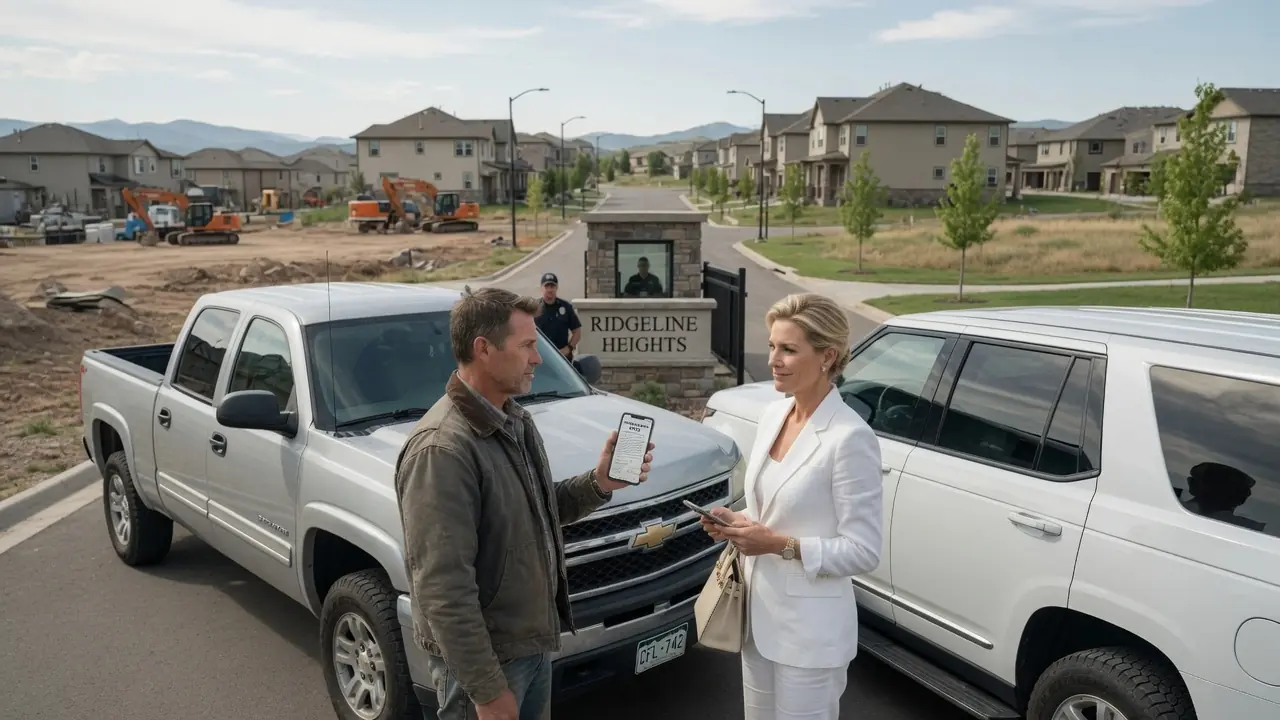
The first thing Dakota Flint noticed was the stone entrance sign.
RIDGELINE HEIGHTS
A WHITMORE LUXURY COMMUNITY
It stood where his grandfather’s old fire road should have been.
Dakota stopped his truck in the middle of the lane and stared through the windshield.
For several seconds, his mind refused to accept what his eyes were seeing.
The pine forest was gone.
The narrow dirt road he had driven as a child had been widened and paved. Fresh streetlights lined both sides. Concrete sidewalks curved through rows of beige Mediterranean-style houses with fake balconies, decorative stonework, and identical black mailboxes.
Construction crews moved between unfinished yards.
A cement mixer turned slowly near the far end of the development.
Two families were unloading furniture from rental trucks.
Children rode scooters through a cul-de-sac.
Dakota checked the navigation screen.
Then his phone.
Then the paper survey map resting on the passenger seat.
The coordinates were correct.
This was not property beside his land.
It was his land.
All forty-seven acres of it.
Dakota Flint was forty-seven years old, divorced, and employed as a structural engineer. He drove a 2008 Chevrolet Silverado that burned oil and made a metallic knocking sound every winter.
Nothing about him suggested wealth.
But the forest beneath Ridgeline Heights had been worth more than four million dollars before the first tree was cut.
His grandfather, William Flint, bought it in 1971 for eight thousand two hundred dollars in cash.
William was a Depression-era man who trusted handwritten records more than banks and remembered every person who had ever tried to cheat him.
He recorded property taxes, timber sales, fence repairs, and survey costs in thick leather ledgers that smelled of pipe tobacco and machine oil.
When he died in 2019, he left the property to Dakota.
Inside the envelope containing the original deed, William included a short handwritten note.
Don’t let the bastards take what’s yours.
Dakota had paid the property taxes every April.
He never missed a payment.
But he had not visited for three years.
A divorce consumed one year.
Two children in college consumed the next.
Seventy-hour workweeks consumed everything else.
In August 2022, Dakota finally drove into the mountains intending to scatter his grandfather’s ashes among the old pines.
Instead, he found ninety-six houses.
A security guard emerged from the gatehouse.
He was heavyset, with mirrored sunglasses and one hand resting near the radio clipped to his belt.
“Residents and authorized contractors only.”
Dakota lowered the window.
“I own this property.”
The guard looked at the battered truck.
“Sure.”
Dakota held up his phone.
“I have the deed.”
The guard smiled.
“And I’m the governor.”
Before Dakota could respond, a white Range Rover stopped behind him.
A woman stepped out.
She appeared to be in her mid-fifties, dressed in white linen with a gold watch bright enough to catch the afternoon sun.
Her hair was perfectly arranged.
Her expression carried the mild boredom of someone who expected problems to disappear when she approached them.
“Is there an issue, Ray?”
The guard nodded toward Dakota.
“This man says he owns the development.”
The woman finally looked at him.
Her eyes moved over his work boots, faded jacket, and calloused hands.
Dakota watched her decide what he was worth before he finished speaking.
“My name is Dakota Flint.”
She gave no sign of recognizing it.
“My grandfather purchased this parcel in 1971.”
“William Flint?”
“Yes.”
Recognition appeared, followed quickly by amusement.
“I’m Cassandra Whitmore.”
She extended no hand.
“Whitmore Development.”
Dakota looked toward the houses.
“You built all this?”
“We did.”
“On my land.”
Cassandra removed her phone.
“Our title company conducted a forensic review. The property had been abandoned for more than three years.”
“It was not abandoned.”
“You had not occupied it.”
“I paid every property tax.”
Her smile sharpened.
“You know just enough legal terminology to be dangerous.”
She opened her purse and handed him a business card.
“Brian Keer. Our attorney.”
Dakota glanced at it.
“He can explain why your claim is frivolous.”
“Adverse possession in Colorado does not happen because someone stays away for three years.”
Cassandra looked irritated now.
“Mr. Flint, this development was properly permitted through Boulder County.”
“How many houses have you sold?”
“All ninety-six.”
The answer came proudly.
“Preconstruction revenue exceeded sixteen million dollars.”
Families continued moving furniture behind her.
Cassandra lowered her voice.
“Those people are moving in by Thanksgiving.”
It was not information.
It was a threat.
“If you interfere, you will be fighting ninety-six families, their mortgage lenders, three title insurers, Boulder County, and a development company with considerably more resources than you.”
Dakota looked at her.
“You knew my name.”
Cassandra paused.
“You knew enough to have your lawyer ready.”
“Our professionals anticipated nuisance claims.”
She lifted her phone and photographed his license plate.
Dakota stared.
“That’s unnecessary.”
“It is precautionary.”
She leaned closer to the open window.
“If you return and damage anything, we will have excellent security footage.”
Then she gave him a thin smile.
“People like you do not win against people like us.”
A nail gun cracked in the distance.
The sound echoed across the development like a countdown.
Dakota drove home with both hands shaking on the steering wheel.
That night, he cleared his kitchen table and opened every box his grandfather had left.
The original 1971 deed.
County surveys.
Tax receipts.
Timber contracts.
Photographs.
Bank statements showing every annual tax payment since Dakota inherited the land.
The records formed a paper history of continuous ownership extending back more than fifty years.
Cassandra had threatened him.
Photographed his truck.
Implied he was a criminal.
She had also revealed something useful.
She was not surprised by his claim.
On Monday morning, Dakota called Brian Keer’s office.
The receptionist spoke in the careful tone of someone accustomed to delivering bad news politely.
“Mr. Keer is in depositions all week.”
“Tell him Dakota Flint called regarding Ridgeline Heights.”
A brief silence followed.
“Yes. Mr. Keer anticipated your call.”
Dakota tightened his grip on the phone.
“He has authorized a nuisance settlement.”
“How much?”
“Fifteen thousand dollars, provided you sign a quitclaim deed by Friday.”
Dakota looked through the kitchen window toward his aging truck.
Fifteen thousand dollars for land worth millions.
A quitclaim deed would surrender every interest he possessed without requiring Whitmore Development to prove anything.
“Tell Mr. Keer I’ll see him in court.”
He hung up.
Dakota’s divorce lawyer was competent enough for dividing furniture, retirement accounts, and a vacation timeshare neither spouse wanted.
This case required someone different.
He needed an attorney who made opposing counsel inspect their malpractice coverage.
A civil-engineer friend gave him one name.
Lydia Chen.
She had defeated a railroad company in an adverse-possession case so thoroughly that the company later tried to hire her.
Her consultation cost five hundred dollars.
Dakota paid with a credit card.
Lydia’s office smelled of old leather and lemon polish.
She was about sixty, with gray hair arranged in a tight bun and reading glasses hanging from a beaded chain.
She listened without interrupting.
When Dakota finished, she held out one hand.
“Tax receipts.”
He placed a thick folder on her desk.
Lydia examined the documents slowly.
Email confirmations.
Bank statements.
County records.
Copies of payments made by William Flint beginning in 1971.
A faint smile appeared at the corner of her mouth.
“Colorado adverse possession requires many years of open, notorious, continuous, and hostile possession under a claim of right.”
She closed the folder.
“They have had months.”
“I know.”
“You paid the taxes.”
“Every year.”
“Their claim is dead.”
Dakota leaned forward.
“Then we get an injunction and stop construction.”
“We could.”
Lydia studied him.
“But that is not what I would do.”
He waited.
“I would let them finish.”
Dakota stared at her.
“They destroyed my forest.”
“Yes.”
“They are still building.”
“Yes.”
“And you want me to do nothing?”
“I want you to do something very precise.”
She folded her hands.
“If we stop construction now, Whitmore Development may declare bankruptcy. The land becomes tied up with contractors, lenders, title companies, and ninety-six buyers who acted in good faith.”
Dakota looked toward the window.
“It becomes legal chaos.”
“Exactly.”
Lydia continued.
“But if they complete the houses and transfer possession, then we file for declaratory judgment.”
She tapped the deed.
“You own the land beneath every completed structure.”
Dakota’s mouth went dry.
“They sold property they did not own.”
“Yes.”
“That’s fraud.”
“Textbook fraud.”
He tried to understand the scale.
“So I would own the houses?”
“Unless they settle.”
“What if we lose?”
“We won’t.”
Lydia’s voice contained no drama.
“Even in some impossible version where a judge accepted their claim, you are no worse off than you are today.”
She leaned forward.
“The real question is whether you fight one developer now, or allow that developer to create assets valuable enough that every bank, insurer, and buyer has an interest in forcing a settlement.”
The strategy was cold.
Brutal.
And logical.
“How much?”
“Forty thousand in legal fees, possibly fifty.”
Dakota almost laughed.
He had twelve thousand dollars in savings.
His daughter’s tuition payment was due in January.
His truck needed a transmission.
“I’ll find it.”
“One condition.”
Lydia’s voice lowered.
“Do not contact Cassandra.”
He nodded.
“Do not post online.”
“All right.”
“Do not speak to reporters.”
“I wasn’t planning to.”
“Tell only your children and one person you trust.”
She slid the retainer agreement across the desk.
“In property litigation, surprise is worth more than gold.”
Dakota signed.
September moved into October.
Twice each week, he drove past Ridgeline Heights and parked on the public road.
He photographed framing crews, concrete trucks, plumbing installations, electrical work, landscaping, and every completed structure.
Each image contained location and time data.
Cassandra noticed him during the third week.
She stood near the gate speaking angrily into her phone.
Twenty minutes later, a sheriff’s cruiser stopped behind Dakota’s truck.
Deputy Rafael Torres approached.
He was young and visibly uncomfortable.
“License, please.”
Dakota handed it over.
“I’m parked on a public road.”
“I know.”
Torres returned after running the plate.
“Mrs. Whitmore says you’ve been harassing her.”
“I’m documenting construction on land I own.”
“That is a civil dispute.”
“Parcel number 55932408.”
Dakota recited it from memory.
“County records list me as owner.”
Torres shifted his weight.
“She has filed a formal complaint.”
“For taking photographs from a public road?”
“If she reports threats, I’ll have to act.”
Dakota understood.
He did not.
“I haven’t threatened anyone.”
“Keep it that way.”
Torres returned to his cruiser.
Dakota kept taking pictures.
By November, families began moving into the first completed houses.
Children rode bicycles along the sidewalks.
A couple carried a crib into house forty-three.
Another family planted a young maple tree in a front yard that had once been part of William Flint’s forest.
Dakota felt sick watching them.
These people were not thieves.
They had saved for down payments.
Signed mortgage papers.
Trusted real-estate agents, title companies, attorneys, and county records.
They thought they were purchasing homes.
They were victims too.
The week before Thanksgiving, Dakota received a certified letter from Whitmore Development.
Brian Keer accused him of stalking residents and threatened legal action if he continued entering or photographing the property.
Attached was a photograph of Dakota’s truck taken from inside the subdivision.
His license plate had been circled in red.
Someone had written in the margin:
DOCUMENT EVERYTHING.
Dakota delivered the letter to Lydia.
She read it and began laughing.
Not politely.
A genuine laugh.
“What is funny?”
“They are documenting their own knowledge.”
She held up the letter.
“This proves they knew an ownership dispute existed and continued construction anyway.”
“It feels like I’m being stalked.”
“You are.”
Lydia placed the document into a folder.
“But every threat they send becomes evidence.”
“Should we respond?”
“No.”
“What do I do?”
“Nothing.”
Dakota stared at her.
“Let them keep writing.”
She pulled out a legal pad.
“In the meantime, I want every public record connected to Cassandra Whitmore, her husband, their lenders, their title company, and every permit issued for Ridgeline Heights.”
Dakota spent the next two weeks becoming an amateur investigator.
His engineering background helped.
He understood survey plats, permit applications, parcel maps, and construction documents.
Whitmore Development was registered in Delaware.
Cassandra was listed as the managing member.
Funding came from Ridgeline Capital Group, a Denver investment company controlled partly by Cassandra’s husband, Preston Whitmore.
Preston had faced earlier lawsuits involving construction defects and investor fraud.
The cases ended in confidential settlements.
County permit records described Dakota’s land as formerly tax delinquent and acquired through an adverse-possession claim filed in March 2022.
But no court had approved that claim.
Whitmore Development filed the paperwork and immediately began selling lots as if ownership had already been granted.
Dakota sent the documents to Lydia.
She called within an hour.
“This is better than I expected.”
“What did you find?”
“They skipped the only step that matters.”
“The judgment.”
“Yes.”
Her voice sharpened.
“They never obtained legal title.”
In early December, county code enforcement contacted Dakota.
An anonymous complaint accused him of operating an illegal dumping site on his parcel.
Dakota almost laughed.
There were ninety-six houses on the land.
No dumping site.
He met Inspector Rick Pollson at the development entrance.
Rick walked the property, examined the boundaries, and found no hazardous waste, abandoned vehicles, or debris beyond material generated by Whitmore’s construction crews.
“False report,” Rick said.
“Who filed it?”
He checked the paperwork.
“It came through Mrs. Whitmore’s office.”
Dakota stared at him.
“She is occupying the property and trying to fine me for conditions that do not exist.”
Rick lowered his voice.
“I have inspected six Whitmore projects.”
Dakota waited.
“Every one involved complaints against neighboring landowners before permits were approved.”
“Why?”
“Pressure.”
Rick handed him a business card.
“If you need a statement, call me.”
By Christmas, eighty-four houses were occupied.
Families hung lights across balconies and built snowmen beside newly planted trees.
Lydia scheduled the first court filing for January.
Then Cassandra attacked Dakota’s reputation.
On January fourth, Dakota’s daughter Emma sent him a message late at night.
Dad, are you being arrested?
A post in a Boulder County community group accused Dakota of stalking children at Ridgeline Heights.
Cassandra wrote that he photographed families, harassed residents, and falsely claimed to own the neighborhood.
She posted the image of his truck and urged residents to report sightings.
Within hours, the post had hundreds of shares.
Comments called Dakota a predator.
Someone suggested he belonged on a criminal registry.
People posted his plate number.
Dakota’s hands shook as he called Lydia.
“She is calling me a pedophile.”
“Do not respond.”
“My children are seeing this.”
“Screenshot everything.”
“She is destroying me.”
“She is creating a defamation claim.”
“That doesn’t help tonight.”
Lydia’s voice softened.
“I know.”
The following morning, Dakota’s employer placed him on temporary leave after a school-district client expressed concern.
A coworker crossed the parking lot to avoid him.
Two days later, someone painted PERVERT across his garage door.
He filed a report.
An officer photographed the damage without enthusiasm.
Dakota began sleeping with a baseball bat beside his bed.
Then Emma received an anonymous message accusing her father of stalking children.
When Dakota arrived at her apartment, she asked him directly whether any part of the accusation was true.
He spread the deed, tax receipts, photographs, and court filings across her table.
Emma read everything.
Her fear changed into fury.
“She is lying.”
“About all of it.”
“Then stop hiding.”
“Lydia says we wait.”
Emma looked at him.
“You have been defending yourself your whole life.”
Her voice shook.
“Maybe it is time to hit first.”
The night before the first hearing, Dakota received a message from an unknown number.
Drop the lawsuit or everyone finds out what you really are.
He forwarded it to Lydia.
Her reply came immediately.
Perfect. Bring the phone tomorrow.
The Boulder County courthouse smelled of floor wax and recycled air.
Lydia met Dakota outside the courtroom wearing a navy suit and carrying a leather briefcase.
Cassandra sat at the defense table beside Brian Keer and Preston Whitmore.
Preston wore a charcoal suit and the relaxed expression of a man who believed money had already decided the outcome.
Judge Angela Ramirez entered.
She was in her fifties, with reading glasses and no patience in her face.
Brian Keer stood first.
He argued that Whitmore Development held valid title through adverse possession.
Judge Ramirez interrupted.
“Did Mr. Flint pay the property taxes?”
Keer hesitated.
“Yes.”
“Then your adverse-possession argument fails.”
The confidence left his face.
Judge Ramirez turned.
“Ms. Chen?”
Lydia rose.
“We are not here to debate adverse possession.”
She opened her briefcase.
“We are here because the defendants knowingly committed fraud.”
She submitted an internal email dated February 18, 2022.
Judge Ramirez read it.
Her eyebrows lifted.
Keer’s face became pale.
Lydia handed Dakota a copy.
The email came from Preston to Cassandra.
It stated that county records showed Dakota had paid property taxes continuously.
It acknowledged that an adverse-possession claim would fail.
Then it proposed moving quickly.
File the claim.
Obtain permits.
Begin presales.
Create enough confusion and financial pressure that Dakota would either settle cheaply or become buried in litigation.
The email ended with a line that made Dakota read it twice.
WE HAVE DONE THIS BEFORE.
Judge Ramirez looked toward Preston.
“Is this document authentic?”
Keer reached for his client’s arm.
“We need time to consult.”
“That sounds like yes.”
The motion to dismiss was denied.
Judge Ramirez froze all further sales and transfers.
Then she looked directly at Cassandra.
“If I see another social-media accusation, anonymous code complaint, or threat against Mr. Flint, I will hold you in contempt.”
Cassandra’s voice was barely audible.
“Yes, Your Honor.”
Outside the courtroom, Lydia explained that the email came from one of Preston’s former partners.
He had lost money in an earlier development scheme and waited years for an opportunity to expose him.
For the first time in months, Dakota felt able to breathe.
It did not last.
During discovery, Lydia uncovered seven other developments involving disputed ownership, elderly landowners, aggressive claims, and rushed construction.
“They are not developers,” she said.
“They are land pirates using limited-liability companies.”
She planned depositions of Cassandra, Preston, the title company, lenders, contractors, and county officials.
Then came the threats against Dakota’s children.
A private investigator visited his son Tyler’s workplace and asked whether Dakota had a history of violence.
Soon after, an anonymous complaint triggered an audit of Dakota’s tax returns.
The same investigator’s vehicle was later seen outside Dakota’s house shortly before someone entered and left a note on his kitchen table.
DROP IT OR LOSE EVERYTHING.
Dakota’s neighbor recorded the license plate.
It belonged to Apex Investigations.
The firm hired by the Whitmores.
The intimidation campaign strengthened the case.
Then the title company broke.
Rocky Mountain Title admitted that Preston had paid forty-five thousand dollars in exchange for approving documents its attorneys knew were unreliable.
They surrendered emails, payment records, and recorded calls.
By late January, residents of Ridgeline Heights learned the truth.
A real-estate blog published the sale contracts.
Families panicked.
Title insurers refused immediate coverage because fraud could void the policies.
One homeowner, Sarah Chen, called Dakota in tears.
She had spent her life savings on house sixty-seven.
“Are you going to evict us?”
“No.”
“What happens if you win?”
“You keep the house.”
“How?”
“I don’t know yet.”
He paused.
“But I’m not fighting you.”
Lydia arranged an interview with an investigative reporter named Patricia Hughes.
The story aired one week before trial.
It showed Dakota’s deed, tax receipts, grandfather’s ledgers, construction photographs, and Preston’s email.
The report also revealed that Whitmore Development donated fifty thousand dollars to a county commissioner shortly before permits were expedited.
Dakota appeared on camera only long enough to say what mattered.
“The families are not the enemy.”
“They bought in good faith.”
“If property law means anything, it has to protect them too.”
The segment changed public opinion overnight.
His employer ended his leave.
Former friends contacted him.
Homeowners began sending evidence about Whitmore representatives.
But the threats increased.
Someone broke into Dakota’s house.
A typed message waited on his table.
He stayed with Emma until trial.
On February ninth, courtroom 3C was packed.
Dozens of Ridgeline Heights homeowners sat in the gallery.
Sarah Chen held her daughter’s hand in the third row.
Cassandra wore an expensive cream suit.
Her face appeared calm.
Her hands did not.
Lydia delivered the opening statement.
“This case is about theft.”
“Not theft committed in an alley with masks.”
“Theft committed in offices using forged documents, shell companies, and legal intimidation.”
She raised a copy of Preston’s email.
“The defendants did not make a mistake.”
“They calculated that Dakota Flint would be unable to afford the truth.”
The trial lasted seven hours.
The title-company representative admitted accepting the bribe.
Rick Pollson testified about false code complaints.
Deputy Torres described Cassandra’s attempts to use law enforcement against Dakota.
William Flint’s ledgers established more than fifty years of continuous ownership.
Preston took the stand.
Lydia questioned him for forty minutes.
Every answer contradicted another record.
By the end, sweat darkened his collar.
Cassandra invoked her right not to testify.
Judge Ramirez announced that she would issue a ruling the following morning.
Outside the courtroom, homeowners surrounded Dakota.
Sarah reached him first.
“If you win, what happens to us?”
Dakota looked toward Lydia.
She nodded.
“You keep your homes.”
He raised his voice so everyone could hear.
“All ninety-six families keep their homes.”
The hallway went silent.
“You did not commit the fraud.”
“The Whitmores did.”
Someone began clapping.
Then another.
Within moments, the courthouse corridor filled with applause.
Cassandra passed with her attorneys.
She looked at Dakota once before entering the elevator.
The hatred in her face was almost pure.
The next morning, Judge Ramirez issued an eighteen-page ruling.
The opening paragraph described a calculated and systematic scheme to defraud Dakota through false claims, bribery, misrepresentation, and intentional harassment.
Dakota received full title to the forty-seven acres and all improvements built upon them.
The court awarded damages for trespass, emotional distress, and loss of use.
Whitmore Development was ordered to pay his legal fees.
The matter was referred to federal prosecutors.
Ridgeline Capital collapsed.
Preston was indicted on fraud and conspiracy charges.
Cassandra accepted a plea agreement involving restitution, probation, and a permanent ban from real-estate development in the state.
The title company lost its license.
Several officials faced investigations.
Dakota now owned ninety-six houses.
Legally, he could have evicted the residents.
He could have sold each property again.
He could have become wealthy enough never to work.
Instead, he called a town meeting.
All ninety-six families gathered inside the unfinished community clubhouse.
Sarah stood near the front.
An elderly couple named Miguel and Rosa Rodriguez sat in the back holding hands.
Dakota stood beside Lydia.
“I know you are afraid.”
No one moved.
“You bought these homes in good faith.”
“You did nothing wrong.”
Snow melted slowly across the roof.
Dakota continued.
“I am transferring the development to a nonprofit community trust.”
A murmur spread through the room.
“Every family will retain ownership of the home they purchased.”
“If you have already paid the full price, you owe nothing more.”
“If you still have a mortgage balance, the trust will restructure it without profit or excessive interest.”
People began crying.
“The trust will maintain the roads, pay shared expenses, and create a scholarship fund for children in this community.”
Dakota looked toward the windows.
“My grandfather believed land was a responsibility.”
“He did not leave it to me so I could become another person using it to frighten families.”
Sarah covered her mouth.
Miguel Rodriguez approached Dakota after the announcement.
He shook his hand with both of his.
“Your grandfather raised a good man.”
Dakota looked around the crowded room.
“No.”
“He left good records.”
The William Flint Memorial Scholarship began the following autumn.
Each year, it awarded ten thousand dollars to a Colorado student studying engineering, forestry, environmental science, or land management.
Dakota kept five acres at the northern edge of the property.
It was the only section of old-growth pines Whitmore Development had not yet cleared.
He built a small two-bedroom cabin there.
Nothing luxurious.
A porch.
A woodstove.
A view of the mountains through the trees.
He sold his house in town and moved into the cabin.
Some mornings, deer crossed the clearing while he drank coffee.
Emma visited with her boyfriend, a law student.
Tyler came on weekends and cooked for the neighbors.
Even Dakota’s former wife visited once.
She stood on the porch and looked toward the subdivision.
“I’m proud of you.”
The words felt strange.
But good.
Months later, Sarah’s daughter gave Dakota a drawing.
It showed a row of houses beneath oversized pine trees.
A stick figure stood in the center holding a giant piece of paper.
Above him, she had written:
MR. DAKOTA SAVED OUR HOME.
He attached the picture to his refrigerator with a Colorado-shaped magnet.
Sometimes Dakota opened the drawer containing William Flint’s note.
Don’t let the bastards take what’s yours.
His grandfather had been right.
But Dakota eventually understood that ownership was larger than land.
What belonged to him was the truth.
The history contained in the old ledgers.
The duty to protect people who had been trapped by the same fraud.
The opportunity to turn an act of theft into something that could outlive the thieves.
Cassandra Whitmore believed wealth made consequences negotiable.
She believed paperwork could bury a man with an old truck and twelve thousand dollars in savings.
She believed that by the time Dakota understood what she had done, the houses, buyers, banks, and politicians surrounding the project would make resistance impossible.
She was almost right.
What she failed to understand was that Dakota did not need more power than she had.
He needed proof.
A deed.
Tax receipts.
Photographs.
Emails.
A grandfather who recorded every dollar.
A lawyer patient enough to wait while the fraud completed itself.
They built ninety-six houses on Dakota Flint’s land.
Not by accident.
On purpose.
Then they laughed when he objected.
Threatened him when he refused to disappear.
Attacked his name when the documents began to speak.
In the end, the development survived.
The families kept their homes.
The children gained a scholarship.
The last remaining pines became protected land.
The only people who lost everything were the ones who believed the law existed only for those wealthy enough to manipulate it.
Dakota never became a real-estate tycoon.
He remained a structural engineer with an aging truck and a cabin in the trees.
But every evening, when the streetlights came on across Ridgeline Heights and warm windows appeared one by one beneath the mountains, he could see ninety-six families living safely on land someone once tried to steal.
That was worth more than revenge.
It was the kind of justice his grandfather would have understood.
The kind built slowly.
Carefully.
And with every receipt still intact.