They started congratulating my wife before her father’s coffin had even reached the hearse. By the time the burial service ended, fourteen different people had squeezed Victoria’s hand, touched her elbow, or leaned close enough to whisper some variation of, “Your father prepared you for this,” as though Richard Hartley’s death were less a funeral than a succession announcement. Five days later, Victoria fired me from the company I had spent twenty-three years helping her father build, and our twenty-two-year-old son raised his hand with the directors who approved my removal. That evening I found my wife drinking Richard’s twenty-five-year-old Scotch in my favorite chair, and she had absolutely no idea what was going to happen the following Monday.
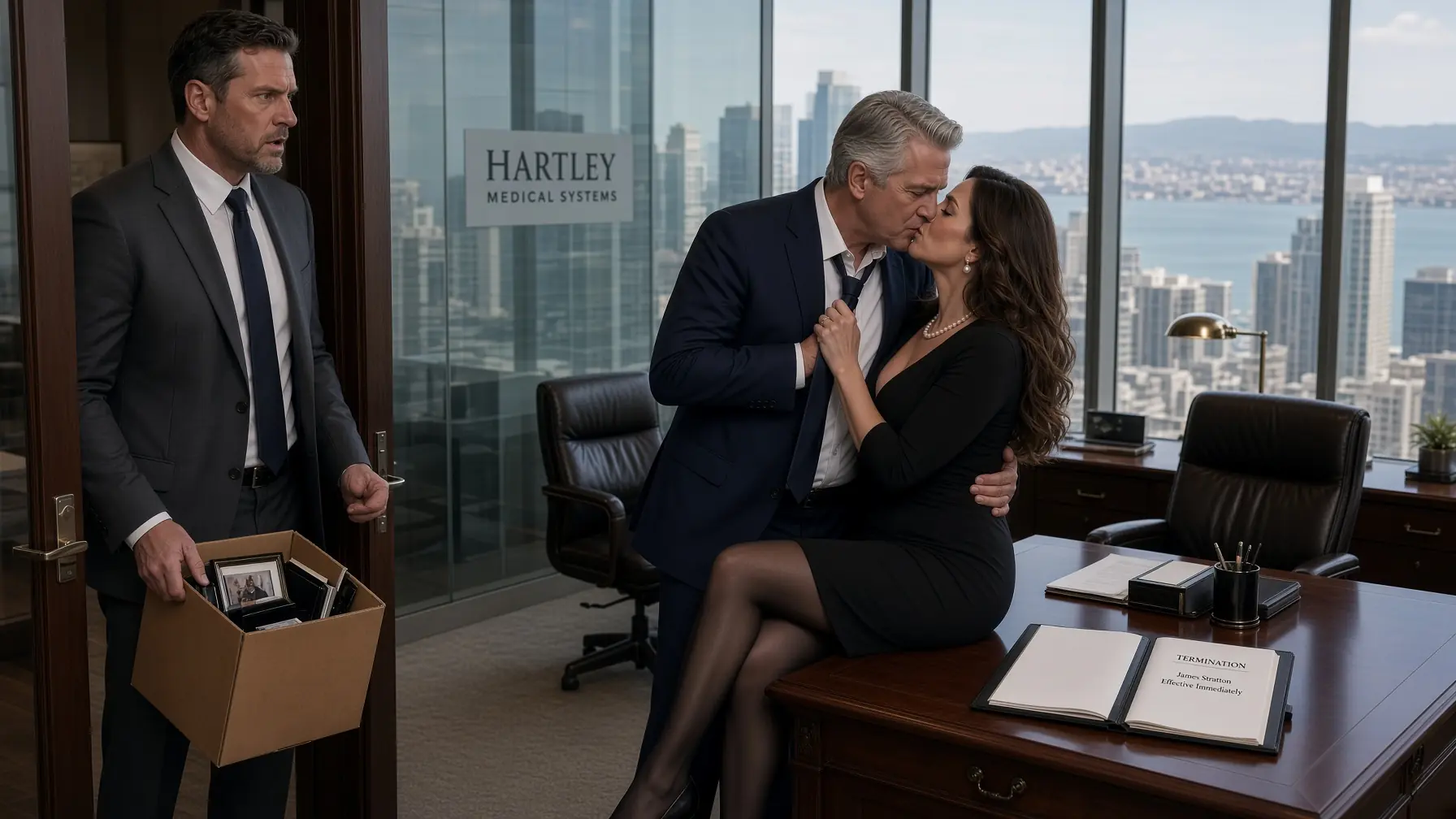
My name is James Stratton, and I was forty-seven years old when my marriage, my career, and everything I thought I understood about my family collided inside one glass-walled boardroom in Foster City, California. Hartley Medical Systems manufactured imaging components, diagnostic hardware, and specialized equipment used by hospitals and outpatient clinics across the United States, and the company had grown from Richard Hartley’s two-man workshop into a privately held business employing more than seven hundred people. Richard founded it in 1981 because he believed medical equipment companies had become too comfortable charging hospitals for complexity instead of solving problems. By the time I entered his world twenty years later, Hartley Medical was successful enough to be respected and fragile enough to be destroyed by one bad decade.
I met Victoria in 1999 at a technology fundraiser in Palo Alto, back when I was a twenty-three-year-old systems engineer who believed a Stanford engineering degree qualified me to explain nearly everything to nearly everyone. She was twenty-five, magnetic, intelligent, socially effortless, and already working inside her father’s company as a junior marketing manager. We were engaged eighteen months later and married in 2001, and I joined Hartley Medical shortly afterward because Richard had spent half our rehearsal dinner arguing with me about signal processing. He called me the following Monday and said, “If you’re going to criticize my machines all night, you might as well come improve them.”
Working for my father-in-law sounded like a terrible idea, which is probably why I accepted. Richard was difficult, impatient, suspicious of consultants, and completely uninterested in flattering anyone who shared his last name. He expected Victoria to prove herself in marketing, expected me to prove myself in engineering, and once told both of us at Thanksgiving that family relationships ended at the front door of the factory. I admired him before I loved him, and with Richard those two emotions were almost interchangeable.
The company nearly broke during the financial crisis, although the pressure started building before the worst months arrived. Hartley Medical had expanded production too quickly, signed unfavorable supplier agreements, and financed two new product lines with debt that assumed hospitals would keep ordering equipment at the same pace. When credit tightened and several major customers delayed capital purchases, our cash projections went from uncomfortable to frightening in less than one quarter. Richard called an emergency meeting one Friday evening and told eight executives that if nothing changed, Hartley had less than nine months before lenders dictated the future.
I had sold the rights to two imaging-control patents years earlier and invested most of the proceeds rather than upgrading my life. Victoria and I had talked about using that money for a larger house, and she was furious when I suggested putting a significant portion into Hartley Medical instead. Richard did not accept it as a sentimental family rescue, because he would have considered that insulting to both of us. He structured the investment as a recapitalization in which I purchased voting common shares at a valuation supported by an outside appraisal, and for the first time I became more than an employee married to the founder’s daughter.
My initial stake was large enough to matter but nowhere near enough to control the company. What mattered more was what followed, because Richard gave me operational responsibility to justify every dollar I had risked. I renegotiated supplier contracts, redesigned production scheduling, consolidated overlapping engineering teams, standardized parts across several product lines, and cut operating costs without eliminating the manufacturing jobs Richard considered the company’s backbone. Richard liked to tell people I saved Hartley with math, but the truth was hundreds of employees saved it by accepting difficult changes without being treated as disposable.
Victoria hated that version of the story. She preferred telling people the family had pulled together during a crisis, which sounded gracious while conveniently blurring who had done what. She was not incompetent, despite the way anger later tempted me to describe her; she understood clients, presentation, physician networks, and brand positioning far better than I ever would. Her weakness was that she gradually began confusing visibility with contribution, and because marketing put her in front of cameras, investors, conferences, and gala dinners, she started believing the person most often seen representing Hartley must be the person most responsible for its success. Richard noticed that long before I did.
Our son Brandon was born first and grew into the kind of young man who could walk into a crowded room and know within two minutes who mattered. Emily came three years later and inherited my tendency to ask the question everyone else wished had remained unasked. Brandon studied business, joined Hartley Medical after college, and eventually received a junior seat on the private company’s board because Richard believed exposure to governance would teach him responsibility. Emily went to Northwestern to study journalism and responded to nearly every family discussion about the company by saying, “This is exactly why I’m never working for any of you.”
Richard adored both of them. He took Brandon to investor meetings and challenged him to explain every financial term afterward, while he sent Emily newspaper articles covered in handwritten arguments about what the reporter had missed. His cancer diagnosis came unexpectedly, and the decline took less than a year. During those months, Victoria became increasingly involved in board discussions because Richard’s energy faded, while I spent more time running operations and less time noticing the political structure forming around me.
I had reasons for missing the signs. Hospital orders were changing, two important suppliers were merging, and a new imaging platform was six months behind schedule. At home, Richard’s illness had turned every dinner into a careful performance where nobody wanted to mention that he was dying. Victoria spent more time with him than I did during those final months, which I respected, and I mistook their increased discussions about the business as a father preparing his daughter emotionally for life without him. I did not realize Victoria interpreted those same conversations as a coronation.
Richard died early on a Sunday morning with Victoria, Emily, Brandon, and me nearby. His funeral was held the following Thursday at Riverside Memorial, a landscaped cemetery where even grief seemed professionally maintained. More than two hundred people came, including surgeons, hospital executives, former employees, suppliers, politicians, investors, and competitors who had spent decades arguing with Richard before discovering they liked him once he was gone. The service program described Victoria as Richard’s daughter and executive successor in the family business, wording I had never approved and immediately understood had not appeared accidentally.
My name appeared once, under the list of surviving family members. I was seated three rows behind Victoria because the front row had been reserved for her, Brandon, the board chairman Thomas Reeves, and several longtime associates Richard’s event planner considered part of the official company delegation. Emily ignored her assigned chair and sat beside me instead. She took my hand before the service started and whispered, “Dad, this is weird,” and I answered, “I noticed.”
Victoria delivered the eulogy with the poise that had made her effective in front of audiences for decades. She spoke about Richard’s courage, his belief in innovation, his refusal to accept mediocre equipment, and his hope that Hartley Medical would continue changing medicine long after he was gone. Every sentence was technically true, yet the speech gradually shifted from remembrance to succession until phrases like “the future we discussed” and “the responsibility he entrusted to me” began sounding less like grief and more like a shareholder presentation. I watched Thomas Reeves nod at exactly the wrong moments.
The first person congratulated her before the casket was loaded into the hearse. He was an investor named Martin Calloway, and he hugged Victoria before murmuring, “Your father always knew you’d take it from here.” The second was a hospital executive, the third a board member, and by the fourteenth I had stopped wondering whether people were being insensitive because it was obvious Victoria had been privately signaling her expected promotion for weeks. Emily counted them too.
“Fourteen,” she whispered after the burial. I asked what she meant even though I knew, and she said, “Fourteen people congratulated Mom at Grandpa’s funeral.” Brandon stood ten yards away beside Victoria, shaking hands with men twice his age and visibly enjoying being treated as part of the incoming leadership family. Emily looked at him, then back at me, and asked, “Do they know something you don’t?”
I had spent years teaching engineers not to answer questions before checking the data. “Maybe,” I said. Emily squeezed my hand and told me that was the most annoying answer I could possibly have given. I smiled because she was right. Deep down, though, I was beginning to understand that Richard’s funeral had merely made public something that had already been decided in private.
The first practical sign arrived Monday morning when my password stopped working. IT restored access within twenty minutes, but several financial dashboards remained unavailable. By Tuesday, meetings I had organized disappeared from my calendar and reappeared under Victoria’s name, while people stopped including me on executive threads I had started. Nobody announced a change, which made the change more obvious.
Wednesday morning, my badge opened the headquarters lobby but failed at the executive-floor elevator. Janet Morales, our longtime security supervisor, stared at her monitor and became visibly uncomfortable. “Your executive credentials are under transition review,” she told me, and when I asked what transition she meant, she lowered her voice and said, “Mr. Stratton, I only know what they entered.” I thanked her and let her escort me upstairs because refusing would have embarrassed both of us.
The elevator opened directly across from the operations conference room. Through the glass wall I saw Victoria seated at the head of the table in the chair I had occupied during Wednesday operations meetings for more than a decade. Brandon sat on her right, and eight executives surrounded them while a slide from the quarterly forecast I had built three weeks earlier glowed on the screen. Victoria saw me standing outside and continued speaking.
That hurt more than I expected. I could have tolerated a political fight, because business had given me plenty of those, but being erased in silence was different. Everyone around the table knew I should have been inside, and not one person moved. I finally turned away because there is a particular kind of humiliation in waiting for people to acknowledge something they have collectively decided not to see.
Two employees were packing files inside my office. One was Derek Lang from human resources, a nervous twenty-six-year-old who had worked for Hartley less than a year, and the other was Melissa Crane, Victoria’s executive assistant. Derek told me they were consolidating duplicate executive materials for the transition, while Melissa explained that Mrs. Stratton had requested centralized control of strategic records. Hearing my wife described as Mrs. Stratton in the same sentence that removed files from my office made our marriage sound like a legal entity being reorganized.
I picked up the framed photograph of Emily’s high-school graduation. Next came a small titanium component from our first successful digital detector housing, a paperweight Richard gave me after we renegotiated our largest supplier contract, and two notebooks containing personal sketches that were not company records. I left the patents, contracts, technical notebooks, and project documents because they belonged to Hartley Medical no matter how much of my life was inside them. Derek looked relieved when I said, “Take care of the originals,” as though he had expected me to start throwing boxes.
Thursday, my parking space was reassigned to Victoria. Friday, a new security guard could not find active employee credentials under my name and made me sign the visitor log while apologizing repeatedly. None of those indignities mattered on their own, but together they told me exactly what Victoria was doing. She wanted my departure to feel inevitable before anyone formally announced it.
I did not confront her. That confused her more than anger would have. At dinner Friday, she discussed Richard’s estate administration, Brandon’s role in business development, and a scheduled call with lenders as though we were two colleagues sharing a kitchen. I listened, washed my plate, and asked whether she wanted coffee.
Victoria finally said, “You’ve been quiet.” I told her there did not seem to be much she wanted to hear from me, and she replied that I was being overly sensitive about a necessary transition. She said Richard’s death required clearer leadership and that people needed to know where decisions came from. I asked whether that meant her, and she answered, “For now, yes.”
I should explain what Victoria believed because arrogance alone does not account for what happened. Richard’s estate plan left her substantial economic ownership, and she knew she would inherit more shares than either of our children individually. She also knew Richard had reduced his day-to-day involvement and increasingly invited her to sit in strategic meetings during his final months. What she did not understand was that ownership, voting power, board authority, and executive office were four different things.
Hartley Medical was privately held. There was no public stock price scrolling across television screens, no daily SEC filing showing casual observers exactly who controlled voting power, and much of the founder’s block sat inside trusts and shareholder agreements created over decades. I owned thirty-four percent of voting common shares directly by the time Richard became ill because my original recapitalization stake had been supplemented by option exercises and purchases from two retiring early investors. That alone made me the largest individual shareholder after Richard, but it still did not give me control.
Richard had retained twenty-seven percent of the voting shares personally. Years earlier, after a succession dispute at another family-owned medical company nearly destroyed one of our suppliers, he created a formal voting trust covering his founder block and several smaller family holdings. The trust did not give me those shares economically, and it did not take inheritance away from Victoria. It designated me as successor voting trustee upon Richard’s death for a limited term, meaning beneficiaries still owned the financial value while I temporarily controlled how that block voted on directors and certain major corporate matters.
My own thirty-four percent combined with the voting trust represented just over sixty-one percent of the voting power. Victoria would still own significant economic interests through inheritance, while Brandon and Emily had smaller blocks gifted by Richard over the years. None of them were being robbed. Richard had simply separated money from control because he believed the person benefiting from a company did not automatically deserve the power to run it.
Victoria knew a voting trust existed. She had seen references to it in board materials and estate summaries. What she apparently never did was read the controlling agreement closely enough to understand who became trustee when Richard died. I knew, Arthur Hastings knew, the corporate secretary knew, and Richard knew, but Richard had insisted for years that I never use the arrangement as a threat inside the family.
“You exercise those votes only if the company needs them,” he told me in 2019. I asked how I was supposed to decide when that happened, and he answered, “If you have to ask whether it’s personal, wait.” Then he added, “If someone starts hurting the company because they think my death makes the rules disappear, stop waiting.” I had hoped never to discover which category Victoria would choose.
Five days after the funeral, the board summoned me at nine in the morning. Seven directors were present, including Thomas Reeves as chairman, Patricia Vaughn as chief financial officer, Dr. Martin Kessler from research, two outside directors, Victoria, and Brandon. Richard had given Brandon a board seat the previous year as an educational responsibility, and I had argued against it because twenty-two was too young for fiduciary obligations he barely understood. Richard told me people learned adulthood faster when decisions carried weight.
I entered as a visitor because my employee badge had been deactivated the previous Friday. Nobody stood. Thomas gestured toward the empty chair opposite Victoria and began with the sentence every executive recognizes immediately: “James, we appreciate everything you have contributed.” Past tense is one of corporate America’s most reliable warning systems.
Thomas continued by explaining that Hartley Medical needed unified leadership after Richard’s death. He said the board had decided my role as chief operating and technology officer no longer fit the organizational structure Victoria planned to implement. My employment would end immediately, the company would provide twelve months of salary continuation plus benefits, and certain unvested compensation would be accelerated subject to the release documents in front of me. He called the package generous three times.
I looked around the table. Patricia would not meet my eyes, Martin Kessler stared at his tablet, and one of the outside directors looked genuinely uncomfortable. Brandon sat beside his mother with his hands clasped, and when Thomas asked directors to confirm the written resolution, my son raised his hand. That was the moment the business dispute stopped feeling professional.
Victoria studied me carefully. I knew what she expected because twenty-three years of marriage teaches you the expressions a person imagines before a confrontation. She expected anger, disbelief, maybe a speech about loyalty and sacrifice, followed eventually by negotiation. Instead, I counted silently to five.
“Understood,” I said. Victoria’s face changed by half an inch. Patricia pushed the separation agreement toward me, and I left it untouched while saying my attorney would review anything requiring a signature. Thomas asked whether I wanted to make a statement, and I stood, buttoned my jacket, and told them, “Only that this has been educational.”
I walked out without slamming the door. The elevator ride lasted perhaps twenty seconds, yet I remember every light above the door changing. My phone buzzed before I reached the lobby, and Emily’s message said Brandon had told her they fired me. She asked whether I was okay.
I typed, I’m fine. She immediately asked what I was going to do, and for a moment I considered writing an explanation about fiduciary duties, voting trusts, succession documents, and the difference between employment and ownership. Instead, I wrote, Monday will be interesting. Her answer came back three seconds later: That sounds terrifyingly like Grandpa.
I spent the next two hours packing my personal belongings. The office looked unfamiliar without the papers, models, whiteboard notes, and equipment samples that had accumulated over years, and I realized how little of the physical space had ever actually belonged to me. I returned my laptop, badge, phone, and parking credential exactly as requested. At 11:47, I carried one cardboard box through the lobby while Martha at reception cried openly.
“This isn’t right,” she whispered. I told her, “It’s going to be all right,” because saying anything else would have made her part of a fight she did not choose. Outside, the parking garage smelled like concrete and engine exhaust. For the first time in twenty-three years, I drove away from Hartley Medical without knowing when I would return.
Our house in Atherton was quiet when I arrived. Victoria’s Mercedes was not in the driveway, but white flowers had appeared in the foyer and Richard’s favorite bottle of Macallan sat on the bar cart with several inches missing. I put my cardboard box near the stairs and went to change. When I came down twenty minutes later, Victoria was home.
She was sitting in the brown leather armchair I bought at an estate sale in 2008. She had complained for seventeen years that the chair was too masculine, too heavy, and too dark for the room, yet there she was with her shoes off and her feet tucked beneath her, holding a crystal tumbler of her father’s Scotch. Richard had given me the bottle on my forty-fifth birthday and told me to save it for an occasion that deserved patience. Victoria apparently believed my termination qualified.
“This is better for everyone,” she said before I asked. I stayed standing. She took a small drink and continued, “You were never happy with the corporate side, James, and your strengths are technical rather than strategic.” I almost admired how efficiently she converted my firing into an act of generosity.
I asked whether Richard had told her I lacked strategic ability. Victoria said he did not need to use those exact words because she could see how he had begun including her in higher-level discussions. According to her, Richard had finally recognized that Hartley needed someone who could present a broader vision rather than someone obsessed with operations, production yields, supplier risk, and engineering details. I said, “Those details are generally where medical equipment companies live.”
Victoria smiled sadly, almost maternally. “That’s exactly what I mean.” She told me I was brilliant but too close to the machinery, too emotionally attached to old systems, and too resistant to changes she considered necessary for growth. For twenty-three years I had argued with executives who disagreed with me, but hearing my wife reduce my work to technical stubbornness produced a different kind of exhaustion.
I looked at the tumbler in her hand. “Did you ever read your father’s voting agreement?” I asked. Victoria stopped moving.
“What voting agreement?” she said. I knew from her face that she understood exactly which document I meant, but she had never considered it dangerous. “The 2012 restatement, amended in 2019,” I said, and her fingers tightened around the crystal.
Victoria recovered quickly. “The trust distributes Dad’s shares according to his estate plan.” I told her that was partly true. She said her attorneys had already reviewed the estate structure and she would receive the largest family block. I said, “Economically, yes.”
Her eyes changed. “What does that mean?” I looked toward the Scotch bottle and said, “It means you should have read the section about voting rights before you fired me.” Then I picked up my cardboard box and went upstairs.
Victoria followed me halfway. She demanded an explanation, and when I kept walking she called my name with the tone she usually reserved for executives who had missed deadlines. I entered my study, closed the door, and called Arthur Hastings. He answered on the second ring.
Arthur had represented Richard personally for more than forty years. He was seventy-one, thin, silver-haired, and almost offensively unimpressed by money, titles, family names, or emotional arguments. When I said, “Arthur, they did it,” he was silent for two seconds. Then he asked, “Brandon too?”
“Yes.”
Another silence followed. Arthur finally said, “Richard hoped the boy would ask one more question before raising his hand.” I closed my eyes. “So did I.”
We agreed to meet Sunday afternoon. Nothing legally required us to wait until Monday, but Arthur wanted the corporate secretary, trust administrator, outside governance counsel, and every relevant original document available before we acted. That was the difference between revenge and control. Revenge wants the other person to feel the blow; control wants the blow to survive scrutiny afterward.
Victoria spent most of Saturday on the phone. She did not ask me about the voting agreement again, which told me her attorneys were trying to figure it out for her. Brandon came home once, avoided my study, packed several things, and left after twenty minutes. Emily called twice and asked whether she should fly back from Chicago.
“No,” I told her. She argued that something was obviously happening, and I said exams mattered more than family politics. Emily replied, “Grandpa is dead, Mom fired you, Brandon voted for it, and you’re speaking like a Bond villain about Monday, but sure, let’s pretend my media-law midterm is the emergency.” I laughed for the first time all week.
Sunday afternoon, I drove to Arthur’s office in Palo Alto. His firm occupied a restored Victorian house surrounded by newer glass buildings, and entering always felt like stepping into a quieter century. Arthur was waiting with Margaret Vickers, the independent trust administrator Richard appointed when the voting arrangement was amended. Margaret had spent three decades managing closely held family trusts and possessed a talent for making complicated people behave because she treated everyone as paperwork with shoes.
A thick binder sat on the table. Arthur opened with my direct share certificates, purchase agreements, stock ledger extracts, and the board approvals supporting each transaction. Nothing in the binder magically created ownership that had not existed before. It simply proved the ownership everyone at Hartley Medical should have confirmed before pretending my employment status had anything to do with my shareholder rights.
Margaret opened the voting trust. Richard’s twenty-seven percent founder block had been placed into a trust that preserved economic benefits for his beneficiaries while assigning voting authority according to a succession mechanism. During Richard’s lifetime, Richard voted the shares. Upon his death, subject to certification by the trustee, voting authority passed to me for up to ten years unless earlier terminated by specified conditions.
The agreement did not make me owner of Richard’s wealth. Victoria would receive substantial distributions and economic interests, while Brandon and Emily remained beneficiaries of portions their grandfather designated for them. What I received was responsibility, not a hidden fortune. Combined with my direct shares, I controlled slightly more than sixty-one percent of the company’s voting power.
“They fired the person who could replace the board that fired him,” Margaret said. Her delivery contained no amusement. Arthur looked at her and said, “That is one way to summarize a week of poor governance.” I asked whether the board could legally terminate me as an employee despite my voting power, and Arthur said yes.
That answer mattered. Being controlling shareholder did not mean Victoria’s board action had never happened. Unless my employment agreement, shareholder rights, or other rules were violated, a properly constituted board could remove me from an executive position even if doing so was politically foolish. What my voting control meant was that I had the lawful ability to change directors through the mechanisms in the company’s governing documents, and those directors could then revisit leadership.
I asked whether we should remove the entire board. Arthur immediately said no. Margaret agreed. A controlling shareholder who purges every dissenter after being fired looks less like a steward and more like the exact governance risk Richard had been trying to prevent.
We reviewed each director individually. Two outside directors had opposed the speed of Victoria’s transition but eventually voted with the majority after being told Richard intended her to lead. Martin Kessler had abstained from informal discussions and then supported my termination because Thomas assured him the ownership structure had been reviewed. Patricia Vaughn appeared uncomfortable throughout, but she had signed the financial materials supporting the severance package.
Thomas Reeves was different. Emails obtained from corporate counsel showed Thomas had worked with Victoria for months on a succession plan while Richard was still alive, despite never obtaining written confirmation that Richard had selected her as permanent CEO. Brandon had been included in several meetings but mostly listened. The seventh director, retired hospital executive Denise Kramer, had explicitly warned them to wait until the trust certification was complete. They ignored her.
“We do this narrowly,” I said. Arthur nodded. We prepared a majority-shareholder written consent removing Thomas and two other directors who had knowingly bypassed succession verification, then appointing three independent replacements with healthcare, finance, and governance experience. I left Denise and Martin in place because neither had acted dishonestly, even though both had made decisions I hated.
Margaret looked at me. “And Victoria?” I said the new board would decide her role after reviewing the transition process. Arthur watched me carefully. “You don’t want to remove her personally?” he asked.
“Of course I do,” I said. “That’s why I shouldn’t be the only person deciding.” Arthur smiled faintly. “Richard would approve of that answer.” I hated how much hearing that still mattered.
Then Arthur gave me Richard’s final letter. It was not sealed with theatrical red wax, and it did not announce that the company secretly belonged to me. It was three handwritten pages on ordinary Hartley stationery. Richard had written it two months before entering hospice.
The opening hurt immediately. James, if you are reading this, then I am gone, and something serious enough has happened that Arthur believes you need to be reminded why I put these votes in your hands. He explained that he loved Victoria but feared she increasingly treated leadership as inheritance, while Brandon remained young enough to confuse proximity to authority with qualification. Then he wrote the sentence I read six times.
Do not use control to punish them. Use it to protect the company from anyone, including yourself, who mistakes ownership for competence. I lowered the page. Arthur said nothing.
Richard continued by reminding me that Hartley Medical existed because technicians, assemblers, quality specialists, engineers, nurses, physicians, logistics workers, and hundreds of people without his last name had trusted the company with their careers. He told me never to turn those people into collateral damage in a family argument. His final line said, If the company needs you to hold the wheel, hold it; when it no longer does, have enough sense to let go.
I folded the letter and sat quietly. For days I had imagined Monday as the moment Victoria discovered she had fired the wrong man. Richard’s letter made that fantasy feel embarrassingly small. This was not about winning our marriage inside a boardroom.
At 8:30 Monday morning, Hartley Medical’s corporate secretary delivered notice that majority shareholder action had changed the composition of the board. Copies went simultaneously to all directors, company counsel, the trust administrator, and affected parties. The notice included the verified stock ledger, trust certification, governance documents, and legal opinion supporting the action. Nobody had to believe me personally.
My phone began ringing at 8:37. Victoria called first. Thomas called twice.
Patricia texted, James, I need to understand what is happening. I answered, The documents explain it. Board meeting at noon. She replied, You control 61.2%? I wrote, Voting power, yes.
At 9:04, Brandon called. I answered because he was my son before he was a director. His first words were, “Dad, Mom says you’re taking Grandpa’s company away from us.”
“No,” I said. “Your grandfather gave all of us different rights and responsibilities.” Brandon sounded confused. He said Victoria had told him Richard’s shares would pass to her and eventually to him and Emily. I told him the economic inheritance and voting authority were separate.
“Why didn’t Grandpa tell us?” he asked. I said, “He did, in the documents you voted without reading.” Brandon went silent. I hated the cruelty in my sentence the moment it left my mouth, even though it was true.
At 10:15, Arthur received a call from Victoria’s attorney, Preston Hale. Preston wanted confirmation of the voting trust, direct-share percentages, and the procedure used for the shareholder consent. Arthur answered every question and offered inspection of originals. He did not say “see you in court” because competent lawyers usually prefer preventing unnecessary court dates.
Preston eventually asked whether I intended to strip Victoria of her inheritance. Arthur told him absolutely not. Her beneficial interests remained untouched. Only board governance was changing.
That distinction spread quickly. Several board members who had initially believed I was launching a retaliatory takeover realized I was not claiming Victoria’s shares, freezing her distributions, or challenging Richard’s estate. I was using voting power that had existed before the funeral. The mistake was not that Victoria failed to predict a clever revenge strategy.
The mistake was believing the cap table did not matter because she had already occupied the chair.
I arrived at headquarters at 11:42. Martha looked at me from behind reception and slowly pushed the visitor clipboard aside. “Do I still need to sign in?” I asked. She smiled despite herself and said, “Corporate counsel reinstated your shareholder access this morning.”
“Shareholder access,” I repeated. “Very glamorous.”
The executive floor felt different, but not because people suddenly loved me. Doors closed when I passed. Conversations stopped.
Fear travels faster through companies than strategy.
The boardroom doors were already open. Victoria sat near the head of the table, although Margaret Vickers had placed the formal meeting materials in front of the central chair. Denise Kramer and Martin Kessler were present, along with the three newly appointed independent directors. Brandon sat against the wall because his director seat had been one of the positions removed by the shareholder consent.
Victoria stared at me as I entered. “You planned this,” she said. I put Richard’s letter and my binder on the table and answered, “Your father planned the governance structure years ago. You planned the crisis.”
Margaret called the meeting to order. The first item was not Victoria’s removal. It was verification that the reconstituted board had been lawfully seated and had received the trust certification, shareholder ledger, and counsel’s opinion.
Twenty-three minutes disappeared into procedure.
Victoria interrupted twice. Margaret stopped her twice. Preston Hale sat behind Victoria and eventually whispered something that made her stop objecting.
The second item was the status of my employment. Martin Kessler stated that my termination had been rushed through without a succession-risk review, without verification of controlling shareholder rights, and without consultation with the independent directors who had raised concerns. Denise said the process had been irresponsible even if the board possessed technical authority to terminate an officer. Nobody claimed the termination magically never happened.
One of the new directors, retired hospital executive Lillian Price, asked me whether I wanted immediate reinstatement as chief operating and technology officer. I said no. Victoria looked surprised.
“I want the board to review what structure the company needs,” I said. “I’m not going to criticize someone for using a funeral as a shortcut to the CEO chair and then use voting control as my shortcut back.” Margaret’s eyes lifted from her notes.
The third item concerned Victoria. Denise asked whether she had represented herself to employees and outside stakeholders as Richard’s chosen permanent successor before the board completed a formal search. Victoria answered that Richard had clearly indicated confidence in her leadership.
“Did he appoint you?” Denise asked. Victoria said the transition had been understood.
“That wasn’t the question,” Denise replied.
Victoria looked toward me. I did nothing.
The board reviewed emails showing she and Thomas had begun describing her internally as incoming CEO months before Richard’s death. They also reviewed communications directing IT to reduce my system access before the board voted on my employment. One email from Victoria instructed HR to “make James’s departure feel operationally complete before the formal conversation so there is no room for resistance.”
That sentence changed the room.
It did not prove fraud. It did not make her a criminal. It proved she had engineered the appearance of inevitability before obtaining formal authority.
Lillian Price asked Victoria why.
Victoria answered honestly enough to hurt. “Because James never lets anything go without turning it into a debate.”
I almost responded.
Then I realized she was talking to the board.
Victoria continued. She said I challenged every assumption, slowed projects, demanded evidence, and forced executives to defend decisions she believed should have moved faster. According to her, Hartley Medical could not modernize if every strategic initiative had to survive James Stratton’s interrogation.
Martin Kessler spoke before I could. “That interrogation prevented three bad acquisitions in eight years.”
Victoria turned toward him.
He continued, “I hated him during all three.”
A few people almost smiled.
Then Martin added, “He was right.”
The board voted to remove Victoria as interim chief executive. The decision was six in favor and one abstention. I had voting control at the shareholder level but no seat on the board during that particular vote because I wanted the governance process separated from my personal authority. Victoria remained a shareholder and beneficiary, but her executive employment was placed on administrative leave while an independent review examined the transition.
She did not scream. That would have been easier.
Victoria sat perfectly still as Margaret announced the result. She looked at each director individually, as though memorizing who had betrayed her. Then she looked at me.
“You did this,” she said.
I shook my head. “I stopped you from doing it without scrutiny.”
“That’s the same thing.”
“No.”
Her eyes filled with anger.
“You’ve always needed everyone to admit you’re the smartest person in the room.”
I almost laughed because Richard had accused me of the same flaw years earlier.
“Maybe,” I said. “That still doesn’t make you CEO.”
Victoria gathered her phone and portfolio. Brandon stood when she did. She told him, “Come on,” without looking at me.
Brandon hesitated.
That was the first crack.
Victoria turned.
“Brandon.”
He looked toward me and then toward his mother. Finally he said, “I’m staying for the rest of the meeting.”
The expression on Victoria’s face changed more than it had when she lost the CEO title.
“Fine,” she said.
She left alone.
The board appointed Daniel Mercer, Hartley Medical’s sixty-year-old head of manufacturing, as interim chief executive. Daniel had no Hartley blood, no glamorous public profile, and no desire to keep the job permanently. He had spent twenty-eight years inside the company and knew the production floor better than anyone alive except me.
When Margaret asked whether I supported him, I said yes.
That was my first use of control that day.
Not taking the chair.
Choosing someone who did not need it.
The board reinstated me as an employee pending negotiation of a new role, but I asked to return temporarily as executive vice chairman responsible for technology, operations, and governance review rather than CEO. The company did not need another family member declaring victory. It needed stability.
At 3:15, I walked into my old office. The boxes remained stacked against the wall. Derek from HR appeared in the doorway looking terrified.
“Should we unpack these?” he asked.
I looked at the boxes.
“No.”
His face fell.
“I’ll do it.”
He stared.
“Mr. Stratton, I’m really sorry.”
“You followed an instruction you had no reason to think was improper.”
“I should have said something.”
“To whom?”
He had no answer.
I picked up the box containing supplier files.
“Next time you think something is wrong, ask the question.”
Derek nodded.
“That’s enough.”
The story did not immediately appear in newspapers. Hartley Medical was privately held, and we had no reason to turn a family governance failure into entertainment. We issued a brief statement saying the board had reorganized leadership following completion of founder-succession procedures. Nothing about Victoria being humiliated.
Nothing about my voting trust.
Nothing about revenge.
That disappointed people.
Employees supplied the missing drama themselves.
By Tuesday morning, the story had become mythology inside the company. In one version, Richard had secretly left me the entire corporation. In another, Victoria discovered during the board meeting that she owned nothing.
Neither was true.
Victoria still possessed substantial wealth.
Brandon still owned shares.
Emily still had her trust interests.
I simply controlled the votes Richard believed required experienced stewardship.
The marriage was harder.
Victoria did not return home Monday night.
She stayed at a hotel in Menlo Park and sent me one message at 1:14 in the morning.
I hope taking Dad’s company was worth destroying our family.
I read the sentence five times.
Then I typed a response.
I didn’t take your father’s company.
I erased it.
I tried again.