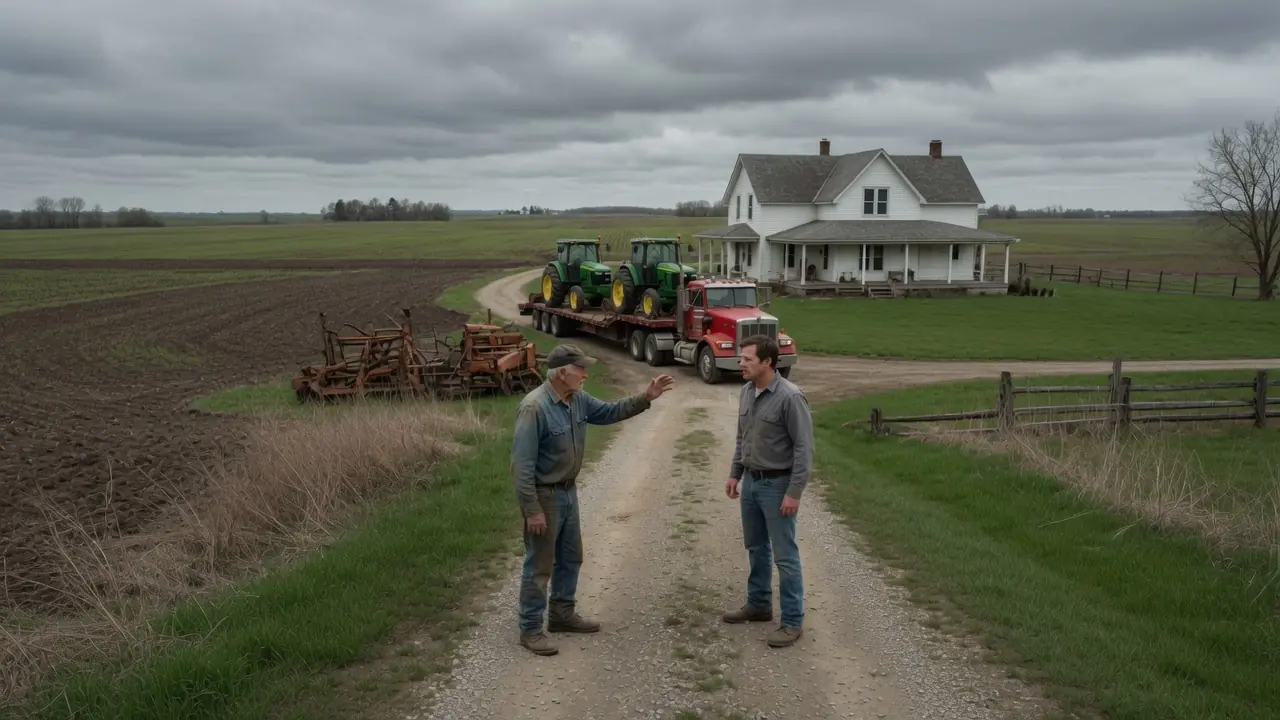
On a gray Tuesday morning in April 1978, the sound of a red semi-truck rolled across County Road 14 in Marshall County, Iowa, long before anyone saw it. The truck came slowly over the rise, pulling a flatbed trailer that carried two brand-new green-and-yellow John Deere tractors, their paint clean enough to shine even beneath the dull spring sky. The gravel road to the Patterson farm ran past a white farmhouse, a weathered barn, rusted old equipment near the field edge, and rows of wet grass bending in the wind. But before the truck could reach the barn, Earl Patterson stepped into the driveway and raised one hand.
Earl was seventy-three years old, with a bent back, gray stubble, and hands that had known more winters than comfort. His faded cap was pulled low, his denim shirt was stained from work, and his boots were planted in the gravel as if the land itself had grown them there. The truck driver braked hard, and the trailer creaked behind him while the tractors rocked slightly on their chains. Earl did not move.
The driver leaned out of the cab window, confused. “Mr. Patterson, I’ve got your delivery,” he called. “Two new John Deeres for the Patterson farm.” Earl looked up at the shining tractors, then back at the driver. “Not my delivery,” he said. “My son’s mistake, and you’re not bringing it onto this land.”
The driver climbed down slowly, holding a clipboard like it might protect him from trouble. “Sir, the paperwork says James Patterson signed for these.” Earl nodded once, as if he had expected every word. “I know what the paperwork says,” he replied. “But this ground is still mine, and no bank-owned tractor is crossing that gate while I am standing here.”
Three hundred yards away, near the white farmhouse, James Patterson came out through the side door and froze. He was thirty-four years old, strong, educated, and impatient in the way young farmers sometimes become when they believe the past is something to escape. He had a gray work shirt tucked into his jeans, boots muddy from the morning chores, and a face that turned red the moment he understood what his father was doing. The new tractors he had secretly ordered had finally arrived, and Earl was stopping them before they ever touched the farm.
James started down the driveway fast, anger driving each step. “Dad!” he shouted. “What are you doing?” Earl did not turn around right away. He kept his hand raised toward the truck and his eyes on the driver, as if one wrong movement might allow the whole future to roll past him. Only when James got close enough for the driver to hear both of them did Earl lower his hand and face his son.
Earl’s eyes hardened. “Debt is not a sin,” he said. “It is a chain, and I watched it drag your grandfather off land he loved more than his own breath.” James looked away for half a second, but pride pulled his gaze back. “This is not 1932,” he snapped. “Farming has changed.” Earl pointed toward the old barn. “Weather has not changed. Bad prices have not changed. Banks have not changed.”
The truck driver shifted uncomfortably beside them, wishing he were anywhere else. He had hauled equipment to farms all over Iowa, and he knew a family fight when he saw one. Still, he had never seen an old man stand in front of eighty-five thousand dollars’ worth of new iron and refuse it like it was poison. The tractors on the trailer looked powerful, beautiful, and dangerous all at once.
James had spent months dreaming about them. The bigger one could pull equipment his old tractors struggled with, and the cab had a comfort he had never known in the fields. The smaller one would handle planting and lighter work, saving time and fuel according to the salesman. James had imagined neighbors slowing down to look, imagined himself finally proving that he was not just Earl Patterson’s son, but the future of the farm.
Earl had imagined something different. He had imagined monthly payments arriving no matter how thin the harvest turned out. He had imagined a dry summer, corn prices falling, repair bills rising, and James sitting at the kitchen table with his head in his hands. He had imagined land that had been debt-free for decades suddenly used as a promise to men in suits who did not care whose grandfather broke the first ground. That was why he stood in the driveway.
“You told me the farm was mine to run,” James said, his voice breaking between anger and betrayal. Earl nodded. “I told you to run it, not gamble it.” James stepped closer. “You think everything new is a gamble.” Earl looked toward the tractors. “No. I think buying what you cannot pay for is a gamble, and I think you let a salesman call it progress.”
That salesman arrived twenty minutes later in a brown pickup, tires spitting gravel as he pulled behind James’s truck. Rick Holloway came out dressed in clean boots, pressed jeans, and a jacket with the dealership name stitched over the pocket. He smiled the way salesmen smile when they are trying to keep money from slipping through their fingers. “Gentlemen,” he said carefully, “let’s all take a breath here.”
Earl turned to him with a look that made the smile fade. “Rick, you sold my boy tractors he did not need and debt he did not understand.” Rick lifted both hands. “James is a grown man, Mr. Patterson. These machines will increase efficiency and help the farm compete.” Earl’s voice dropped. “The farm has competed for nearly ninety years by not owing men like you a dime.”
Rick glanced at James, hoping the son would take control of the conversation. James did, but not in the way Rick hoped. “Dad, every farm around here is upgrading. You think I can run six hundred forty acres forever with old machines patched together by wire and stubbornness?” Earl looked toward the barn, where his 4010 and 4020 sat inside, dirty but paid for. “I think a slow tractor that belongs to you is better than a fast one that belongs to the bank.”
The argument grew loud enough that a few neighbors later admitted they heard pieces of it from the county road. James accused Earl of holding him back, of making him look foolish, of treating him like a boy instead of the man who would inherit the farm. Earl accused James of confusing horsepower with wisdom and comfort with profit. Rick tried twice to interrupt, but Earl cut him off both times.
Finally, the truck driver asked what he was supposed to do. Earl faced him, and his tone softened because the driver had done nothing wrong. “Son, I know you are working. I am not blaming you.” He pointed back toward the county road. “But I am refusing delivery on my property. Take them back.”
“I can’t just take them back,” the driver said. Earl looked at Rick. “Then he can sit here all day while you explain to your dealership why your sale is parked on my driveway.” Rick’s jaw tightened, and James swore under his breath. For a long minute, nobody moved.
Then Rick made the decision he did not want to make. He told the driver to turn around and bring the tractors back to the lot until the ownership dispute was resolved. James looked at him like he had been betrayed twice in the same morning. The driver climbed back into the cab, started the engine, and the truck began the slow, awkward turn on the narrow gravel road. The two new tractors rolled away from the Patterson barn without ever being unloaded.
James stood there with dust drifting around his boots. “I will never forgive you for this,” he said. Earl watched the truck disappear toward the county road. “You might,” he replied. “But I would rather have your anger than your bankruptcy.” James said nothing, climbed into his pickup, and slammed the door hard enough to shake the window.
For three weeks, James did not speak to his father except when work required it. He arranged for the tractors to be stored at a neighbor’s shed five miles away, paid extra fees he had not planned for, and used them anyway because pride would not let him cancel the deal. He took out another loan for operating costs, telling himself it was temporary. Every payment felt small when viewed alone, but together they began to gather like storm clouds.
At first, the new tractors seemed to prove him right. They ran smooth, pulled strong, and covered ground faster than the old machines ever could. James sat in the cab with the windows closed and the engine humming beneath him, feeling like he had finally entered the modern age. When neighbors slowed their trucks to look, he lifted a hand from the steering wheel and pretended not to enjoy it.
Earl watched from a distance and said nothing. That was harder for James than another argument would have been. His father did not gloat, did not sabotage, did not lecture from the edge of the field. He simply watched the way an old farmer watches the sky, waiting for what he already knows will come.
By June, the rain became unreliable. The fields still looked green from the road, but James could see stress in the leaves when he walked the rows. He had spent heavily on fertilizer because every expert told him bigger yields required bigger inputs. But dry weather turned confidence into worry, and some of the corn began to show the cost of pushing too hard.
James ran the numbers again one night at the kitchen table. Corn prices had slipped lower than he expected. Fuel had cost more. The fertilizer bill was higher, the storage fees had annoyed him, and the equipment payments waited like a hammer at the end of every month. He tried to make the math behave, but numbers do not care about pride.
In August, the bigger tractor broke down. The repair was not covered the way James had assumed it would be. The dealership man explained it politely, with the same careful tone Rick Holloway used when selling dreams, except now the dream had become an invoice. James borrowed again to fix the machine, and for the first time, the cab of that new tractor felt less like progress and more like a seat inside a moving debt.
Harvest came with disappointment. The yield was lower than James had predicted, and the price was worse. When the last loads were counted, James stared at his books and felt something cold open inside him. He had worked more acres, with newer machines, longer hours, and bigger plans, yet he had less money left than neighbors farming half as much with equipment older than his boots.
That November, James came to dinner at the farmhouse because hunger, exhaustion, and fear had worn pride thin. Earl had made coffee and set two cups at the kitchen table without making a speech. The kitchen smelled of black coffee, wood smoke, and the same old house James had tried to outgrow. For a while, father and son sat across from each other in silence.
“How did you do?” Earl asked at last. James stared into his cup. “Bad.” Earl waited. James rubbed both hands over his face and said the number like it hurt to release it. Earl nodded slowly, not surprised, not pleased, only tired.
“Tom Wendell cleared more on half the ground,” Earl said. James’s mouth tightened. “Tom got lucky.” Earl shook his head. “Tom kept his costs low. Luck helps a man once in a while, but low debt helps him every morning.” James looked down because he knew it was true.
The confession came quietly. “How do I get out?” Earl leaned back in his chair, and for the first time that year, he looked fully his age. “There is no easy way,” he said. “You can keep going and hope for perfect years, but farming is not built on perfect years.” James swallowed. “What would you do?”
Earl looked toward the dark window, where his own reflection stared back older than he felt. “I will buy them from you,” he said. “I will pay off what remains, take the loss, and sell them myself. Then you will farm this land with paid-for equipment until you understand that ownership is not about what shines in the barn.” James closed his eyes, and humiliation flooded him, but beneath it came relief so strong it nearly broke him.
“Why would you do that after what I said?” James asked. Earl’s voice softened. “Because you are my son.” James shook his head. “I called you old and scared.” Earl gave a faint smile. “I am old. And I am scared. I am scared of debt because I have seen what it eats.”
The next week, Earl paid off the loan and took possession of the tractors. James signed the papers with a hand that shook more from shame than anger. Six months later, Earl sold both machines for less than what was owed and absorbed the loss without complaint. James never forgot watching his father write that check.
The following season, James returned to the old equipment. The tractors were slower, louder, and rougher on his back, but they were his. When something broke, he fixed it in the shop with grease under his fingernails instead of calling a dealer. The farm’s costs dropped so sharply that James began to understand profit in a way no college class had taught him.
Another hard year came, but this time the payments did not. The weather was dry, prices stayed weak, and James still had to fight for every dollar. Yet without the monthly equipment debt, the farm could breathe. He could make decisions from patience instead of panic.
Earl did not say “I told you so.” He did not need to. He and James worked together more quietly after that, arguing still, but with a different kind of respect beneath the words. James began asking before he bought, not because he needed permission forever, but because he finally understood that experience was not the enemy of progress. Earl, in return, listened when James suggested changes that did not involve borrowing against the future.
Years later, when interest rates climbed and farms across Iowa began to fall, James remembered the truck in the driveway. Auction signs appeared on land that had carried family names for generations. New equipment sat on dealership lots after being repossessed from men who had once looked successful from the road. James drove past those signs in an old paid-for tractor and felt the weight of his father’s raised hand all over again.
By then, Earl’s knees had worsened, and his hands shook when he held a coffee cup. Still, his mind remained sharp whenever the subject of debt came up. “The bank does not care how hard you worked,” he would say. “It only cares what the paper says.” James used to think that sounded bitter. Later, he realized it was mercy spoken plainly.
Earl died in 1985, after transferring the farm fully into James’s hands. The night before he passed, James sat beside his bed and held the same hand that had stopped the truck seven years earlier. The old farmer’s fingers were thin by then, but they still felt strong enough to hold the memory of every fence post, wrench, and harvest. James leaned close and said what he should have said long before.
“Thank you for stopping that truck,” he whispered.
Earl opened his eyes and looked at him with the smallest trace of a smile. “I did not stop it only for you,” he said. “I stopped it for your children, and their children after them.” James could not answer. He only held his father’s hand until the old man slept.
The Patterson farm survived the years that broke many others. James eventually bought newer equipment, but never new on credit. When he upgraded, he paid cash for used machines that had already lost their shine but still had work left in them. He learned to love equipment that belonged to him more than equipment that impressed strangers.
When James’s own son grew old enough to run the operation, the story of the stopped truck became family law. Not a legend told for drama, but a warning told at the kitchen table whenever glossy brochures arrived in the mail. The rule was simple: if the farm could not pay for it, the farm could wait. No machine was worth losing land.
Many years after that April morning, James stood at the same gravel driveway where Earl had blocked the semi. The white farmhouse still stood, the fields still opened wide beyond it, and old iron still rested near the edge of the grass. He could almost see his father there, one hand raised, body worn but will unbreakable. What had felt like betrayal at thirty-four felt like salvation in old age.
James finally understood that his father had not been against progress. Earl had been against surrendering control to debt and calling it progress because the paint was new. The tractors had promised speed, comfort, and pride, but they had also carried a chain hidden beneath their shine. Earl saw the chain before James did.
The morning the truck turned around, James believed his future had been taken from him. In truth, it had been handed back. The farm remained because one old man was willing to be hated for forty-five minutes rather than let his family be owned for forty-five years. That was the lesson buried in the gravel of County Road 14.
And whenever young farmers asked James what saved the Patterson land, he never said luck, weather, or timing. He said an old farmer stood in a driveway and refused to let debt come home. Then he would look toward the fields and add the same truth Earl had spent a lifetime proving. “The newest tractor will not save a farm, but owning what you have just might.”