Thomas Mitchell stood near his late son’s old recliner while the last murmurs from the funeral reception faded through the living room. The house was too clean, too quiet, and too full of people pretending not to look at him. He wore the same gray suit he had worn to his wife Margaret’s funeral two years earlier, and the fabric felt heavier now than it had that day. Across the room, his daughter-in-law Victoria moved through the guests in a fitted black funeral dress, accepting condolences like she was managing an event instead of saying goodbye to her husband.
David had been Thomas’s only son. He had been the boy who once ran across these hardwood floors in socks, the teenager who helped measure crown molding in the hallway, and the grown man who still came by to fix the fence when Thomas’s knees started bothering him. Losing him had hollowed something out of Thomas that words could not reach. He had not even found the strength to cry properly during the service.
Victoria had cried enough for the room. She dabbed her eyes at just the right moments, hugged the right people, and spoke about David as if she were now the official keeper of his memory. At the funeral home, she had chosen the flowers, the music, the casket, and even the photograph beside the guest book. When Thomas suggested David’s favorite old song, the one father and son used to play while building this house together in 1987, Victoria cut him off.
“That song is too depressing,” she said. “We need something more uplifting.” Thomas had not argued. He had already learned, in the two months since David’s sudden road tragedy, that Victoria did not want his grief in the center of the room. She wanted him sitting quietly where people could pity him, but not consult him. She wanted control more than comfort.
The reception had been held at the house on Maple Street. Thomas still thought of it as his house because that was what it was. He had bought the lot in 1987, hired the contractors, supervised the construction, installed the hardwood floors with his own hands, and raised David within its walls. But Victoria had been moving through it all afternoon as if the deed had changed the moment David was gone.
Thomas heard her talking to Helen Davis, the neighbor who had known him for thirty-seven years. “Tom is having such a difficult time adjusting,” Victoria said softly, her voice lowered just enough to sound kind. “David handled everything for him. Finances, house bills, repairs. Poor man really doesn’t understand how much David did.” Helen glanced at Thomas with sympathy, and the look hurt more than he expected.
He wanted to stand up and correct every word. He wanted to say that David never owned the house, that David had helped with groceries and doctor appointments because he was a good son, not because Thomas was helpless. He wanted to say he had spent forty years as a certified public accountant and could probably balance Victoria’s books faster than she could open her laptop. But grief kept him quiet, and Victoria mistook his silence for weakness.
When the last guest stepped out into the evening cold, Victoria closed the door and turned to him. Her expression changed immediately. The soft widow’s face disappeared, replaced by the sharp, practical look she used when negotiating real estate commissions. She folded her arms and said, “Tom, we need to talk about your situation.”
Thomas looked at her. “My situation?” Victoria sighed as if he were making things harder than necessary. “You’re financially dependent on us now. David was supporting you, and with him gone, I can’t carry that burden.” The word landed in the room with more force than a shout. Burden.
Thomas stood near the recliner David used to love, his hands resting at his sides. “I see.” Victoria seemed encouraged by his quiet response. “I’ve been more than generous letting you stay here this long,” she continued. “But this house is mine now. Everything David owned is mine, and I need to start making practical decisions.” Thomas slowly raised his eyes to meet hers. “Your house?”
“Yes,” Victoria said sharply. “David is gone. Everything he owned is mine now, including this place.” Thomas looked around the living room, at the walls he had painted, the window trim he had sanded, and the fireplace Margaret had insisted on even when it stretched their budget. Then he looked back at Victoria. “You should have checked what David actually owned.”
Victoria frowned, but she did not understand enough to be afraid. “Do not start being difficult tonight,” she said. “I am grieving too.” Thomas almost smiled at that, not because it was funny, but because grief had become her shield for cruelty. She stepped closer and lowered her voice. “Stop crying, pack your bags, and start looking for somewhere appropriate to live.”
There were no guests left to witness it, but Thomas heard the echo of the afternoon anyway. Victoria had been building this story all day. The helpless old father-in-law. The generous widow. The house she had inherited. The burden she would no longer carry. Thomas realized then that she had not only misunderstood his life. She had rewritten it in her own favor.
The next morning, he sat at the kitchen table with a cup of black coffee and made a list. Not of what he feared losing, but of what Victoria believed she had gained. The house, currently worth a little over four hundred thousand dollars. David’s life insurance policy, which Victoria had already mentioned twice in passing. The furniture, the old family photographs, Margaret’s china cabinet, and every memory that had become inconvenient to Victoria’s new version of the future.
What hurt most was not the money. Thomas had never been a man who measured his life by how much others thought he owned. What hurt was the erasure. Victoria had already boxed up Margaret’s photographs from the mantel, saying the living room needed a cleaner look. David’s childhood drawings had vanished from the refrigerator. Even Thomas’s framed CPA certificates had been removed from the den wall.
“I’m redecorating,” Victoria had said when he asked. “David always thought this place needed updating.” Updating. As if four decades of love were old wallpaper. Thomas had said nothing then, but the silence inside him was beginning to change shape. It was no longer only grief. It was calculation.
On Thursday morning, Victoria let herself into the house without knocking. She entered the kitchen with a manila folder under her arm and sat across from Thomas as though conducting a business meeting. “We need to discuss your finances,” she announced. Thomas took a slow sip of coffee. “What about them?”
“I need to know exactly what David was covering for you,” she said, opening the folder. “Utilities, taxes, insurance, repairs. I have to budget properly until you move out.” Thomas studied her face. “What makes you think David paid those bills?” Victoria blinked, irritated by the question. “Because obviously you couldn’t.”
“Is that what David told you?” Thomas asked. “He didn’t have to tell me,” she said. “I saw him helping you all the time. Groceries, appointments, yard work. You live on a fixed income, Tom. This house is worth over four hundred thousand dollars.” Thomas set his cup down carefully. “Have you ever seen the deed?”
Victoria’s pen stopped moving. “I don’t need to see the deed.” “No?” “David inherited the house when Margaret died.” Thomas tilted his head slightly. “Did he?” Victoria’s jaw tightened. “Of course he did. Who else would get it?”
Thomas stood and walked to the sink, rinsing his coffee cup because he needed to do something with his hands. “You have made a lot of assumptions.” Victoria gave a short, frustrated laugh. “They are not assumptions. They are facts.” Thomas turned back to her. “Then show me one fact.”
She stood abruptly, gathering her papers. “You have until November fifteenth. After that, I am changing the locks.” Thomas looked at her calmly. “We will see about that.” She paused near the doorway. “See about what?” Thomas only started loading the dishwasher. Some conversations were best continued with documents.
The next day, Thomas went down to the basement. The filing cabinet stood in the corner exactly where it had stood for years, four drawers of careful organization that Margaret used to tease him about. Each drawer was labeled by decade. Each folder had a category, a date range, and a purpose. Thomas had been a CPA too long to trust memory when paper could speak.
He opened the bottom drawer and found the folder marked Real Estate, 447 Maple Street. The first document was the land purchase agreement from March 1987, naming Thomas Mitchell as the buyer. The second was the construction contract. The third was the original deed, recorded that same year, naming Thomas as sole owner. No co-signer. No mortgage. No transfer to David.
He checked the later folders too. Property taxes, paid by Thomas. Insurance policies, in Thomas’s name. Utility accounts, maintenance invoices, roof repairs, furnace installation, landscaping, all documented year after year. David’s name did not appear on any ownership record. He had lived here as Thomas’s son, not as the owner.
Then Thomas pulled the folder Victoria knew nothing about. The Thomas and Margaret Mitchell Family Trust. Inside were the documents that had quietly supported the family for decades. The trust had helped pay for David’s engineering degree, assisted with the wedding, and provided money when David and Victoria needed help early in their marriage. Victoria had enjoyed the comfort of that help while assuming David was the source.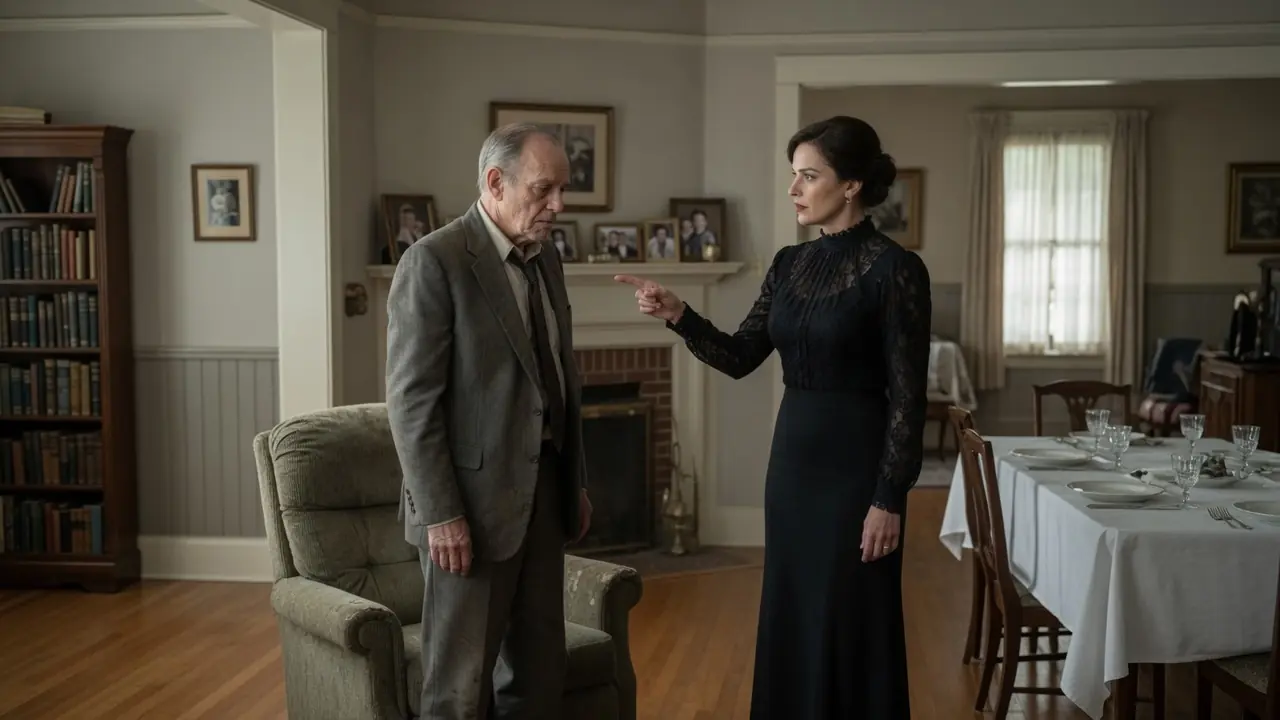
The current balance was a little over eight hundred fifty thousand dollars. Thomas was the sole trustee after Margaret’s passing. David had been a beneficiary during his lifetime, not an owner and not a trustee. The life insurance policy Victoria had been counting in her head also named the trust as beneficiary. Which meant the money was not hers. It was Thomas’s to manage through the trust.
He closed the folder slowly. The truth was not complicated. Victoria’s confidence had been built on nothing. She thought she had inherited a house, insurance money, and authority. In reality, she had inherited David’s personal effects and very little else. She had mistaken access for ownership and kindness for dependency.
Sunday morning brought the ugliest proof of who Victoria had chosen to be. Thomas was getting ready for church when she arrived with three women from her real estate office. They entered without permission and began walking through his rooms with phones raised, discussing renovations as if Thomas were already gone. Victoria’s voice floated up the stairs. “The bones are good, but the decor is so outdated. Classic old person style.”
Thomas stood at the top of the stairs and listened. One woman admired the crown molding. Victoria said, “Tom built this place, but he has no eye for modern design.” Another suggested gutting the kitchen. Victoria replied, “That’s the plan once he moves to a senior community.” Full control, she said. Over his kitchen, his walls, his memories.
He came downstairs in his church clothes. The three women turned, embarrassed, but Victoria smiled brightly. “Tom, perfect timing. I wanted you to meet some colleagues.” Then she introduced him like a piece of property attached to the listing. “This is Tom, David’s father. He is transitioning to a more suitable living situation.”
“Is that what I’m doing?” Thomas asked. Victoria’s smile stiffened. “We discussed this.” “No,” he said. “You discussed it. I listened.” The women exchanged uncomfortable looks, but Victoria pushed forward, perhaps believing retreat would make her look weak.
She began talking about maintenance issues that did not exist. A roof leak. Furnace problems. A damp basement. Thomas corrected each one calmly. “The roof is sound. The furnace is two years old. The basement has been dry for twenty years.” Victoria’s expression tightened. “Tom is very attached to this place. Sometimes he does not see problems that are obvious to others.”
“Problems like what?” Thomas asked. Victoria lost patience. “Like the fact that you cannot afford to maintain a house this size anymore.” The room went still. One of the agents lowered her phone. Thomas looked at Victoria and asked, “And you know that how?”
“Because you have been living off David’s generosity,” she said. “Everyone knows it.” Thomas felt a quiet sadness then, not because she was right, but because she had finally said the lie in front of witnesses. “You might want to check your facts before saying that again,” he said.
Victoria laughed nervously. “Tom, I’m a real estate professional. I know how property ownership works.” Thomas looked at the women near the door. “Then before you plan renovations, ask Victoria to show you the deed.” Victoria’s face went pale. “Tom, don’t.” He took his coat from the hall closet. “Don’t what? Tell the truth?”
He left for church, but he did not go straight there. He sat in his car for several minutes, hands on the steering wheel, thinking about Margaret, David, and the strange way grief could be sharpened by disrespect. Then he drove to his attorney’s office and left a message. By Monday morning, Margaret Collins, his lawyer of twenty years, had the folders on her desk.
Margaret reviewed everything with professional calm. The deed. The tax records. The insurance policies. The trust. The life insurance beneficiary form. When she finished, she leaned back and removed her glasses. “Tom, legally this is very clear. Socially, it may become unpleasant.”
“It is already unpleasant,” Thomas said. “She called me a burden in my own living room.” Margaret’s expression softened. “What do you want?” Thomas looked down at the folder holding the deed. “Clear boundaries. Formal notice that she is not the owner. The insurance processed through the trust. And the truth delivered where her lies were loudest.”
Margaret understood immediately. “Her office?” “Yes.” “With colleagues present?” “The same kind of audience she invited into my home.” Margaret considered this for a long moment. “This is not necessary legally.” Thomas nodded. “But it is necessary socially.”
Tuesday at ten o’clock, Thomas and Margaret Collins entered Premier Realty on Main Street. Victoria was at her desk with a young couple, smiling over house photos. Her smile disappeared when she saw Thomas and the attorney beside him. “Tom? What are you doing here?” Margaret stepped forward. “We need to discuss urgent legal matters regarding your late husband’s estate.”
The young couple sensed the tension and quickly excused themselves. Other agents pretended to work but slowed their typing. Jessica, the blonde agent who had toured Thomas’s house, stepped closer. Victoria tried to regain control. “Tom is having difficulty accepting his new living situation.”
“Actually,” Margaret Collins said, opening her briefcase, “Thomas is having difficulty accepting false claims about his old living situation.” Victoria’s face hardened. “There are no false claims. I inherited David’s house.” Margaret removed the deed and placed it on the desk. “David did not own a house.”
The office fell silent. Victoria stared at the document. “That’s impossible.” “447 Maple Street is owned by Thomas Mitchell,” Margaret said. “Purchased and recorded in March 1987. No co-owner, no mortgage, no transfer to David.” Victoria picked up the paper with shaking hands. “But David lived there his whole life.”
“As Thomas’s son,” Margaret replied, “in Thomas’s house.” Jessica covered her mouth slightly. Another agent leaned over to read the document. Victoria’s professional composure began to unravel.
“What about the bills?” Victoria demanded. “David paid everything.” Margaret placed tax records beside the deed. “Property taxes paid by Thomas Mitchell for thirty-seven years. Insurance, utilities, maintenance, all in his name and paid from his accounts.” Victoria looked at Thomas. “But David helped you.”
“He helped me as a son,” Thomas said quietly. “Groceries, rides, yard work. I helped him financially.” Margaret opened the trust folder. “The Thomas and Margaret Mitchell Family Trust currently holds over eight hundred fifty thousand dollars. David was a beneficiary during his lifetime, not an owner. The trust helped support him and, by extension, the household he shared with you.”
Victoria sat down slowly. “No.” Margaret placed the life insurance document on top. “David’s life insurance also names the trust as beneficiary.” Victoria’s voice thinned. “That money was supposed to be mine.” Thomas looked at her with the first hard expression he had allowed himself. “You were spending money you never had.”
The office was so quiet that the hum of the lights seemed loud. Victoria looked around and realized everyone had heard. The women who had walked through Thomas’s home discussing renovations now knew she had not even verified ownership. The colleagues who trusted her real estate judgment had just watched that judgment collapse.
“Tom,” Victoria whispered, “I didn’t know.” Thomas answered gently but firmly. “You didn’t ask.” “You could have told me.” “You could have shown respect.” Margaret handed Victoria formal notice. “You have thirty days to secure alternative housing arrangements. The same amount of time you gave Thomas.”
Victoria looked up sharply. “Where am I supposed to go?” Margaret’s voice remained professional. “You are an employed adult. That is no longer Thomas’s responsibility.” Victoria turned to him. “Can we work something out?” Thomas paused. The office waited. “Respect is not negotiable, Victoria. It never was.”
The consequences came faster than Thomas expected. Within days, the story spread through Victoria’s real estate community. Clients who heard about the office confrontation asked to be transferred to other agents. Her broker called her in for a private meeting. After all, if a real estate professional could live in a house for eight years and never understand who owned it, why would clients trust her with their transactions?
Victoria’s attorney called Margaret Collins asking if she could remain in the house for six months at reduced rent. Thomas declined the reduced amount. If she wished to stay temporarily, she would pay fair market rent with deposit, like any other tenant. She could not afford it. By the end of the week, Victoria agreed to move out.
Neighbors who had once believed her story began stopping by with apologies. Helen Davis brought coffee and admitted she should have trusted what she knew of Thomas instead of what Victoria implied. David’s old college friend Mike came by and said the same. “David always talked about how proud he was of you,” Mike said. “I don’t know why I believed her version.” Thomas answered simply, “Because it fit the picture she painted.”
Three weeks later, the doorbell rang. Thomas opened the door to find Victoria on the porch holding a moving box. She looked different without the polished certainty. Her face was tired, her clothes plain, and her voice quiet. “I found some things that belong to you,” she said. “David’s baby photos. Some of Margaret’s recipe cards.”
Thomas opened the door wider. “Come in.” Victoria stepped into the living room she had once planned to remake and looked around with an expression that finally contained humility. “It looks the same,” she said. “Some things do not need changing,” Thomas replied.
She set the box on the coffee table and sat across from him. For a while, neither spoke. Then Victoria said, “I owe you more than an apology.” Thomas looked at her. “You owe me honesty with yourself.” Her eyes lowered. “I treated you terribly. I made assumptions about your finances, your worth, your place in this family. I thought quiet meant weak.”
Thomas leaned back in David’s old recliner. “Many people make that mistake.” “I lost my job,” she said. “I’m moving to Columbus. Starting over.” “That may be good for you.” Victoria nodded, absorbing the fairness of a response that offered neither cruelty nor comfort.
Before leaving, she paused by the door. “If I had asked respectfully from the beginning, would things have been different?” Thomas thought about David, about grief, about the choice Victoria had made at the exact moment kindness mattered most. “Yes,” he said. “I would have helped you transition. We might have honored David together instead of fighting over what he never owned.”
Victoria’s face tightened with regret. “Respect really isn’t negotiable, is it?” “No,” Thomas said. “It is the foundation everything else stands on.” She nodded, then left quietly, closing the door behind her as if she finally understood whose house it was.
Thomas opened the box she had brought. David’s baby pictures lay on top, followed by Margaret’s handwritten recipes, birthday cards, and a small drawing David had made when he was six. Thomas held the drawing for a long time. The house felt quiet again, but not empty. It had survived misunderstanding, grief, and disrespect because its truth had never depended on Victoria believing it.
That evening, Thomas returned Margaret’s photos to the mantel. He placed David’s childhood drawing back on the refrigerator. Then he rehung his CPA certificates in the den, not out of vanity, but because history deserved its place. Victoria had tried to erase what she did not understand. Thomas restored it without anger.
He learned something in those weeks too. Quiet strength does not mean accepting every insult. Boundaries are not cruelty. Truth is not revenge. Sometimes the most powerful answer is not shouting back, but laying the documents on the table and letting reality speak.
David would have understood that. Margaret would have smiled at it. Thomas sat in the living room he built, in the house he owned, surrounded by memories no one could evict. Outside, the neighborhood settled into evening. Inside, the quiet was finally peaceful.
And Thomas Mitchell understood, more clearly than ever, that quiet people are not weak.
They are simply selective about when they raise their voice.