Nolan Whitcomb knew the sound before the warning lights appeared. It was not the ordinary groan of a machine working hard, nor the quick metallic knock of a stone passing somewhere it should not have gone, but a deep mechanical tearing that seemed to travel through the floor of the combine and into his boots. The machine jerked once, the header stopped, and the cab filled with alarms while behind him fourteen feet of clean wheat stubble ended abruptly in a wall of standing grain. Nolan killed the engine and sat perfectly still for three seconds, because sometimes a farmer already knows how bad the news is and simply needs a moment before climbing down to confirm it.
It was June 15, the second morning of wheat harvest in southwest Nebraska, and the weather forecast had given him perhaps six good days before thunderstorms pushed in from the west. Nolan farmed roughly twenty-four hundred acres spread across wheat, corn, soybeans, pasture, and registered Angus cattle, but winter wheat was the crop that set the emotional rhythm of the year. You spent months watching it survive wind, cold, freeze-thaw cycles, spring hail, disease pressure, and the uncertainty of every forecast, then harvest arrived and suddenly the whole year came down to whether machinery would keep moving while the grain was ready. On that morning, eighteen hundred acres remained standing.
Nolan climbed down from the cab and opened the side panel. He was fifty-six, tall enough that his back complained when he worked beneath machinery and experienced enough to know when not to start disassembling something in the field out of pride. Oil had sprayed across the inside of the housing, small fragments of metal glittered where they should never have been, and one look was enough to make him close his eyes. He took out his phone and called Brockman Equipment in McCook.
The Whitcomb family had bought John Deere machinery from Brockman Equipment for nearly fifty years. Nolan’s grandfather bought parts there when the business was little more than a block building with two service bays, his father bought a 4020 there in the 1970s, and Nolan financed his first high-horsepower tractor through Steve Brockman’s father when Nolan was still young enough to think a monthly payment was proof of success. Over time the relationship became something deeper than commerce, or at least Nolan had believed it had. There was a bronze plaque inside the Brockman showroom recognizing three generations of Whitcomb business, and Nolan had never once questioned whether the people behind that plaque would be there when he truly needed them.
A service writer named Caleb answered. Nolan gave him the machine serial number, location, symptoms, and the kind of description that made Caleb stop typing for a moment. “I can get somebody there tomorrow morning,” Caleb said, and Nolan looked out across the wheat because surely he had misheard. “Tomorrow morning?” he asked, and Caleb answered that every technician was already dispatched.
Nolan said, “Caleb, I’ve got eighteen hundred acres standing and a storm system coming.” Caleb replied, “I know, Nolan, but so does everybody else who’s calling us today.” That answer was not insulting, and years later Nolan would admit it was probably the most honest sentence anyone at Brockman Equipment gave him during the entire ordeal. At the time, he heard only that the relationship he believed made his farm special had placed him in exactly the same line as everybody else.
The technician arrived twenty-five hours later in a service truck covered in harvest dust. His name was Eric Sandoval, and Nolan trusted him because Eric had repaired three different Whitcomb tractors over the years and never pretended certainty when he did not have it. Eric climbed into the machine, inspected the drive system, pulled covers, checked fluid, made two calls, and finally climbed back down with the expression mechanics wear when they would rather give the customer a different answer. “You’re not running this again today,” he said.
Nolan crossed his arms. “How bad?” Eric explained that a major transmission component had failed and contaminated enough surrounding parts that the repair would be more than simply replacing one broken piece. They would need to confirm what could be sourced, flush the system carefully, and probably replace additional components once the unit was opened completely. Nolan asked the question that mattered more than cost. “How long?”
Eric hesitated. “If we locate everything quickly, maybe a couple of weeks.” Nolan stared at him, and Eric added, “Could be longer.” Wheat moved lightly behind them in the wind, making the field look peaceful in a way Nolan found almost offensive. He finally asked about money, and Eric gave him a preliminary number large enough that Nolan stopped listening halfway through because time, not price, had become the real problem.
A forty-thousand-dollar repair could be financed, negotiated, absorbed, insured in some circumstances, or cursed at for the rest of a farmer’s life. Three weeks of lost harvest could not be bought back after the grain had lodged, shattered, sprouted, or been beaten by hail. Nolan called Steve Brockman before Eric had finished packing his tools. Steve answered on the fourth ring and sounded as though he had been having this same conversation all morning.
“Nolan, I know,” Steve said before Nolan finished explaining. “Eric already called me.” Nolan asked whether Brockman could move a replacement part from another dealership, pull one from a machine, find a salvage component, or use the regional dealer network to locate something faster. Steve answered each suggestion seriously, which was somehow more frustrating than being dismissed.
“We can check all of it,” Steve said. “I’m just telling you not to plan on this machine running next week.” Nolan asked what Brockman could put in his field instead, and Steve mentioned a used combine that might be available on a harvest rental. The rate, transportation, header compatibility, and insurance costs together came close enough to the cost of the repair that Nolan laughed once without humor.
“You’re telling me I can pay nearly forty thousand dollars to borrow a machine while I wait to spend another forty or fifty fixing mine?” Nolan asked. Steve said, “I’m telling you that’s one option.” Nolan looked across the field again and asked whether Steve had a better one. Steve was silent long enough that Nolan finally understood the answer.
That evening Nolan sat alone at his kitchen table with a laptop open and a beer warming beside him. The farmhouse had been too quiet since Margaret died three years earlier, and machinery problems made that silence worse because she had always been the person who forced Nolan to separate panic from numbers. She had handled farm records for most of their marriage and possessed an irritating ability to ask one question that cut through five minutes of Nolan complaining. He still occasionally caught himself turning toward her empty chair whenever he needed someone to say, “All right, what do we actually know?”
So Nolan tried asking himself. He knew the wheat could not wait, he knew Brockman could not guarantee the repair, and he knew renting their available machine might save harvest but would leave him with an expensive repaired asset afterward and a second major bill for the temporary machine. Custom harvesters were working throughout the region, but most were committed, and the few Nolan reached wanted schedules he could not depend on. For the first time in decades, he typed the names of competing combine manufacturers into a search bar without treating the exercise as entertainment.
He looked at Case IH, New Holland, Claas, Massey Ferguson, and several used machines offered through independent dealers. The internet was full of owners claiming their preferred brand could harvest faster, burn less fuel, save more grain, never break, and probably raise a man’s children better if somebody uploaded the correct software. Nolan distrusted most of it. What interested him were operator discussions about service, parts availability, dealer coverage, maintenance access, and what happened when a machine went down during the only six days that mattered.
One name kept appearing in conversations from operators Nolan respected: the Massey Ferguson IDEAL. Nolan had seen them at farm shows but never spent enough time around one to have an opinion. He read about the drivetrain, rotor design, grain tank, automation features, and fuel consumption, but the machine itself was almost secondary to the dealer locator sitting open in another tab. Central Plains Ag near Kearney was roughly eighty miles away.
He called at 6:40 the next morning. A man named Mark Ralston answered with the rough voice of somebody who had already been awake for two hours, and Nolan explained the problem in less than a minute. Mark interrupted only to ask crop moisture, acreage remaining, header width, and how quickly Nolan needed a machine.
“Yesterday,” Nolan said. Mark replied, “That I can’t do.” Then he added, “But I might be able to do this afternoon.”
Central Plains had a low-hour demonstration combine on its lot. It was not free, not being given away because Nolan had a compelling story, and Mark made that clear immediately. They could transport it under a short demonstration rental, credit part of the rental toward purchase if Nolan bought it, and send two technicians to set it for his crop.
“What if I hate it?” Nolan asked. Mark answered, “Then you paid to harvest some wheat while your Deere sits dead.” Nolan liked the answer because it contained no mythology. “Bring it,” he said.
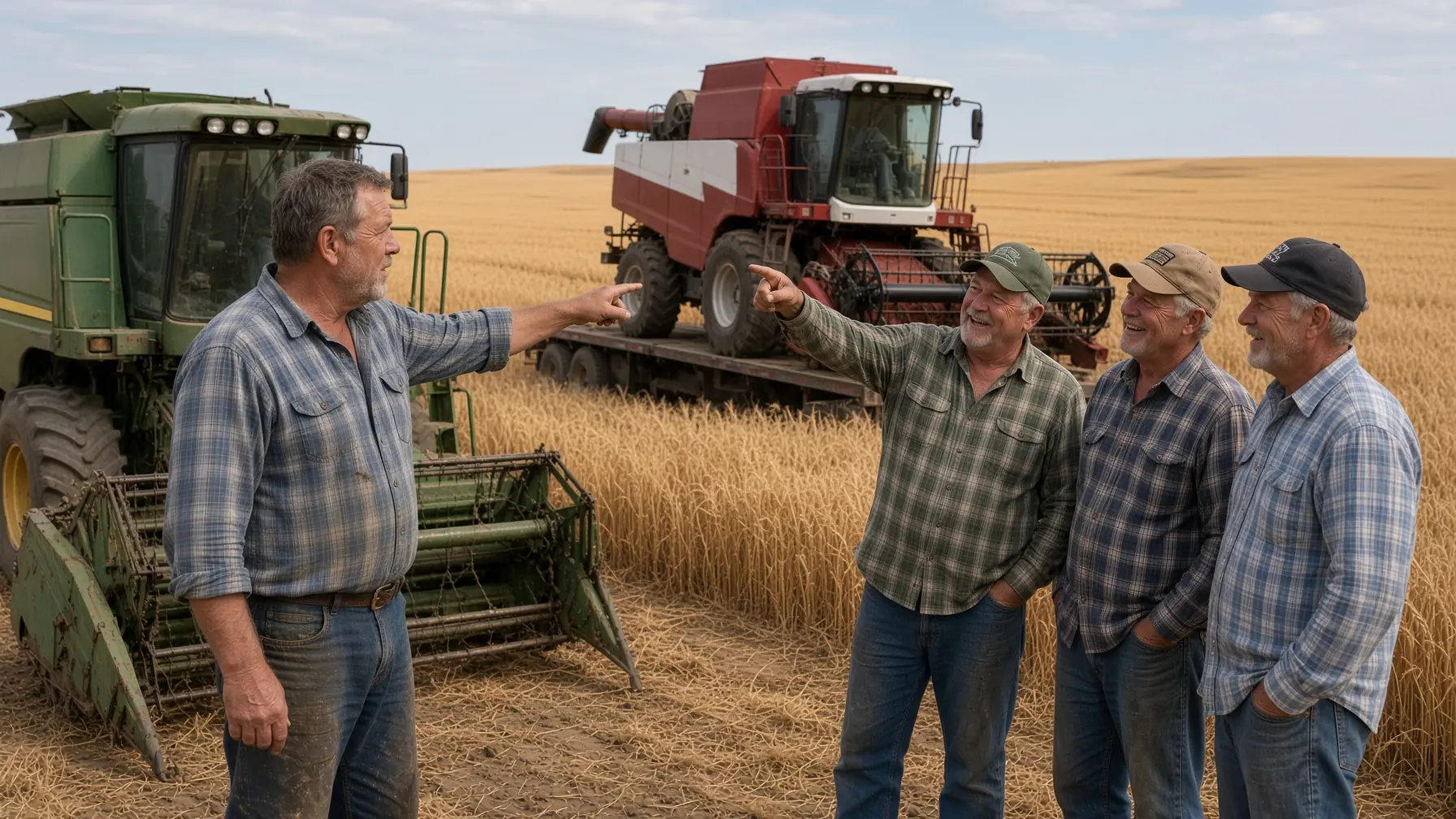
The machine arrived shortly after four on a lowboy. The red-and-silver combine looked almost confrontational sitting beside Nolan’s green grain cart and the disabled Deere waiting near the edge of the field. Dean Mercer, Nolan’s closest neighbor and one of the most devoted Deere operators in the county, drove over specifically to witness what he called “the Whitcomb family crisis.” Nolan told him to make himself useful or go home.
Mark came with the machine, along with technician Luis Ortega. Luis climbed into the cab beside Nolan and spent an hour walking through the controls, calibration procedure, loss monitors, header setup, and the logic behind menus Nolan initially hated. When Nolan complained that he should not need three screens to harvest wheat, Luis said, “Give it two hours before you decide the Germans and engineers have ruined farming.”
“Is this thing German?” Nolan asked. Luis smiled. “See? You’re already learning.”
The first pass was ugly. Nolan moved too slowly, overcorrected settings, missed a section near a terrace, and muttered about where Deere put certain controls more logically. Mark rode the buddy seat without trying to sell him anything.
By the fourth pass, Nolan stopped thinking about the color. By sunset, he was watching grain loss, fuel use, and throughput rather than comparing switches. By midnight, he had forgotten the argument completely because the most important fact in his world was that wheat was once again disappearing from the field and entering trucks.
Dean stayed until almost ten. Before leaving he climbed onto the platform and asked Nolan how the machine was doing. Nolan said, “It’s harvesting.” Dean laughed and said, “That enthusiastic, huh?”
“What do you want me to say?”
“I want you to say red changed your life.”
Nolan pointed toward the Deere sitting dark at the field edge. “Right now, anything moving under its own power looks romantic.”
He ran until after one in the morning, slept four hours, and returned before sunrise. The combine started, the monitors returned to their previous settings, and the machine moved into standing wheat as though it had not spent the night sitting in unfamiliar territory. Nolan finished the field section two days earlier than his emergency rental calculations had assumed.
Mark called every morning. Sometimes he asked about the machine, sometimes about crop conditions, and once he called simply to say a storm system had shifted north and Nolan might have another day. The attention impressed Nolan more than the sales pitch because Mark was not waiting for a crisis before answering the phone.
On the fourth evening, Nolan finally asked the purchase price. Mark gave him the number, explained which warranties remained, what trade possibilities might exist, and which financing programs were currently available. Nolan said he would decide after harvest.
Mark answered, “Good.”
Nolan paused. “You don’t want the sale tonight?”
“I want the sale after you’ve run enough wheat to blame yourself honestly if you regret it.”
Nolan laughed. “You’re not as good a salesman as you think.”
“I sleep fine.”
They finished wheat before the storms. Nolan did not escape without losses because some fields were already drier than he preferred and a late shower forced him to wait through one morning. Still, the crop came out in good condition.
The disabled Deere eventually left for Brockman’s shop. Steve called twice with updates, and Nolan remained courteous because none of the mechanics had caused the failure. Parts began arriving sooner than the worst estimate but later than the best one.
Meanwhile Nolan’s office filled with numbers. He compared fuel tickets from comparable fields, measured harvest losses as carefully as he could, reviewed operator hours, considered purchase price and financing, and asked his accountant to calculate several scenarios. The red machine looked good, but not magically good.
That mattered.
Nolan had spent his life around farmers who bought eighty-thousand-dollar pickups after driving them fifteen minutes and then spent six months comparing prices on fence posts. He had no intention of making the largest equipment decision of his life simply because one dealer had rescued him during a bad week.
The IDEAL used less fuel than the disabled machine had averaged in similar conditions, though not the extraordinary percentages internet enthusiasts claimed. It handled certain crop conditions well, and Nolan liked several design decisions after learning them. The cab still contained two controls he believed had been placed by someone angry at farmers.
The strongest number was not fuel.
It was uptime.
The demonstration combine had given Nolan back six days he believed he had lost.
He bought it.
The decision traveled through the county faster than weather news. At the co-op, people asked whether Nolan had “gone red,” and he told them he had bought one combine. Dean told everyone Nolan had started wearing red underwear.
Nolan threatened to tell Dean’s wife about a certain grain-cart accident from 2018.
The story stopped.
For a while.
When the repaired Deere returned, Nolan made the second significant decision. He sold it.
That sale hurt more than buying the Massey had. Nolan had spent years in that combine, Margaret had ridden beside him during several harvests, and his father had sat in the same cab during one of his last seasons before illness kept him out of machinery.
The machine was not only steel.
That was exactly why Nolan knew he needed to sell it.
He had stopped trusting it.
The new transmission might run ten thousand hours without trouble, but every unfamiliar vibration would make Nolan wonder whether another failure was coming. A custom operator in eastern Colorado bought the combine with complete documentation of the repair, and Nolan received a fair market price rather than dumping it during his initial panic.
He kept the money.
He did not call Mark and order an entire red fleet.
That would come later, and even then not quite the way people told it.
Autumn corn harvest arrived with one red combine and one older Deere backup machine sharing Nolan’s shed. The Deere belonged to an earlier generation and had accumulated enough hours that Nolan usually used it on smaller fields or when the primary machine needed maintenance. This year he deliberately ran both.
He wanted comparison data.
His employees rotated between them so operator preference would not completely distort results. The Massey moved efficiently through heavy corn and handled grain well, while the older Deere remained familiar and dependable. When properly adjusted, both produced acceptable samples.
The red machine used somewhat less fuel.
The green machine was easier for Nolan’s foreman, Wade Collins, to troubleshoot because Wade had spent seventeen years learning Deere systems. When a sensor warning appeared on the Massey one afternoon, Wade looked at Nolan and said, “If that were green, I’d already know which wire to kick.”
“That is not a repair method.”
“It has been.”
The warning turned out to be minor. Central Plains guided them through diagnostics by phone, and the problem was corrected without a service visit.
Nolan wrote that down.
He had begun keeping equipment notes the way Margaret used to keep household expenses. Every call received a date, time, response, downtime hours, travel expense, parts cost, and outcome.
At first it seemed obsessive.
By winter, the notebook would become one of the most valuable tools on the farm.
Brockman Equipment still serviced the green tractors Nolan owned. Nobody refused his business openly, nobody shouted at him, and there were no threatening letters telling him to return to Deere.
The change was subtler.
Calls felt less personal.
Parts that Nolan expected to find locally sometimes required ordering.
Service scheduling became less flexible.
Nolan could not tell whether he was experiencing retaliation or simply seeing normal dealership constraints now that he no longer considered himself family.
So he refused to accuse anyone.
When a baler component was unavailable locally, he recorded the date. When another Deere dealer located it faster, he recorded that too.
When Brockman delivered a filter set the next morning without difficulty, he recorded that as well.
“You’re keeping score,” Dean said after spotting the notebook inside Nolan’s shop. Nolan answered, “I’m keeping facts because feelings are terrible accountants.”
Dean flipped through several pages.
“Margaret would like this.”
Nolan closed the notebook.
“Margaret would say I should have been doing it twenty years ago.”
Dean smiled. “She was usually right.”
“Don’t speak badly of the dead.”
Winter forced Nolan to think about the rest of the fleet. Two of his primary tractors were approaching the point where trade values remained strong but repairs could become more frequent. Under his old pattern, he would have called Steve Brockman, traded them for newer Deere units, and considered the matter finished before lunch.
This time he asked for bids from three dealers.
The exercise felt almost disloyal.
That embarrassed him.
Nolan had spent millions of dollars over his lifetime and somehow allowed shopping to feel like betrayal. Margaret would have called that ridiculous.
Central Plains brought a Massey Ferguson 8S for demonstration. Brockman brought a comparable Deere. A Case IH dealer from farther east offered another machine but warned that service distance could become a problem on Nolan’s western acres.
Nolan appreciated the warning.
He ran all three.
No tractor dominated every category.
The Deere had controls Nolan and his employees understood immediately and strong regional resale value. The Case offered features Wade liked but carried a service network Nolan considered too distant.
The Massey priced competitively, delivered strong hydraulic performance, and came with Central Plains promising specific service response arrangements rather than general assurances. Nolan asked Mark to put those arrangements in writing.
Mark did.
That impressed him.
Nolan traded one high-hour Deere and bought one Massey.
Only one.
At the coffee counter, Dean stared at the red tractor through the window and said, “It’s spreading.”
“Like stupidity?”
“Exactly.”
Nolan handed him the fuel ticket.
“Your coffee’s on you today.”
The county treated the new tractor like an experiment everyone had invested emotionally in. Farmers stopped beside Nolan’s fields to watch planting, neighbors asked his employees questions at fuel pumps, and strangers Nolan barely knew offered predictions about resale value.
One man told Nolan, “Those things won’t be worth anything in five years.”
Nolan asked, “What will corn be worth in five years?”
The man shrugged.
Nolan said, “Then we’re both guessing.”
The first real stress test came in December. Calving preparation meant tractors hauling hay, bedding pens, moving feed, cleaning lots, and operating when equipment preferred to remain indoors. Temperatures dropped sharply over several nights.
Nolan prepared every machine properly.
He plugged in heaters.
He checked batteries.
He used winter fuel treatment where appropriate.
He inspected hydraulic systems before the cold arrived instead of waiting for weather to create a crisis.
That preparation annoyed people who wanted the winter to serve as a fairytale contest.
On the coldest morning, the Massey started.
The Deere started too.
Dean later complained that this ruined an excellent argument.
A week later the red tractor failed to start.
Nolan smiled when he saw the dark display because failure made equipment discussions more honest. The cause was a damaged battery cable connection, not an exotic electronic disaster.
Central Plains helped diagnose it.
A replacement came that morning.
Total downtime was a little over four hours.
Nolan wrote it down.
That evening Wade asked, “Still love the red one?”
“I don’t love machinery.”
“You talked to that combine during harvest.”
“I was lonely.”
“Margaret would’ve been offended.”
Nolan smiled despite himself.
By January, his notebook had changed the way he thought about ownership. The cost of a machine was no longer purchase price plus fuel and repairs.
Downtime belonged in the equation.
So did employee familiarity.
Parts inventory.
Dealer travel time.
Financing flexibility.
Diagnostic access.
Resale.
Even how quickly somebody returned a phone call mattered if the wrong failure happened on the right day.
Nolan wrote another sentence on the shop whiteboard.
A cheap hour of downtime does not exist during harvest.
Wade added beneath it, Neither does cheap coffee at Central Plains.
Nolan erased Wade’s contribution.
Then the bank called.
Peter Sloan at Western County Bank had financed Whitcomb land and equipment for years. Peter asked Nolan to come in with updated machinery schedules, and Nolan assumed the meeting involved routine annual review.
Instead, Peter began asking about brand composition.
Nolan immediately became defensive.
“You worried my tractors turned red?”
Peter leaned back.
“I’m worried the collateral schedule we have is no longer accurate.”
“I haven’t missed a payment.”
“I know.”
“Then what’s the problem?”
“The problem is we have loan documents describing equipment you sold.”
Nolan stopped.
Peter continued, “Your payment history is excellent. Your farm’s debt coverage is strong. But if you replace financed collateral or significantly change the equipment base, the bank needs current valuations.”
That was reasonable.
Nolan hated it anyway.
“Would you be asking if I bought Deere?”
“I’d still need updated serial numbers and values.”
“Would your collateral model treat them the same?”
“No.”
There it was.
Peter explained regional auction data. Deere machines historically maintained strong resale values in Nolan’s area because buyer demand and dealer support were extensive.
Massey equipment could also retain value, but local auction depth differed.
The bank was not banning brands.
It was pricing risk.
Nolan left irritated, then spent the evening reading the documents he had signed years earlier.
Margaret would have enjoyed that.
She had always read the pages Nolan skipped.
Two days later he called Peter and said, “Let’s get independent valuations.”
“Good.”
“If the numbers support the loan, we leave it alone.”
“If they support it.”
“And if another bank gives me better terms?”
Peter laughed.
“Then I’ll try to beat them.”
Nolan liked that answer.
The independent appraisals came back within acceptable ranges. The bank adjusted some collateral values but did not demand the dramatic additional land pledge Nolan had feared.
Another lender nevertheless offered slightly better equipment terms.
Nolan moved one loan.
Peter did not take it personally.
That taught Nolan something too.
Professional relationships survived comparison better than fragile ones did.
February brought trouble somewhere Nolan had not expected.
Scott Lang, a young farmer twenty miles south, called asking about the Massey tractor. Nolan barely knew him but agreed to meet at the shop.
Scott arrived with a notebook.
For two hours he asked everything from hydraulic flow to dealer response.
Finally he said, “Everybody tells me you switched because Brockman screwed you.”
Nolan frowned.
“They couldn’t get my combine running fast enough.”
“That sounds like screwing you.”
“No.”
Scott looked confused.
Nolan continued, “They had twenty farmers needing service. I thought loyalty meant I would become priority when I needed it most.”
“Didn’t it?”
“No.”
“So you left.”
“I learned I had one service path and no backup.”
Scott leaned against the workbench.
“That’s not as exciting.”
“Reality usually isn’t.”
Scott asked whether he should buy Massey.
Nolan said, “How far is Central Plains from your farm?”
“Ninety-eight miles.”
“Who services Deere for you?”
“Brockman.”
“How good are they?”
“Pretty good.”
“Then why are you switching?”
Scott hesitated.
“Because you did.”
Nolan shook his head.
“Keep your Deere.”
Scott laughed because he thought Nolan was joking.
Nolan was not.
“You don’t have my problem,” he explained. “Don’t manufacture one because you like my solution.”
That conversation changed how Nolan spoke about equipment afterward.
He stopped saying the Massey was better.
He said the system around his farm had become better.
That distinction mattered.
Spring planting arrived with the usual pressure. Nolan ran the new Massey tractor beside two remaining Deere units, pulling planters and tillage equipment across soil that changed from heavy creek bottom to lighter upland ground.
The Massey performed well.
So did the Deere.
Fuel use varied with workload, field shape, operator, and soil conditions enough that Nolan refused to make sweeping claims.
The clearest difference remained service experience.
Central Plains called proactively before planting to verify filters and common parts.
Brockman did not.
Then again, Nolan was now buying most new equipment through Central Plains.
Perhaps that was normal.
The notebook kept him honest.
In April, Nolan needed a hydraulic component for one of the older Deere tractors.
Brockman had it.
The part was waiting at the counter before lunch.
Nolan wrote same-day, excellent beside the entry.
Dean saw it.
“I thought we hated them.”
“We don’t hate anybody.”
“That makes coffee conversations difficult.”
“Drink quietly.”
Then came a problem with Central Plains.
A planter tractor developed an electronic fault that intermittently dropped communication with an implement controller.
Luis diagnosed one likely cause.
It was wrong.
A second technician replaced another module.
The fault returned.
By the third day, Nolan was furious.
He called Mark.
“This is exactly the kind of garbage everybody warned me about.”
Mark said, “I know.”
“You know?”
“I’ve got Luis coming back with our field specialist.”
“I already had Luis twice.”
“Then we owe you a better answer.”
That sentence lowered Nolan’s anger slightly.
The field specialist traced the problem to a damaged harness connection that had likely been stressed during an implement change.
The tractor was not fundamentally defective.
Neither technician had identified the problem quickly enough.
Central Plains did not charge Nolan for repeated diagnostic time beyond the covered work.
Nolan recorded three days of intermittent downtime.
Then he recorded the response.
When harvest conversations later turned into claims that Central Plains had never failed him, Nolan corrected them.
“They have.”
“What happened?”
“They came back.”
That became the difference he valued.
Nobody could promise zero failure.
A dealer could promise not to disappear inside it.
By the next wheat harvest, Nolan owned one red combine, one primary red tractor, several green tractors, and enough mixed implements to make brand loyalists uncomfortable.
The wheat matured evenly.
The forecast was better than the year before.
For several days Nolan almost missed the urgency that had accompanied the previous harvest.
Then the Massey combine threw a sensor error in the middle of a field.
Dean happened to be riding with him.
When the warning appeared, Dean grinned so broadly Nolan considered throwing him out.
“There it is.”
“Shut up.”
“Red failure.”
“Green passenger.”
The machine reduced capacity automatically.
Nolan stopped.
He called Central Plains.
Within twenty minutes, Luis was on the phone checking diagnostics remotely.
The likely problem was a sensor near the grain-handling system.
Luis had one on his service truck.
He arrived in under two hours.
The combine returned to work slightly more than three hours after the warning.
Nolan wrote the number that evening.
3.2 hours.
Then he opened the previous year’s entry.
Approx. six harvest days effectively lost before replacement solution.
The comparison was imperfect.
Different failure.
Different parts.
Different circumstances.
But it captured what Nolan cared about.
He was no longer expecting machines not to break.
He was building a farm capable of surviving when they did.
That summer Steve Brockman approached him at a county agricultural meeting.
The room was full of farmers drinking bad coffee beneath fluorescent lights while somebody discussed water policy.
During open discussion, Steve made a comment about supporting local businesses.
He said dealerships financed farms during hard years, sponsored community events, employed local families, and depended on customers remembering that loyalty worked both ways.
He never said Nolan’s name.
Everyone looked at Nolan anyway.
Nolan stayed quiet.
The old version of him would have answered publicly.
Margaret would have kicked him beneath the table.
So he waited until the meeting ended.
Steve found him near the door.
“You could have at least talked to me before moving business.”
Nolan looked at him.
“I called you while wheat was standing.”
“That’s not what I mean.”
“What do you mean?”
“Before buying from Kearney.”
“I needed a combine.”
“We offered one.”
“At a rate that made no sense for me.”
Steve sighed.
“You think I set that rate because I wanted to hurt you?”
“No.”
“Then why does everybody think we abandoned you?”
“I didn’t tell them that.”
Steve stared toward the parking lot.
“You didn’t exactly defend us.”
Nolan considered the accusation.
It was fair.
He said, “Maybe I should’ve.”
Steve looked back.
Nolan continued, “You didn’t cause the transmission failure.”
“No.”
“You didn’t control the parts network.”
“No.”
“You had other customers already waiting.”
“Yes.”
Nolan put both hands in his coat pockets.
“I think what made me angry was finding out thirty years of loyalty didn’t buy what I thought it bought.”
Steve’s voice softened.
“What did you think it bought?”
“I thought when things got ugly, I’d matter differently.”
Steve was quiet.
“So you wanted me to move you ahead of other farmers?”
“No.”
Nolan smiled sadly.
“That’s the problem. I don’t know what I wanted.”
Steve nodded.
For the first time, their disagreement became something other than customer versus dealer.
It became two men confronting assumptions neither had ever named.
Steve finally said, “We got comfortable too.”
Nolan waited.
“We saw Whitcomb on the account and assumed you’d always be there.”
“Probably.”
“That’s not the same as taking you for granted.”
“Feels similar from my side.”
Steve nodded again.
They did not resolve everything.
They shook hands.
Then they walked to separate trucks.
For months, that conversation was enough.
Nolan continued shifting his fleet gradually.
When another tractor reached trade age, he compared bids.
Massey won.
When a small utility Deere needed only ordinary maintenance and remained reliable, Nolan kept it.
When a loader machine was better priced through another manufacturer, he bought that instead.
The shed stopped looking like a brand dealership.
Wade loved it.
“We finally look poor,” he said.
Nolan frowned.
“With this much financed iron?”
“Exactly.”
The farm’s employees adapted.
Some preferred the Deere controls.
One younger operator loved the Massey transmissions.
Wade remained stubbornly brand-agnostic as long as the air conditioning worked.
Training became more important because mixed fleets meant different maintenance intervals, diagnostic systems, filters, and operating habits.
That introduced costs Nolan had not predicted.
Inventory became more complex.
He could no longer stock one family of filters and expect broad compatibility.
Attachments sometimes needed different connections or software.
Employees occasionally climbed into the wrong tractor and complained about a control they had forgotten was elsewhere.
Diversification had a price.
Nolan wrote that down too.
For months, his total maintenance spending appeared lower than before.
People at the co-op treated that as proof the new brands were cheaper.
Nolan corrected them.
“Some of my new equipment is under warranty.”
“So?”
“So comparing a five-year-old tractor’s repair bill to a new tractor’s first year makes you look smarter than you are.”
Dean laughed.
“You ruin every good argument.”
“I’m trying.”
The farm’s accounting showed genuine improvement in downtime and some fuel savings.
It also showed new depreciation, financing costs, training, additional parts inventory, and the transaction costs of changing equipment.
The result was positive.
Not miraculous.
That made Nolan trust it.
During cattle season, the red tractors accumulated long hours feeding and bedding.
One developed a hydraulic hose failure.
Wade replaced it quickly using a locally made hose rather than waiting for branded parts.
Another machine suffered a heater problem during a bitter January morning.
Central Plains sent a component overnight.
Nothing dramatic happened.
That became Nolan’s favorite kind of year.
No machine became the hero.
No dealer became the enemy.
The operation simply kept moving.
Then Nolan’s relationship with Brockman’s agronomy affiliate became strained.
For years he had purchased certain chemicals, treatments, and services through Brockman Ag Supply.
When Nolan requested spring pricing, the package came back less favorable than expected.
He asked whether discounts had changed.
Jeff Brockman, Steve’s brother, said long-term purchasing commitments influenced priority and price.
Nolan heard the subtext.
He did not accuse Jeff of retaliation.
He requested competitive bids.
A cooperative thirty miles west offered better pricing on enough items that moving the business made sense.
Nolan moved it.
Jeff called two days later.
“You really taking all of it?”
“Most.”
“After twelve years?”
“Your price lost.”
Jeff paused.
“That simple?”
“I’m trying to make it that simple.”
It was not simple.
Relationships never were.
Still, Nolan felt lighter afterward.
He had spent decades confusing continuity with obligation.
Now every major farm expense had a comparison process.
Insurance.
Fuel.
Agronomy.
Equipment.
Financing.
Transportation.
Even grain marketing services.
Some old providers remained because they were still competitive.
Others changed.
The result was not disloyalty.
It was awareness.
Margaret would have liked that word.
She had once told Nolan after negotiating a fertilizer contract, “Trust people. Verify invoices.”
At the time Nolan told her she sounded like a government auditor.
Now he wrote the sentence on the office wall.
Two years after the combine failure, Whitcomb Farms finished wheat in nine long days.
A neighboring operation took eleven.
People immediately credited the combines.
Nolan refused.
He had two machines running.
The neighbor had one primary machine.
Field shape differed.
Crew size differed.
Crop moisture differed.
Weather delays differed.
“The red combines didn’t create extra hours in the day,” he told Dean.
Dean said, “They painted them red though.”
Nolan ignored him.
That harvest brought the farm’s strongest net income in years.
Again, people credited equipment.
Again, Nolan corrected them.
Cattle prices were favorable.
Several input costs behaved better than expected.
Yields were strong.
Interest expense had changed after refinancing.
Machinery downtime was lower.
All of it mattered.
One afternoon his son Caleb visited from Lincoln.
Caleb had chosen engineering rather than farming and worked for an energy company.
For years Nolan quietly resented that decision.
He had never told Caleb.
He thought about Steve, loyalty, inherited assumptions, and Margaret’s habit of forcing difficult conversations.
So while they stood beside the shop, Nolan said, “I used to think you leaving meant I’d failed at making the farm worth staying for.”
Caleb looked startled.
“I never knew that.”
“I never said it.”
“No.”
Nolan nodded.
“That was probably the problem.”
Caleb leaned against the pickup.
“Dad, I didn’t leave because I hated farming.”
“I know that now.”
“I wanted something that was mine.”
Nolan looked toward the machinery shed.
His father had never allowed him to imagine something else.
Nolan realized he had almost repeated that mistake.
“I’m proud of you,” he said.
Caleb stared at him.
“What?”
Nolan immediately regretted how awkwardly it came out.
“I said I’m proud of you.”
Caleb smiled.
“Mom would like that.”
Nolan looked away.
“She’d be furious it took me this long.”
“Also true.”
The equipment change had started as a business decision.
It was slowly teaching Nolan things about inheritance he had never intended to learn.
His grandfather chose Deere because the dealer available to him sold Deere.
His father stayed because the machines worked and the dealer relationship deepened.
Nolan inherited both the machinery and the assumption that changing it would dishonor the men before him.
But his grandfather had not worshiped a logo.
He had needed a tractor that started.
His father had needed parts during planting.
They had chosen what sustained the farm.
Nolan finally understood that copying their choice forever was not the same as honoring their reasoning.
That realization freed him from the last part of the guilt.
One summer afternoon, Steve Brockman drove onto Whitcomb Farms without calling.
Nolan recognized the pickup from half a field away.
He shut down at the headland and climbed out.
Steve walked toward him across wheat stubble.
“I’m not selling anything,” Steve said.
“Then this is unusual.”
Steve smiled.
“I owe you something.”
Nolan waited.
“We changed harvest response.”
“How?”
Steve explained they had expanded shared rental agreements with sister dealerships, created a larger emergency-parts cross-reference list, and changed the way service advisors handled catastrophic harvest failures.
A customer would still wait if technicians were busy.
No dealership could create unlimited labor.
But the first conversation would include rental possibilities across a broader network, salvage options, neighboring inventory searches, custom operator contacts, and realistic timelines.
“We should have done that before,” Steve said.
Nolan nodded.
“Probably.”
Steve looked toward the farm.
“Watching you leave hurt.”
“I figured.”
“Then two other big customers started asking us what our emergency plan was.”
Nolan smiled.
“That’ll do it.”
Steve extended his hand.
“I’m not asking you to come back.”
Nolan shook it.
“Good.”
“I mean it.”
“I know.”
Steve took a breath.
“I’m saying we were good at selling equipment and got lazy about explaining what happened when we couldn’t fix it.”
Nolan considered that.
“That sounds about right.”
Steve nodded.
“You were right about one thing.”
“Only one?”
“Don’t ruin it.”
Nolan smiled.
Steve continued. “A customer should know what his backup plan is before he breaks.”
They stood in the field for another twenty minutes.
They talked about employees, grain prices, Steve’s father’s health, and the bronze plaque in the dealership lobby.
Steve said he had considered removing it after Nolan moved business.
Nolan laughed.
“Why?”
“Made me mad every time I walked past.”
“Did you?”
“No.”
“Good.”
“Why?”
“Because the history was real.”
Steve looked at him.
Nolan continued, “One bad year doesn’t erase forty good ones.”
Steve said nothing.
Then he nodded.
A month later Nolan needed a part for one of the Deere tractors he had kept.
He called Brockman Equipment.
The parts clerk answered.
They had it in stock.
Nolan drove to McCook.
Steve saw him through the showroom window.
He lifted one hand.
Nolan lifted his.
Nobody made a speech.
The transaction took twelve minutes.
That was enough.
By the fourth year, Whitcomb Farms ran a mixed fleet with more red than green but no ideological commitment to either.
The primary combines were Massey Ferguson because they fit Nolan’s harvest system and Central Plains continued providing support he trusted.
Two high-horsepower tractors were Massey.
One Deere remained because its trade value was lower than its usefulness.
A small green utility tractor fed cattle every winter with no apparent concern about betraying anybody.
Wade named it Switzerland.
Nolan told him the joke was stupid.
Wade painted a tiny Swiss flag inside the cab anyway.
The biggest change was not machinery.
It was planning.
Every critical harvest machine now had a documented fallback.
Rental contacts were kept current.
Custom operators Nolan trusted were listed.
Common high-failure parts were stocked when economically sensible.
Fuel and filter inventories were checked ahead of season.
Dealer contacts included more than one person.
Loan documents matched actual equipment.
Nothing was left to the assumption that someone would “take care of it.”
That reduced drama.
Nolan considered that a success.
A young farmer named Ethan Caldwell visited one evening asking about buying his first major combine.
Ethan had grown up on green equipment but was considering changing brands because Nolan’s story had become regional folklore.
He walked through the machine shed with the reverence of someone visiting a museum.
Finally he asked, “If you were me, what would you buy?”
Nolan asked, “How many acres?”
“Fourteen hundred.”
“Dealer distance?”
“Deere is twenty minutes. Case is forty. Massey is almost two hours.”
“Do you like your Deere dealer?”
“They’re good.”
“Then why are you leaving?”
Ethan hesitated.
“I figured maybe I was being too loyal.”
Nolan leaned against the workbench.
“Loyalty isn’t stupid.”
Ethan looked surprised.
“Blind loyalty is.”
“What’s the difference?”
“You know what you’re getting.”
Ethan waited.
Nolan continued, “If your dealer answers, carries parts, treats you fairly, and the equipment works for your operation, staying isn’t weakness.”
“So I should buy Deere?”
“I didn’t say that.”
Ethan laughed.
“You’re terrible at recommendations.”
“I’m trying to save you four hundred thousand dollars worth of somebody else’s opinion.”
They spent another hour discussing grain capacity, service radius, financing, dealer staffing, warranty, resale, and what Ethan’s employees already knew how to run.
Ethan eventually bought Deere.
He called Nolan after harvest.
“You were right.”
“About what?”
“I didn’t need your machine.”
Nolan smiled.
“You needed your answer.”
“Yeah.”
That conversation became more satisfying than convincing another farmer to switch ever could have been.
The county had initially treated Nolan’s red equipment as a rebellion.
Eventually it became ordinary.
Other farms added different brands.
Some stayed entirely green.
Some ran mixed fleets because used equipment markets made the decision for them.
The coffee-shop arguments continued because farmers would argue about paint if weather, politics, and grain prices disappeared overnight.
Nolan participated occasionally.
Mostly he listened.
One morning Dean said, “Tell them the real reason you switched.”
Nolan looked over his coffee.
“Transmission failure.”
“No.”
“Dealer response.”
“No.”
“What then?”
“You wanted prettier tractors.”
Nolan threw a sugar packet at him.
The room laughed.
Nolan realized he no longer felt angry when people joked about it.
That mattered.
For the first year, every red machine had felt like a statement.
By the fourth, they were simply machinery.
That was exactly where Nolan wanted to end up.
His best lesson came during a harvest in which both brands failed within forty-eight hours.
The Massey combine developed an electrical issue that required a service visit.
The Deere utility tractor broke a front-end component while moving grain equipment.
Central Plains repaired one.
Brockman supplied the parts for the other.
Neither company treated the situation as proof of anything.
Both simply helped.
That evening Nolan stood inside the shop looking at two invoices on the desk.
Margaret’s old calculator sat beside them.
He pressed several buttons even though the total was already printed.
Then he laughed.
He could almost hear her asking why he needed arithmetic twice.
The farm had survived both failures because Nolan had stopped treating reliability as a property of machines alone.
Reliability belonged to the entire operation.
Equipment.
People.
Parts.
Money.
Backup plans.
Training.
Relationships.
And humility.
Especially humility.
He had once believed the Whitcomb name on a bronze dealership plaque guaranteed something no contract had ever promised.
Steve had once believed three generations of purchases guaranteed Nolan would never leave.
Both had been wrong.
Neither had been evil.
That nuance disappeared when other people told the story.
Online versions eventually claimed Nolan had sold three million dollars of Deere equipment in two weeks, replaced every machine with Massey Ferguson, been blacklisted by Brockman, targeted by his bank, denied seed by a dealer conspiracy, and then earned record profits because red tractors used twenty percent less fuel in every operation.
Nolan saw one of those stories on his phone.
He read it twice.
Then he called Caleb.
“You know the internet says I bankrupted Brockman Equipment?”
Caleb laughed.
“You did?”
“Apparently.”
“What else?”
“It says my bank demanded extra collateral because Steve called them.”
“Did he?”
“I have no idea.”
“Sounds exciting.”
“It also says I finished wheat two days faster than Dean because my combines are superior.”
“That part true?”
“No.”
“Are you sure?”
Nolan hung up on him.
The exaggerated story bothered Nolan at first.
Then he understood why people preferred it.
A villain was easier than a supply-chain problem.
A miracle machine was easier than total-cost analysis.
Revenge was easier than changing vendors.
But farmers who based decisions on simple stories rarely remained farmers for long.
Reality charged interest.
So whenever someone asked, Nolan told the boring version.
The combine failed.
His dealer could not save him quickly enough.
Another dealer had a machine available.
He tested it.
The numbers worked.
He bought it.
Then he slowly changed his operation because diversification reduced risks he had ignored.
That was all.
And it was enough.
One June morning, exactly five years after the original transmission failure, Nolan drove to the north wheat field before sunrise.
The crop stood almost ready.
Light spread slowly across the heads until the field changed from gray to gold.
He parked beside the old oak where his father used to check grain by rubbing kernels between his palms.
The disabled combine had stopped less than a quarter mile away all those years earlier.
Nolan could still identify the spot.
Not because anything marked it.
Because farmers remember where expensive things happen.
Behind him, two combines waited near the field entrance.
Both were red now.
The Deere backup had finally been sold the previous winter after repair costs and age made keeping it difficult to justify.
Nolan felt surprisingly little emotion when it left.
It had done its work.
That was enough.
Wade arrived in a pickup carrying coffee.
“You ready?”
“No.”
“Good.”
Wade handed him a cup.
“Dean says he’ll beat us this year.”
“Dean says that every year.”
“He got a newer combine.”
“Good for him.”
“You worried?”
“No.”
“Boring.”
Nolan smiled.
Wade looked toward the field.
“Remember when that Deere died out here?”
“Yes.”
“You were unpleasant.”
“I remain unpleasant.”
“Different flavor.”
They drank coffee.
The sun rose.
Harvest began.
For eight days machinery moved across the farm.
One combine lost a belt.
Central Plains had one available.
A truck tire failed.
A local shop replaced it.
A grain cart operator buried a wheel in a soft irrigation corner and required two tractors to pull him out.
No brand could prevent stupidity.
Wade wrote that on the whiteboard.
Nolan left it.
They finished wheat without drama.
That evening Nolan parked the combine inside the shed and shut off the engine.
The silence afterward settled slowly.
He climbed down and stood between the machines.
On the wall near the office door hung the old bronze Brockman plaque.
He had moved it there when the original shop office was remodeled.
The engraved words were still readable.
In appreciation of three generations of Whitcomb family business.
Nolan ran one finger across the dusty edge.
The plaque no longer angered him.
It reminded him of something more useful.
Relationships were real.
So were limits.
The Brockmans had helped his family for decades.
Central Plains had helped him through a different era.
Someday Central Plains might fail him too.
If they did, Nolan hoped he would remember what the original breakdown taught him.
Ask questions before becoming trapped.
Know the alternatives before needing them.
Never confuse gratitude with obligation.
And never expect another business to care about your harvest more than you do.
He entered the office.
The whiteboard still held two sentences.
The first had been there for years.
Do not measure reliability by whether something fails. Measure it by how much work the failure costs you.
Below it, Nolan added another.
Loyalty is valuable. Dependence is expensive.
He looked at both.
Then he wrote one more line.
People matter more than paint.
Wade walked in behind him.
“That’s getting sentimental.”
“I’ll erase it tomorrow.”
“No, you won’t.”
Nolan looked at Margaret’s photograph sitting beside the computer.
She was smiling in the picture, standing beside a grain truck during harvest nearly fifteen years earlier.
Nolan had spent most of his life believing farming was about preserving what the previous generation handed you.
The land.
The herd.
The equipment.
The relationships.
Now he understood preservation differently.
His grandfather had not wanted Nolan to use the same tractor forever.
His father had not wanted him to worship a dealership.
Margaret had not wanted him to repeat every decision simply because it once worked.
They had wanted the farm to continue.
Continuing required change.
Sometimes careful.
Sometimes expensive.
Sometimes uncomfortable enough that everyone in town talked about it.
But change just the same.
A few weeks later Steve Brockman invited Nolan to the dealership’s fiftieth-anniversary open house.
Nolan almost declined.
Then he went.
The showroom looked different but smelled exactly as he remembered from childhood, a mixture of rubber, oil, coffee, and new machinery.
The bronze plaque was no longer in the lobby because renovations had moved most old displays into a history wall near the parts department.
There was a photograph of Nolan’s father beside his old 4020.
Nolan stopped.
He had forgotten the picture existed.
Steve walked over.
“Found that in Dad’s office.”
Nolan studied it.
His father looked thirty years younger than Nolan remembered him, one boot on the tractor step and a smile he rarely wore in photographs.
“Can I get a copy?”
“I already made you one.”
Steve handed him an envelope.
Inside was the photograph.
Nolan swallowed.
“Thank you.”
Steve nodded.
Neither man mentioned lost business.
They did not need to.
A young salesman nearby recognized Nolan and asked whether he really ran all Massey equipment now.
Steve answered first.
“No.”
The salesman looked surprised.
Steve smiled.
“He runs whatever makes him money.”
Nolan laughed.
“That’s almost accurate.”
Steve looked toward him.
“What’s missing?”
Nolan thought about the field, the broken combine, Mark’s early-morning phone calls, Wade’s jokes, bank appraisals, parts counters, and five years of learning what support actually meant.
Then he said, “I run whatever lets us keep farming.”
Steve nodded.
“That’s better.”
They shook hands.
Nolan drove home with his father’s photograph on the passenger seat.
He passed fields his family had worked for generations and dealerships his grandfather would not have recognized.
Nothing about the landscape seemed threatened by the fact that his machinery shed no longer matched one company’s advertising brochure.
The farm was still there.
That was the point.
By then Nolan had stopped telling people he “switched brands.”
He had switched assumptions.
The most expensive assumption had been that history guaranteed service.
The second most expensive had been believing changing a supplier meant betraying history.
Neither was true.
Loyalty worked best when chosen repeatedly, not inherited blindly.
Every invoice was a chance to choose it again.
Every phone call too.
Some years Central Plains earned more of Nolan’s business.
Some years Brockman won parts or service work because they were closer or faster.
Other suppliers entered the picture when they made sense.
The farm became less elegant as a system.
It also became harder to trap.
That was worth something.
One autumn evening Dean Mercer stopped beside Nolan’s machine shed.
He looked inside.
“Still a lot of red.”
Nolan nodded.
“Happy?”
“With what?”
“The switch.”
Nolan considered the question.
“I’m happy I had options.”
“That sounds like a politician.”
“It’s the truth.”
Dean pointed toward the whiteboard.
“Loyalty is valuable. Dependence is expensive.”
“You can read.”
“Barely.”
Dean leaned against the doorway.
“You ever regret not staying all green?”
Nolan looked toward the equipment.
“No.”
“Ever regret leaving?”
“No.”
“Ever regret buying red?”
“Sometimes.”
Dean laughed.
“There it is.”
Nolan smiled.
“Every farmer regrets every machine at some point.”
They stood watching sunset settle across the yard.
Dean eventually asked, “What would Margaret think?”
Nolan looked toward the farmhouse.
“She’d ask whether the numbers worked.”
“Do they?”
“Yes.”
“Then?”
“She’d tell me to stop talking about tractor colors and come inside for supper.”
Dean nodded.
“Smart woman.”
“The smartest.”
Nolan closed the machine-shed door.
The farm did not become famous.
Brockman Equipment did not collapse.
Central Plains did not conquer southwest Nebraska.
Massey Ferguson did not replace John Deere across the county.
Reality continued doing what reality usually does.
Some farmers switched.
Some did not.
Some tried a different brand and switched back.
Some discovered their existing dealer had been excellent all along.
What changed most was the conversation.
People began asking different questions.
Not “Which tractor is best?”
They asked, “Who services it here?”
Not “Which combine has the most horsepower?”
They asked, “What happens when the part isn’t in stock?”
Not “Which brand holds value?”
They asked, “What does downtime cost on my farm?”
Nolan liked those questions.
They were harder.
Hard questions often saved easy money.
Years later, when a young grandson named Eli started riding in the combine, Nolan told him the story of the breakdown.
Eli was nine and cared more about screens than business philosophy.
“Did it explode?”
“No.”
“Were there sparks?”
“Not really.”
“Did Grandpa Dean laugh?”
“Your Grandpa Dean isn’t your grandpa.”
“He says he is.”
“Dean says many incorrect things.”
Eli considered that.
“What did you do?”
“I called another dealer.”
“That’s it?”
“That’s it.”
Eli looked disappointed.
Nolan smiled.
“What did you want, a helicopter?”
“Maybe.”
Nolan pointed through the windshield toward the wheat.
“The important part wasn’t changing machines.”
“What was it?”
“Knowing we could.”
Eli looked confused.
Nolan knew he would understand later.
Maybe.
If the farm lasted long enough.
That, ultimately, was the only measure Nolan cared about.
Not whether every tractor wore the same logo.
Not whether neighbors approved.
Not whether an old dealer felt betrayed.
Not whether a new dealer made him feel important.
Whether the operation remained healthy enough that the next generation still had choices.
His grandfather broke prairie with whatever machinery he could afford.
His father expanded with whatever dealer could keep him running.
Nolan inherited a farm large enough to make loyalty comfortable.
A broken combine reminded him that comfort and resilience were not the same thing.
So he changed.
Slowly.
Imperfectly.
Without burning every bridge.
And without pretending the bridge had never mattered.
The machine that failed that June eventually worked again for somebody else.
Brockman Equipment continued serving hundreds of farms.
Central Plains continued answering Nolan’s calls.
The red machines eventually needed repairs just like every machine ever built.
Nothing magical happened.
That made the lesson more valuable.
Sometimes the decision that changes a farm is not buying a different combine.
It is discovering that the system you trusted has limits.
Then building enough alternatives that those limits no longer control you.
Nolan Whitcomb still checked harvest forecasts obsessively.
He still complained about parts prices.
He still argued with software updates.
He still cursed engineers who placed grease fittings where human hands were clearly not intended to reach.
He was still a farmer.
But when machinery stopped now, he no longer stared at one phone number as if it were the only door out.
He had others.
That freedom had a value no resale guide could calculate.
And every June, when the wheat turned gold and the combines rolled toward the first field, Nolan remembered the morning one machine stopped with eighteen hundred acres still standing.
For years, people said that failure made him abandon a brand.
They were wrong.
The failure taught him something much more important.
A farm should never depend completely on any company, any dealer, any bank, any machine, or any promise that begins with the words, “We’ve always done it this way.”
Because harvest does not care about loyalty.
Weather does not care about history.
A broken transmission does not care whose grandfather bought the first tractor.
When the machine stops, all that matters is what happens next.
And after that June morning, Nolan Whitcomb made sure he would always have more than one answer.