The breakdown happened at 2:47 on a Friday afternoon.
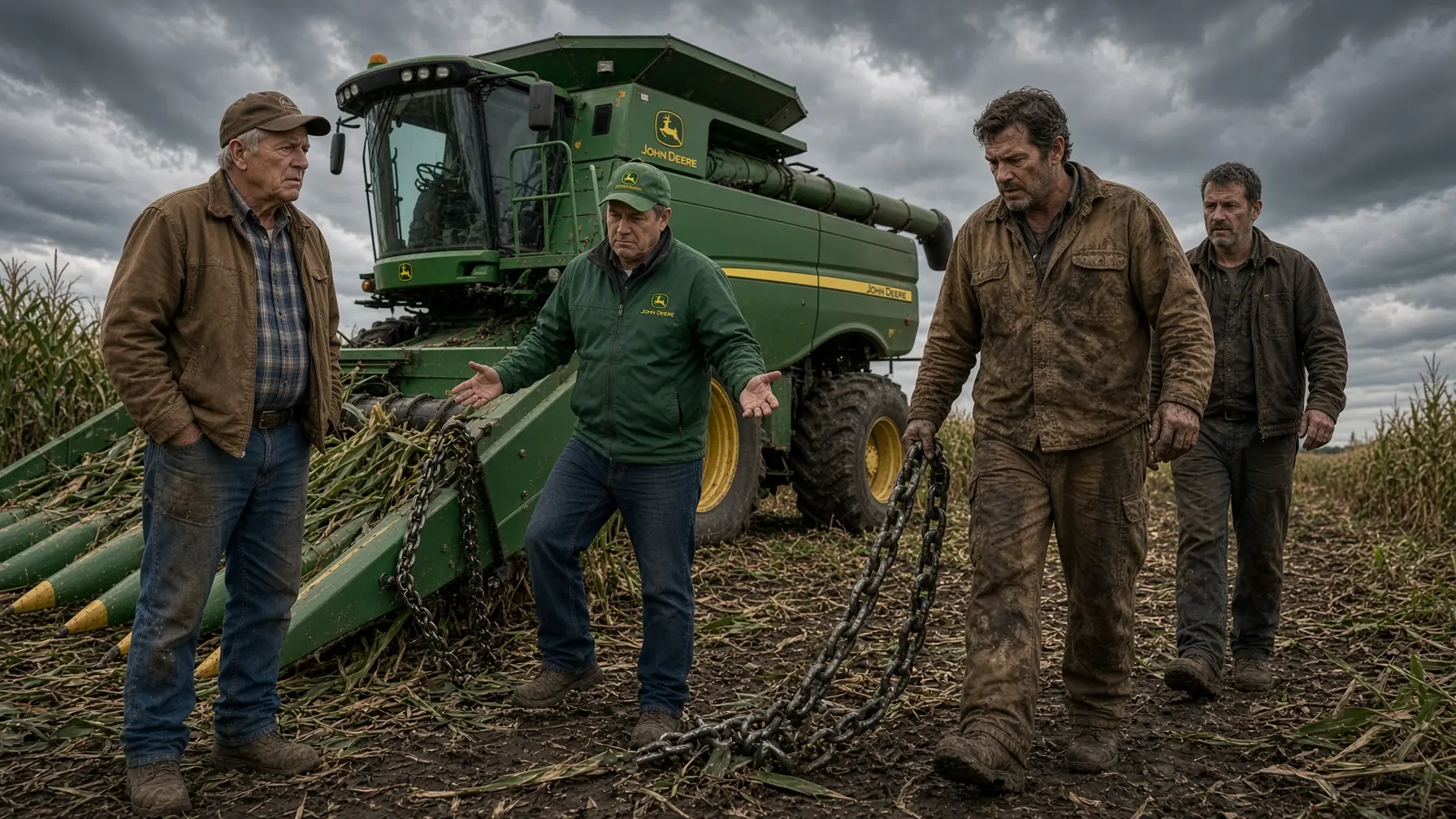
The first thing Gary Hoof did was look at the sky.
Not the combine.
The combine had already told him what was wrong.
The feeder house had thrown its drive chain.
The header sat buried in standing corn, engine idling uselessly while dry stalks rattled in a southwest wind.
Gary had diagnosed the immediate failure within thirty seconds.
Broken chain.
No obvious sprocket damage from where he sat.
No reason yet to believe the feeder house itself had suffered anything worse.
That part could be fixed.
The sky was different.
Gary looked southwest, toward the direction weather usually arrived from in that part of Iowa.
Clouds were beginning to form there.
Not storm clouds yet.
Nothing dramatic.
Just the kind of October sky a man noticed after spending forty-one harvests watching weather decide whether weeks of work ended cleanly or painfully.
Gary pulled out his phone.
Sunday evening.
Seventy percent chance of rain.
Significant accumulation.
He stared at the forecast.
Then at the rows still standing.
Six hundred forty acres.
If the forecast held, he had roughly forty-eight hours.
After the rain, he might lose four days waiting for the ground and corn to dry enough to run efficiently again.
Four days did not sound catastrophic to somebody outside farming.
To Gary, at the moisture level he was seeing, it meant more field loss, more weather risk, more quality concerns, and the possibility of the harvest window tightening in exactly the wrong direction.
He shut off the combine.
Then wrote the time in his notebook.
2:47 p.m. — feeder house drive chain failure.
Gary Hoof was sixty-seven years old.
He farmed approximately 2,800 acres of corn and soybeans in Linn County, Iowa.
He had been farming for forty-one years.
For thirty-three of them, the majority of his major equipment had been John Deere.
Same general dealer network.
Same relationship.
Same green machines.
Gary was not loyal to equipment because of color.
He was loyal to evidence.
And for most of those thirty-three years, the evidence had been good enough.
That was why the next phone call mattered.
Gary kept better records than almost anybody who knew him.
Field notebooks.
Repair logs.
Fuel records.
Yield maps.
Maintenance intervals.
Hour-meter readings.
Parts numbers.
But in 2001, after a parts delay had cost him nearly three days during harvest, he started keeping something else.
A relationship log.
It sat in the back section of his equipment notebook.
Every significant dealer interaction received a date and a simple mark.
Check.
Dash.
X.
A check meant the dealer had delivered what Gary considered a reasonable response under the circumstances.
A dash meant neither good nor bad.
An X meant something had failed.
Not necessarily a machine.
Sometimes communication.
Sometimes parts.
Sometimes response time.
Sometimes a promise.
Gary did not keep the log because he enjoyed judging people.
He kept it because memory was unreliable.
A farmer could have thirty good interactions and remember only the last bad one.
Or endure a slow decline for years while nostalgia convinced him the relationship was still what it had been a decade earlier.
Paper was less sentimental.
The Cedar Rapids entries stretched back twenty-three years.
There were many check marks.
Enough Xs had appeared during the previous two seasons, however, that Gary had begun watching the direction of the pattern.
He had not acted.
A trend was not the same thing as a decision.
A fleet change involved hundreds of thousands of dollars.
Different parts inventories.
Different technicians.
Different software.
Different resale considerations.
Gary had watched neighbors switch brands because somebody offended them at a parts counter, then spend five years discovering what emotional decision-making cost.
He did not intend to join them.
He needed evidence.
At 2:52 p.m., five minutes after the breakdown, he called the Cedar Rapids dealership.
The service manager answered.
Gary gave him the information in the order he always gave mechanical information.
Machine.
Failure.
Location.
Current condition.
Weather window.
Operational consequence.
“Feeder house drive chain failed at one link. Machine is stopped in corn. I have six hundred forty acres standing. Rain is forecast Sunday evening. What does your harvest-emergency capacity look like?”
The service manager understood immediately.
Gary appreciated that.
No wasted questions.
No pretending the situation was less serious than it was.
“I’m sorry, Gary. We’re full.”
“How full?”
“Both harvest technicians are out. One is west of Vinton and the other is down near Washington. I’ve got two more machines already queued.”
“Earliest?”
“Monday morning.”
Gary looked through the cab glass.
“After the rain.”
“I know.”
The manager sounded genuinely apologetic.
That mattered.
Gary did not confuse inability with dishonesty.
“You have anybody willing to come after hours?”
“I checked before I called you back on the other jobs.”
“I’ll pay weekend emergency rate.”
“It's one seventy-four an hour.”
“Fine.”
“I still don't have anybody.”
Gary was quiet.
“What about a loaner combine?”
The service manager exhaled.
“We stopped maintaining a combine loaner fleet four years ago after restructuring.”
Gary already suspected that.
He had not needed a loaner in years.
“Understood.”
“I wish I had something better.”
“I know.”
And Gary meant it.
The dealer had not lied.
Had not overpromised.
Had not told him somebody would come and then disappeared.
The answer was simply:
Monday.
Gary thanked him.
Ended the call.
Then sat in the cab.
Three miles away, across a field road and county highway, he could see the top of the dealership sign.
That detail bothered him more than it should have.
His combine was broken within sight of the dealer he had used for thirty-three years.
And nobody from that dealer could reach him before the weather did.
Gary wrote another entry.
2:52 — dealer called. Earliest service Monday. No loaner availability.
He did not write the X yet.
He rarely coded an interaction before the problem was finished.
Then he called Carl Messing.
Carl farmed north of Gary.
Three years earlier, Carl had switched part of his operation to Massey Ferguson equipment.
Gary had noticed.
He noticed most things involving operations he respected.
Twice during the previous year Carl had mentioned the Massey Ferguson dealer in Ely.
Once during a county equipment meeting when somebody asked about harvest support.
Once at the elevator when the conversation turned to parts availability.
Gary remembered both conversations.
Not because he had been considering changing brands.
Because useful information stayed useful even before a man knew what he would need it for.
Carl answered on the first ring.
“What's broken?”
Gary smiled.
“You assume I only call when something’s broken?”
“Yes.”
“Fair.”
Gary explained.
Feeder house chain.
Friday afternoon.
640 acres.
Sunday rain.
Dealer unavailable until Monday.
Carl listened.
Then said:
“Call Dale Brower.”
“You think he keeps Deere chains?”
“No.”
“Then why?”
“Because Dale knows people.”
Gary frowned.
“What people?”
“The kind who fix whatever everybody else says they can't get to.”
“Specific?”
Carl thought.
“Twice I've called him with problems outside what his dealership was supposed to handle. Both times he found somebody useful.”
“He’s a Massey dealer.”
“I’m aware.”