Laura Bennett arrived in rural Iowa carrying a folder she hoped she would not have to open.
Inside were brochures for assisted-living communities, information about financial powers of attorney, and several printed articles discussing cognitive decline in recently widowed seniors.
She had spent most of the three-hour drive rehearsing what she would say to her father.
She would remain calm.
She would not accuse him of anything.
She would explain that buying forty acres of flooded land at a county auction was not a reasonable decision for a seventy-three-year-old man living alone.
If necessary, she would remind him that he had spent nearly every day since the purchase standing knee-deep in mud, digging drainage channels by hand.
She expected resistance.
What she did not expect was to see twenty-five people working on land that was supposed to be underwater.
Laura stopped her rental car on the gravel shoulder and stared through the windshield.
The swamp was gone.
Dark soil stretched across the property in broad, orderly sections. Newly built garden beds lined a gravel path. Children carried buckets of compost between rows of winter rye and garlic. An elderly farmer drove a green tractor across a field that had appeared as blue standing water in the satellite photograph Laura had studied online.
Near the center of the property stood a timber shelter built above low limestone walls.
Clear water moved beneath it.
Laura opened the car door slowly.
She saw her father beneath the shelter.
Walter Reeves sat on a wooden bench holding an old glass jar while a dozen elementary-school children gathered around him. Their teacher stood beside the group with a clipboard.
Walter lifted a folded letter from the jar and began reading.
Laura could not hear his words from the road.
But she saw the children lean closer.
She saw her father point toward a date carved into an exposed cornerstone.
She saw the clear spring bubbling through pale limestone beside his boots.
The folder beneath Laura’s arm suddenly felt heavier than it had during the entire drive.
She left it in the car.
Three months earlier, Walter had sat alone in the rear row of the Garrison County Courthouse.
The annual delinquent-property auction was held in a room normally used for public hearings. Folding chairs had been arranged in crooked lines across the waxed floor. Farmers wearing work jackets sat beside out-of-town investors carrying tablets and legal pads.
Walter recognized most of the local faces.
He had spent thirty-six years in the county surveyor’s office. He had measured farm boundaries, traced drainage easements, investigated fence disputes, and watched generations of families buy, divide, and lose land.
He retired seven years earlier.
Most people in the room remembered him as the quiet man who could locate a century-old property corner beneath three feet of brush by studying the slope of the ground.
Nobody paid much attention when he entered.
The auctioneer moved quickly through the first sixteen properties.
Two residential lots sold to a developer.
A foreclosed grain-storage building went to a trucking company.
Several acres of scrubland near the river attracted a brief bidding contest between neighboring farmers.
Then the auctioneer adjusted his glasses.
“Parcel seventeen. Forty acres in Section Nine, Madison Township. Classified as nonproductive wetland. Delinquent taxes dating to 2015.”
He glanced around the room.
“Opening bid: one hundred eighty-five dollars.”
Nobody lifted a hand.
A man near the front whispered that the land was mostly water.
Someone else called it a mosquito preserve.
The auctioneer waited.
“Forty acres for less than five dollars an acre.”
Silence.
Walter raised his bidding card.
Several heads turned.
The auctioneer blinked.
“One hundred eighty-five dollars from Mr. Reeves. Do I hear two hundred?”
Nobody answered.
“Sold.”
The gavel struck.
Walter completed the paperwork before leaving the courthouse.
The deed rested on the passenger seat during the drive home.
His small farmhouse stood seven miles outside town beneath two old maples. The rooms had been too quiet for nineteen months.
His wife, Margaret, had died there after a short and aggressive illness.
Her gardening gloves still hung from a hook beside the back door.
Her reading glasses remained on the kitchen counter.
Walter had moved them once while cleaning and then returned them to the exact spot where she had left them.
He entered the kitchen and placed the new deed beside Margaret’s garden journal.
The journal was thick, covered in faded green cloth, and swollen with pressed flowers, seed packets, and handwritten notes gathered across fifty-one years of marriage.
Walter opened it to a page marked by a dried purple aster.
Margaret’s handwriting filled the center.
The old spring beyond Ridley Road. Grandma Ruth took me there when I was a girl. The water came through white stone and stayed colder than anything from a well. I would like to see it again before I die.
Walter placed one hand over the words.
Then he called his daughter.
Laura answered from her office in Des Moines.
“Dad?”
“I bought some land today.”
There was a brief pause.
“What kind of land?”
“Forty acres near the old county highway.”
“How much?”
“One hundred eighty-five dollars.”
The pause became longer.
“What is on it?”
“Cattails. Brush. Water.”
“You bought a swamp?”
“It used to be something else.”
“Dad, land does not sell for one hundred eighty-five dollars unless something is very wrong with it.”
“Something was done wrong to it.”
Laura exhaled.
Since Margaret’s death, she had begun listening to Walter for signs of confusion.
A forgotten appointment.
An unpaid bill.
A sentence that wandered away from its meaning.
She had found none.
Still, grief could change people in less visible ways.
“Why did you buy it?”
“I wanted it.”
“That isn’t a reason.”
“It’s enough of one.”
“Can you cancel the purchase?”
“No.”
“Dad, you are seventy-three years old. You live alone. You cannot start buying flooded land because it reminds you of something Mom once said.”
Walter looked at the journal.
“I didn’t say anything about your mother.”
“You didn’t have to.”
Her voice softened.
“I’m worried about you.”
“I know.”
“This sounds impulsive.”
“It wasn’t.”
“It sounds like the kind of decision people make when they aren’t thinking clearly.”
Walter remained silent.
Laura regretted the words almost immediately, but fear had already carried them too far.
“Some people call it dementia spending,” she added carefully.
“I know what you’re suggesting.”
“I’m not trying to insult you.”
“You did a poor job of it.”
“Dad—”
“I’m fine, Laura.”
He ended the call gently.
His youngest son, Scott, telephoned twenty minutes later.
“Laura says you bought forty acres of mosquitoes.”
Walter could hear laughter in his voice.
“That sounds expensive,” Scott continued. “You’ll have to feed them.”
“I think they’ll manage.”
“What are you going to do with a swamp?”
“Drain it.”
Scott’s laughter weakened.
“You’re serious.”
“Yes.”
His middle son, Daniel, sent a more cautious message.
Can we discuss the land and make sure everything is financially sound?
Walter replied:
The land cost less than your last set of tires. Everything is sound.
His children were not cruel.
Laura expressed fear through control.
Scott used humor whenever emotion made him uncomfortable.
Daniel trusted numbers because they rarely surprised him.
They loved their father.
They simply believed grief had caused him to see value where none existed.
Walter knew they would not understand until the land showed them itself.
After dark, he entered the small room Margaret used to call his cave.
An olive-green filing cabinet stood beside the desk.
Walter opened its bottom drawer and removed a thick envelope.
Inside were two copied survey maps.
The first was dated 1959.
It showed the forty-acre parcel before the construction of the new county highway.
Contour lines revealed a gradual slope toward a natural drainage channel on the eastern boundary. Soil notes identified deep glacial loam, among the richest agricultural ground in the county.
A blue mark indicated a natural limestone spring.
Beside it, a surveyor had written:
Consistent flow. Approximately 3.5 gallons per minute. Potable quality reported by surrounding residents.
The second map was dated 1965.
The spring had disappeared.
The drainage line had been rerouted during highway construction. Water that once traveled east toward the creek now collected across the forty acres.
The soil classification had been changed from prime agricultural land to nonproductive wetland.
Walter had copied both maps as a young county clerk in 1971 while old records were being boxed for storage.
The originals had likely been destroyed during one of the courthouse basement floods.
Nobody else remembered what the maps showed.
Walter did.
He also remembered Margaret speaking about that spring.
She had grown up two miles from the property. Her grandmother brought her there during summer afternoons, walking through fields to fill Mason jars with cold water.
Margaret described the place so often that Walter could picture it despite never seeing it dry.
“The prettiest ground in the county,” she used to say. “And they drowned it for a road.”
Near the end of her life, when a hospital bed occupied their living room, she held Walter’s hand and asked him to care for her garden.
He assumed she meant the flowers behind their house.
After her death, he began wondering whether she had meant something larger.
The morning after the auction, Walter drove to the forty acres.
A cold October wind moved across the standing water.
Dead cattails leaned beneath the gray sky. A blue heron lifted from the center of the property and disappeared toward the south.
Walter pulled on the rubber boots he once wore during field surveys.
He entered the water.
Mud clung to each step.
The water reached halfway up his shins near the road, then gradually became shallower as he followed the route memorized from the old survey.
Fifty yards in, he stopped.
The ground beneath his boots felt firmer.
Walter crouched and pushed his fingers through the layer of wet leaves and silt.
His hand reached darker earth.
He pulled up a fistful.
The soil beneath the swamp was almost black.
It held together when squeezed, rich with organic material and protected beneath decades of water.
Walter brought it close to his face.
It smelled alive.
“Still here,” he whispered.
The words disappeared across the water.
He returned home with a small bag of soil and spread the maps across the kitchen table.
Margaret’s journal remained open beside them.
Walter worked until midnight drawing drainage routes.
The plan was simple enough on paper.
The natural eastern outlet needed to be reconnected to the county ditch. Once a main channel existed, smaller lateral drains could pull standing water from the interior.
Gravity would perform most of the work.
First, somebody had to give the water somewhere to go.
Walter arrived at the hardware store before it opened the following morning.
He purchased shovels, a pickaxe, lengths of drainage pipe, gloves, stakes, and marking paint.
The cashier studied the tools.
“Large project?”
“A garden.”
She looked at the pickaxe.
“That must be some garden.”
“It will be.”
Walter began digging at seven fifteen.
The channel needed to run nearly three hundred yards along the eastern portion of the property.
The wet soil was heavy.
Each shovelful strained his shoulders and lower back. After twenty feet, his palms began blistering beneath the gloves.
He rested on an overturned bucket every half hour.
By noon, he had completed less than forty feet.
The remaining distance seemed enormous.
Walter ate a sandwich, drank from a thermos, and continued.
On the third day, a young man appeared at the roadside.
He wore worn work boots, a canvas jacket, and jeans stained with old machine grease.
Walter estimated his age at twenty-six.
“You hiring?” the young man called.
“Do I look like I have employees?”
“You look like you need one.”
Walter rested both hands on the shovel.
“What’s your name?”
“Caleb Hart.”
“You from here?”
“South of town.”
“What kind of work have you done?”
“Grain elevator. Conveyor repair. Truck loading. Whatever they needed.”
The county grain elevator had closed six months earlier.
More than forty people lost work.
“You know how to dig?”
Caleb looked at the unfinished channel.
“I understand the basic concept.”
Walter almost smiled.
“Fifteen dollars an hour. Cash. You work until the light goes or my back does.”
“Which happens first?”
“We’ll find out.”
Caleb began that afternoon.
He worked quickly but not carelessly.
Walter showed him the required grade, the slope toward the county ditch, and the places where the channel needed to avoid buried rock.
By sunset, they had completed more than Walter managed during the previous three days.
Caleb wiped mud from his face.
“Tomorrow?”
“Seven.”
Caleb looked toward the road.
Walter realized the young man had no vehicle.
“How far are you walking?”
“Two miles.”
Walter considered offering a ride but sensed Caleb would hear pity.
“Be here at seven,” he said instead.
Caleb arrived at six fifty the next morning.
For two weeks, they worked side by side.
Walter brought additional sandwiches without mentioning why.
Caleb never asked whether one was meant for him. He simply ate when Walter handed it over.
As the channel lengthened, Walter taught him to read the ground.
“Water always tells you where it wants to go,” Walter said. “You look for the low point, but you also look for what is holding it back.”
Caleb studied the subtle changes in elevation.
“The county channel blocked the original route.”
“Exactly.”
“So the land isn’t naturally wet.”
“Not like this.”
“What was it before?”
“Prime soil. Hay, vegetables, corn. A natural spring near the center.”
Caleb looked across the cattails.
“You believe it is still there?”
“I know it is.”
“How?”
Walter pointed toward the standing water.
“Because it has been pushing water into this basin for sixty years.”
The main channel finally reached the county ditch on a cold Monday afternoon.
Water entered it slowly at first.
Then the current strengthened.
By the following morning, the standing water at the eastern end of the property had dropped more than an inch.
Caleb stood beside newly exposed mud.
“It’s actually working.”
Walter adjusted a survey stake.
“Water is patient. Give it a path and it leaves.”
They dug lateral branches toward the center.
More ground appeared each day.
The cattails began collapsing as their roots dried.
Mud hardened beneath the autumn sun.
Then, late one October morning, Walter heard a sound he had known only from Margaret’s descriptions.
Bubbling water.
Caleb had gone to collect more pipe.
Walter followed the sound beyond a cluster of dying reeds.
A shallow depression opened in the drying ground.
Clear water pushed upward through pale cracks in exposed limestone.
It gathered in a natural basin before spilling into the new drainage channel.
Walter stopped several feet away.
For sixty years, the spring had remained beneath standing water and silt.
Now it moved in the open air again.
Walter lowered himself beside it.
He cupped the water in both hands.
It was cold enough to make his fingers ache.
He drank.
The taste was clean and mineral-rich, exactly as Margaret had described.
Walter sat on a flat stone.
He wished she were beside him.
For the first time since her death, the grief did not feel like an empty room.
It felt like a person arriving late to a promised meeting.
Caleb found him twenty minutes later.
“Is that it?”
Walter nodded.
“The spring?”
“Yes.”
Caleb sat nearby without speaking.
Walter looked at the water.
“Margaret played here as a child. Her grandmother brought her. She talked about it for fifty years.”
“That’s why you bought the land.”
“She asked me to bring it back.”
“You did.”
Walter shook his head.
“We’ve only opened the door.”
They cleared the reeds surrounding the spring and exposed a broad limestone shelf.
Walter began drawing plans for a garden around it.
Raised beds nearest the water.
Fruit trees along the southern edge.
A path from the road.
A bench beside the spring where Margaret should have been able to sit.
A neighboring farmer named Frank Holloway visited several days later.
He had known Walter and Margaret for forty years.
Frank stood beside the spring with his hands on his hips.
“My father used to talk about this place.”
“He remembered it before the highway.”
“I thought it was one of his stories.”
Frank crouched and touched the water.
Then he picked up a handful of exposed soil.
His eyebrows rose.
“This is better than the ground on my north field.”
“Glacial loam.”
“How deep?”
“Twelve to eighteen inches.”
Frank looked across the forty acres.
“You paid one hundred eighty-five dollars?”
“Yes.”
“You may be the most dangerous old man in the county.”
“Keep that to yourself for now.”
Walter’s children still believed the property was a flooded mistake.
Laura telephoned that Friday.
“I’m coming this weekend.”
“I’ll be working.”
“That is part of what we need to discuss.”
“The land is draining.”
Silence followed.
“You drained it?”
“I restored its original outlet.”
“You have been digging through a swamp for three weeks?”
“Caleb helped.”
“Who is Caleb?”
“A young man who needed work.”
“Dad, do you hear how this sounds?”
“Different from how it looks.”
Before Laura arrived, the land revealed another secret.
Caleb was clearing soil north of the spring when his shovel struck a hard surface.
“Rock,” he called.
Walter examined it.
The edge was too straight.
They switched to hand tools.
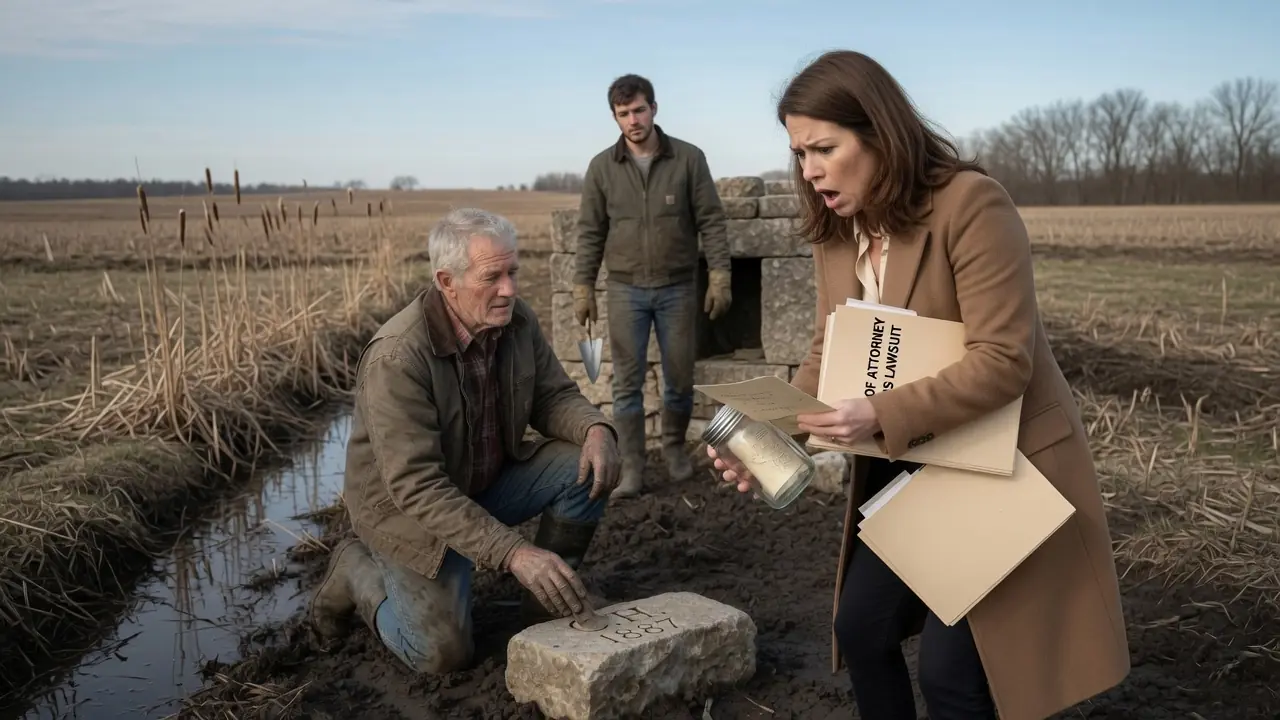
Beneath the mud, they uncovered a line of cut limestone blocks joined with old mortar.
The stones formed a corner.
Then another wall appeared.
A structure had once stood beside the spring.
Walter remembered a story Margaret repeated from her grandmother.
“There used to be a little stone house where everyone kept milk cold,” she had said. “Grandma claimed the spring ran through the middle.”
“A springhouse,” Walter whispered.
They worked carefully across two days, exposing a rectangular foundation approximately twenty feet long and fifteen feet wide.
At the southeastern corner, Walter found a larger stone.
Mud covered its face.
Caleb brought a soft brush.
A date appeared first.
1889
Beneath it were two initials.
E.R.
Walter traced the carving.
Margaret’s maiden name was Ralston.
Her great-grandmother had been named Eleanor Ralston.
Walter drove immediately to the county library.
In the basement historical archive, he searched property ledgers from the nineteenth century.
The forty acres had been purchased from the federal government in 1888 by Eleanor Ralston.
The tax books showed her family retaining the land for nearly four decades before selling it to another farmer.
Margaret never knew her ancestors owned the property.
The stories passed through generations had lost their names and dates.
All that remained by Margaret’s childhood was a spring, cold water, and a grandmother’s memory.
Walter returned to the land and told Caleb.
“She spent her whole life dreaming about a place her own family built.”
Caleb looked at the cornerstone.
“She never knew?”
“No.”
They resumed clearing.
Near the northern wall, Caleb’s trowel struck glass.
A sealed Mason jar had been hidden inside a narrow recess between stones.
The zinc lid was corroded but intact.
Folded paper remained visible through cloudy glass.
Walter removed the jar with both hands.
The paper inside had stayed dry.
He opened the lid carefully and unfolded the letter.
The ink had faded to brown.
At the top was a date from September 1889.
Walter read aloud.
To the person who finds this spring after us,
My name is Eleanor Ralston. My husband, Jacob, our neighbor Peter Wells, and I completed this springhouse during the summer of 1889. We built it because the spring does not belong only to the family whose deed contains it. The water has served every household nearby, and we hope it continues serving those who come after us.
Walter paused.
Caleb stood motionless.
The letter continued.
Our children drink here. Neighbors fill jars on Saturdays. The spring keeps milk cold in summer and never freezes completely in winter. I do not know how long these walls will remain, but if someone finds this letter, then the water has brought you here.
This ground has cared for our family. Care for it when our hands no longer can.
Walter lowered the page.
His hands trembled.
Margaret had spent fifty years asking someone to restore the spring without knowing her great-grandmother had left instructions inside its walls.
Walter placed the letter against his chest.
“She would have loved this.”
Caleb looked toward the bubbling water.
“She would have understood why you had to buy it.”
Walter stood too quickly.
The landscape tilted.
Caleb caught his arm before he fell.
“When did you eat?”
“Breakfast.”
“It’s almost four.”
“I was busy.”
“You’re going to finish this garden from a hospital bed if you keep doing that.”
Walter sat reluctantly.
Caleb brought water and a granola bar from the truck.
“You remind me of my youngest son,” Walter said.
“Is that good?”
“Usually.”
“Then eat.”
That evening, Walter placed Eleanor’s letter beside Margaret’s garden journal on the kitchen table.
Two women separated by more than a century had written about the same water.
Eleanor hoped somebody would care for the land after her.
Margaret hoped somebody would bring the spring back.
Walter sat between their words.
“I found it,” he said to the quiet house. “And I’m not letting it disappear again.”
News traveled quickly.
Frank told his wife.
His wife mentioned the spring at church.
A local newspaper published a small article about a retired surveyor uncovering nineteenth-century stonework beneath tax-sale wetland.
People began arriving with supplies.
A farmer donated cedar fence posts.
A retired carpenter brought reclaimed barn wood and built raised beds.
A woman named Janet Morris delivered strawberry plants and tomato cages.
Several church members planted daffodil bulbs along the path.
Frank arrived with a tractor and leveled an acre without waiting to be asked.
Caleb constructed a simple roof above the springhouse foundation to protect the old stones.
Walter framed a copy of Eleanor’s letter and mounted it beneath the shelter.
The original remained sealed safely inside the jar.
Every visitor stopped to read the final line.
This ground has cared for our family. Care for it when our hands no longer can.
Walter noticed Caleb changing.
The young man no longer arrived looking merely relieved to have a day’s work.
He came with questions.
He studied drainage grades and soil types.
He learned to operate Walter’s old survey level.
One afternoon, Walter found him measuring the boundary against the deed.
“You expecting an argument?”
“Better to prevent one.”
“You sound like a surveyor.”
Caleb looked through the instrument.
“I’ve had a teacher.”
“There’s a two-year land-survey program at the community college.”
“I never went to college.”
“You never needed to before.”
Caleb said nothing.
Walter saw him look at the instrument differently afterward.
Then Laura arrived with the folder in her car.
She walked down the gravel path and found her father beneath the shelter.
The school group had just left.
Walter stood.
“You came.”
“I did.”
He did not ask about the folder.
“Want to see the spring?”
Laura followed him around the exposed limestone walls.
Clear water entered the basin and moved along a stone-lined channel toward the east.
She knelt and touched it.
The cold startled her.
“Mom always said it hurt your teeth.”
“She was right.”
Walter showed her the old maps, the carved cornerstone, Eleanor’s letter, and Margaret’s journal.
Laura sat on the bench and read both women’s words.
Her eyes filled.
“Mom never knew this belonged to her family.”
“No.”
“She thought it was only a place her grandmother visited.”
“The story lost pieces over time.”
Laura pressed the journal to her chest.
“I brought information about assisted living.”
Walter looked at her.
She laughed weakly through the tears.
“It’s in the car.”
“I don’t need it yet.”
“I know.”
That evening, they sat on the porch with coffee.
Laura apologized for calling the purchase dementia spending.
“I was afraid,” she admitted. “After Mom died, I kept waiting for something inside you to break. Then you bought a swamp.”
“Understandable.”
“No. Worry was understandable. Treating you as though you were already incapable was not.”
Walter looked toward the dark field.
“I knew what was under the water.”
“You were keeping a promise.”
“Yes.”
Laura stayed through Sunday.
She hauled compost, repaired a garden bed, and helped Caleb install deer fencing.
Before leaving, she hugged Walter.
“I’ll come back in two weeks.”
“You don’t have to.”
“I know.”
Scott and Daniel arrived the following weekend.
Scott stopped joking when he saw the spring.
He sat beside Walter beneath the shelter.
“I called it a mosquito farm.”
“It did have mosquitoes.”
“I was wrong.”
“You are occasionally allowed.”
Scott looked toward the water.
“Do you talk to Mom here?”
“Most evenings.”
“What do you tell her?”
“What we finished. What was planted. Who visited.”
Scott nodded.
“I may move closer.”
“You don’t need to do that for me.”
“I know.”
Daniel examined the property with the careful attention he gave financial statements.
He reviewed drainage routes, boundaries, and the developing garden.
Then he approached Walter privately.
“This should be protected.”
Walter waited.
“A land trust,” Daniel explained. “If the property remains in ordinary ownership, somebody could sell it after you’re gone. A trust could prevent development and guarantee public access to the spring.”
“Can you arrange it?”
“Yes.”
“Then do it.”
Daniel smiled slightly.
It was one of Margaret’s expressions.
The family planted fifteen apple trees along the southern boundary.
Laura dug holes.
Scott carried the saplings.
Daniel measured each space to ensure exactly twelve feet separated the trunks.
Caleb filled and tamped the soil.
Frank arrived with mulch.
Walter stood near the spring and listened to his children laughing together.
Margaret had loved apple trees.
Every October, she baked more pies than their family could eat and delivered them to neighbors.
The young trees looked small in the open field.
Walter imagined them a decade later, their branches heavy with fruit.
By the following August, the forty acres had become unrecognizable.
Eighty raised beds produced tomatoes, beans, peppers, pumpkins, and squash.
Corn filled the western field.
Families from town tended shared plots.
The apple trees had doubled in size.
A sign near the entrance read:
TAKE WHAT YOU NEED. LEAVE WHAT YOU CAN.
Nobody monitored quantities.
The garden produced more than the community could use. Surplus food went to the local pantry.
Caleb enrolled in the land-survey program during winter.
Walter wrote his recommendation letter.
Caleb Hart reads terrain the way some people read music. He notices what the land is trying to say and respects it enough to listen.
Caleb read the letter in silence.
He folded it and placed it carefully in his jacket.
The following morning, he arrived thirty minutes early and recalibrated the survey equipment.
Daniel completed the land trust.
The property could never be sold for development, subdivided, or separated from public access.
Walter would remain steward for life.
Caleb would succeed him, supported by a community board.
The total filing cost was forty-seven dollars.
Daniel handed his father the final papers.
“One hundred eighty-five for the land and forty-seven to protect it forever.”
Walter looked at the number.
“Best purchase I ever made.”
The first harvest gathering brought nearly seventy people to the property.
Tables appeared beside the garden.
Neighbors brought casseroles, bread, lemonade, and pies.
Children ran between the orchard rows.
Laura’s daughter guarded the strawberry patch with great seriousness.
Scott had moved into a farmhouse twenty minutes away and built benches along the spring path.
Daniel organized the trust records and pretended not to enjoy the celebration.
Near noon, Frank asked Walter to speak.
Walter resisted until the crowd gathered beside the springhouse.
Caleb stood on his left.
Laura, Scott, and Daniel stood on his right.
Behind them, the garden stretched green beneath the summer sky.
Walter rested one hand on the old stone wall.
“My wife grew up near here,” he began. “She visited this spring as a child and spent fifty years telling me somebody should bring it back.”
He looked toward the water.
“When I bought these forty acres, everybody thought I had lost my mind.”
Scott raised one hand.
“I said mosquito farm.”
Laughter moved through the crowd.
“He did.”
Walter continued.
“They had reason to worry. A seventy-three-year-old widower buying flooded ground for one hundred eighty-five dollars is not normally an encouraging story.”
He paused.
“But I knew what the water had covered.”
His voice became rougher.
“I believed I was buying this land for Margaret. Then we found the springhouse, the cornerstone, and Eleanor’s letter. I learned Margaret’s family had cared for this place long before she was born.”
Walter looked at the surrounding faces.
“I paid one hundred eighty-five dollars.”
He glanced toward the garden beds.
“What the land returned cannot be measured in money. It gave me a reason to wake up when mornings had become difficult. It gave Caleb a place to begin again. It gave my family something to build together.”
He placed his palm against the limestone.
“And it gave all of us water that waited sixty years for someone to remember where it belonged.”
The crowd applauded.
Laura cried openly.
Walter stepped aside before emotion prevented him from saying more.
The celebration continued until evening.
Families filled baskets with vegetables.
Children fell asleep beneath the apple trees.
The string lights Scott installed along the path began glowing as the sky darkened.
By eight, only Walter and Caleb remained.
Caleb sat beside the spring reading one of Walter’s old survey manuals by the light of his phone.
Walter approached slowly.
“Thought you went home.”
“I wanted to finish the chapter.”
“What’s it about?”
“The original public-land surveys. Sections, townships, boundary chains.”
“That material puts most people to sleep.”
“I like it.”
Walter sat beside him.
“When I started at the county office, the oldest surveyor told me something.”
Caleb closed the book.
“He said the land existed before us and would remain after us. Our job was only to record what we saw so the next person would understand what they had.”
Caleb looked toward Eleanor’s letter.
“That is what she did.”
Walter followed his gaze.
“She recorded the spring for the next person.”
“And you were the next person.”
“Then you will be the one after me.”
Neither spoke for a while.
The spring moved through the limestone with the same steady sound it had carried in 1889.
It flowed while Eleanor built the walls.
It flowed beneath the floodwater.
It flowed while Margaret grew old dreaming about it.
Now it passed through a garden filled with food, children, and the work of people who had chosen to care for something together.
Walter stood.
His knees objected.
He had learned to ignore them within reason.
“See you tomorrow.”
“I’ll be here.”
Walter walked toward the road carrying Margaret’s journal.
At the end of the path, he turned.
The springhouse rested beneath the stars.
Young apple trees lined the southern boundary, reaching upward with thin branches that would not bear fruit for several years.
Walter opened the journal.
The dried aster remained between the pages, its purple petals faded nearly brown.
He touched it gently.
Then he looked across the forty acres nobody wanted.
“I found it, Margaret,” he whispered. “You were right. It was the prettiest ground in the county.”
The garden remained still.
The spring answered in its own language.
Cold water over limestone.
Patient.
Unbroken.
Carrying one family’s memory into another generation.
Some promises remain hidden beneath years of silence.
Some appear worthless from the road.
And some must be dug free by hand before anyone else can understand what they were always worth.