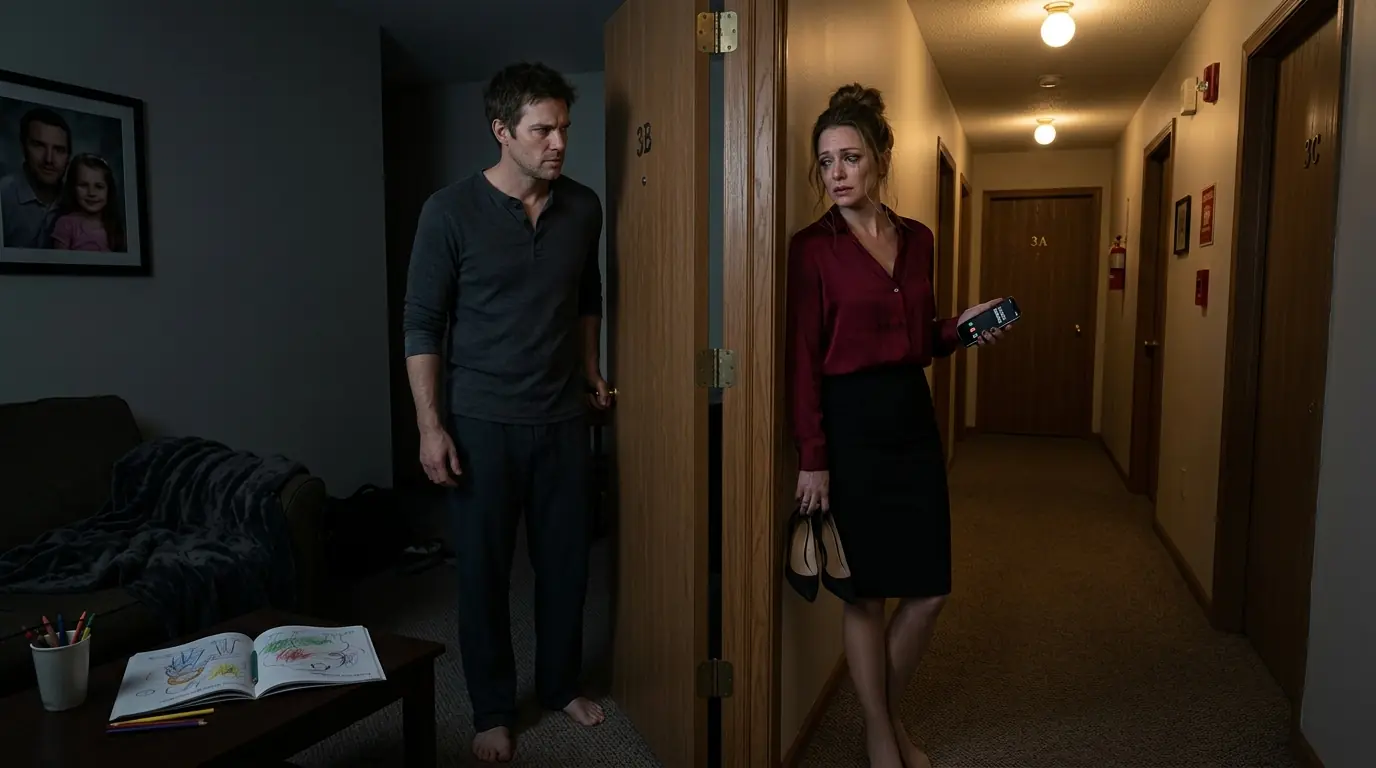
At 2:07 on a Saturday morning, Aaron Blake opened his apartment door and found the woman he disliked most in the world standing barefoot in the hallway.
Cassandra Vale still wore the black dress she had chosen for the company’s largest client dinner, but the woman inside it looked nothing like the executive who controlled every boardroom she entered.
Her hair had fallen loose from its careful knot.
Mascara marked both cheeks.
One heel dangled from her right hand, while the other appeared to have been abandoned somewhere between downtown and Aaron’s building.
She looked at him as if she had spent the entire drive trying not to fall apart and had failed only after reaching his door.
“I didn’t know where else to go,” she whispered.
Aaron did not move.
For three years, Cassandra had denied his requests to leave early for his daughter’s school events.
She had returned presentations at midnight with comments demanding revisions by sunrise.
She had once told him that personal responsibilities were “a private scheduling problem, not a company concern.”
Now she stood outside the modest apartment he shared with his eight-year-old daughter, shivering beneath fluorescent hallway lights.
Aaron’s first thought was that she had come to fire him.
His second was that she was drunk.
His third was that something worse had happened.
“Are you hurt?” he asked.
Cassandra shook her head.
“Did someone follow you?”
“No.”
“Were you driving?”
“No. I left my car.”
Her voice broke.
“I think I destroyed the Townsend account.”
The Townsend account was worth nearly twelve million dollars a year.
Losing it could cost Aaron’s agency an entire department.
Possibly more.
Aaron glanced toward the small living room behind him.
His daughter, Sophie, was asleep on the pullout couch beneath a blanket covered with yellow stars. They had stayed awake late reading the final chapters of a fantasy novel, then Sophie had insisted on sleeping near the lamp because she wanted to finish drawing the castle from the story in the morning.
Aaron stepped into the hallway and pulled the door nearly closed.
“What happened?”
Cassandra pressed her lips together.
“I made a scene.”
“That could mean many things.”
“I argued with Richard Townsend.”
“Tonight?”
“At the Meridian Club.”
Aaron waited.
She looked down at the heel in her hand.
“He told me he was reconsidering the contract. I accused him of using the anniversary of my mother’s death to pressure me.”
Aaron’s expression changed.
Cassandra continued before he could ask.
“I had been drinking. Too much. He left. Then someone recorded the argument.”
“How many people saw it?”
“I don’t know.”
“Did Townsend threaten to cancel?”
“He said he would call the board at eight in the morning.”
Aaron looked at the clock on the wall behind him.
Less than six hours.
Cassandra lifted her eyes.
“I called everyone on the executive team.”
“And they didn’t answer?”
“They answered.”
That surprised him.
“They told me to call legal in the morning.”
Aaron understood.
They had not refused because they were unavailable.
They had refused because they did not want to be standing beside Cassandra when the consequences arrived.
“Why did you come here?”
Her face tightened.
“Because you always know what to say when clients are angry.”
“You don’t usually consider that a valuable skill.”
“I know.”
“And because?”
Cassandra looked toward the narrow line of warm light beneath the apartment door.
“Because you’re the only person at the company who has ever told me the truth without trying to gain something.”
Aaron almost laughed.
The statement was so unlike anything he expected from her that he could not decide whether it was an apology or another demand.
Then Cassandra’s knees weakened.
He caught her elbow before she reached the wall.
That ended the discussion.
“Come inside.”
The apartment was small.
Two bedrooms.
One bathroom.
A kitchen connected to the living room by a counter covered with crayons, unopened mail, and the pieces of a cardboard castle Sophie had been building all week.
Cassandra looked around as Aaron guided her to the kitchen table.
The room contained more life than her penthouse had in all its polished spaces.
Photographs covered the refrigerator.
Sophie missing her two front teeth.
Sophie wearing a paper crown at school.
Aaron and his daughter standing beside a lake in mismatched raincoats.
A framed photograph of a woman with dark curls rested on a shelf near the window.
Aaron noticed Cassandra looking at it.
“My wife,” he said. “Megan.”
Cassandra had heard office gossip but never asked directly.
“She died?”
“No.”
He filled a glass with water.
“She left.”
Cassandra looked away.
Aaron placed the water in front of her.
“Drink.”
She obeyed.
That alone told him how badly shaken she was.
Cassandra Vale never followed instructions without changing them first.
From the living room came the quiet sound of movement.
Sophie appeared in the doorway, dragging the yellow-star blanket behind her.
“Dad?”
Aaron turned.
“Sorry, sweetheart. Did we wake you?”
Sophie rubbed one eye.
Then she noticed Cassandra.
“Is that your boss?”
Cassandra straightened instinctively, as though even a child required the professional version of her.
“Yes.”
Sophie studied the mascara, the missing shoe, and the water glass.
“You look different.”
Cassandra almost smiled.
“I feel different.”
Sophie looked at Aaron.
“Is she the one who made you miss my music night?”
Aaron closed his eyes briefly.
Children remembered every careless adult conversation.
Cassandra’s face lost what little color remained.
“Yes,” she said before Aaron could answer. “I am.”
Sophie considered that.
“Did you say sorry?”
“Not yet.”
“You probably should.”
“Sophie,” Aaron warned gently.
Cassandra raised one hand.
“She’s right.”
She looked at the child.
“I’m sorry I kept your father away that night.”
Sophie hugged the blanket closer.
“He was sad.”
“I know.”
“No, you didn’t.”
The words contained no cruelty.
Only fact.
Cassandra accepted them.
“No,” she said quietly. “I didn’t.”
Sophie looked toward her father.
“Can she have the couch after I go back to bed?”
“She isn’t staying.”
Cassandra stood too quickly and caught the edge of the table.
Aaron steadied her.
Sophie frowned.
“She should stay until she can stand.”
Aaron stared at his daughter.
Cassandra did too.
Megan had once told him that children were often kinder because they had not yet learned to calculate whether someone deserved it.
Sophie returned to her room with the blanket.
Aaron found aspirin, made coffee strong enough to sober the dead, and placed his laptop on the kitchen table.
Cassandra watched him open the Townsend account files.
“You’re helping me.”
“I’m helping the people who will lose their jobs if this account collapses.”
The answer should have hurt.
Instead, she nodded.
“That’s fair.”
Aaron reviewed the client history.
Richard Townsend was the founder of a national chain of rehabilitation clinics. His company had hired Vale Creative three years earlier to rebuild its public identity after a difficult expansion.
Aaron had led the initial campaign.
Cassandra had presented it.
Townsend trusted Aaron’s judgment, though the two men had met only a few times.
“What exactly did he say tonight?” Aaron asked.
Cassandra described the dinner.
Townsend had raised concerns about the newest campaign concept. He believed Cassandra had made the work too aggressive and impersonal.
She accused him of resisting modernization.
He said she was no longer listening to patients, employees, or her own creative team.
That last remark hit a nerve.
It was the fifth anniversary of Cassandra’s mother’s death, and she had already consumed two glasses of wine before dinner.
By the fourth, she was angry enough to hear every criticism as humiliation.
“What did you say about your mother?” Aaron asked.
“That he waited until tonight to challenge me because he knew I was vulnerable.”
“Did he know the date?”
“No.”
“Then the accusation made no sense.”
“I know that now.”
“What happened next?”
“I told him he could take his account to an agency willing to recycle sentimental nonsense.”
Aaron stopped typing.
“You said that?”
“In a louder voice than I intended.”
“How much louder?”
“People at other tables turned around.”
“And the recording?”
“A woman near the bar.”
Aaron leaned back.
“This is not only a client problem.”
“I know.”
“It’s a leadership problem.”
“I know.”
“It may become a public-relations problem.”
“I know, Aaron.”
For the first time, she used his name without attaching an instruction.
He watched her for a moment.
“Why tonight?”
Cassandra looked toward the photograph of Megan.
“My mother died five years ago today.”
“You said that.”
“She raised me alone.”
Aaron waited.
“She owned a small print shop. Worked twelve hours a day. Never complained. When I was in college, she was diagnosed with pancreatic cancer.”
Cassandra stared into the untouched coffee.
“I promised I would take time off and stay with her. But the agency was close to winning its first national contract. I kept postponing the trip.”
Aaron said nothing.
“The last time she called, I let it ring because I was in a client meeting.”
Her fingers tightened around the cup.
“She died the next morning.”
The apartment became very quiet.
“I built everything after that,” Cassandra continued. “The agency. The reputation. The rules. I told myself the work had to mean something because of what I gave up for it.”
Aaron understood more than he wanted to.
“And when other people chose their families, you treated it like weakness.”
Her eyes filled.
“It made my sacrifice look unnecessary.”
“That doesn’t excuse what you did.”
“No.”
“You made employees pay for a decision they didn’t make.”
“I know.”
“Especially me.”
“Yes.”
Aaron closed the laptop.
Cassandra looked frightened.
“Are you done helping?”
“No. I’m done pretending this can be fixed with a clever phone call.”
He checked the time.
3:14 a.m.
“We need three things before eight. An honest apology to Townsend. A corrected campaign direction. And a plan for what you will say if the video becomes public.”
Cassandra nodded.
“What should the apology say?”
“What is true?”
“That I was wrong.”
“More.”
“That I insulted him.”
“More.”
She looked toward him.
“That I stopped listening.”
Aaron opened the laptop again.
“Now we have somewhere to begin.”
They worked until dawn.
Aaron rewrote the campaign strategy around patient stories rather than abstract brand language. Cassandra removed the phrases she had insisted were “bold” and admitted they sounded cold when read beside actual testimonials.
At 5:40, Aaron called the senior account director.
At 6:10, he contacted legal and instructed them to preserve the video rather than threaten the person who recorded it.
At 6:45, Cassandra recorded a short statement accepting responsibility without blaming grief, alcohol, or Townsend.
Aaron made her record it three times.
The first sounded rehearsed.
The second sounded defensive.
The third sounded like a person.
At seven, Sophie entered the kitchen wearing pajamas and carrying her coloring book.
She stopped when she saw both adults surrounded by papers.
“Did you stay all night?”
Cassandra looked toward the brightening window.
“I suppose I did.”
Sophie climbed into the chair beside Aaron.
“Are you still the dragon boss?”
Aaron nearly spilled his coffee.
Cassandra looked at him.
“The what?”
He stared at his daughter.
Sophie opened her coloring book.
“Dad called you that one time.”
“I did not.”
“You said she breathes fire through email.”
Cassandra’s mouth opened.
Then she laughed.
It began as a small sound and became something warmer.
Aaron had worked for her for three years.
He had never heard her laugh without calculation.
“I probably deserved that,” she said.
Sophie held up a purple crayon.
“Dragons can be good.”
“Can they?”
“If they guard people instead of burning them.”
Cassandra looked toward Aaron.
He looked away first.
At 7:52, Richard Townsend joined the emergency video call.
He appeared from his home office wearing a sweater rather than a suit. Three members of his executive team sat in separate windows.
The chairman of Vale Creative’s board joined as well.
Cassandra sat at Aaron’s kitchen table.
The refrigerator photographs remained visible behind her.
She had considered using a blurred background.
Aaron told her not to.
Townsend began without greeting.
“I assume you know why we are here.”
“Yes,” Cassandra said.
“I received the revised campaign at seven twenty. It is much stronger than the version presented yesterday.”
“Aaron rebuilt it.”
Townsend looked toward him.
“I suspected.”
Cassandra continued.
“What I said last night was insulting and unprofessional. You questioned the work because the work deserved to be questioned. I responded by attacking you personally.”
Townsend’s expression remained firm.
“I was told you experienced a difficult anniversary.”
“I did. That explains my condition. It does not excuse my conduct.”
The board chairman leaned forward slightly.
Townsend said nothing.
Cassandra continued.
“I also need to acknowledge that the campaign failed because I ignored the people closest to it. Aaron raised concerns. So did our account team. I overruled them because I believed authority made me correct.”
Aaron watched her.
This was not the statement they had written.
It was better.
Townsend looked toward Aaron.
“Do you agree with the revised direction?”
“Yes.”
“Do you believe the agency can deliver it?”
Aaron paused.
“With structural changes.”
The board chairman frowned.
“What changes?”
“Creative decisions need documented team review. Employees must be able to challenge executive direction without retaliation. And the account should no longer depend on one person’s approval.”
Cassandra nodded.
“I agree.”
Townsend looked at her.
“You are willing to surrender final control?”
“I am willing to stop confusing control with leadership.”
A long silence followed.
Then Townsend leaned back.
“I was prepared to cancel the account.”
Cassandra lowered her eyes.
“I understand.”
“I am not canceling today.”
The chairman exhaled.
Townsend raised one hand.
“This is not forgiveness. It is an opportunity to prove that this morning is more than crisis management.”
“It will be,” Cassandra said.
“How do I know?”
She looked toward Aaron.
“You don’t. Not yet.”
Townsend nodded slowly.
“That is the first honest answer I have heard from your agency in months.”
He approved the revised campaign and scheduled a review for thirty days later.
When the call ended, Cassandra remained motionless.
Aaron closed the laptop.
“You kept the account.”
“We kept it.”
She looked around the kitchen.
The cardboard castle occupied half the counter. A sock hung from the back of one chair. Sophie had fallen asleep again with her head against Aaron’s arm.
Cassandra stood carefully.
“I should leave.”
“You shouldn’t drive.”
“My car is still downtown.”
“I’ll call one.”
She reached for her purse, then stopped.
“Aaron.”
“Yes?”
“I am sorry.”
He looked at her.
“For last night?”
“For three years.”
“That is a larger apology.”
“I know.”
He adjusted the blanket around Sophie.
“I’m not ready to tell you it’s all right.”
“I’m not asking you to.”
That mattered.
On Monday morning, Cassandra arrived at the office before anyone else.
She stood beside Aaron’s desk holding two cups of coffee.
The employees entering behind him slowed.
Vale Creative had nearly ninety people.
By nine fifteen, every one of them would know that Cassandra Vale had carried coffee for another human being.
“Black with one sugar,” she said.
Aaron accepted it.
“Who told you?”
“Your assistant.”
“You asked?”
“I’m trying something new.”
“What?”
“Paying attention.”
She requested a private meeting.
Inside her office, Cassandra handed him a folder.
It contained a promotion to Senior Creative Director, a forty-percent salary increase, and full authority to set his working hours.
Aaron read the first page.
Then he closed it.
“No.”
Cassandra blinked.
“You haven’t read the entire offer.”
“I’ve read enough.”
“You deserve the position.”
“I did last month too.”
Her expression tightened with shame.
“Yes.”
“If I accept this today, everyone will believe I was rewarded for rescuing you.”
“The promotion reflects three years of performance.”
“Then it should have happened before you needed me.”
Cassandra sat slowly.
Aaron placed the folder on her desk.
“I want the role reviewed by an independent committee. I want the criteria published. And I want every employee overlooked under your leadership to receive the same review.”
“That could expose serious inequities.”
“That is the point.”
Cassandra looked toward the city through the window.
“You could simply take the promotion.”
“I could.”
“Why won’t you?”
“Because my daughter was watching last night.”
Cassandra turned.
“I told her kindness matters. I do not want her learning that kindness is a transaction.”
For several seconds, Cassandra said nothing.
Then she opened the folder and removed the promotion letter.
“What do you want today?”
“My previously approved flexible schedule honored.”
“Done.”
“The account team protected from retaliation.”
“Done.”
“And permission to leave at three thirty.”
“Why?”
“Sophie has a science presentation.”
Cassandra nodded.
“Go at three.”
Aaron studied her.
“The presentation begins at four.”
“You should arrive before it starts.”
That afternoon, Cassandra called an all-staff meeting.
People entered expecting an announcement about the Townsend account.
Instead, she stood before them without slides.
“On Friday evening, I behaved in a way that endangered this agency and disrespected a client,” she said. “That incident was not isolated from how I have led here.”
The room became still.
“I have rewarded availability more than effectiveness. I have treated family obligations as lack of commitment. I have discouraged disagreement and confused fear with respect.”
Several employees looked toward Aaron.
He kept his eyes on Cassandra.
“Beginning today, promotion decisions from the past three years will be independently reviewed. Flexible-work policies will be rewritten. No employee will be penalized for using approved leave or attending family responsibilities.”
A senior strategist raised her hand.
“Why now?”
Cassandra did not offer the safe answer.
“Because someone I treated badly chose to help me when I did not deserve it.”
She looked toward Aaron.
“That kindness exposed how far I had moved from the person I wanted to be.”
The changes did not happen overnight.
Some employees assumed Cassandra was performing remorse until the crisis passed.
Others waited for her temper to return.
At first, it did.
During one meeting, a junior designer criticized her preferred concept. Cassandra’s voice sharpened automatically.
The room froze.
Then she stopped herself.
“You’re right,” she said. “I’m reacting instead of listening. Continue.”
The designer did.
Each time Cassandra chose differently, trust moved one inch.
She approved flexible schedules.
Removed the expectation of weekend responses.
Required managers to document workload before requesting overtime.
She also accepted consequences.
The board removed part of her operational authority for six months.
She agreed without protest.
Aaron’s promotion went through the independent review.
Three other employees received overdue promotions as well.
He accepted after requesting a reporting structure that placed him under the chief operating officer rather than Cassandra.
She understood immediately.
“You don’t trust me as your direct manager.”
“Not yet.”
“That is fair.”
Three days after the emergency call, Sophie became ill with influenza.
Aaron sent a message saying he would work from home.
The old Cassandra would have asked whether a neighbor could help.
The new Cassandra sent one reply.
Take care of her. Work can wait.
That evening, the doorbell rang.
Cassandra stood outside holding chicken soup, children’s books, and the expression of someone who had reconsidered leaving at least six times on the way upstairs.
“I hope this is not inappropriate.”
Aaron looked at the containers.
“What is it?”
“My mother’s soup recipe.”
“That does not answer the question.”
“I know.”
He invited her inside.
Sophie emerged from the bedroom wrapped in the yellow-star blanket.
“The dragon boss.”
Cassandra nodded gravely.
“I’m trying to become a less dangerous species.”
Sophie examined the bag.
“Did you bring treasure?”
“Soup and books.”
“That’s acceptable treasure.”
Cassandra knelt beside her.
One book was about a girl who repaired a damaged moon.
Sophie carried it to the couch and asked Cassandra to read.
Aaron expected her to refuse politely.
Instead, she sat.
Her first few sentences sounded like a board presentation.
Sophie corrected her.
“You have to make the moon sound sad.”
Cassandra tried again.
By the third page, she had found the voices.
Aaron watched from the kitchen.
The woman reading to his daughter was still demanding, ambitious, and uncomfortable in his cluttered apartment.
But she was present.
Later, after Sophie fell asleep, Cassandra helped wash the soup bowls.
“You don’t have to do that,” Aaron said.
“I know.”
The answer reminded him of Monday’s coffee.
They sat at the small kitchen table.
Cassandra traced one finger around the rim of her tea cup.
“Do you believe people change?”
“Yes.”
“That quickly?”
“No.”
She looked up.
“Then what happened to me?”
“You became aware.”
“That is not change?”
“It is the beginning.”
Cassandra nodded slowly.
“What comes after?”
“Choices. Repeated long enough that other people stop expecting the old version of you.”
“That could take years.”
“Yes.”
She looked toward Sophie sleeping on the couch.
“I spent years becoming difficult. I suppose I shouldn’t expect to undo it in a weekend.”
Aaron smiled faintly.
“That may be the most realistic thing you’ve said.”
Months passed.
The Townsend campaign became one of the agency’s strongest projects.
Aaron led it with a team that included employees Cassandra had previously overlooked.
The work focused on real patients, caregivers, and clinic employees. It was warmer than anything Vale Creative had produced in years.
The client expanded the account.
Cassandra refused to present the success as her own.
Aaron noticed.
He also noticed other things.
She began leaving the office by six.
She spoke to interns by name.
She placed a photograph of her mother on her desk.
The penthouse she once kept empty slowly changed.
Sophie’s drawings appeared on the refrigerator after Cassandra invited Aaron and his daughter to dinner.
A plant appeared near the window.
Then another.
The agency gossip grew predictable.
Aaron ignored it.
Cassandra did too.
They did not begin dating while he worked beneath her authority.
The boundary mattered to both of them.
A year after the Meridian Club incident, Cassandra stepped down as chief executive and became chair of the agency’s creative foundation, which funded arts programs for children and small businesses.
The board appointed an experienced operating executive to replace her.
Aaron became Creative Vice President after another formal review.
Only then did Cassandra ask him to dinner.
Not a client dinner.
Not a work dinner.
A real one.
Aaron looked at her across the elevator lobby.
“Are you asking because you feel grateful?”
“No.”
“Guilty?”
“No.”
“Lonely?”
“Probably somewhat.”
“That is not reassuring.”
She smiled.
“I’m asking because I have spent a year becoming someone who can ask without hiding behind authority.”
Aaron considered her.
“And because?”
“Because Sophie says my dragon scales have become glitter.”
“That sounds like her.”
“And because I would like to know who you are when we are not repairing disasters.”
Aaron accepted.
Their relationship grew slowly.
Sophie remained suspicious for almost two weeks, then decided Cassandra’s willingness to eat cereal for dinner proved she could be trusted in emergencies.
Cassandra attended school events.
Not as Aaron’s boss.
Not as a donor.
As someone Sophie searched for in the audience.
Aaron finished the children’s book he had begun writing before the night Cassandra appeared at his door.
It told the story of a lonely dragon who guarded an empty castle because she had forgotten the difference between protecting something and keeping everyone away.
Sophie illustrated it.
Cassandra helped submit it to a publisher but refused to use her name during the process.
The book was accepted on its own merit.
When the first printed copy arrived, Sophie made Cassandra read the final page aloud.
The dragon did not lose her fire.
She learned where to aim it.
Two years after that 2 a.m. knock, Aaron stood inside Cassandra’s apartment watching her and Sophie attempt to prepare lasagna.
The place no longer resembled a hotel suite.
Photographs covered one wall.
Books crowded the shelves.
Sophie’s schoolbag rested beside the couch.
A slightly crooked paper moon hung from the kitchen cabinet.
“You are adding too much cheese,” Cassandra told Sophie.
“There is no such thing.”
“There is when the cheese begins to form a separate geological layer.”
Aaron leaned against the doorway.
Cassandra noticed him.
“Are you going to help?”
“I’m observing leadership in action.”
“You’re enjoying our suffering.”
“Also true.”
After dinner, Sophie fell asleep watching a movie.
Cassandra and Aaron sat on the balcony above the city.
She handed him a wrapped package.
Inside was a first-edition copy of the book his father had read to him when he was a child.
Aaron ran his fingers over the worn cover.
“How did you find this?”
“I asked questions and paid attention.”
He opened the book.
On the first page, Cassandra had written:
Some people save us by refusing to become as cruel as we have been. You gave me kindness without surrendering your boundaries. That difference changed my life.
Below the inscription rested a small velvet box.
Aaron looked at her.
Cassandra’s hands were trembling.
“I rehearsed this,” she said. “It sounded much better when you weren’t looking at me.”
“You can still use the speech.”
“I have forgotten every word.”
She opened the box.
Inside was a simple ring.
“I am not asking to replace Sophie’s mother.”
Aaron’s expression softened.
“I know.”
“I am not asking to erase the years when I hurt you.”
“I know.”
“I am asking whether there is room for me in the life you and Sophie built. Not as a rescue project. Not as your former boss. As someone who will continue choosing both of you, even when choosing well is difficult.”
Aaron looked through the glass door.
Sophie slept beneath the yellow-star blanket.
The same blanket she had carried into the kitchen the night Cassandra first appeared.
“You once asked whether people truly change,” he said.
Cassandra nodded.
“I think this is the answer.”
“What is?”
“They do not become different in one dramatic moment.”
He took the ring from the box.
“They become different through every ordinary moment that follows.”
Tears filled her eyes.
“Is that a yes?”
Aaron smiled.
“It is.”
The story people at Vale Creative told about Cassandra’s transformation usually began with the lost shoe, the client crisis, or the coffee she carried into the office on Monday morning.
They were memorable details.
They were not the reason she changed.
Cassandra changed because, at the lowest point of her life, a man she had repeatedly hurt opened his door.
Aaron did not excuse her.
He did not allow compassion to erase accountability.
He helped her stand, then required her to face what she had done.
That was the second chance she had never understood before.
Not freedom from consequences.
The opportunity to meet them differently.
Aaron also changed.
For years, he had believed being a good father meant asking nothing for himself.
He endured unfair treatment because stability seemed safer than dignity.
Helping Cassandra taught him that kindness did not require self-erasure.
He could care for another person and still protect his own worth.
The most important moment in both their lives arrived without warning.
It did not look like romance.
It looked like an exhausted single father standing in an apartment hallway at two in the morning, deciding whether to close the door on someone who had made his life miserable.
Resentment would have been understandable.
Indifference would have been easy.
Aaron chose compassion.
Then, in the morning, he chose honesty.
Cassandra chose to listen.
And from those choices came everything that followed.
A repaired company.
A finished book.
A child who gained another person willing to show up.
A cold apartment that became a home.
A woman who learned that strength did not require cruelty.
And a man who discovered that opening a door for someone else did not mean allowing them to walk over him again.
Sometimes second chances arrive as apologies.
Sometimes they arrive as consequences.
And sometimes they stand barefoot outside your apartment at two in the morning, holding one broken shoe and asking for help in a voice you have never heard before.