The slap cracked across the garden like a snapped branch, and the Duke of Foxmere, who had been standing at the edge of the terrace, wishing himself anywhere else on earth, turned toward the sound, and saw a woman he had never met struck across the face before two hundred people, and found that he was already moving before he had decided to. He had not wanted to come to the Marchmont garden party. Sebastian, the fourth Duke of Foxmere, was a man of six-and-thirty with a reputation for coldness he had earned honestly and cultivated on purpose, disliked garden parties the way other men disliked toothache, as a predictable, tedious, recurring affliction to be endured with as little conversation as possible. He came to these things only when duty compelled him, spoke to as few people as he could manage, and left the instant civility permitted. He had chosen his position accordingly, at the far edge of the terrace, half shadowed by a stone urn spilling over with roses, from which vantage he could observe the whole bright, cruel machinery of society, without being drawn into it, which was how he came to see the whole of it.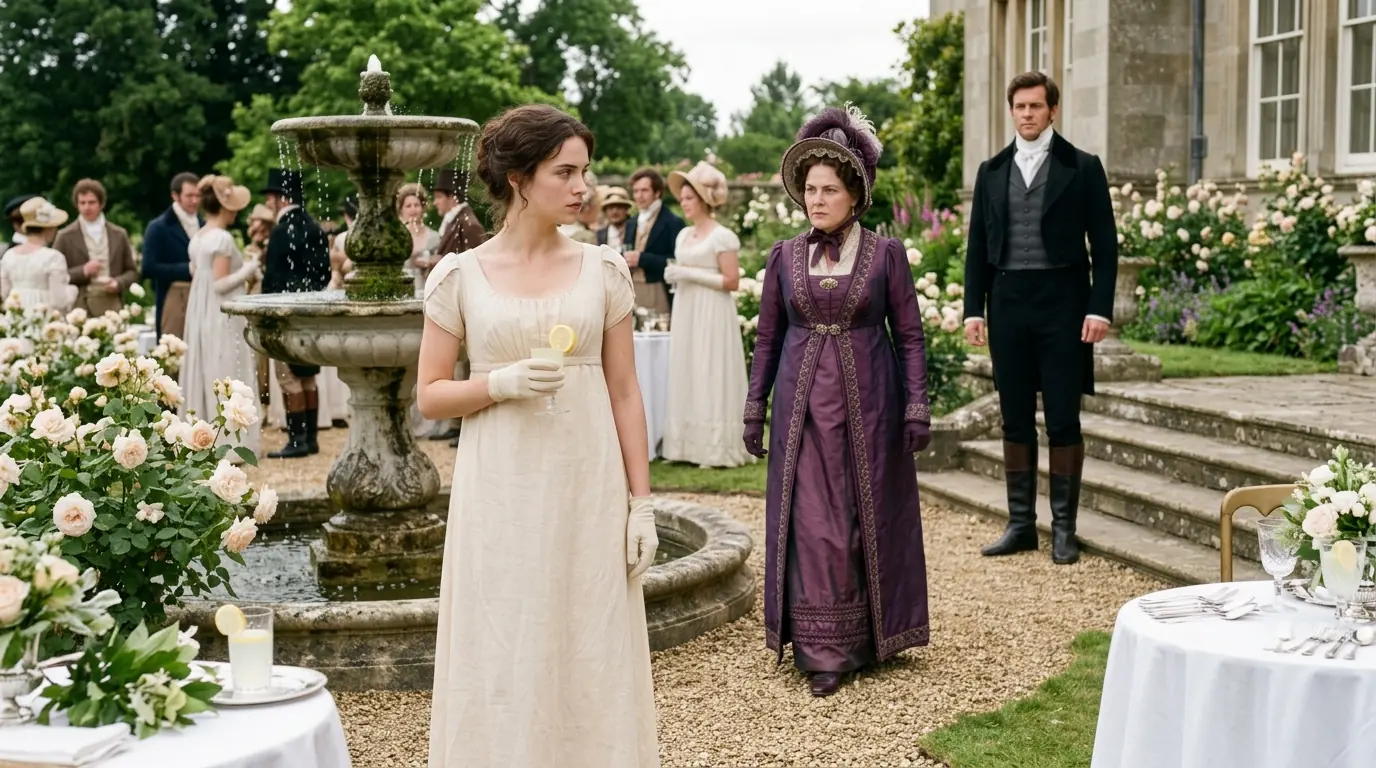
The young woman had been standing near the roses on the lower lawn, a little apart from the crowd, in a gown that was clean and neat and unmistakably several years out of fashion, a pale muslin, mended at one shoulder, worn with the careful dignity of a woman making the best of what she had. She was not one of the glittering women. Sebastian had noticed her earlier in the vague way one notices a quiet figure at the margin of a loud scene and had thought without much interest that she had a striking face—grave and fine-boned—with a stillness to it that the fluttering debutantes around her entirely lacked. She had been standing by herself holding a cup of lemonade she did not drink watching the party as one watches a fire from the cold side of a window and then an older woman had swept down upon her. Sebastian did not know at first who the older woman was; he learned later.
But he could read the shape of it well enough from where he stood, the elder woman, richly and expensively dressed, her face handsome and hard, bearing down on the young one with the particular predatory energy of a person who has found in a crowd a safe target to be cruel to. There had been words. Sebastian could not hear them from the terrace, the older woman's face contorting with a venom she made no effort to disguise; the younger woman's face going pale and very still. And then the older woman's hand had come up and swung and struck the young woman full across the cheek, hard enough that her head snapped to the side, hard enough that the crack of it carried the length of the garden and stilled every conversation on the lawn. For a heartbeat the whole party froze, and in that frozen heartbeat Sebastian saw two things that decided him.
He saw the young woman not cry out, not clutch her face, not flee, but slowly, deliberately straighten her spine and lift her struck cheek, and turn back to face the woman who had hit her in a silence more dignified than any protest could have been, refusing even now to give her tormentor the satisfaction of a public collapse. And he saw the crowd, the bright, glittering, watching crowd of his own class, do the thing that crowds of his class always did. They did not move to help her. They did not cry shame. They drew back a half step altogether, the way water draws back from a stone, and their faces arranged themselves into expressions of delicious scandalized interest.
And Sebastian understood that not one of the two hundred well-bred people on that lawn intended to lift a finger for the girl in the mended muslin. They intended to watch. They intended to enjoy it. They intended to go home and speak of it for a fortnight, and to conclude in the end that the girl must somehow have deserved it, because it was more comfortable to believe that than to have stood by and done nothing while a woman was struck in a garden. Sebastian of Foxmere was not, by temperament, a rescuer.
He had spent his life perfecting the art of not caring what happened to the people around him because caring he had found was expensive and he had paid the price of it once long ago and had resolved never to pay it again. He was called the cold duke, the iron duke of Foxmere, and he had never troubled to correct the reputation because it kept people at the distance he preferred. But he found now that his feet had already carried him off the terrace and down the shallow stone steps and onto the lawn, and that the crowd was parting before him as it always parted, and that the elder woman's hand was rising again, rising for a second blow, emboldened by the crowd's silence, by the young woman's refusal to cower, by the intoxicating discovery that she could do this in public, and no one would stop her, and Sebastian caught her wrist. He caught it in midair, an inch from the young woman's face, his hand closing around the older woman's forearm with a firmness that was not quite violence, but left no possibility of argument, and he held it there, arrested, in front of the entire silent garden, and the woman turned to see who had dared, her face still ugly with its interrupted rage, and found herself looking up into the cold, dark eyes of the Duke of Foxmere. "I think not," said Sebastian.
His voice was very quiet. He did not raise it. He had learned long ago that a quiet voice in a silent room carries further and cuts deeper than any shout, and this garden was very silent now. Two hundred people had stopped pretending not to watch and were watching openly, and the only sound was the small, ordinary sound of a fountain somewhere behind the roses. And the Duke of Foxmere stood on the lawn with a cruel woman's wrist locked in his hand, and put himself deliberately and immovably between her and the young woman in the mended muslin.
So again, he did not let go. You struck this young woman across the face in front of two hundred people. I watched you do it. And then, madam, I watched you raise your hand to do it a second time, not in the heat of a quarrel, but slowly at your leisure, because you had discovered that no one here intended to stop you. You were wrong about that.
Someone did intend to stop you. I find I am that someone. It appears to have come as a surprise to us both. He released her wrist, then flung it down, almost with a small contemptuous gesture, as one discards a thing one does not wish to hold longer than necessary, and turned his back on her entirely, which was, he knew, the deeper insult, and gave the whole of his attention to the young woman she had struck. She was staring at him, of course she was staring at him.
The whole garden was staring at him, but there was in her face something more than the crowd's simple astonishment. There was a wariness so deep it was nearly its own kind of grief. The look of a person so thoroughly accustomed to cruelty that a piece of unexpected protection arrives like a thing she cannot trust. A trick a prelude to some fresh humiliation she has not yet seen the shape of. Her struck cheek was reddening already, a livid mark blooming across the pale skin, and her dark eyes were bright with the effort of holding back tears she plainly refused to shed in front of these people, and Sebastian felt something turn over in his chest that he had not felt in a very long time and had believed himself safely rid of.
He did not touch her. He understood without being told that she had been touched enough today and not gently. Instead, he stood close and lowered his voice so that it was meant for her alone, though the nearest of the watching crowd could still hear, and he said her name. Eleanor, he said he had learned it not two minutes before from a whisper in the crowd as he crossed the lawn. Miss Vance, "Miss Eleanor Vance," someone had murmured, "And the stepmother—oh, the stepmother." and he did not know why he chose to say it now in that low, steady voice, except that he had watched a woman be struck and stripped of every dignity in front of two hundred people, reduced to an object, a thing to be slapped and scorned.
And he wished, more than he had wished anything in years, to give her back one small piece of what had been taken, to speak her name as a name, as a person's name, as the name of a woman who mattered, and not as the whispered scandal the crowd was already making of her. He watched the effect of it move across her face. He watched her hear her own name spoken kindly in a garden where she had just been struck by a man she had never met, and he watched something in her carefully held composure crack, not into collapse, but into a kind of terrible, disbelieving hope, as though no one had spoken to her gently in so long that she had forgotten the sound of it. "You know my name," she said. Her voice was low and unsteady, and she was fighting to keep it level.
I do not know yours your grace. I do not know why you would. She stopped. Her eyes flicked once to the watching faces and to the older woman standing rigid and furious behind him and came back to his. You should not have done that.
You do not know what you have done. She will make me pay for it. She always makes me pay. It would have been better to let her strike me twice and be done. It would not have been better, said Sebastian.
It is never better to let cruelty go unanswered because the answering is inconvenient. I know that lesson well, Miss Vance. I learned it too late once, and it cost me a great deal, and I have not forgotten. He held her gaze. "Who is she?"
"My stepmother." The word came out flat, exhausted, a fact worn smooth by long carrying. Lady Vance, my father married her when I was 15. He died two years ago and left everything to her in trust and me in her keeping until I should marry, which she has taken very good care I shall not do. For an unmarried stepdaughter she can command is worth a great deal more to her than a married one she cannot.
I keep her house. I mind her comforts, and when she is displeased or bored, or simply wishes to remind me of my place, she does. Eleanor lifted her chin the smallest degree, the same gesture he had seen when she turned to face the second blow. I have learned to bear it. I did not ask you to interfere.
Your grace, though I, though it was kind, it was the first kind thing anyone has done in this garden today. But you have a great name and a great deal to lose, and I have neither. And by tomorrow, the whole of society will have decided that I somehow contrived to have a duke defend me, and it will be one more sin laid at my door. So I thank you and I beg you to walk away now and let me manage her as I always do. Sebastian looked at her for a long moment.
And he thought that in six-and-thirty years he had met a great many women who wanted things from him, his name, his fortune, his consequence, his hand, and that this was the first he could remember who was trying out of some worn down protective instinct to send him away for his own good. "No," he said. Eleanor blinked. "Your Grace?" "I said no."
He turned his head unhurried and looked at the assembled crowd, the two hundred well-bred people who had watched a woman struck and drawn back to enjoy it at their scandalized faces. At Lady Vance, standing white and shaking with rage among them, and he raised his voice now for the first time, and let it carry to the farthest of the garden, "I find I have something to say to all of you, since you have all made yourselves witnesses." I have stood among you at a great many of these gatherings, and I have thought you tedious, and I have never troubled to think worse of you than that. I was too generous. I have just watched every one of you stand by while a young woman was struck across the face, and not one of you moved.
You drew back. You made room. You arranged your faces to enjoy it, and you will go home tonight and tell one another that Miss Vance must have deserved it. Because that is easier than admitting you watched a cruelty and did nothing, which is its own kind of cruelty, and a more cowardly one. His cold gaze swept them, and they flinched from it one by one.
"You call me the cold duke. You have said it behind my hand for years. Look to yourselves. I have never in my life struck a woman in a garden, nor stood in a smiling crowd and watched it done. Whatever I am, I am warmer than that.
The silence was absolute. And then Sebastian turned back to Eleanor Vance and did the thing that ended the garden party and the whispering and the whole comfortable order of that bright cruel world all at once. He offered her his arm. Miss Vance, he said, will you allow me to take you out of this garden? You need not stay to be looked at.
You have been looked at quite enough for one afternoon. My carriage is at the front of the house, and it is entirely at your disposal. And I give you my word, which I do not give lightly, and have not given in some years, that no one in it will raise a hand to you or a voice to you now or ever. You may go home to your stepmother's house if you wish, and I will not prevent you. But you will not walk out of this garden alone with that mark on your face, past two hundred people who did nothing, as though you were the one who ought to be ashamed.
You will walk out on the arm of the Duke of Foxmere with your head up and let every one of them wonder for the rest of their lives what it was they failed to see in you. Eleanor Vance looked at the offered arm as though it were a door in a wall she had spent her whole life believing was solid. Behind them, Lady Vance found her voice. Eleanor. It cracked out like a whip.
The voice of a woman accustomed to instant obedience, sensing her authority slipping and grabbing after it. You will not. You will come here to me this instant. You forget yourself. You forget what you are.
His grace is amusing himself at your expense. Do you imagine a duke means anything by taking notice of a girl like you? He will set you down before the week is out and it will be I who am left to deal with the scandal. Come here. Come here at once or I promise you you will regret this to the end of your days.
It was, Sebastian would reflect afterward, exactly the wrong thing for the woman to have said. He watched it land. He watched Eleanor Vance hear her stepmother threaten her in front of everyone. Moments after striking her, and he watched something in the young woman's face change, watched the worn-down submission of two years of tyranny meet. For the first time, an alternative hand held out, a door in the wall, and he watched her decide.
She put her hand on his arm. Her fingers were cold and they trembled, and Sebastian covered them briefly with his own free hand, steadying them, and felt her draw breath as though she had not breathed properly in a long while. "No," Eleanor said to her stepmother, and though her voice shook, it did not fail. "I do not think I shall regret it. I have regretted staying silent for two years.
I have never once regretted the small handful of times I found the courage to speak. And I find I have a little courage left today, after all, enough at least, to walk out of a garden on my own two feet, on the arm of a man who was kind to me when no one else would be. You may deal with the scandal, madam. You made it. You made it in front of everyone with your own hand.
I am only walking away from it. She walked on the Duke's arm up the shallow stone steps and across the terrace and into the great house through a silent staring parting crowd with her struck cheek still red and her chin held high. And Sebastian matched his stride to hers and looked at no one and behind them Lady Vance stood alone on the lawn in the wreckage of her own cruelty, having struck a girl in a garden and lost her in the space of five minutes to a duke. They did not speak until they were in the carriage, and the horses had started forward, and the great house with its staring windows had begun to slide away behind them. And then Eleanor Vance, who had held herself so rigidly upright through the whole long walk, who had not wept in the garden or on the terrace or in the hall, put her face in her cold, trembling hands, and wept at last, silently, exhaustedly, the deep, dry, then flooding weeping of a person who has held something back for far too long, and Sebastian sat across from her and did not touch her and did not tell her to stop but only waited and let her have it and thought that whoever Eleanor Vance had been before her father died.
She had spent two years being ground down into someone who did not permit herself to cry where anyone could see and that this more than the slap was the true measure of the cruelty done to her. When she had finished, she wiped her face with a handkerchief he had silently offered, and she looked at him with red- rimmed eyes, and she said, "You have ruined yourself, you know, for me." A duke does not carry off a penniless stepdaughter from a garden party in front of the whole of society. By tomorrow, they will be saying the most dreadful things about us both. Let them, said Sebastian, I have been the subject of dreadful sayings before.
I find I care remarkably little for the opinion of two hundred people who watched you struck and did nothing. Their good opinion is not worth having, Miss Vance. I would assume be scorned by them as praised. But you did not have to. That is what I do not understand.
She twisted the handkerchief in her hands. You do not know me. You had never seen me before this afternoon. You could have stayed on your terrace and let it happen as everyone else did, and no one would have thought a moment the worse of you, and your life would have gone on exactly as before. Why did you not?
Why would a man who is called the coldest in England cross a whole garden to catch a stranger's wrist? Sebastian was quiet for a moment. The town slid past the carriage windows, and he found, to his own surprise, that he wished to tell her the truth. "I had a sister," Sebastian said. Eleanor went still.
Her name was Charlotte. She was younger than I by four years, and after our parents died, she was left in my keeping. I was the head of the family, the Duke, responsible for her, and I was in those years exactly the cold and careless man society still believes me to be. I was occupied with my own concerns. I did not attend to her as I should have.
She married badly a charming cruel man I did not trouble to look at closely enough because looking closely would have cost me effort and I disliked effort and he was uncontind to her not at first but steadily and then not steadily but constantly and Charlotte wrote to me once or twice hinting at it never quite saying it because she was proud as I was proud as we were all raised to be proud and I did not read the hints or I chose not to because reading them would have obliged me to act and acting would have been inconvenient. His jaw tightened. She died of a fever four years ago in a house where she had not been happy for a single day. And I went to the funeral and stood at the graveside and understood far too late that my sister had been unkindly used for years within a day's ride of me and had reached out to me for help, and I had not come cuz I was cold because I had made a virtue of not caring because caring was expensive and I had decided I would not pay. The carriage rolled on.
Eleanor said nothing but her eyes had not left his face. So you asked me why I crossed the garden. Sebastian said that is why I stood on that terrace and watched a woman struck across the face while a crowd drew back to enjoy it. And for one moment I was standing at Charlotte's graveside again, understanding too late what I had let happen. And I found that I could not do it a second time.
I could not stand at the edge of another cruelty and tell myself it was not my concern. It was my concern. It became my concern the instant I saw it. And so I did the thing I did not do for my sister. Four years too late.
I crossed the room. It is not a heroism, Miss Vance. It is only a man trying once to be less of a coward than he was. You need feel no debt for it. You have, if anything, done me a kindness by giving me a cruelty I could actually stop.
For a long moment, Eleanor did not speak. And then she reached across the carriage slowly and laid her cold hand over his where it rested on his knee and pressed it. Once the way one presses the hand of someone who is grieving, then I am glad it was I, she said softly. I am sorry for your sister, your grace. Truly sorry.
And I think if she could see you cross a garden today, she would not think you a coward at all. I think she would be very proud. Sebastian looked down at the cold hand over his and did not trust himself to speak for a moment, and when he did, his voice was not entirely steady. "You have a mark on your face," he said. "And you have just been struck and threatened and carried off in front of the whole of society, and you are sitting in a stranger's carriage comforting him about his dead sister.
Miss Vance, I have known you the better part of an hour, and I begin to think you are the most remarkable woman I have ever met." She smiled, a small, wet, astonished smile, the first he had seen from her, and it changed her whole grave face, and Sebastian understood, with the clean certainty of a man who has spent his life avoiding exactly this, that he was in a very great deal of trouble. He did not take her back to Lady Vance's house. He had meant to give her the choice. He had said as much in the garden, but by the time the carriage neared the turning, Eleanor had told him quietly, haltingly the true shape of her life in that house, the small cruelties and the large ones, the isolation carefully engineered, so that she had no friend and no ally and nowhere to go, the way her stepmother had turned away the two respectable men who had shown interest in her over the years, the slow, deliberate erasure of a young woman who had once, she said, before her father died, laughed a good deal, and hoped for things, and Sebastian had listened, and his face had grown harder with every sentence.
And when she finished, he said only, "You are not going back there." And Eleanor, who had spent two years believing she had nowhere else to go, discovered that she believed him. He took her that evening to his aunt, the Dowager Lady Marisdale, his mother's sister, a formidable and warm-hearted old woman who kept a house in town, and had despared of her cold nephew for two decades. And he told the old woman the whole of it in the hall in ten blunt sentences. And the Dowager took one look at the mark on Eleanor Vance's face, and folded the young woman into her keeping without a moment's hesitation, and turned to her nephew with an expression he had not seen from her in years.
Sebastian, she said, you have done a decent thing. I had begun to think you had it in you and had simply mislaid it. Go home. Leave the girl with me. She is safe here, and she will stay as long as she likes, and if that dreadful woman comes to my door demanding her back, I shall enjoy myself enormously.
Come tomorrow. I can see perfectly well that you will want to. He did want to. He came the next day, and the day after, and the day after that, and in the weeks that followed, in the Dowager's warm, cluttered drawing room, Sebastian of Foxmere courted Eleanor Vance slowly, patiently, with the care of a man who understood that she had been taught by two hard years to distrust every kindness, and who was determined to teach her otherwise, one unhurried day at a time. He did not press her.
He did not overwhelm her with gifts or grand declarations, sensing that grandeur would only frighten her. He simply came and sat with her and talked with her and listened to her and let her see day by day that the man who had crossed the garden was not a caprice or a rescuer chasing a moment's drama, but a constant thing, a thing she could rely on, a warmth that did not flicker. And he watched Eleanor Vance come back to life. It was slow, and it was one of the great privileges of Sebastian's existence to witness it. The wariness left her face by degrees.
She began to laugh, first in surprise, catching herself, glancing at him as though laughter were a thing she might be punished for, and then more freely until the Dowager's drawing room rang with it, until Sebastian found himself doing absurd things, telling foolish stories purely for the pleasure of hearing the sound. The stillness that had been the stillness of a hunted creature became instead the stillness of a woman at peace, and the grave, fine-boned face he had noticed at the margin of a garden party bloomed over those weeks into something that stopped his breath. Lady Vance did not accept her defeat quietly. She was not a woman who accepted anything quietly. She came, as the Dowager had predicted, and hoped, to demand her stepdaughter back, trading first on her legal guardianship, then on threats of scandal, then on a tearful performance of a wronged mother that convinced no one, and the Dowager Lady Marisdale sent her away each time with a relish that the old woman confessed afterward, had done more for her spirits than a season of card parties.
When threats failed, Lady Vance turned to society, whispering her poison in every drawing room that would receive her, that the Vance girl had thrown herself at the Duke, that she had engineered the whole scene in the garden, that a stepmother had every right to discipline an ungovernable ward, that the Duke of Foxmere had been entrapped by a scheming, penniless nobody, and would rue it. But society this once did not swallow the poison hall, for there had been two hundred witnesses in that garden, and though not one of them had lifted a finger, they had all seen exactly what happened. They had seen a cruel woman strike a silent girl and raise her hand to strike again, and a lie is difficult to maintain against two hundred eyewitnesses, however much they might have preferred a more comfortable version of events. And there was something else, too, that turned the tide. The Duke of Foxmere, the cold Duke, the man who had never once troubled to explain or defend himself to society, began to appear in public with Eleanor on his arm, at the opera, at concerts, at the few gatherings he could be persuaded to attend.
And he looked at her wherever they went, with an expression that no one who saw it could mistake, and that no story about scheming and entrapment could survive. Whatever else people said, they could not, having seen his face, believe that the Duke of Foxmere had been trapped. He had the look of a man who had chosen with his whole heart, and was glad of it. The whispering turned slowly, as it always did. Society rearranged its sympathies to match the direction of power, and Lady Vance found the drawing rooms that had received her growing cold, then closing.
It emerged as such things emerge once a person has fallen out of favor and there is no longer any advantage in protecting them. That she had mistreated her stepdaughter for years. That she had squandered a good part of the estate her husband had left in trust. That the girl she had struck in the garden had in fact kept her house and minded her comforts and endured her cruelties with a patience that shamed everyone who had known of it and said nothing. By the season's end, Lady Vance had retired from town, ostensibly for her health, in fact, because there was no longer a single door in society that would open to her.
She had raised her hand in a garden in front of everyone, certain of her power and her impunity, and she had lost everything to the quiet girl she had struck, and the cold duke who had caught her wrist. Sebastian did not spare her a great deal of thought. He found once Eleanor was safe and happy that his anger toward Lady Vance simply drained away, replaced by a kind of distant contempt too settled to require any feeding. The woman had made her own ruin. He had only, as he had done in the garden, declined to look away from it.
He asked Eleanor to marry him on an ordinary afternoon in the Dowager's garden among the late roses with no audience at all, which was, he had decided, exactly as it should be. She had been made a spectacle once in a garden before two hundred cruel strangers. He wished her to be asked the most important question of her life in a garden with no one watching but the man who loved her and the roses and the warm slanting light. He did not make a speech. He was not.
He was not, as he had told her once, a man given to speeches. He simply took both her hands and looked at the grave fine-boned face that had come so wonderfully back to life over the passing weeks and said what was true. I crossed a garden for you, he said, the first day I ever saw you. And I have been crossing it every day since in one way or another, and I find I should like to go on crossing it for the rest of my life. I have spent six-and-thirty years being called cold and telling myself it was safer, and I was wrong.
It was only lonely, and I did not have the courage to see the difference. You have given me the difference. You have given me warmth I did not know I was capable of and laughter I had forgotten the sound of and a reason to be at home in my own life for the first time since I can remember. Marry me not because I rescued you. You had rescued yourself long before I arrived in every way that matters simply by refusing to break.
Marry me because I love you and because I believe though I hardly dare hope it that you might have come to love me too. Eleanor Vance, who had wept in his carriage the first day out of exhaustion and grief, wept now for an entirely different reason, and she did not try to hide it, and she did not apologize for it, which Sebastian understood to be a measure of how far she had come. "I do love you," she said. "I have loved you, I think, since you said my name in the garden. Do you know no one had said my name kindly in two years?"
She never used it. I was girl or you, or nothing at all. And you crossed a whole garden of people who despised me. And you looked at me as though I were a person. And you said my name, Eleanor, as though it meant something.
As though I meant something. And I thought, whatever happens after this, whatever it costs me, I will remember to the end of my life that once on the worst day, a stranger looked at me and knew my name. She pressed his hands. Yes, Sebastian. Yes.
A hundred times. Yes. I will marry you and I will spend the rest of my life being grateful that the coldest man in England turned out to be the warmest and that I was the one lucky enough to find it out. They were married in the spring, quietly at Foxmere, with the Dowager Lady Marisdale weeping happily in the front pew, and a scattering of the few true friends the Duke possessed, and none of the society that had watched Eleanor be struck in the garden, for Sebastian had no wish to give those people a second spectacle. And Eleanor had no wish ever to see most of them again.
She wore a gown of ivory silk, and there was no mark on her face. And when she came up the aisle toward him, Sebastian thought of the girl in the mended muslin standing alone at the margin of a cruel, bright party, holding a cup of lemonade she did not drink, and he thought of how nearly he had stayed on his terrace, and how nearly he had let her walk out of that garden and out of his life forever, and he felt the whole weight of his old coldness fall away from him for good. In the years that followed, the Duke and Duchess of Foxmere became known in the drawing rooms of the county for something that scandalized society far more than any elopement could have. They were happy, openly, unfashionably, entirely happy. The cold Duke of Foxmere, who had for two decades held the world at arm's length, was to be found walking the grounds of his estate with his wife's hand tucked in his arm, laughing at things, she said, watching her across every room they entered, as though he still could not quite believe his luck.
And the Duchess, the penniless stepdaughter, the girl who had been struck in a garden, proved to be exactly the woman he had glimpsed in a single afternoon, kind and steady, and quietly courageous, with a particular tenderness toward anyone overlooked or ill-used, for she had not forgotten what it was to be either. She reopened the great house's charities. She took a special care for the young women of the county, who had no one to defend them. And it became known quietly that if any girl in the district were mistreated or cornered or struck, she had only to send word to Foxmere, and the Duke and Duchess would come, the one who had once been struck, and the one who had once too late learned to cross a room. One evening in their first autumn, they walked together in the Foxmere Rose Garden as the light went gold and long over the hedges, and Eleanor stopped by a bush of late roses, and stood a moment breathing in the scent, and Sebastian watched her, as he was always watching her, and thought that he had spent his whole life being told he had no warmth in him, and that had taken a slap in a stranger's garden to prove them all wrong.
"You are looking at me again," Eleanor said without turning, a smile in her voice. "I am," said Sebastian. "I intend to keep doing it." I lost four years being too cold to look at the people who needed me. I do not mean to waste another moment not looking at you.
He came to stand beside her among the roses and drew her against his side, and she leaned into him easily and without fear, a woman entirely at home in her own life at last. "Do you know what I thought that first day when I saw you turn to face her a second time and refuse to cower?" he asked. "I thought, there is a woman who will not break, and I was right." "You never broke, Eleanor—not in two years of it.
All I did was give you somewhere soft to stand once the breaking was over." Eleanor turned her face up to his in the golden fading light among the roses of the garden that had become the whole shape of her happiness. "You did more than that," she said quietly. "You caught her wrist. You stepped between us."
"You said my name. Do you know how long I had waited for someone—anyone—simply to step between me and the thing that was hurting me? My whole life, I think, and no one ever did." "And then you did—a man who owed me nothing, a stranger on a terrace—and you changed everything in the space of a single breath."
She laid her hand against his chest. "So do not tell me you only gave me somewhere to stand. You gave me back the whole of my life, and I mean to spend every day of it right here beside the warmest man in England." Sebastian of Foxmere, who had crossed a garden once and been undone by it, gathered his wife into his arms among the late roses, and held her while the light went down over the hedges, and was, for the first time in his long, cold life, entirely and unashamedly warm.