The first time Wyatt Calder saw my face, the whole town was waiting for him to turn away. They had been turning away from me for twenty-three years, and I had learned to live with it. A wine-colored birthmark covered the left side of my face from temple to jaw, dark enough against my fair skin that strangers sometimes mistook it for an injury. People who knew better were often crueler. They could admire my dark hair, my clear amber eyes, and the shape of my smile, then speak of the mark as though it canceled everything else. Wyatt did not turn away. He looked directly at me, at the horse I had just pulled from a dangerous harness, and at the bloody rope burns across my palms. Then he asked whether I needed help or whether I intended to finish the job alone.
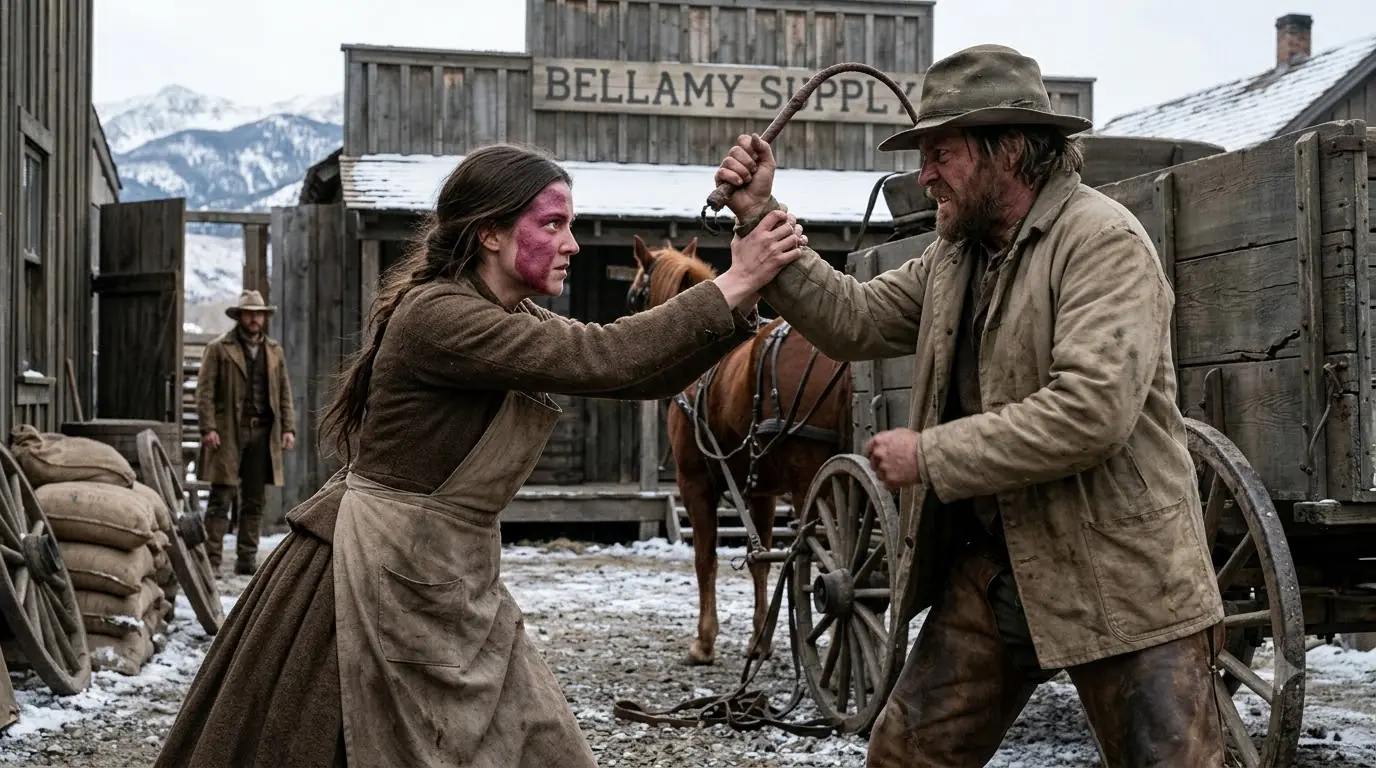
That was the beginning of it, although the newspapers later preferred the story about a beautiful woman and a wealthy cowboy. Newspapers seldom had patience for the truth. The truth was a winter road, a stolen ledger, a sister who had been taught to mistake admiration for safety, and a banker who thought every person in our valley could be bought. The truth was also an old sorrel mare, a broken wagon axle, and a man who knew how to say my name without looking apologetic. Before Wyatt came, I had nearly forgotten there were ways for a person to be seen that did not feel like judgment.
In November of 1879, Silver Run, Colorado, crouched beneath the San Juan Mountains like an animal expecting a blow. The town had a short main street, a church that leaned westward, two saloons, a little schoolhouse, and enough mud to swallow a wagon wheel in a wet season. On clear mornings, the peaks turned pink and gold above the frost, so beautiful that visitors sometimes stopped breathing for a moment. Those of us who lived there looked at the same mountains and calculated when the next snow would close the passes. Our lives depended on freight arriving before the drifts did, on water remaining unfrozen, on livestock staying healthy, and on the unlikely kindness of people who had very little to spare.
My father, Nathaniel Bellamy, had once owned the busiest wagon-and-feed establishment between Silver Run and the mining camps north of town. A freight driver could buy grain, bolts, harness, lamp oil, rope, stovepipe, or a decent cup of coffee at Bellamy Supply, and if he paid fairly he could sleep in the loft. We were not rich, but we were secure. Then Father's team went over a steep grade in the spring of 1876. He survived, though his left leg healed crooked and his right hip would never again bear a full day's work. I was twenty then, old enough to inherit the tasks without inheriting the authority men expected a proprietor to possess.
My younger sister, Rose, was seventeen at the time and beautiful in a way people recognized immediately. She had bright golden hair, blue eyes, and an effortless grace that seemed almost supernatural to people who had never watched her practice. Mother had taught her how to walk with a book balanced on her