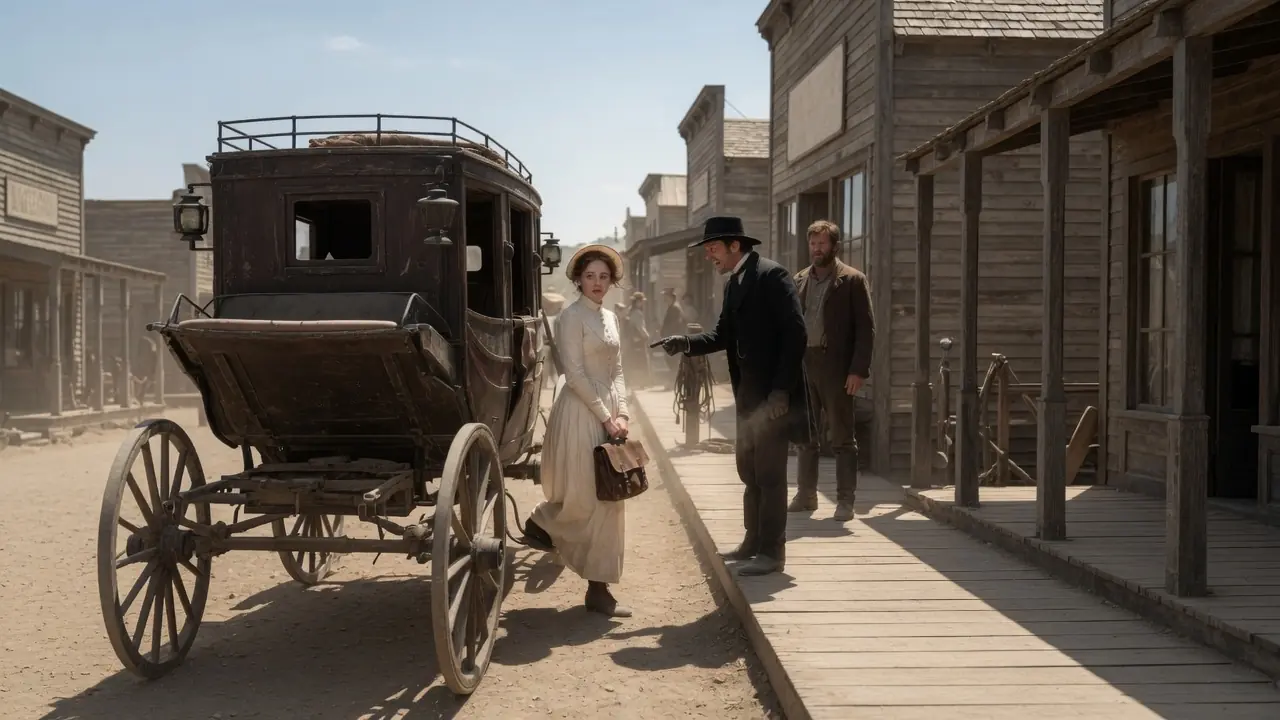
Anna Ramsay arrived in Cedar Hollow with a bridal dress folded in her trunk, a promise in her pocket, and dust from three days of stagecoach travel clinging to the hem of her skirt. The town sat between a dark line of pine-covered mountains and a dry, yellow road that seemed to run forever in both directions. She had pictured the moment carefully during the journey, imagining Tobias McKenna stepping forward with a shy smile, taking her bag, and saying he was grateful she had come. Instead, the man waiting near the boardwalk looked at her as if someone had delivered the wrong parcel.
Tobias stood in a black coat too fine for the dusty street, one gloved hand resting on the polished handle of his cane. His narrow gray eyes moved from Anna’s travel-worn bonnet to the plain cream dress she had kept as clean as possible through three hard days on the road. He did not ask if she was tired, hungry, frightened, or relieved to have arrived safely. He tilted his head, let a small disgusted smile form on his mouth, and said loud enough for everyone nearby to hear, “You’re not what the letters suggested.”
Anna felt the words strike before she fully understood them. A woman outside the dry goods store stopped with a bolt of fabric in her arms, a boy carrying a water bucket froze in the road, and the blacksmith near the farrier’s gate turned his head slowly. Tobias had chosen his volume carefully; this was not a private disappointment slipping out by accident. This was a public weighing, a man measuring a woman in front of witnesses and announcing that she had come up short.
“I had a picture in my mind,” Tobias continued, stepping down from the boardwalk to stand closer to her. “A refined woman, graceful, charming, perhaps even pretty in the right light.” His eyes dragged over her dress again, and his mouth curled. “But this? Three days on the road, and this is what arrived at my door?”
Anna’s fingers tightened around the handle of her worn leather bag. She had known rooms where she was not enough, known relatives who called her practical when they meant plain, known women who smiled while reminding her she was past the age when a poor bride could be choosy. Still, none of that had prepared her for being stripped of dignity in the middle of a frontier street. She lifted her chin, but the shame burned hot beneath her face.
“Tobias,” she said carefully, keeping her voice steady. “If you wished to end the arrangement, you could have written.” He laughed once, sharply, and the sound made the watching townspeople shift uncomfortably. “Written? After you had already set yourself in motion like some desperate mail-order parcel? A man has a right to see what he is buying before he accepts delivery.”
The word buying moved through the street like a slap. Anna’s lips parted, but no sound came out. Tobias leaned closer, pretending to lower his voice while still speaking loud enough for the boardwalk to catch every word. “Look at you. I sent for a bride, not a plain little burden wrapped in cheap lace.”
He nudged her leather bag lightly with the toe of his boot, pushing it away from his polished shoes as if even her belongings offended him. The movement was small but cruel, rough enough to make the boy with the bucket gasp. “I would be laughed out of every church in this town if I stood beside you,” Tobias said. “No, Miss Ramsay, I believe this misunderstanding ends here.”
Anna stared at the bag lying sideways in the dust. The world narrowed to that sight: her comb, her letters, her wedding bonnet, her last coins, all shoved aside by a man who had promised to marry her. She did not cry because crying would give Tobias one more thing to dislike. She did not plead because something inside her, though badly shaken, still refused to kneel in front of cruelty.
Across the road, the door of the hardware store opened. A man stepped out carrying a coil of rope over one shoulder and a sack of nails in one hand. He was broad, bearded, and dressed without concern for polish, with heavy boots, a worn brown coat, and hands shaped by work rather than manners. His name, though Anna did not yet know it, was Einar Holmstrom, a mountain man who lived above the valley and came to town only when supplies forced him down.
Einar had heard enough before he reached the middle of the street. He set the sack of nails on a barrel, crossed the road without hurry, and stopped between Tobias and Anna. He did not raise his voice, did not reach for a weapon, and did not perform outrage for the watching town. He simply looked at Tobias with eyes steady enough to make the smaller man straighten.
“That’s not how you treat a lady,” Einar said. Tobias’s chin lifted. “This is my business.” Einar glanced at the dusty street, the watching townspeople, and Anna’s bag lying near Tobias’s boot. “You put it in the middle of the road,” he said. “That makes it everybody’s business until you learn to speak decent.”
Tobias’s face reddened. He looked Einar up and down, calculating size, risk, pride, and audience all at once. “She came here under an arrangement with me.” Einar’s expression did not change. “Then you ended it poorly, and now you are done talking.”
Anna could feel the town holding its breath. Tobias wanted to answer; she saw it in the twitch of his jaw and the stiffening of his fingers around the cane. But Einar was not a man easily pushed into embarrassment, and Tobias was too careful with his own skin to test him in front of everyone. After one last hateful glance at Anna, Tobias turned, mounted his horse, and rode away with his coat tails snapping behind him.
Only when the hoofbeats faded did Anna realize she had stopped breathing properly. The street slowly returned to sound: a door creaking, the bucket water sloshing, a horse stamping near the hitching post. Einar turned to her, and for the first time she saw the man’s face clearly. He was not handsome in any polished way, but there was honesty in him, and that honesty made it difficult for Anna to keep her composure.
“You have people here?” he asked. Anna looked down the road where Tobias had vanished. The answer should have been yes; she had traveled west because she believed she would be received as a bride. But the truth was standing beside her bag in the dust. “No,” she said. “Not anymore.”
Einar bent, picked up the leather bag, and brushed dust from its side with the back of his hand. He did not comment on its cheapness or ask what she planned to do now, which was mercy of a kind Anna had not expected. “Cabin up the ridge,” he said. “Back room’s empty. Yours until you work out what’s next.”
Anna looked at him sharply. A strange man offering a room could be danger dressed as kindness, and she was not foolish enough to forget that. Einar seemed to read the calculation in her face because he added, “Widow Aldridge at the church knows me. Storekeeper too. Ask them if I am the kind you should refuse.”
“I cook well,” Anna said after a moment, because she needed to offer something before accepting shelter. Einar shifted the bag in his hand. “Good. Larder’s been thin since October.” That was all he said, and somehow the plainness of it made the offer feel safer than a dozen soft speeches could have.
They walked out of town together, and Cedar Hollow watched them go. Anna kept her eyes on the ground for the first half mile because the ground was something she could manage. The road climbed into pines, and the town slipped behind them in pieces: roofs, smoke, voices, then only the creak of Einar’s boots and the small sound of her dress brushing dry grass. He did not fill the silence with false comfort, and Anna was grateful because she had no strength left to answer it.
The cabin sat on a slope above the valley, plain and sturdy, with a woodpile stacked neatly along the south wall and a horse in the east pen who lifted her head, judged them, and returned to eating hay. Inside, everything was spare and ordered. Tools hung in careful rows above a workbench, the stone fireplace was swept clean, and two mismatched chairs stood at a table scrubbed pale with use. The place looked like a man alone had built a system and kept it because systems do not ask questions.
Einar showed her the back room. It had an east-facing window, a narrow bed, a quilt folded with surprising precision, and one empty peg on the wall. “I am up before light,” he said. “Trap line in the morning. Coffee is on when I leave.” Anna set her bag on the bed. “Breakfast will be ready when you return.”
He looked at her as though he had expected argument and found none. Then he nodded and pulled the door nearly closed, leaving her alone. Anna stood in the little room, listening to the quiet settle around her. It was the first silence all day that had not felt like judgment.
She unpacked with method because method kept panic from rising. Dress on the peg, comb on the sill, coins under the folded handkerchief, letters beneath the mattress. When she washed her face in the basin, the water turned gray with road dust, and only then did her eyes fill. She pressed the cloth to her mouth so no sound would pass through the cabin wall.
That evening, Anna learned the larder and turned it into supper. Salt pork, a handful of beans, a little flour, and onions softening in a pan became something warm enough to smell like hope. Rain came down from the mountains just before dark, cold and determined, tapping hard against the roof. A slow drip began near the window in her room, and Anna placed a pot beneath it without mentioning anything.
Einar came in after sunset with rain darkening his coat and his hair damp beneath his hat. He paused when he saw the pot catching water in the corner. Anna looked at the table and said nothing. He looked at the ceiling, then at her, then sat down to eat, and that silence became their first agreement.
The days found their shape with surprising speed. Einar left before dawn, and Anna had coffee waiting when he returned, strong enough to warm a man from the inside. She learned the cabin by attention: where the flour was kept, which chair had a weak leg, how the stove drafted, where the clean rags were folded. Einar learned her by evidence: the larder lasting longer, the floor swept before dust settled, bread appearing on the table one evening when he had not expected anything except beans.
On the third clear morning, Anna heard him on the roof. He moved slowly and steadily above her back room, lifting old shingles and setting new cedar in place with pitch. She stayed outside brushing Nell, the mare, because she understood that some repairs were not meant to be watched too closely. When she returned to her room, the corner was dry, and the pot was empty.
She left the pot there for a week before returning it to the kitchen shelf. Einar never asked why. She never thanked him directly. Some things between them worked better without being pulled into language too soon.
Two weeks after Anna arrived, Einar took her into town for supplies. Cedar Hollow watched them with the alert curiosity of a town revising its own story. The woman who had been rejected in the street now walked beside the mountain man with her list folded neatly in one hand and her head level. The storekeeper looked from Anna to Einar while tallying flour, lard, salt, beans, coffee, and thread, but he said nothing careless.
A woman near the milliner’s window whispered behind her glove, and Anna heard enough to know her name had become entertainment. Her face warmed, but she did not lower her head. Einar, standing beside her with rope over his shoulder, turned slightly toward the whispering woman. He did not speak, but the whispering stopped.
Walking back to the ridge, Einar carried the flour sack without making a ceremony of it. Anna carried the smaller parcels and kept his pace without needing him to slow down. That evening she made bread, and when the smell reached the porch, she heard his hands stop working on the harness leather. He came inside later, looked at the loaf cooling on the table, then at Anna, and said, “That’ll do.”
It was not a grand compliment. It was barely a compliment at all. Yet Anna felt something in her chest soften because Einar spoke only when words had weight. Tobias had filled a street with talk and meant none of it kindly; Einar offered three plain words and made her feel seen.
On Sundays, Anna began helping at the small schoolhouse after church. The teacher, Mrs. Aldridge, asked if she could handle the younger children two mornings a week. Anna accepted because she needed wages, but also because she needed a place in town that was not tied to Tobias’s rejection. Children, she discovered, cared less about scandal than whether a person could read a story well and keep order without shouting.
Einar repaired the hinge on her bedroom door while she was teaching. She came home to find it swinging cleanly, no longer catching unless lifted just so. A small curl of shaved metal lay on the floor beside the frame, the only evidence of his work. Anna swept it up and said nothing, because by then she understood that Einar’s care often arrived disguised as maintenance.
The first time he played guitar, she stood very still in the kitchen with a dishcloth in her hands. The melody came from the porch, low and unhurried, shaped by fingers that looked too rough for gentleness and yet found it easily on the strings. Anna listened until the last note faded. Then she dried her hands and stepped into the doorway.
“Would you play it again from the start?” she asked. Einar looked up, his face unreadable, then began again. Anna sat on the step below him and listened while the valley went gray beneath the coming weather. Neither of them spoke afterward, and the quiet felt full instead of empty.
A few mornings later, while Einar was out on the trap line, Anna repaired the cracked seam on his guitar case. She used her own thread, taking small even stitches along the worn leather until the split lay flat again. She put the case back exactly where it had been and started bread before he returned. That evening, Einar found the repair and stood with the case in both hands for a long time.
At supper, he was quieter than usual. Anna passed him bread, and he took it without looking away from the table. After a while, he said, “My father played that song.” Anna waited, knowing better than to rush a man approaching a difficult door. “Keeps the quiet from going the wrong way,” he added.
The tenderness between them did not announce itself with flowers or long speeches. It came in two cups on the counter where there had once been one, in dry wood brought closer to the door, in Anna knowing how Einar took his coffee and Einar knowing when her hands were cold. It came in the way he stood beside her in town without claiming her and the way she turned toward him without fear. By the end of the first month, the cabin had become something neither of them had named.
Then Tobias McKenna came back. He found them on a Saturday morning as they stepped out of the general store, Anna carrying dark ribbon and Einar with a coil of rope on his shoulder. Tobias rode into the middle of the street with his hat in his hands and a manner he had clearly practiced. “Anna,” he said, measured and smooth. “I spoke poorly that day.”
Anna stood still. The street paused again, remembering. Tobias glanced at Einar, then back at her. “A man can be hasty. Our arrangement still stands if you are willing to be sensible.”
Einar stood one step behind Anna and to her left, close enough to help but not close enough to take the choice from her. Tobias’s eyes slid toward him with irritation. “This was between us before your mountain guard dog involved himself,” he said. Einar’s voice was quiet. “Say what you want, but say it to her.”
Tobias forced a smile. “I am willing to put things right. You know what was intended between us.” Anna looked at the man who had pushed her bag into the dust and called her a burden in a dress. She felt no anger now, only a clear distance. “I know what happened,” she said. “You said it in front of this street.”
“I was surprised,” Tobias answered quickly. “You were cruel,” Anna said. The town heard it, and nobody laughed. Tobias’s face tightened, his practiced apology cracking under the plain truth. “I can still give you a respectable name.”
Anna lifted the parcel beneath her arm. “I have my name.” She glanced once toward Einar, not for permission, but because his steadiness had become part of her courage. “And I have a home to walk back to.” Tobias waited for regret to appear in her face, but none came.
When he rode away the second time, the street felt different. No one held their breath for Tobias anymore. A woman near the milliner’s shop exhaled slowly, and the storekeeper pretended to rearrange tins in the window. Einar looked at Anna. “You didn’t need me for that.”
“No,” Anna said, her voice softer now. “But I was glad you were there.” Einar shifted the rope on his shoulder and looked toward the road up the ridge. “Come home,” he said. Not come back to the cabin, not let us leave, but home, set down plainly between them like something that already belonged to her.
That evening, the cold came early. Anna made soup while Einar split wood near the porch, and after supper he brought the guitar out. She sat beside him on the step instead of in the doorway, close enough that their sleeves touched. The melody moved into the dark valley and returned changed by distance.
Anna was tired in a way that felt deep but not hopeless. She leaned slightly, just for a moment, and her head came to rest against Einar’s shoulder. He did not move, except to set the guitar aside and wrap the edge of his coat gently around her. The gesture held no demand, no triumph, only shelter.
“I should sit up,” Anna whispered. Einar looked down at her, his beard rough in the lamplight spilling from the open door. “You’ve been standing straight since the day you arrived,” he said. “Rest if you want.” Her eyes closed, and for a few minutes she slept against him while the cabin fire burned low inside and the stars came bright above the ridge.
When she woke, embarrassment colored her cheeks. “I am sorry,” she said, starting to pull away. Einar’s hand covered hers, warm and steady. “Don’t apologize for trusting me.”
Anna looked at him then, really looked, and the space between them changed. Einar lifted his hand slowly enough that she could stop him, then brushed a tear from her cheek with his thumb. “No man who throws you away in the street gets to decide what you are worth,” he said.
“And what do you decide?” she asked, voice trembling. Einar leaned closer, his eyes never leaving hers. “I decide you are worth treating careful.”
His kiss was soft, almost cautious, as if he understood that tenderness had to be offered, not taken. Anna’s hand rose to his chest, feeling the steady beat beneath his work shirt. The kiss did not erase the pain of Tobias or the shame of the street, but it placed something stronger beside it. For the first time since arriving in Cedar Hollow, Anna felt chosen without being judged.
The preacher came the following week, though there was no great fuss about it. Anna and Einar stood in the small church with Mrs. Aldridge, the storekeeper, and a handful of townspeople who had learned to understand what they were seeing. There were no polished vows made for performance, no expensive lace, no grand supper. There was only a man who had crossed a street for a woman’s dignity and a woman who had found the courage to stay where she was respected.
Afterward, the cabin changed very little because it did not need to. Two cups remained on the counter, two coats hung by the door, and the two mismatched chairs stayed exactly as they were. Anna kept teaching Tuesdays and Fridays, and Einar kept the trap line, though he came back earlier on the coldest days because he liked finding her at the window. She still cooked, he still repaired, and between them silence became less a hiding place and more a language.
Sometimes, months later, Tobias’s name would surface in town, carried by travelers who said he had moved on to another settlement and another scheme. Anna listened without pain. She had learned that a man’s rejection can feel like ruin only until someone better shows you it was rescue. Einar never mentioned Tobias unless she did, and most days she had no reason to.
One winter evening, snow began falling over the ridge while Einar played his father’s song on the porch. Anna sat beside him with a wool shawl around her shoulders, close enough that their warmth met in the space between them. When the melody ended, she leaned her head against him as she had that first night after Tobias returned. Einar kissed her hair, quiet and certain, and the valley below disappeared into white.
Anna had come west to marry a man who saw her as a disappointment. Instead, she found the man who saw her standing alone and understood that dignity was not something to be granted by a groom. It was something a woman carried, even when others tried to kick it into the dust. And every morning after, when she woke in the cabin above Cedar Hollow, she knew the street had not been the end of her story. It had been the place where the right man finally stepped between her and a life that never deserved her.