Shelter Cat Kept Waking Her Owner at 3 A.M. Every Night — The Doctor’s Diagnosis Left Everyone Speechless
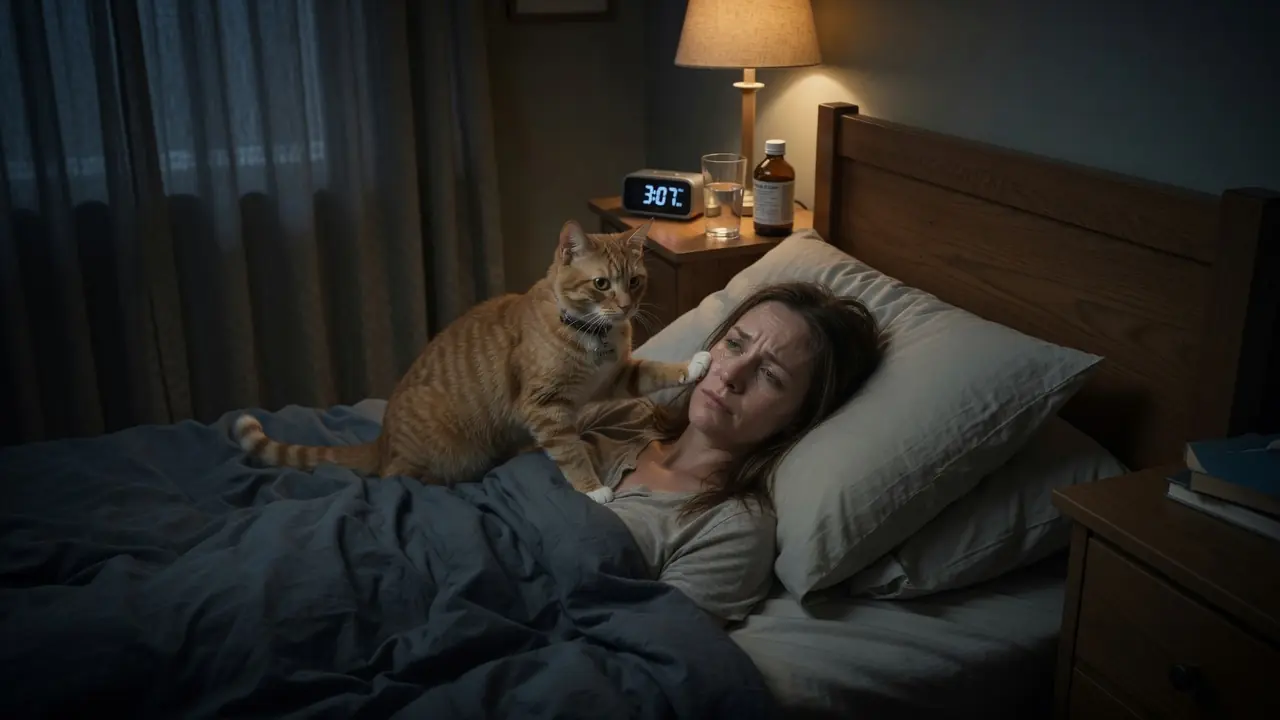
Every night at exactly 3:07 a.m., Oliver climbed onto Sarah Bennett’s bed and refused to let her sleep.
He never arrived at 3:05.
Never at 3:10.
Always 3:07.
The first time it happened, Sarah opened her eyes to find an orange face hovering inches above her own.
Oliver pressed one white paw against her cheek.
“Stop,” she whispered.
The cat pressed harder.
Sarah turned onto her side.
Oliver walked across her pillow, sat directly in front of her face, and released a low, urgent cry unlike any sound he made during the day.
“Mrrrow.”
Sarah pulled the blanket over her head.
Oliver burrowed beneath it.
When that failed to move her, he began licking her forehead.
“All right.”
She sat up.
Oliver jumped onto the floor and stared at her.
His tail stood straight, but the tip twitched rapidly.
Sarah looked at the digital clock.
3:07.
“What do you want?”
Oliver walked toward the bedroom door.
Sarah followed him into the kitchen, expecting an empty food bowl or spilled water.
Both bowls were full.
The litter box was clean.
The apartment was quiet.
Oliver sat beside the refrigerator and looked up at her.
Sarah opened the door.
“You want cheese?”
The cat did not move.
She tore off a small piece and placed it on the floor.
Oliver sniffed it once, then looked back at Sarah.
“You woke me up for nothing?”
His ears turned slightly.
Sarah returned to bed.
Oliver followed.
He curled beside her legs and slept until morning.
The same thing happened the next night.
And the night after that.
By the end of the first week, Sarah had developed a private hatred for the glowing numbers 3:07.
Oliver would climb onto her chest.
Paw at her face.
Lick her nose.
Pull at her hair.
Once, when she refused to respond, he bit the sleeve of her pajama shirt and tried to drag her arm from beneath the blanket.
The behavior made no sense.
During the day, Oliver was calm almost to the point of laziness.
He spent his mornings sleeping on the windowsill. He ignored toys unless they moved directly in front of him. He watched birds with the quiet concentration of an old man observing traffic.
He did not damage furniture.
He did not knock cups from tables.
He did not cry for food before mealtimes.
The shelter had described him as “gentle, independent, and slightly serious.”
At night, he became something else.
Desperate.
Persistent.
Afraid.
Sarah had adopted him three months earlier from the Pine Ridge Animal Shelter.
She had not planned to take a cat home.
She had gone to the shelter with her friend Megan, who wanted to adopt a kitten for her daughter. While Megan played with three energetic kittens in the visiting room, Sarah wandered past the adult-cat enclosures.
Oliver sat at the back of the final cage.
He was six years old, large but underweight, with faded orange fur and a white patch beneath his chin. A small notch marked the top of his left ear.
He did not approach when Sarah stopped.
He simply looked at her.
The card on his cage said:
OLIVER
MALE
APPROXIMATELY SIX YEARS OLD
OWNER DECEASED
QUIET HOME PREFERRED
Sarah read the final line twice.
Owner deceased.
She understood what it meant to have a life disappear without warning.
Two years earlier, her mother had died after a short illness. Six months after that, Sarah’s fiancé ended their engagement and moved across the country.
He told her grief had changed her.
Sarah could not disagree.
She had become quieter.
More cautious.
Less willing to believe that anything good would remain simply because she loved it.
At thirty-four, she lived alone in a one-bedroom apartment, worked remotely as an insurance claims reviewer, and had slowly reduced her world to manageable pieces.
Work.
Groceries.
Occasional dinners with Megan.
Sunday phone calls with her father.
No surprises.
No promises.
Then Oliver walked to the front of his cage and placed one paw against the wire.
Sarah placed her fingers against the other side.
He did not purr.
He only kept his paw there.
“You like him?” a shelter volunteer asked.
Sarah looked at the cat.
“I think he looks sad.”
“He’s been here four months. People want kittens.”
“What happened to his owner?”
“Older man. Lived alone. A neighbor found him after a few days.”
Sarah looked back at Oliver.
“Was the cat with him?”
The volunteer nodded.
“He wouldn’t leave the bedroom.”
That should have frightened her away.
Instead, she filled out the paperwork.
For the first three months, Oliver fit perfectly into her quiet life.
Then the 3:07 wake-ups began.
After ten nights, Sarah recorded him on her phone.
The video showed Oliver jumping onto the bed, moving straight toward her head, and pressing both front paws against her shoulder.
His cries sounded strained.
Not hungry.
Not playful.
Urgent.
Sarah sent the clip to Megan.
Her friend called immediately.
“That is not normal.”
“Thank you. Very helpful.”
“I mean he looks possessed.”
“He’s not possessed.”
“He’s sitting on your chest in the dark.”
“He weighs twelve pounds. If he were possessed, I assume he’d be more effective.”
Megan laughed.
Then she became serious.
“Maybe he misses his old owner.”
“At exactly the same time every night?”
“Maybe that’s when the man died.”
Sarah looked at Oliver sleeping beside the window.
“That’s horrible.”
“Sorry.”
“I already thought of it.”
Megan suggested closing the bedroom door.
Sarah tried.
At 3:07, Oliver threw himself against it.
The first impact woke her.
The second made her sit up.
Then came rapid scratching and the same strained cry.
“Mrrrow. Mrrrow. Mrrrow.”
Sarah opened the door.
Oliver rushed past her, jumped onto the bed, and began sniffing the pillow where her head had been.
When Sarah sat beside him, he calmed immediately.
The following night, she locked him in the living room.
At 3:07, he knocked a lamp from the side table and clawed at the bedroom door until one nail bled.
Sarah found a small red mark on the carpet.
She felt so guilty that she sat on the kitchen floor holding him for nearly an hour.
“I’m sorry,” she whispered.
Oliver pushed his face against her chest.
The sleep deprivation began affecting everything.
Sarah made errors at work.
She forgot appointments.
She poured coffee into a cereal bowl one morning and stood staring at it for several seconds before understanding what she had done.
Her supervisor asked whether she needed time off.
Megan became more direct.
“You have to return him.”
Sarah shook her head.
“He’ll end up in the shelter again.”
“You can’t function.”
“He isn’t doing it to be difficult.”
“He’s a cat, Sarah.”
“Exactly. Cats don’t check clocks.”
Megan looked at her across the café table.
“Then take him to a veterinarian.”
Sarah did.
Dr. Priya Shah examined Oliver from whiskers to tail.
His heart sounded normal.
His bloodwork was unremarkable.
His hearing and vision were appropriate for his age.
He showed no evidence of pain, thyroid disease, neurological problems, or age-related confusion.
“His behavior is very specific,” Priya said.
Sarah showed her the videos.
The veterinarian watched all three.
“Does he do this if you sleep during the day?”
“I don’t sleep during the day.”
“Try taking a nap.”
“You want me to rearrange my sleep schedule for a cat experiment?”
Priya smiled.
“You came here because you think he’s trying to communicate.”
Sarah glanced at Oliver.
He sat in the examination room with his tail wrapped around his feet.
“Yes.”
“Then we need to determine whether he reacts to the time, the darkness, or something about you.”
That Saturday, Sarah lay down at two in the afternoon.
She rarely napped, but months of broken sleep made it easy.
Oliver slept on the couch.
At 3:07 p.m., nothing happened.
He continued sleeping.
Sarah set an alarm for the next day and went to bed at six in the evening.
At 9:07, Oliver remained asleep at her feet.
At midnight, he stretched, walked into the kitchen, and drank water.
At 3:07, he climbed onto her chest.
Sarah opened her eyes before he touched her.
“You’re watching me.”
Oliver sniffed her mouth.
Then he pawed at her cheek.
Sarah sat up.
He jumped down and led her toward the kitchen.
This time, she noticed something unusual.
Her hands were trembling.
Not badly.
Just enough that the light switch clicked beneath her fingers.
She assumed it was exhaustion.
She drank water.
Oliver watched.
After a few minutes, the shaking stopped.
She returned to bed.
The next morning, she told Priya.
“Were you hungry?” the veterinarian asked.
“I’m always hungry at three in the morning.”
“Did you eat?”
“No.”
“Next time, try it.”
Sarah bought a box of crackers and kept them beside the bed.
At 3:07 the following night, Oliver woke her.
Her skin felt damp beneath her shirt.
The room seemed strangely cold.
She ate two crackers.
Oliver sat beside her, staring.
Within ten minutes, he curled against her legs and slept.
The next night, Sarah ignored the crackers.
Oliver did not settle.
He paced across the bed, cried, and repeatedly touched her mouth with his paw.
Finally, she ate.
The cat calmed.
Sarah began to wonder whether she had accidentally trained him.
Perhaps Oliver woke her because he expected a midnight snack.
But he never ate the crackers.
He never approached the food.
He only watched Sarah until she did.
She mentioned the behavior at dinner with her father.
David Bennett was sixty-six, retired from teaching history, and approached most problems as if they were disputed facts requiring sources.
“You need a camera,” he said.
“I have videos.”
“A camera that records the full night.”
“I don’t want hours of footage of myself sleeping.”
“That’s understandable.”
He cut into his steak.
“Still necessary.”
Sarah bought a small indoor security camera and pointed it toward the bed.
The first night’s recording showed Oliver asleep near her feet until 3:03.
Then his head lifted.
He stared at Sarah.
At 3:05, he moved closer and sniffed her hand.
At 3:06, he sniffed her face.
At 3:07, he began pawing her.
Sarah replayed the sequence repeatedly.
Oliver was not waking because of a clock.
Something changed in her before he moved.
She sent the footage to Priya.
The veterinarian called.
“I think you should see your doctor.”
“Why?”
“Animals can respond to physical changes in people.”
“What physical changes?”
“Breathing, movement, scent. I can’t diagnose you, Sarah. But Oliver isn’t looking at the door or the food bowl. He is watching you.”
Sarah tried to dismiss the concern.
She was young.
Mostly healthy.
She ate reasonably well when she remembered.
She walked several miles each week.
Her last physical had shown nothing alarming.
Still, she made an appointment.
Dr. Daniel Cho had been her primary-care physician for five years. He listened while she described the nightly pattern, though his expression suggested he was trying not to smile.
“You’re here because your cat wakes you?”
“I know how it sounds.”
“Have you noticed symptoms?”
“I’m tired.”
“That tends to happen when something wakes you nightly.”
“My hands shook once.”
“Anxiety?”
“I was half asleep.”
“Palpitations?”
“Sometimes.”
“Nightmares?”
“No.”
“Shortness of breath?”
“No.”
He reviewed her chart.
Normal blood pressure.
Normal weight.
No diabetes.
No significant medical history.
He ordered basic bloodwork and suggested reducing caffeine.
The results came back normal.
Sarah felt foolish.
Megan felt relieved.
“See? He’s just weird.”
“He’s not just weird.”
“He has a schedule.”
Sarah continued eating crackers when Oliver woke her.
For two weeks, the episodes seemed manageable.
Then she began waking with headaches.
They were dull and heavy, located behind her eyes. By breakfast they usually disappeared.
She also noticed occasional gaps in her memory.
One morning, she found the refrigerator door open and a spoon in the bathroom sink.
Another day, she opened a work file and discovered several paragraphs she did not remember writing.
The words were confused and repetitive.
She blamed exhaustion.
Then, on a Thursday morning in November, Oliver saved her in a way no one could dismiss.
At 3:07, he climbed onto Sarah’s chest.
She did not respond.
He pawed her face.
Nothing.
Oliver cried.
Sarah remained motionless.
The camera later showed the cat pacing across her body, sniffing her mouth, and biting the blanket near her shoulder.
At 3:09, he jumped from the bed.
He ran into the hallway.
Then back again.
At 3:11, he began knocking objects from the nightstand.
A book fell.
Then a glass of water.
The crash brought Sarah partly awake.
She opened her eyes, but the room did not look right.
The walls seemed too far away.
Her heart pounded.
Her entire body shook beneath the blanket, yet cold sweat covered her skin.
Oliver stood beside her head, crying.
Sarah tried to sit up.
Her arms would not cooperate.
She reached for the crackers but knocked the box onto the floor.
Oliver jumped down.
He pawed at the scattered crackers, then looked at her.
Sarah understood.
She lowered herself from the bed and crawled toward them.
Her fingers felt numb.
She placed one cracker in her mouth but could barely chew.
Oliver remained inches away.
After eating several, Sarah lay on the carpet until the room became steady.
At 6:30, she called Megan.
Her words were slurred.
Megan drove her to the emergency department.
By the time they arrived, Sarah felt almost normal.
A nurse checked her blood sugar.
It was low, though not dangerously so after the crackers she had eaten.
Dr. Cho met them after reviewing the emergency report.
He asked Sarah to describe the episode from the beginning.
She told him about the dizziness.
The shaking.
The sweat.
The confusion.
Then he asked, “What time do these episodes usually happen?”
Sarah looked at Megan.
“Around three in the morning.”
Dr. Cho stopped writing.
“Exactly when?”
“Usually 3:07.”
The room became quiet.
Megan stared at Sarah.
Dr. Cho looked back through her records.
“Have you ever checked your glucose during one of these episodes?”
“No. I’m not diabetic.”
“That wasn’t my question.”
Sarah shook her head.
He ordered a monitored fast and admitted her overnight.
The hospital staff checked her blood sugar regularly.
At midnight, it was normal.
At 1:30, it had fallen.
At 2:45, it dropped further.
At 3:04, Sarah began sweating.
Her hands trembled.
By 3:07, her blood glucose had fallen to a dangerously low level.
A nurse gave her glucose through an intravenous line.
The symptoms improved within minutes.
Dr. Cho stood at the foot of the bed staring at the readings.
Megan sat beside Sarah.
“So Oliver knew?” she asked.
Dr. Cho looked at her.
“It appears the cat was reacting before Sarah fully woke.”
“To low blood sugar?”
“Possibly to changes in scent, breathing, movement, or body temperature.”
Sarah looked at the clock.
3:22.
For weeks, everyone had blamed Oliver for destroying her sleep.
He had been interrupting something far more dangerous.
Further testing showed that Sarah’s body was producing abnormally high levels of insulin even when she had not eaten.
Dr. Cho referred her to an endocrinologist, Dr. Elena Ramirez.
After reviewing the results, Elena ordered specialized imaging.
The scan revealed a small tumor in Sarah’s pancreas.
An insulinoma.
It was rare, usually slow-growing, and in Sarah’s case likely benign.
But it released insulin at the wrong times, driving her blood sugar dangerously low during the night, especially after long periods without food.
The episodes had probably begun mildly months earlier.
Oliver noticed before Sarah did.
The diagnosis frightened her.
The word tumor erased everything said after it.
Benign.
Treatable.
Small.
Operable.
She heard only tumor.
Elena sat beside her.
“We found it early.”
“Because of my cat.”
The doctor smiled slightly.
“Because your cat refused to let you ignore it.”
“What would have happened if he hadn’t?”
Elena did not answer immediately.
“Repeated severe hypoglycemia can cause seizures, loss of consciousness, injury, and in rare cases can become life-threatening.”
Sarah looked down at her hands.
Every night at 3:07, Oliver had forced her awake before her blood sugar fell farther.
The crackers had helped because they raised it.
He had not ruined her sleep.
He had protected it from becoming something worse.
Sarah was scheduled for surgery.
The night before entering the hospital, she sat on the apartment floor with Oliver in her lap.
He rarely allowed anyone to hold him for long.
That evening, he stayed.
Sarah pressed her face into his fur.
“You knew.”
Oliver purred.
“I’m sorry I closed the door.”
His paws rested against her arm.
“I’m sorry I thought you were difficult.”
The purring grew louder.
Megan stood near the kitchen holding Oliver’s feeding instructions.
“He doesn’t understand apologies.”
Sarah looked up.
“I think he understands more than we do.”
The surgery lasted three hours.
The surgeon removed the small tumor while preserving most of Sarah’s pancreas.
Pathology confirmed it was benign.
Her insulin levels returned to normal almost immediately.
Sarah spent four days in the hospital.
Oliver waited beside the apartment door every evening.
Megan sent videos.
In each one, he sat facing the hallway as though expecting Sarah’s key in the lock.
When Sarah finally returned home, Oliver did not run toward her.
He remained in the living room.
For one painful second, she thought he did not recognize her.
Then he walked slowly forward.
He sniffed the hospital scent on her clothes.
He touched one paw to her leg.
Sarah knelt carefully.
Oliver pressed his forehead against hers.
That night, Sarah went to bed early.
She kept juice and crackers beside her, though the doctors said the dangerous drops should no longer occur.
Oliver curled near her feet.
At 3:07, Sarah’s eyes opened automatically.
She looked at the clock.
Then at the cat.
Oliver remained asleep.
His body rose and fell with each quiet breath.
Sarah lay in the darkness listening to the unfamiliar silence.
She expected relief.
Instead, tears filled her eyes.
For months, 3:07 had represented exhaustion and frustration.
Now it felt like a time she had been given back.
Oliver opened one eye.
Sarah whispered, “I’m okay.”
The cat closed it again.
The story might have ended there.
But several weeks later, Sarah received a call from the Pine Ridge Animal Shelter.
A volunteer named Grace asked whether Oliver was doing well.
“He saved my life,” Sarah said.
Grace laughed politely, assuming exaggeration.
Sarah explained.
There was a long silence.
Then Grace said, “You need to speak with Oliver’s former owner’s daughter.”
Sarah’s chest tightened.
“I thought his owner died.”
“He did. His daughter surrendered Oliver because she couldn’t keep him. I can ask whether she’s willing to talk.”
The woman called two days later.
Her name was Rebecca Lawson.
She lived in Oregon and sounded nervous.
“My father’s name was Harold,” she said. “Oliver lived with him for five years.”
Sarah looked at the cat sleeping on the couch.
“What was your father’s illness?”
Rebecca became quiet.
“He had diabetes.”
Sarah closed her eyes.
“Did he have low blood sugar at night?”
“All the time.”
The answer explained everything.
Harold lived alone after his wife died. Oliver began waking him when his glucose dropped. At first, the family assumed the cat wanted food. Then Rebecca saw Oliver pawing her father during an episode.
They trained Harold to keep glucose tablets beside the bed.
Oliver would wake him.
If he did not respond, the cat knocked the tablets onto the floor or cried until someone heard.
One winter morning, Oliver scratched continuously at the bedroom door until Harold’s neighbor entered with a spare key.
Harold was unconscious.
Paramedics saved him.
“He became dependent on that cat,” Rebecca said. “Not emotionally. Medically.”
“What happened when your father died?”
Rebecca’s voice broke.
“It wasn’t a glucose episode. He had a heart attack.”
Oliver remained beside him for nearly two days before the neighbor found them.
At the shelter, he waited four months.
Then Sarah arrived.
“He knew the signs,” Rebecca whispered. “He recognized them in you.”
Sarah stroked Oliver’s back.
“He kept doing the same job.”
“Yes.”
They both began crying.
Rebecca apologized for surrendering him.
Sarah told her she had nothing to apologize for.
“You gave him the chance to find me.”
A month later, Rebecca visited.
Oliver was sitting on the windowsill when she entered.
He turned at the sound of her voice.
“Hello, old man.”
The cat jumped down.
He approached cautiously, sniffed her shoes, then lifted his head.
Recognition transformed him.
Oliver cried once and pressed his body against her legs.
Rebecca knelt.
For several minutes, she could not speak.
Sarah watched from the kitchen, understanding that the cat belonged to a part of someone else’s life too.
Rebecca opened an envelope and removed a photograph.
Harold sat in a faded armchair with Oliver across his lap.
On the back, he had written:
The little orange alarm clock that keeps me alive.
Sarah placed the photograph beside Oliver’s shelter papers.
Rebecca looked toward the bedroom.
“Does he still wake you?”
“Not anymore.”
“He knows you’re better.”
Sarah smiled.
“I think so.”
The experience changed more than Sarah’s health.
For years, she had believed needing others made a person vulnerable.
Her mother’s death, the broken engagement, and the quiet apartment had taught her to reduce dependence wherever possible.
Then a shelter cat depended on her for food and safety.
At the same time, she depended on him without knowing it.
The relationship was not weakness.
It was attention moving in both directions.
Sarah began volunteering at Pine Ridge Animal Shelter.
At first, she cleaned enclosures and wrote adoption profiles for older cats.
She refused to describe them as “less playful” or “difficult.”
Instead, she wrote what people needed to understand.
Quiet.
Observant.
Patient.
Already knows how to live with people.
When adopters asked why they should choose an adult animal instead of a kitten, Sarah pointed toward Oliver’s photograph on the volunteer board.
“Because older animals come with histories,” she said. “Sometimes those histories contain things you need.”
Dr. Priya Shah asked Sarah for permission to share Oliver’s story with veterinary students studying animal behavior.
Dr. Ramirez invited her to speak briefly at an endocrinology awareness event.
Sarah disliked public speaking, but she agreed.
She stood before a room of patients, doctors, and nurses with a photograph of Oliver on the screen behind her.
“Everyone asks how he knew,” she said. “I don’t know exactly.”
She looked at the image of his serious orange face.
“Maybe he smelled a change. Maybe he heard my breathing. Maybe he recognized movements from his previous owner.”
She paused.
“But I think the more important question is why he kept trying after I ignored him.”
The room became quiet.
“He scratched the door. He knocked things over. He hurt his paw. He did not stop because I misunderstood him.”
Sarah smiled.
“I hope we learn to pay that much attention to one another.”
One year after the surgery, Sarah’s scans remained clear.
Her blood sugar stayed normal.
Her headaches disappeared.
She slept through most nights.
Oliver still checked on her.
Around midnight, he walked from the foot of the bed to the pillow, sniffed her face once, and returned to his place.
At 3:07, he sometimes opened his eyes.
The camera captured it.
He would lift his head, watch Sarah for several seconds, then settle again.
He was still monitoring her.
He simply found nothing wrong.
On the anniversary of her diagnosis, Sarah woke at 3:07 without being touched.
Moonlight crossed the bedroom floor.
Oliver sat beside her pillow.
He was silent.
Sarah looked at the clock and smiled.
“You checking?”
He placed one paw lightly against her cheek.
Not urgent this time.
Just contact.
Sarah covered his paw with her hand.
“I’m here.”
Oliver began to purr.
The sound filled the quiet room.
For months, everyone had called him disruptive.
Stubborn.
Untrainable.
A shelter cat with strange nighttime behavior.
Some people told Sarah to send him back.
They believed a good pet should fit neatly into a human life.
Oliver had done something better.
He had interrupted hers.
Every night at exactly 3:07, while Sarah’s blood sugar silently fell and danger moved through her sleeping body, the orange cat climbed onto the bed and refused to let her disappear.
He could not explain.
He could not call for help.
He could only place one paw against her face and try again.
And again.
And again.
Until she finally listened.