“Don’t bother coming home this Christmas. We decided it’s best you stay away this year.” Rachel Monroe read the message three times before setting her phone facedown on the kitchen counter of her one-bedroom apartment outside Fayetteville, North Carolina. There was no call before it, no explanation after it, and not even the courtesy of a question asking whether she had already bought a ticket. Her father had reduced thirty-eight years of being his daughter to two sentences that sounded more like a termination notice than something sent three days before Christmas.
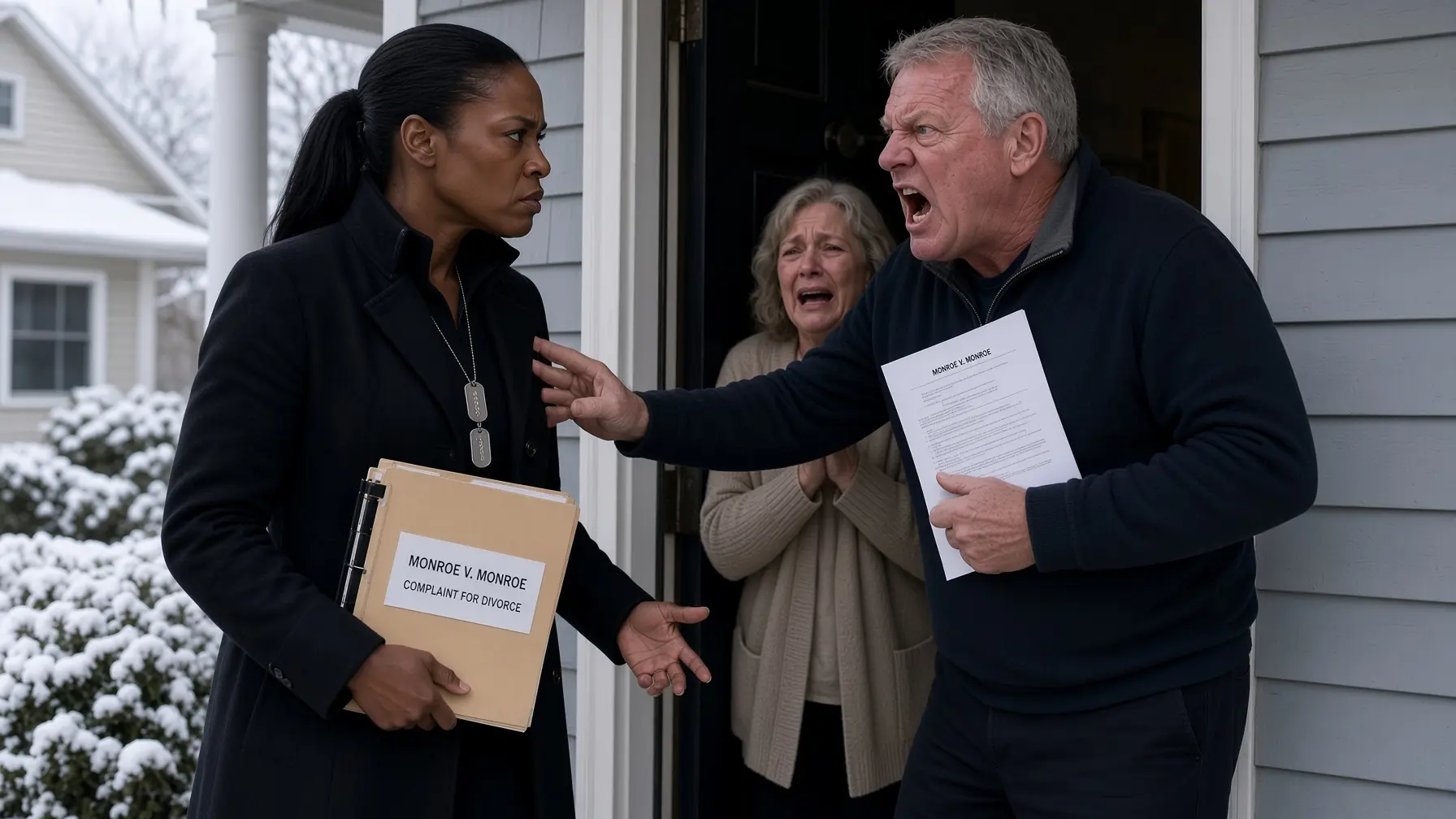
Rachel had spent almost twenty years in the United States Army. She had deployed four times, undergone two surgeries after injuries that eventually ended her field career, attended memorial services for people whose voices she could still hear when a room became too quiet, and retired as a sergeant first class six months earlier. She had learned how to work while exhausted, stay calm when frightened, and sleep through sounds that would have sent most people running for a window. Yet one text from Thomas Monroe managed to reach a place artillery never had.
The Christmas lights taped around Rachel’s apartment window blinked red, green, red, green against the dark glass. A bottle of wine sat unopened beside the stove, and her airline itinerary to Greensboro remained on the laptop because she had planned to spend eight days with her parents and younger brother, Colin. Rachel had even bought her mother a wool coat she knew Ellen would never purchase for herself and ordered a woodworking tool Thomas had mentioned twice during their last conversation. She stared at the gifts and felt foolish for still believing preparation could manufacture belonging.
Rachel typed three different responses. The first demanded an explanation, the second contained several words her first sergeant would have admired, and the third simply said, Fine. She sent the third one, canceled the flight, put the gifts in the bedroom closet, and poured the wine she had been saving for Christmas dinner. Then she raised the glass toward nobody and whispered, “To family.”
The message hurt because it was not completely surprising. Thomas Monroe had never been a man who expressed tenderness when criticism could occupy the same amount of air, and Rachel had spent most of her childhood trying to turn achievement into something he might mistake for pride. When she enlisted at eighteen, he did not hug her before she left for training. He shook her hand and said, “Try not to embarrass yourself out there.”
Rachel remembered laughing because she thought he was nervous. Years later she understood that Thomas used contempt as armor whenever affection made him uncomfortable, and the rest of the family had organized itself around avoiding his anger. Ellen softened his insults after he left the room, while Colin learned early that agreement was the safest path through dinner. Rachel did the opposite and spent most of adolescence colliding with him.
The Army gave her something home had not. Expectations were stated plainly, performance could be measured, and people occasionally said exactly what they meant. Rachel still dealt with bad leaders, unfair decisions, and people whose authority exceeded their judgment, but at least nobody expected her to guess whether silence meant love. When she was promoted to sergeant, her platoon applauded.
Thomas asked her to shovel the driveway when she came home for Christmas. Rachel had been inside the house less than ten minutes, still wearing boots from the airport, when he nodded toward the window and said the snow was getting heavy. She laughed at first because she expected a joke, but Thomas handed her a shovel. Ellen whispered, “You know how your father is,” as though personality were an exemption from kindness.
Rachel shoveled. She also mailed birthday cards, sent flowers on her parents’ anniversary, and transferred money when Ellen’s car transmission failed. When the roof developed a leak while Rachel was deployed in Kuwait, she wired six thousand dollars after Thomas said the insurance deductible and uncovered repairs were more than they could handle. She never received more than a short message saying the contractor had been paid.
None of that stopped Rachel from hoping. Every Christmas she imagined some small transformation in which Thomas looked at her uniform or retirement papers and finally saw something other than the difficult daughter who had refused to become easy. She did not need a parade. She would have settled for, “I’m glad you’re home.”
Retirement made that hope stronger. Rachel had spent almost two decades thinking of home as somewhere she visited between assignments, deployments, training rotations, temporary duty, and recovery periods. Now there was no next set of orders. She had a pension, a modest consulting job helping defense contractors with logistics compliance, a bad left knee, and enough free weekends to realize how little relationship existed beneath the habit of calling family.
The text destroyed the fantasy cleanly. Rachel did not know why Thomas wanted her absent that Christmas, but she knew the family had made the decision together because his message used the word we. Ellen did not call to object. Colin did not text to say their father had gone too far.
Rachel spent the next day cleaning her apartment with military precision because anger required somewhere to go. She sorted retirement paperwork, medical records, old tax returns, and digital files she had been ignoring since leaving active service. Near midnight she opened a folder labeled MONROE HOUSE REFI — 2021. She had almost forgotten it existed.
Five years earlier, Thomas had called Rachel while she was preparing for another overseas rotation. His small commercial painting business had suffered through a bad year, he had missed several debt payments, and the mortgage on the family home was becoming difficult to refinance because his credit had deteriorated. He told Rachel the bank needed a financially stronger family member involved in the transaction. “Just a technical thing,” he had said.
Rachel was twenty-nine and exhausted. She flew home for forty-eight hours, attended a closing with Thomas and Ellen, contributed seventy-eight thousand dollars from savings toward arrears and refinancing costs, and signed a stack of documents she barely read. Thomas told her the arrangement protected everybody and promised the house would remain the family home.
Rachel remembered signing a deed. She had assumed it was connected to being added to the loan. Now she opened the scanned closing package and started reading it properly for the first time.
The documents did not say Rachel became majority owner because she was a co-signer. That part of the story Thomas had told her was incomplete. The refinance had been structured with a recorded deed granting Rachel a fifty-one-percent tenancy-in-common interest in the property in exchange for her cash contribution and assuming joint responsibility on the new mortgage, while Thomas and Ellen retained the remaining forty-nine percent together.
An accompanying occupancy and expense agreement contained more surprises. Thomas and Ellen could continue living in the house, but they were responsible for making the monthly mortgage payment from their household account, maintaining insurance and taxes, and obtaining Rachel’s written consent before granting long-term occupancy rights to unrelated third parties. If major payment defaults occurred and could not be cured, any owner could demand an accounting, seek sale of the property, or pursue a partition proceeding under state law.
Rachel read the pages again. She did not suddenly own the house outright, could not simply order her parents onto the street, and certainly could not change locks on two other legal owners. But she had far more rights and far more financial exposure than the word co-signer had ever suggested.
Another fact made her sit straighter. Because Rachel remained a co-borrower on the mortgage, any missed payments affected her credit and could expose her to collection even if she had not lived in the house for years. She logged into the loan portal using credentials she had saved during the refinance. Two payments were past due.
Rachel stared at the screen until anger became something colder. Thomas had told her not to come home while quietly allowing a loan attached to her name to fall behind. Whatever argument had caused the Christmas exclusion now mattered less than the possibility that her father was again using Rachel’s financial stability without giving her basic information.
She did not call him. Instead, she called attorney Andrea Keene, a real-estate lawyer Rachel had met during a veterans’ small-business seminar. Andrea listened, requested the closing documents, and immediately corrected Rachel when she said, “So I can take control of the house.”
“No,” Andrea told her. “You are a majority co-owner, which is meaningful, but fifty-one percent does not turn the other owners into tenants you can evict because they offended you.” Rachel felt embarrassed and asked what the fifty-one percent actually gave her. Andrea said it gave Rachel a substantial economic interest, standing to demand records concerning the property, leverage in any voluntary sale or buyout, and the right to seek judicial partition if the owners could no longer manage the property together.
Rachel asked whether Thomas missing mortgage payments changed anything. Andrea said it changed urgency because Rachel’s credit and money were exposed, and the written agreement appeared to require Thomas and Ellen to keep the loan current while they occupied the home. If the default continued, Rachel could seek reimbursement, an accounting, and ultimately a court-supervised resolution. “But do not confuse legal rights with a license for revenge,” Andrea warned.
Rachel bristled. “He told me I’m not allowed in a house I partly own.” Andrea answered that Rachel, as a co-owner, likely had possessory rights too, subject to practical and legal considerations, but a holiday argument was not a reason to create a dangerous self-help confrontation. “You spent twenty years learning rules of engagement,” Andrea said. “Use them now.”
That sentence worked. Rachel emailed the documents, turned off her phone, and booked a small cabin near Bryson City for Christmas week. She wanted mountains, snow if the weather cooperated, and enough distance from her parents that no impulsive two-hour drive could become a scene everyone regretted.
Andrea called the following afternoon. Her title review confirmed Rachel’s fifty-one-percent interest was recorded properly, and the mortgage delinquency was real. There were also indications that Thomas had taken out a small home-improvement line secured only against his own interest, though Andrea needed more information before deciding whether it created another problem.
“Can he do that without me?” Rachel asked. Andrea explained that a co-owner could sometimes encumber only the interest he actually owned, but lenders rarely liked the resulting complication. The larger issue remained the first mortgage, where Rachel was jointly liable. Andrea recommended sending a formal demand for updated loan information, proof of taxes and insurance, and an explanation for the delinquency.
Rachel approved the letter. It did not mention Christmas. It did not threaten eviction.
Andrea’s letter stated that Rachel had become aware of missed payments on a mortgage for which she remained jointly obligated and requested full accounting within ten business days. It reminded Thomas and Ellen that the occupancy agreement required them to maintain the mortgage and prohibited certain unapproved third-party occupancy arrangements. Finally, it reserved Rachel’s right to pursue reimbursement, partition, or other relief if the owners could not resolve the default.
Rachel mailed a personal letter separately. It contained only four sentences: Dad, you told me not to come home. I will respect that request as your daughter for now, but I will no longer ignore financial obligations connected to my name. Andrea Keene will handle the property issue. Any conversation about our family has to come from you, not through Mom or Colin.
The Christmas cabin had no tree. Rachel bought a tiny string of battery lights at a grocery store, wrapped them around the porch railing, and spent December twenty-third hiking farther than her knee liked. She slept nine uninterrupted hours that night.
Five days after Thomas’s original text, Rachel turned her phone back on. There were ten missed calls, including three from Ellen, two from Colin, two from Thomas, one from an unknown local number, and two from attorney Harold Wells. Rachel listened only to Harold’s message.
“Ms. Monroe, I represent your parents regarding the property matter,” the man said. “I believe there may be some confusion surrounding the refinance documents and would appreciate the opportunity to speak with your counsel.” Rachel forwarded the message to Andrea. She did not call back herself.
Colin called again ten minutes later. Rachel answered because she had spent thirty-six years being his sister even when he had spent much of that time hiding behind their father. “What did you do?” he demanded, and Rachel almost ended the call immediately.
“I asked for records on a mortgage attached to my credit.” Colin said Thomas was talking about lawyers, losing the house, and Rachel trying to throw them into the street. “Did you read the letter?” Rachel asked.
“No.”
“Then maybe do that before repeating his version.”
Colin went quiet. Then he said, “This is because of the Christmas text.” Rachel looked through the cabin window at snow caught in the pine branches.
“The text made me open the file,” she said. “The missed payments made me call a lawyer.”
“Dad’s having a hard year.”
“Why didn’t anybody tell me?”
“He was embarrassed.”
Rachel laughed without humor. “Apparently telling his daughter she isn’t welcome was less embarrassing.”
Colin sighed. “You know how he is.”
Rachel closed her eyes.
That sentence had protected Thomas for decades.
“Yes,” she said. “I finally do.”
Ellen called on Christmas morning. Her voice shook as she asked Rachel not to “take the house,” as though Rachel had announced a military seizure rather than requested mortgage records. Rachel asked why the payments were late.
Ellen hesitated. Thomas’s painting business had nearly collapsed, medical bills from his heart procedure were larger than expected, and Colin had lost his job for several months and moved back home temporarily. The family had been using savings to cover gaps until there was almost nothing left.
“Why didn’t you call me?” Rachel asked. Ellen said Thomas did not want another loan from his daughter.
Rachel stared at the fireplace.
“He was willing to miss payments on a loan with my name on it.”
“I know.”
“But asking me would hurt his pride.”
Ellen began crying.
Rachel did not soften the question.
“Why did he tell me not to come for Christmas?”
There was a long silence.
Finally Ellen said the part nobody had wanted to say. Thomas had become furious when Rachel told him during Thanksgiving that she intended to sell her share in a small defense-consulting company and use the money to buy a townhouse near Fayetteville rather than move back closer to the family. He called her selfish for “choosing the Army life even after the Army was done with her,” and Rachel told him he had spent years using her when money was needed while offering no place for her when nothing needed fixing.
The argument had continued after Rachel returned home. Thomas told Ellen that Christmas would be “more peaceful” without Rachel there. Colin did not defend her because he was living under their parents’ roof and needed the arrangement.
Rachel sat very still.
“So all three of you agreed.”
“I didn’t agree.”
“You didn’t call.”
Ellen cried harder.
Rachel’s voice remained quiet.
“Mom, silence is how you have agreed with him my whole life.”
Ellen whispered, “I’m sorry.”
Rachel believed she meant it.
That did not repair anything.
The property records arrived several days later through Harold Wells. The mortgage was three months behind, property taxes had been paid, insurance remained active, and Thomas had been renting two upstairs bedrooms to local college students for cash. The written occupancy agreement prohibited granting leases longer than thirty days without Rachel’s consent because additional residents could affect insurance and financing.
Thomas had never asked.
The room rentals generated roughly fourteen hundred dollars a month. Most of that money had gone toward utilities, medical debt, and partial mortgage payments. What originally sounded to Rachel like another exploitation of her property was, on paper, more desperate than profitable.
Andrea warned her again against simplifying the story. “Your father breached the agreement,” she said. “That does not mean he was operating some secret rental empire.” Rachel knew she was right.
The lender was less philosophical. Unless the arrears were cured within the next several weeks, additional fees and default procedures would accelerate. Rachel could pay the amount herself and later seek contribution from the other owners, but doing so would once again place her in the familiar position of rescuing everyone while receiving no meaningful change in return.
She refused to make another quiet transfer. Andrea proposed a formal meeting instead. Harold Wells agreed.
The meeting took place two days after New Year’s at Harold’s office rather than 12 Winmir Lane. Rachel arrived wearing jeans, boots, and the dark wool coat Ellen had unknowingly bought her years earlier. Thomas was already seated beside Ellen.
He looked older. His hair had become almost entirely gray since Rachel’s last visit, and the heart surgery had taken weight from his face. None of that stopped him from opening with, “You’ve made your point.”
Rachel took the seat opposite him. “What point is that?”
“That you can make life difficult when you don’t get your way.”
Andrea glanced toward Rachel but said nothing.
Rachel looked at Thomas.
“You told me not to come home and then I discovered you had missed three payments on a mortgage attached to my name.”
“I was handling it.”
“You were not.”
“I would have.”
“When?”
Thomas’s jaw tightened.
Rachel continued, “Before or after the bank damaged my credit?”
Ellen touched his arm.
Thomas pulled away.
“This house was mine before you were old enough to drive.”
Rachel nodded.
“And five years ago it was close to foreclosure.”
Thomas’s face reddened.
“I paid seventy-eight thousand dollars and accepted liability on the new loan.”
“I paid you back.”
“No.”
Thomas opened his mouth.
Andrea slid a statement across the table.
“He has not,” she said calmly.
Rachel had never actually calculated the total. Thomas and Ellen made several transfers to her after the refinance, but those payments totaled less than seventeen thousand dollars and had been described at the time as repayment for closing costs rather than purchase of Rachel’s ownership interest. The recorded deed remained what it was.
Harold Wells intervened. “Nobody disputes Rachel’s title interest.” Thomas looked at his own lawyer as though betrayal had just occurred inside the conference room.
Rachel said, “I don’t want to live in your house.”
Thomas laughed sharply. “Then what is this?”
“I want my name off a loan you cannot keep current.”
Silence entered the room.
That was the first time Rachel understood the property fight clearly.
The house was not the prize.
Freedom from the financial chain was.
Andrea explained the options. Thomas and Ellen could refinance the property and buy Rachel’s fifty-one-percent interest at a negotiated fair value, they could agree to sell the house and divide net proceeds according to ownership and any documented credits, or Rachel could seek a partition action if no voluntary agreement could be reached. A court proceeding could ultimately result in sale, but it would be expensive, slow, and unpleasant for everybody.
Thomas said, “I’m not selling my home.” Andrea answered, “Then refinancing is the cleanest option.”
Harold lowered his eyes.
Rachel noticed.
“You already checked,” she said.
Harold nodded reluctantly. Thomas and Ellen could not qualify for enough financing to pay off the existing mortgage and buy Rachel out at current value. Colin could not help because his income was still unstable.
Thomas looked toward the window.
Rachel felt the old impulse to rescue him.
She hated that it was still there.
“What if I buy you out?”
Thomas turned.
Rachel continued before emotion could ruin the offer. “Independent appraisal, full accounting, mortgage arrears deducted where legally appropriate, and you receive your actual equity. I become sole owner and assume the debt if the lender approves.”
Ellen stared at her.
“Then where do we live?”
Rachel answered, “Wherever you choose with your proceeds.”
Thomas stood.
“You think you can buy my life?”
Rachel remained seated.
“No.”
She looked directly at him.
“You taught me for thirty years that money was the language this family trusted most.”
Thomas left the room.
The meeting ended without agreement.
Rachel drove back to Fayetteville feeling worse than she had after receiving the Christmas text. Power had not given her the satisfaction she expected because Thomas’s humiliation did not fill the place where paternal love should have been. She realized revenge fantasies always skipped that part.
Her cabin had felt peaceful because nobody was demanding anything. The lawyer’s office felt like childhood because everything was once again organized around Thomas’s pride. Rachel stopped for coffee halfway home and sat inside her parked car until the anger settled.
Colin called that evening. This time he did not begin by accusing her.
“Dad’s losing it,” he said.
Rachel answered, “That isn’t new.”
“He thinks selling means he failed.”
“He has missed mortgage payments.”
“I know.”
“He rented rooms without telling me.”
“I know.”
“And he put my credit at risk.”
“I know.”
Rachel’s voice softened slightly.
“So what are you asking?”
Colin was quiet.
“I’m asking whether there’s a way they don’t lose everything.”
Rachel stared at the dashboard.
“They have equity.”
“Not enough to buy another house around there.”
“Then they rent.”
“Dad will hate that.”
“That is not homelessness.”
Colin exhaled.
“No.”
For once, her brother did not ask her to absorb the cost.
That mattered.
Three weeks later, an independent appraisal valued the property at four hundred and thirty-five thousand dollars. The primary mortgage balance, arrears, and related costs totaled slightly over two hundred and forty thousand, leaving meaningful equity even after transaction expenses. Thomas and Ellen’s forty-nine-percent interest was enough to fund several years of modest housing if managed carefully.
Rachel offered more than the minimum accounting calculation would have required. She agreed not to seek reimbursement for several smaller repairs and carrying expenses she could arguably claim, and she gave her parents six months after closing to relocate instead of demanding an immediate move. Andrea asked why.
“Because I’m angry,” Rachel said.
“That usually makes people offer less.”
“I don’t want to mistake cruelty for boundaries.”
Andrea smiled slightly.
“Good.”
Thomas rejected the offer.
Harold Wells recommended accepting it.
Thomas rejected it again.
Rachel finally authorized Andrea to prepare a partition complaint but instructed her not to file until one final mediation session occurred. Thomas viewed the draft as a threat, which legally it was, but Rachel had reached the point where an unresolved ownership arrangement had become untenable.
The mediation lasted seven hours. Thomas insisted Rachel had no right to force the issue because parents were not supposed to be treated like business partners. Rachel answered that parents were also not supposed to place seventy-eight thousand dollars and a mortgage liability on their daughter while pretending the documents were merely a technicality.
The mediator, James Holloway, listened to both until lunch. Then he asked Thomas why Rachel had been given fifty-one percent rather than a smaller share if everyone had intended the arrangement to be symbolic. Thomas said the lender and closing attorney suggested it because Rachel contributed significant capital and had the stronger financial profile.
James nodded.
“So everyone understood she was acquiring real ownership.”
Thomas did not answer.
Rachel looked at her father and realized something she had never allowed herself to see. Thomas had known.
He might have described the paperwork casually to Rachel because acknowledging the truth would have meant admitting his daughter had become financially responsible for saving the family home. But he had understood enough at closing to sign a deed giving her control over more than half the equity.
“You knew,” Rachel said.
Thomas looked at her.
“You knew it wasn’t just co-signing.”
He stared at the conference table.
“You needed to get back to base.”
“That is not what I asked.”
Thomas’s mouth tightened.
“Yes.”
Rachel leaned back.
The word hurt more than expected.
He had allowed her to sign exhausted because it was convenient, then spent five years talking about the house as though her ownership were imaginary.
“Why didn’t you tell me clearly?”
Thomas answered, “Because you would have thought you owned the place.”
Rachel almost laughed.
“I did.”
“You know what I mean.”
“No.”
Her voice remained controlled.
“I really don’t anymore.”
The mediator called a break.
Ellen found Rachel alone near a window overlooking the parking lot. She stood beside her daughter without touching her.
“I knew too,” she said.
Rachel closed her eyes.
“Of course you did.”
“I thought your father explained it.”
“You always think he explained the thing you were too afraid to explain yourself.”
Ellen began crying.
Rachel did not enjoy that.
Her mother told her Thomas had spent years ashamed that Rachel became the strongest financial person in the family. Colin struggled, the painting business weakened, and Rachel kept advancing while deployed, injured, exhausted, and far from home.
“He was proud of you,” Ellen said.
Rachel looked at her.
“Then he should have learned the words.”
Ellen nodded.
“Yes.”
It was the first time Rachel heard her mother say the problem belonged to Thomas without immediately protecting him.
The settlement came together late that afternoon. Rachel would purchase Thomas and Ellen’s forty-nine-percent interest based on the independent appraisal, subject to mortgage payoff adjustments, documented credits, and closing costs. Her parents would have six months to relocate under a written occupancy agreement, contribute toward utilities, stop accepting new room renters, and cooperate with any lender requirements for Rachel’s refinance.
The two college students already occupying rooms would not be thrown onto the street. Their arrangements would be documented temporarily, and they would receive lawful notice aligned with local tenant rules. Rachel had originally wanted them out immediately until Andrea reminded her that people did not lose legal protections simply because Thomas had handled the rentals badly.
Thomas signed last.
He did not look at Rachel.
She did not ask him to.
Closing occurred in March.
Rachel became sole owner only after the deed was recorded and her refinance completed, not because she possessed a magical majority clause but because she had legally purchased her parents’ remaining interest. Thomas and Ellen received the net proceeds owed to them.
The mortgage attached to Rachel’s name became hers alone.
Her credit stopped depending on whether Thomas remembered a payment.
That felt more liberating than ownership.
Rachel did not move into the house.
She returned to Fayetteville and continued consulting work while Thomas and Ellen searched for an apartment. Colin found a permanent job and offered to help them relocate, the first concrete contribution Rachel could remember him making without waiting to be asked.
The family barely spoke for two months.
Then Ellen began sending short messages.
We found a place.
Your father hates the kitchen.
I like the balcony.
Rachel answered politely.
She did not restart daily contact.
Boundaries did not require permanent silence, but neither did forgiveness require pretending the old pattern had disappeared.
Thomas said nothing until May.
Then Rachel received an envelope containing no letter.
Inside was her Army basic-training photograph, the one she believed had been removed from the living-room mantel years earlier.
On the back, in Thomas’s handwriting, were six words.
I should have kept this up.
Rachel sat at her kitchen table for a long time.
She did not call him.
Not yet.
In June, Thomas and Ellen moved into their apartment.
Rachel attended the final walk-through only after the moving truck left.
The old house looked exhausted.
There were basement moisture problems, damaged trim near two windows, a bathroom fan that barely worked, and years of deferred maintenance hidden behind furniture.
None of it was catastrophic.
The property was not secretly collapsing.
Rachel hired inspectors, plumbers, electricians, and a contractor.
The renovation estimate was large enough to make her question why she had fought so hard to own a building capable of consuming money with such enthusiasm.
Andrea laughed when Rachel complained.
“Congratulations on real estate.”
Rachel considered selling.
She could have repaired the major issues, placed the house on the market, and likely walked away with a profit after everything she invested.
Then she visited a women-veterans support organization in Winston-Salem.
The visit changed the plan.
The organization helped former service members with housing transitions, employment, disability benefits navigation, counseling referrals, and the disorienting period after leaving military structure.
Rachel recognized herself in several women she met.
Not because all had been rejected by family.
Because many had returned from service carrying skills useful everywhere except the places they were trying to call home.
One former medic was living in a motel with her daughter.
Another woman had left an abusive marriage shortly after retiring from the National Guard.
A third had been sleeping on a friend’s sofa for four months while waiting for stable work.
Rachel drove past the Monroe house afterward and imagined it differently.
Not as the childhood home Thomas refused to welcome her into.
As a temporary place where someone else could arrive without begging.
She did not simply move strangers into the bedrooms.
The zoning rules were more complicated than that, and her insurer immediately explained that a transitional residence serving unrelated adults required different coverage and possibly permits depending on how the program operated.
Rachel partnered with the veterans’ nonprofit instead.
Attorneys created an arrangement under which the organization would lease the renovated property for a structured housing program if local approvals and funding could be obtained.
The process took almost a year.
The basement had to be waterproofed.
Smoke and carbon-monoxide systems were upgraded.
The electrical panel needed replacement.
One bedroom was modified for greater accessibility.
The illegal attic renovation Thomas had begun years earlier had to be partially removed because it did not meet code.
Rachel spent more than she originally planned.
She also discovered she enjoyed building something that did not require anybody’s permission to matter.
The program opened the following spring.
They called it Monroe House after the family name, though Rachel considered choosing something else.
In the end, she decided her father did not own the name either.
The first residents were three women transitioning out of unstable housing after military service.
Nobody held a press conference.
A local newspaper eventually wrote a short article because one of the nonprofit directors mentioned Rachel’s role at a veterans’ luncheon.
The story described her as a retired Army sergeant who converted a family property into transitional housing.
It did not mention the Christmas text.
Rachel had no interest in turning the program into public revenge.
The truth was complicated enough without an audience.
Colin visited one Saturday carrying a toolbox.
Rachel looked at him suspiciously.
“What’s that?”
“Tools.”
“I can see that.”
“The back gate sticks.”
“How do you know?”
“Mom told me.”
Rachel almost laughed.
Colin spent three hours repairing the gate and replacing loose hardware on the porch.
Afterward they sat on the steps with bottled water.
“I should’ve called you that Christmas,” he said.
Rachel looked toward the street.
“Yes.”
“I was afraid Dad would kick me out.”
“I know.”
“That doesn’t make it okay.”
“No.”
Colin nodded.
“I’m sorry.”
Rachel believed him.
They did not become suddenly close.
They started speaking twice a month.
That was enough to begin.
Ellen visited Monroe House shortly before its first Christmas.
She brought cookies and asked whether the residents needed anything.
Rachel told her the nonprofit handled donations through a formal list.
Her mother smiled sadly.
“You always did like rules.”
“No.”
Rachel looked at her.
“I like knowing where I stand.”
Ellen’s smile disappeared.
“I’m sorry you never knew that with us.”
Rachel looked away.
She had imagined hearing those words for years.
They did not fix childhood.
They did make the present more honest.
Thomas refused to visit.
Rachel told herself she did not care.
That was mostly true.
Then Christmas Eve arrived.
Rachel stayed at Monroe House after helping staff prepare dinner.
The current residents had decorated the porch with white lights, stockings hung along a fireplace Rachel remembered being forbidden to touch as a child, and cinnamon filled the kitchen.
At seven-thirty, somebody knocked.
Rachel opened the door.
Thomas stood outside.
He wore an old brown coat and held a cardboard box.
For several seconds neither spoke.
Rachel almost asked whether Ellen sent him.
Then she decided not to give him an escape route.
“What are you doing here?”
Thomas looked past her toward the lights.
“I wanted to see what you did.”
Rachel stepped onto the porch and closed the door behind her.
“The residents deserve privacy.”
He nodded.
“Fair.”
The box contained photographs.
Rachel’s high-school graduation.
Basic training.
Her first promotion.
A photograph of her in dress uniform with Ellen.
Newspaper clippings from a deployment ceremony.
Rachel stared at him.
“I thought you threw these away.”
Thomas looked embarrassed.
“I kept them in my workshop.”
“Why?”
His answer came slowly.
“Because I was proud of you.”
Rachel felt anger rise so quickly she almost laughed.
“Do you know how useless that sentence is after hiding the evidence for twenty years?”
Thomas nodded.
“Yes.”
That stopped her.
Her father looked older than he had during mediation.
“I thought if I told you I was proud, you’d think you were better than everybody.”
Rachel stared at him.
“That makes no sense.”
“I know.”
“I spent half my life thinking I wasn’t good enough for you.”
“I know that now.”
“Mom told you?”
“No.”
Thomas looked toward the floorboards.
“Living without you told me.”
Rachel crossed her arms.
Thomas continued.
“I kept thinking you’d call after Christmas.”
“I did that for years.”
“Yes.”
“You thought I would apologize for being excluded?”
“I thought you’d come back because you always came back.”
Rachel looked through the porch window.
Inside, one of the residents laughed at something near the kitchen.
“That was the problem.”
Thomas nodded.
“I know.”
She almost told him forgiveness was impossible.
It was not.
What felt impossible was pretending the relationship could return to what it had been.
“You told me not to come home.”
Thomas’s eyes filled.
“I did.”
“You let me risk my savings and credit to save that house, then treated me like a guest when it suited you.”
“I did.”
“You knew I owned most of it.”
“Yes.”
“You let Mom and Colin hide behind you.”
“Yes.”
Rachel waited.
No excuses came.
For the first time in her life, Thomas Monroe stood in front of his daughter without turning criticism into self-defense.
“I’m sorry,” he said.
Rachel looked at him for a long time.
“I believe you.”
Thomas exhaled.
“But believing you’re sorry does not mean we go back.”
“I know.”
“I’m not spending another twenty years trying to earn affection.”
“You shouldn’t.”
Rachel glanced at the box.
“You can leave those.”
Thomas nodded.
Then he asked, “Can I call you sometime?”
Rachel almost smiled at the strange humility of the question.
“You can call.”
“Will you answer?”
“Depends on how you talk to me.”
Thomas gave a small laugh.
“Fair.”
He left after ten minutes.
Rachel carried the box inside and placed it temporarily in the office rather than making the evening about herself.
One of the residents, a former Army mechanic named Tasha Green, noticed her face and asked whether everything was all right.
“My father came by.”
“Good visit or bad?”
Rachel considered it.
“Honest.”
Tasha nodded.
“Those can be worse.”
Rachel laughed.
“Sometimes.”
The following morning Rachel drove to her own apartment rather than sleeping at Monroe House.
She made coffee, opened the box, and arranged the photographs across the table.
Thomas had saved more than she expected.
On the back of one promotion photograph he had written the date correctly.
Rachel could not remember ever telling him.
She cried then.
Not because the pictures proved he had secretly been a perfect father.
He had not.
They proved something more frustrating.
Thomas had loved her.
He had simply been too emotionally damaged, proud, and controlling to make that love useful.
Rachel spent years believing the absence of tenderness meant the absence of feeling.
Now she understood that feelings nobody is willing to express can injure people almost as effectively as having none.
Understanding did not erase responsibility.
It prevented Rachel from needing her father to be a monster before she could justify protecting herself.
That distinction changed the next several years.
Rachel spoke with Thomas occasionally.
Some calls went well.
Some ended when he slipped back into criticism and Rachel said, “We can try again another day.”
At first he became angry.
Then he learned she meant it.
Ellen stopped telling Rachel to tolerate him.
Colin stopped saying, “You know how Dad is.”
The family did not become perfect.
It became less dishonest.
Monroe House continued operating.
Some residents stayed three months.
Others needed nearly a year.
The nonprofit helped them locate permanent housing, employment, counseling, disability resources, education benefits, and community connections that did not depend on pretending military life had prepared them emotionally for civilian isolation.
Rachel rarely told residents how the house became hers.
When she did, she kept the explanation short.
“My parents and I owned it together. We had a disagreement. Eventually I bought them out.”
That was legally true.
The emotional truth was larger.
The house had once represented everything Rachel wanted from her family.
Warmth.
Recognition.
A guaranteed place at the table.
Owning it taught her the building could provide none of those things by itself.
A deed granted property rights.
It did not grant belonging.
Rachel could have won every court motion, taken possession, and still remained the same daughter waiting for Thomas to say he was proud.
The real change came when she stopped making his approval the condition for her peace.
Years later, a younger veteran asked Rachel why she had named the program Monroe House if her family history was painful.
Rachel answered, “Because painful things don’t get permanent ownership of a name.”
The woman thought about that.
Rachel added, “And because reclaiming something doesn’t always mean taking it away from somebody.”
“What does it mean?”
“Deciding what it means now.”
The veteran smiled.
Rachel looked toward the house.
She liked that answer.
Thomas died eleven years after the Christmas text.
His heart failed unexpectedly after a second surgery.
Rachel reached the hospital before he died.
She stood beside Ellen and Colin while machines hummed around the bed.
Thomas was conscious for only short periods.
During one of them, he opened his eyes and recognized Rachel.
“You came.”
She squeezed his hand.
“Yes.”
He struggled to speak.
“I’m glad.”
Rachel smiled through tears.
“That’s all you ever had to say.”
His eyes closed.
He died the following morning.
Rachel grieved him harder than she expected.
Not because everything between them had been repaired.
It had not.
She grieved the father he was, the father he might have been, and the years both of them lost because pride had been mistaken for strength.
At the funeral, Colin spoke about Thomas teaching him to work with his hands.
Ellen spoke about forty-four years of marriage.
Rachel almost declined to speak.
Then she stood.
“My father was not good at saying what he felt,” she told the small congregation. “Sometimes that hurt the people closest to him, including me.”
The room became still.
“But near the end of his life, he learned something I had to learn too.”
Rachel looked toward the casket.
“Love that is never expressed can become almost impossible for another person to recognize.”
She paused.
“That does not excuse the harm silence causes.”
“It simply means we should not wait until we are running out of time to say the thing somebody needed twenty years earlier.”
Rachel sat down.
Afterward, Ellen hugged her.
No one told Rachel she had embarrassed the family.
That alone showed how much had changed.
Every Christmas afterward, Monroe House placed one light in each front window.
The tradition came from Rachel’s first lonely holiday in the Smoky Mountains, when a cheap string of battery lights had made a borrowed cabin feel briefly like somewhere she belonged.
Residents came and went.
The lights remained.
Rachel eventually bought a house of her own outside town.
Nothing large.
Two bedrooms, a porch, enough land for a dog she repeatedly claimed she was not going to adopt until she eventually adopted one.
The first Christmas there, Ellen and Colin came for dinner.
Rachel invited them.
The sentence itself still felt important.
Thomas’s old woodworking tool sat in Rachel’s garage.
It was the gift she had planned to give him on the Christmas he told her not to come home.
She had never returned it.
Years later she finally opened the box and learned how to use it herself.
The first thing Rachel built was a rough wooden bench for the porch at Monroe House.
The joints were imperfect.
The stain was uneven.
Tasha, who had long since moved into her own apartment but returned occasionally to volunteer, told Rachel the bench leaned slightly to the left.
“So do I,” Rachel answered.
They kept it.
One winter afternoon Rachel found a new resident sitting there alone.
The woman had served twelve years in the Air Force and had recently separated from a family that told her she had changed too much after service.
Rachel sat beside her.
The woman said, “I don’t know where home is anymore.”
Rachel looked toward the front door.
For a moment she remembered standing in uniform outside the Monroe house years earlier, waiting for someone to behave as though her arrival mattered.
Then she remembered the Christmas text.
The lawyers.
The deed.
The months of thinking ownership would repair rejection.
“It took me a long time to understand something,” Rachel said.
The woman waited.
“Home is not necessarily where people are related to you.”
Rachel looked through the window where another resident was making coffee.
“It is where you do not have to earn permission to exist.”
The woman began crying.
Rachel did not tell her everything would be fine.
She knew better than to promise outcomes nobody controlled.
She simply stayed beside her.
That evening Rachel drove home beneath a sky beginning to snow.
Ellen had left a voicemail asking what time Christmas dinner would begin.
Colin had sent a photograph of the dessert he planned to bring.
Rachel smiled.
The family that survived Thomas was smaller, quieter, and less certain of itself.
It was also more honest.
Rachel had once believed the greatest revenge would be forcing the people who excluded her to understand that the house partly belonged to her.
She had been wrong.
The most important discovery in those closing documents was not that Rachel possessed fifty-one percent of a property.
It was that she had spent years assuming her contribution created an obligation for her family to love her.
Money could purchase ownership.
Sacrifice could create debt.
Neither could manufacture affection.
The moment Rachel stopped trying to collect love as repayment, Thomas lost the power to decide whether she belonged.
That was why the legal fight eventually became smaller than the Christmas text.
The house could be appraised.
Equity could be divided.
A mortgage could be refinanced.
A deed could be recorded.
There was no document capable of ordering a father to become emotionally available.
Rachel could only decide what she would accept from him.
Thomas eventually learned to meet that standard often enough for them to have something real before time ran out.
Not the relationship Rachel wanted as a child.
A smaller one.
An honest one.
She came to value honest things.
Monroe House was one of them.
The women who stayed there did not need to pretend they were grateful every minute.
They could be angry.
Homesick.
Depressed.
Proud.
Confused about who they had become.
Nobody told them to make themselves smaller so the household would remain peaceful.
Every December Rachel visited on Christmas Eve.
She lit the porch candle herself.
At first she believed the candle represented the girl who had been told not to come home.
Years later the meaning changed.
It represented the woman who finally understood she did not need to take a house away from anyone in order to reclaim her life.
She only needed to stop standing outside closed doors, waiting for someone else to decide whether she deserved to enter.