The sun over Fort Benson showed no mercy.
It beat against the adobe walls, turned the courtyard dust white, and made every piece of metal too hot to touch with a bare hand.
Eleanor Whitmore stood beneath it with her head lowered.
Sweat gathered beneath the high collar of her traveling dress. The stiff corset pressed painfully into her ribs. Dust clung to the hem of her skirts, and the delicate shoes her father had chosen for the journey had already blistered both heels.
She was twenty-four years old.
Tall for a woman and broad through the hips and shoulders, Eleanor had spent most of her life being described by the things she was not.
Not graceful.
Not disciplined.
Not desirable.
Not suitable.
Her father, Lord Edmund Whitmore, rarely used her name unless he was angry.
That afternoon, he stood several yards away in a cream-colored coat, untouched by the dust because two servants had spent the morning protecting him from it.
Soldiers, traders, and laborers had gathered around the fort courtyard.
They pretended to be occupied.
None of them looked away.
“This is the consequence of disobedience,” Edmund announced.
His voice carried easily.
Eleanor kept her eyes on the ground.
She refused to cry where he could see.
“For six years,” her father continued, “I have attempted to arrange a respectable future for you. Every opportunity was ruined by your appetite, your temper, or your refusal to behave as a woman of your position should.”
A few men near the supply building exchanged glances.
No one challenged him.
Eleanor’s hands tightened at her sides.
The truth was less convenient.
The first man her father chose was nearly sixty and wanted access to her inheritance.
The second struck his servants.
The third informed Eleanor that after marriage, she would be confined to a country estate where no one would be forced to look at her.
She refused each arrangement.
Her father called that disobedience.
A tall Apache man stood opposite them.
His name was Makai.
He wore a buckskin shirt, dark trousers, and moccasins marked by several days of travel. His hair was tied behind his neck. A narrow scar crossed his left forearm.
He had come to Fort Benson with three elders to resolve a dispute over grazing land and access to a spring that the army had promised would remain open to his people.
Lord Whitmore had invested in a cattle company using that same land.
Rather than surrender the claim, he proposed a personal guarantee.
Eleanor.
“My daughter will remain with your people,” Edmund said. “Her presence will prove that my interests in the region are peaceful.”
The fort commander, Captain Daniel Reeves, shifted uncomfortably.
“That was not the agreement discussed this morning.”
Edmund barely looked at him.
“The territorial officials want stability. Chief Makai wants assurance. I am providing both.”
Makai’s eyes remained on Eleanor.
He did not look triumphant.
He did not look pleased.
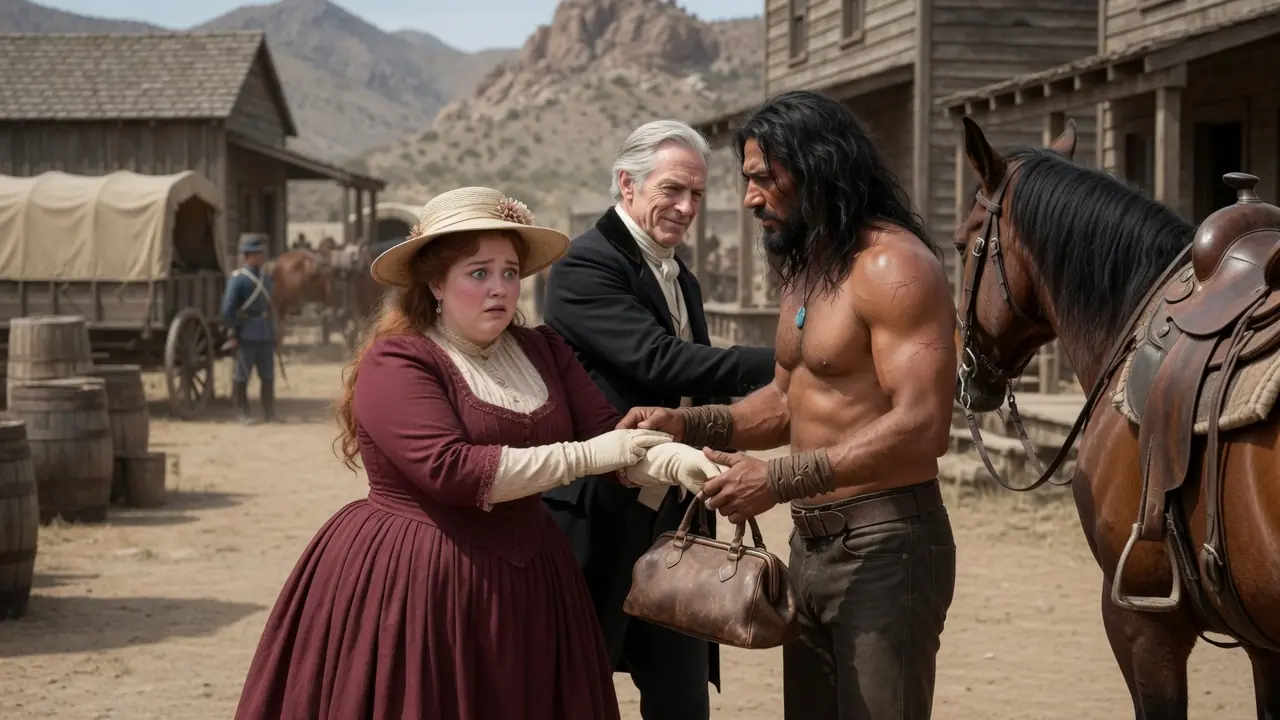
He looked as if he were trying to understand what kind of father could speak about his daughter as though she were a crate of rifles.
Eleanor finally raised her head.
“Father, you cannot simply leave me here.”
Edmund’s expression hardened.
“You have spent your life insisting on independence. Now you may experience it.”
“You are using me to protect a business agreement.”
“I am teaching you the cost of humiliating your family.”
Eleanor’s cheeks burned.
Captain Reeves stepped forward.
“Miss Whitmore cannot be transferred like property.”
“She is an adult,” Edmund replied. “She may remain at the fort if Makai refuses the arrangement.”
Everyone understood what that meant.
The fort had no quarters for an unmarried civilian woman.
Eleanor possessed no independent money.
Her father controlled her accounts, her luggage, and the servants who had accompanied them west.
If he left, she would have no safe transportation back east and no place to go.
Edmund turned toward Makai.
“You wanted proof that I would honor the spring agreement. She is that proof.”
Makai spoke in careful English.
“A person is not proof.”
Edmund smiled thinly.
“Then consider her a guest.”
Makai looked at Eleanor.
“Does she choose to be a guest?”
Edmund answered before she could.
“She has no better option.”
Makai’s expression changed.
Not much.
Only enough for Eleanor to see that he disliked the answer.
He stepped closer but stopped several feet away from her.
“If you remain at this fort, what happens?”
Eleanor swallowed.
“My father leaves.”
“And if you travel with us?”
“I don’t know.”
“That is true.”
Makai looked toward the western mountains.
“My people will not make you a servant. You will stay with my grandmother. You may leave when safe travel can be arranged.”
Edmund laughed.
“She has never worked a day in her life. You will discover that quickly.”
Makai ignored him.
He spoke only to Eleanor.
“You decide.”
The courtyard became silent.
It was the first time anyone had asked her what she wanted.
Not what she was willing to endure.
Not which husband she would accept.
Not whether she understood how fortunate she was.
What she wanted.
Eleanor looked at her father.
His face showed no regret.
Only impatience.
Behind him waited a carriage that would take him east before sunset.
If she begged, he might let her climb inside.
He would also remind her of that moment for the rest of her life.
He would marry her to the next man willing to overlook her body.
He would call it mercy.
Eleanor turned toward Makai.
“I will go.”
Her father’s eyebrows rose.
He had expected fear to defeat her.
Makai nodded once.
“You will need different shoes.”
Edmund turned toward his carriage.
“Do with her what you wish.”
Makai’s voice stopped him.
“She is not mine to use.”
Edmund looked over his shoulder.
For a brief moment, the two men faced each other across the courtyard.
One possessed a title, money, and the protection of distant officials.
The other possessed no power Edmund respected.
Yet Eleanor knew which man appeared smaller.
Her father left without saying goodbye.
She watched the carriage pass through the fort gates and disappear into the heat.
Only then did she allow herself to understand that he was truly gone.
Makai took the small traveling bag from the ground.
Eleanor flinched when he approached.
He noticed.
Instead of reaching for her, he placed the bag beside his own horse.
“You may carry it if you prefer.”
She looked at the heavy case.
“No.”
“I will carry it.”
“Why?”
“Because your feet already hurt.”
Eleanor stared at him.
He turned away before she could answer.
They left Fort Benson with Makai’s companions before the sun began to lower.
For the first hour, Eleanor tried to maintain the posture expected of a noblewoman.
Her back remained straight.
Her steps stayed measured.
She did not complain.
By the second hour, blood had begun soaking into one shoe.
Makai stopped.
Eleanor almost walked into him.
“Why are we stopping?”
“Sit.”
“I can continue.”
“You are limping.”
“I said I can continue.”
Makai looked toward her shoes.
“You can continue badly.”
One of the older women traveling with them, Sani, removed a pair of soft leather moccasins from a bundle.
She gestured toward Eleanor’s feet.
Eleanor hesitated.
Removing her stockings in front of strangers felt more shameful than the pain.
Sani seemed to understand.
She led Eleanor behind a low wall of rocks.
The blisters were worse than Eleanor realized.
Sani cleaned them with water and wrapped the damaged skin in strips of soft cloth.
Then she handed over the moccasins.
They were too narrow at first.
Without mockery, Sani loosened the ties and adjusted them.
When Eleanor emerged, Makai had not looked toward the rocks once.
They continued more slowly.
That night, the temperature fell sharply.
Makai built a fire beneath a sandstone ledge. Food was divided without ceremony: dried meat, roasted roots, and a handful of berries.
Eleanor accepted the portion given to her.
She had eaten almost nothing during the day, afraid the others would watch her.
Her father’s voice remained inside her.
Slow down.
Must you take another helping?
Do you not see how people look at you?
Eleanor held the food without eating.
Sani noticed.
The older woman pointed toward Eleanor’s portion, then toward the long road behind them.
“Eat,” Makai translated.
“I’m not hungry.”
He looked at her.
“That is not true.”
Anger rose instantly.
“You know nothing about me.”
“I know you walked all day.”
“That does not give you the right to tell me what I need.”
“No.”
He took another piece of dried meat from his own portion.
“It gives the desert the right.”
He placed it on a flat stone near her, then returned to the fire.
No one watched her.
No one counted what she ate.
Eleanor finished everything.
On the second day, she asked where they were going.
Makai pointed toward distant red cliffs.
“Home.”
“How far?”
“Three days if the weather holds.”
“And if it doesn’t?”
“Longer.”
His answers were rarely comforting.
They were always honest.
On the third afternoon, Eleanor stumbled while crossing a dry wash.
Makai offered his hand.
She stared at it.
He did not seize her arm or tell her not to be foolish.
He simply waited.
Eleanor placed her hand in his.
His grip was strong and steady.
Once she reached level ground, he released her immediately.
That evening, they sat on opposite sides of the fire.
“Why did you agree to take me?” Eleanor asked.
“I did not.”
“You allowed me to come.”
“Yes.”
“That is not an answer.”
Makai sharpened a small knife against a stone.
“Your father wanted to make you feel unwanted.”
Eleanor looked down.
“He succeeded.”
“No.”
She raised her eyes.
Makai continued working.
“He showed that he does not know your value. That is not the same thing.”
A bitter laugh escaped her.
“You have known me three days.”
“Yes.”
“You don’t know my value either.”
“That is also true.”
She waited.
Makai looked at her across the fire.
“But I know it cannot be measured by whether a cruel man approves of your body.”
Eleanor’s throat tightened.
She turned away before he could see her face.
The settlement appeared late on the fourth day.
It rested inside a hidden valley surrounded by rust-colored cliffs. Homes made from brush, hides, and timber stood in small groups. Cooking fires sent thin columns of smoke into the evening air.
Children paused when the travelers entered.
Several stared openly at Eleanor.
Women looked up from grinding corn and preparing hides.
Men returning from hunting stopped near the edge of the settlement.
Eleanor tightened the shawl around her shoulders.
She knew what they saw.
A large white woman in torn clothes.
A burden.
A curiosity.
Makai spoke to several elders in his own language.
The discussion was calm but serious.
At last, an elderly woman stepped forward.
Her hair was silver, her face deeply lined, and her dark eyes seemed to notice everything.
“This is Amaya,” Makai said. “My grandmother.”
Amaya examined Eleanor from head to foot.
Eleanor prepared herself for judgment.
Instead, Amaya touched the torn edge of Eleanor’s sleeve, frowned, and said something sharp to Makai.
“What did she say?” Eleanor asked.
“That I should have found you shade before your skin burned.”
Eleanor looked at the red skin along her neck.
Makai accepted the criticism without protest.
Amaya led Eleanor to a dwelling near the center of the settlement.
Inside, woven mats covered the ground. Clay vessels stood neatly along one wall. Bundles of dried plants hung from the ceiling.
Amaya pointed toward a sleeping mat.
Then toward a bowl of water.
“This is for me?” Eleanor asked.
Amaya nodded.
The old woman turned away, giving Eleanor privacy to wash.
That small act nearly brought her to tears.
Over the following days, Eleanor watched the community.
It was nothing like the stories she had heard in eastern drawing rooms.
Her father spoke of Apache people as lawless raiders who understood nothing but violence.
What Eleanor saw was order.
Children carried water and gathered wood.
Hunters divided meat among families.
Elders settled disagreements.
Women worked together while talking and laughing.
No one moved without purpose, but no one appeared afraid of being noticed.
Eleanor was treated cautiously.
Not cruelly.
She could not speak the language.
She did not understand customs.
Her clothes were unsuitable.
Her hands were soft.
Amaya began with simple tasks.
Sorting dried beans.
Cleaning herbs.
Holding cord while baskets were woven.
Eleanor failed often.
One morning, Amaya handed her a large clay pot and pointed toward the stream.
Eleanor understood.
She carried the empty vessel down the path.
Filling it was easy.
Lifting it was not.
The weight pulled against her shoulders and lower back. She managed only a few steps before the pot slipped.
It shattered against the stones.
Eleanor stared at the broken pieces.
Shame arrived immediately.
Hotter than the sun.
She knelt to gather the shards and cut her palm.
“You ruin everything.”
Her father’s voice.
“You cannot complete the simplest task.”
A shadow crossed the ground.
Makai crouched beside her.
Eleanor expected annoyance.
Instead, he took a strip of clean cloth from his pouch.
“I broke it,” she said.
“Yes.”
“I’m sorry.”
“It was a pot.”
“It belonged to your people.”
“We make more.”
He cleaned the cut and wrapped her palm.
“I cannot even carry water.”
“You tried to carry too much.”
“Everyone else can.”
“You are not everyone else.”
The sentence should have sounded insulting.
It did not.
Makai retrieved a smaller water container from his belt and placed it beside her.
“Start with what you can carry.”
Eleanor looked at him.
“My father would call that weakness.”
“Your father is not here.”
Makai gathered the sharpest pieces of the broken pot.
Eleanor picked up the rest.
The next day, she carried the smaller container.
A week later, Amaya gave her a larger one.
Nobody applauded.
Nobody treated her like a child.
Her strength increased quietly.
So did her confidence.
Eleanor’s body did not become thin.
It changed through use.
Her legs became steadier.
Her hands developed calluses.
She learned how to wrap cloth around her head against the sun and which paths remained shaded in the afternoon.
The women taught her words.
Water.
Food.
Fire.
Child.
Pain.
Friend.
Eleanor began helping Amaya prepare remedies.
Her own mother had kept journals about herbs used by midwives on the family estates in England. Eleanor remembered more than she expected.
Amaya distrusted some of the methods and approved others.
They communicated through gestures, drawings, and eventually fragments of shared language.
Neither woman treated the other’s knowledge as complete.
One afternoon, a child arrived with a badly burned arm.
Eleanor’s first instinct was to apply butter, as servants had done in England.
Amaya stopped her.
The old woman cooled the burn with clean water and used a prepared salve.
Eleanor watched carefully.
Later, she asked why.
Amaya explained through Makai that grease trapped heat.
Eleanor wrote the lesson inside the small notebook she still carried from home.
Makai saw her writing.
“What is that?”
“My mother’s medical notes.”
“You remember her?”
“Some days.”
Eleanor closed the book.
“She was gentle when my father was away.”
“And when he was home?”
“She became quiet.”
Makai sat beside the fire.
“My mother died when I was young.”
“I’m sorry.”
“My grandmother raised me.”
Eleanor looked toward Amaya, who was arguing with two boys over a damaged basket.
“She seems formidable.”
Makai smiled.
“She believes fear is useful only when it keeps a person from stepping on a snake.”
It was the first time Eleanor saw him smile fully.
The expression changed his entire face.
She began noticing him more after that.
The way children climbed onto his back when he returned from hunting.
The patience with which he listened to elders.
The sadness that sometimes appeared when distant gunfire echoed from beyond the valley.
Makai was not a chief in the way white newspapers used the word.
He was a respected leader among several families, chosen to speak during negotiations because he understood English and had spent time near army posts.
Authority did not belong to him alone.
Decisions were argued.
Elders challenged him.
Women disagreed openly.
Eleanor watched one council meeting where Amaya spoke so sharply that Makai remained silent for several minutes afterward.
“You are not obeyed without question,” Eleanor observed later.
“That would be dangerous.”
“My father believes leadership means nobody says no.”
“That is why he is alone.”
Autumn came slowly.
The nights cooled.
Eleanor had been in the valley for almost five months when Makai asked her to walk with him to a ridge above the settlement.
They climbed in silence.
At the top, the valley spread beneath them. Fires glowed between the homes. Beyond the cliffs lay miles of desert turning violet beneath the evening sky.
Makai carried a small flute carved from wood.
“My father made this,” he said.
He played a quiet melody.
It was not a performance.
The music seemed to belong to the wind and stones more than to the man holding the instrument.
When he finished, Eleanor remained silent.
“What does it mean?” she asked.
“It has no words.”
“It still feels sad.”
“It is.”
“For whom?”
“For people who leave and cannot return.”
Eleanor looked toward the distant east.
“My father left and could return.”
“That is different.”
“Yes.”
Makai placed the flute in his lap.
“Do you want to return?”
The question frightened her.
Sometimes she missed hot baths, books, and music played on a proper piano.
She missed bread with butter and rooms where dust did not enter through every opening.
But she did not miss her father’s table.
She did not miss mirrors used as instruments of punishment.
She did not miss being told that hunger was a moral failure or that no man could love a woman shaped like her.
“I don’t know where I would return to,” she said.
“That is not what I asked.”
Eleanor looked at him.
“No.”
Makai waited.
“No,” she repeated. “I do not want to go back to my father.”
He nodded.
“Then do not.”
Her voice became smaller.
“Is it truly that simple?”
“No.”
He looked toward the valley.
“Nothing important is simple. But the choice is still yours.”
Eleanor’s eyes filled.
Makai did not tell her not to cry.
He did not pretend not to notice.
He simply remained beside her.
After a while, he said, “Your father saw only what you could not become for him.”
Eleanor wiped her cheek.
“And what do you see?”
Makai answered slowly.
“A woman who learns quickly.”
“That sounds practical.”
“You are kind to children.”
“Also practical.”
“You remember every plant Amaya teaches you.”
“She tests me constantly.”
“You make people laugh when you forget you are afraid.”
Eleanor looked at him.
Makai’s voice lowered.
“And you are beautiful.”
She turned away immediately.
“Do not say that because you feel sorry for me.”
“I do not.”
“No one has ever called me beautiful without wanting something.”
“I want something.”
Her heart tightened.
“What?”
“I want you to believe I mean it.”
He did not touch her.
That made the words more powerful.
Eleanor looked at his face.
There was no mockery.
No calculation.
No astonishment at his own generosity.
Only certainty.
She placed her hand beside his on the stone.
Their fingers did not meet.
Not yet.
The first warning arrived with winter frost.
A scout returned from the eastern ridge and spoke urgently to the council.
Soldiers were approaching.
With them rode a white civilian dressed in expensive clothes.
Eleanor understood before Makai translated.
“My father.”
That night, the council gathered.
Some families wanted to move deeper into the mountains.
Others argued that abandoning the spring would allow cattlemen to claim it permanently.
The soldiers might have come peacefully.
They might not.
No one knew.
Makai spoke last.
“We will not begin a fight.”
Then he looked at Eleanor.
“But we cannot decide for her.”
After the council, he found her near Amaya’s dwelling.
“If your father asks you to leave, what will you say?”
“What do you want me to say?”
His expression became serious.
“What I want should not decide.”
Eleanor breathed slowly.
“I will stay.”
Makai’s shoulders lowered slightly.
She almost smiled.
“You are relieved.”
“Yes.”
“Then you did want something.”
“I wanted you to stay because you chose us.”
“And you?”
He looked at her.
“Because you chose me?”
Makai stepped closer.
“I have no right to ask that.”
“You could.”
“No.”
“Why?”
“Because you arrived here after a man used his power to remove your choices. I will not use kindness to do the same.”
Eleanor felt something inside her break open.
Not pain.
Something that had been locked for too long.
She reached for his hand.
This time, their fingers met.
The soldiers arrived the following afternoon.
Twelve men rode into the valley under the command of Lieutenant Samuel Ward.
Behind them came Lord Edmund Whitmore.
He appeared older.
Dust clung to his coat. Anger had deepened the lines around his mouth.
The families gathered near the center of the settlement.
No weapons were raised, though several remained close at hand.
Makai stood with two elders.
Eleanor stood beside Amaya.
Her father’s eyes found her.
For one moment, he appeared shocked.
Eleanor wore a practical woven dress with a loose belt and soft boots. Her hair had been divided into two simple braids. Her face and arms were darkened by months beneath the sun.
Her body remained full.
But she no longer attempted to fold herself smaller.
“Eleanor,” Edmund said. “Thank God.”
She did not move.
“I have come to take you home.”
“This is my home.”
His relief vanished.
“Do not be ridiculous.”
Lieutenant Ward looked between them.
“Miss Whitmore, we were informed you were being held against your will.”
“Who informed you?”
Her father answered.
“I did.”
Eleanor laughed once.
“You left me here.”
“As a temporary lesson.”
“You called me compensation.”
“That was a figure of speech.”
Makai spoke.
“She was asked whether she wished to travel with us.”
Edmund’s face hardened.
“I did not ask you.”
“No,” Eleanor said. “You never asked anyone except yourself.”
Her father ignored her words.
“I have arranged a marriage.”
The old shame rose automatically.
“To whom?”
“Mr. Bartholomew Crane. A widower in Boston with respectable holdings.”
“How old?”
“That is irrelevant.”
“How old?”
“Fifty-nine.”
Eleanor looked toward Lieutenant Ward.
“My father wants to rescue me so he can sell me more respectably.”
Edmund’s face reddened.
“You ungrateful girl.”
“I am not a girl.”
“You are my daughter.”
“That does not make me your property.”
Lieutenant Ward cleared his throat.
“Miss Whitmore is of legal age.”
Edmund turned sharply.
“She is not competent to make this decision.”
“On what grounds?”
“Look at her. She has been living among savages for months.”
The insult moved through the gathered families even before every word was translated.
Makai remained still.
Eleanor stepped forward.
“These people fed me when you left me with nothing.”
“Because they wanted influence over you.”
“They taught me. They gave me work. They allowed me to refuse.”
“Enough.”
Edmund pointed toward the soldiers.
“Lieutenant, remove her.”
Ward did not move.
“My orders are to recover a captive, not abduct an adult woman.”
Edmund stared at him.
“I financed half the supplies at your fort.”
“That does not change my orders.”
Makai spoke calmly.
“She may leave if she chooses.”
Eleanor looked toward him.
He met her eyes.
No fear.
No demand.
Freedom, even now.
She turned back to her father.
“I stay.”
The words carried across the settlement.
Edmund’s face changed.
The mask of dignity disappeared.
“You would choose him over your own blood?”
“I choose myself.”
Her father reached beneath his coat.
Makai moved instantly.
So did Lieutenant Ward.
The pistol appeared in Edmund’s hand.
He aimed toward Makai.
“You have poisoned her mind.”
Eleanor stepped between them.
The gun fired.
Someone struck her from the side.
She fell.
For several seconds, all sound became confusion.
Horses reared.
Children screamed.
Apache men rushed forward.
Soldiers drew rifles.
Then Makai’s voice cut through everything.
“Stop!”
Eleanor pushed herself upright.
A young warrior named Chato lay several feet away, blood spreading across his shoulder.
He had knocked Eleanor aside and taken the bullet.
Makai knelt beside him.
Lieutenant Ward seized Edmund’s wrist while another soldier removed the pistol.
“Hold your fire!” Ward shouted.
The two sides remained facing each other.
One frightened movement could have turned the valley into a graveyard.
Makai pressed cloth against Chato’s wound.
“No more blood,” he ordered his people.
Ward dragged Edmund backward.
“You fired without provocation.”
“That man stole my daughter.”
“She rejected you in front of twelve witnesses.”
“She is not in her right mind.”
Eleanor rose.
Her knees shook, but her voice did not.
“Lieutenant, arrest him.”
Edmund stared at her.
“You would see your own father imprisoned?”
“You tried to kill a man because I said no.”
Ward looked toward Makai.
“We will take him to the fort.”
Makai’s hands remained red with Chato’s blood.
“If this man returns armed, there will not be another warning.”
Ward nodded.
The soldiers departed with Edmund bound to his horse.
Eleanor watched until he disappeared beyond the cliffs.
Then she turned toward the wounded man.
She worked beside Amaya through the night.
The bullet had passed through the upper shoulder without striking bone.
They cleaned the wound.
Controlled the bleeding.
Prepared bandages.
Eleanor followed Amaya’s instructions and kept Chato awake when fever began.
At dawn, the young man opened his eyes.
“You pushed me,” Eleanor said.
Chato managed a weak smile.
“You were standing badly.”
Tears filled her eyes.
“I am sorry.”
“You did not fire.”
The answer remained with her.
She had spent her life taking responsibility for other people’s cruelty.
Her father’s anger.
Her rejected suitors’ insults.
The servants’ resentment.
Now Chato refused to let her carry a bullet she had not fired.
Makai found Eleanor after sunrise beside a small fire.
“You should sleep.”
“So should you.”
He sat beside her.
“My father would have killed you.”
“He tried.”
“Because of me.”
“No.”
“He came for me.”
“He came because he could not accept your choice.”
Eleanor looked toward him.
Makai continued.
“That belongs to him.”
She began crying.
Not quietly.
Months of fear, humiliation, anger, and relief broke through at once.
Makai opened his arms but did not touch her.
Eleanor moved toward him.
He held her carefully.
For the first time in her life, comfort did not come with a demand attached.
Spring returned to the valley.
Chato recovered.
Lord Edmund Whitmore was taken before a territorial military court for firing during a peaceful encounter and endangering soldiers under Ward’s command.
His money prevented the harshest punishment.
It did not prevent public disgrace.
He returned east without Eleanor.
She remained with Amaya and continued learning.
Her knowledge grew slowly.
She became useful in caring for children, treating minor wounds, and assisting during childbirth.
She never called herself a healer while Amaya lived.
“I am still learning,” she said whenever others praised her.
Makai respected that.
Their relationship also moved slowly.
They walked together.
Worked together.
Argued.
Eleanor disliked the risks he took during negotiations.
Makai disliked her habit of working until exhaustion to prove she deserved her place.
One evening, he found her carrying a water pot too heavy for her.
He took one handle.
“I can carry it.”
“I know.”
“Then let go.”
“No.”
She glared.
Makai smiled.
“Start with what you can carry.”
Eleanor nearly dropped the pot from laughing.
A year after her arrival, Makai asked if she wished to form a household with him according to the customs of his family and with the consent of the elders.
Eleanor did not answer immediately.
Not because she doubted her love.
Because she wanted to be certain that gratitude had not disguised itself as devotion.
She spent several days alone with Amaya in the high country gathering plants.
When she returned, Makai waited near the stream.
“I have an answer,” she said.
He became very still.
“Yes.”
“Is that the answer?”
“Yes.”
He smiled.
Eleanor raised one finger.
“But I will not belong to you.”
“No.”
“You will not speak for me when I can speak for myself.”
“No.”
“You will not decide what I eat.”
Makai’s smile widened.
“I value my life too much.”
She laughed.
Then she touched his face.
“And I will not ask you to become less Apache so I can feel more comfortable.”
His expression softened.
They joined their lives before the families of the valley.
There was no moment when the community gave Eleanor a new identity and erased the old one.
She kept her name.
Some called her Eleanor.
Others shortened it in their own way.
Children called her whatever was easiest when they were hurt and running toward her.
Her body remained full.
It also became stronger.
She carried water, though not always the largest pot.
She rode confidently.
She knelt beside sick children and stood through long council discussions.
Makai never loved her because her body changed.
He loved the woman who had survived being taught to hate it.
Several years later, an eastern reporter named Margaret Flynn arrived in the valley with an interpreter and an army doctor.
She wanted to interview “the noblewoman who chose an Apache husband.”
Eleanor agreed only after the families approved the visit.
Margaret sat with her beneath a cottonwood tree.
“People in Boston believe you were given to Makai as punishment,” the reporter said.
“I was abandoned.”
“And he rescued you?”
Eleanor looked toward Makai, who was repairing a saddle with Chato.
“No.”
Margaret appeared surprised.
“He offered safety.”
“Is that not rescue?”
“Safety gave me time. I rescued myself from believing my father’s judgment was the truth.”
The reporter wrote quickly.
“Did you remain because you fell in love?”
“Not at first.”
“Why, then?”
“Because nobody here required me to apologize for existing.”
Margaret paused.
Eleanor continued.
“Do not write that this place is perfect. It is not. People argue. People fail one another. We face hunger, disease, and soldiers who do not always care whether agreements are honored.”
“Then what should I write?”
“That I was not exchanged from one owner to another.”
Eleanor’s voice became firm.
“My father believed Makai would treat me as property because that was how my father understood women. He was wrong about Makai.”
“And about you?”
“Especially about me.”
The article reached newspapers in the east.
Some editors changed the title into something cruel.
Others described Eleanor as bewitched.
A few printed her words accurately.
She learned not to measure truth by how widely it was accepted.
Years passed.
The valley changed.
More settlers arrived.
Government pressure increased.
Agreements were made and broken.
Makai spent long periods negotiating for access to water and safe passage.
Eleanor sometimes interpreted letters and helped identify where official documents contradicted spoken promises.
She did not become the bridge between two civilizations.
No single person could carry that burden.
She became one voice among many.
Amaya died peacefully during Eleanor’s tenth year in the valley.
Before her death, the old woman placed a bundle of dried herbs and Eleanor’s mother’s notebook into the same basket.
The meaning required no translation.
Keep learning.
Keep both.
Eleanor continued helping the women who came to her.
Apache women.
Mexican settlers.
Occasionally white women who traveled from distant ranches because no other medical help was available.
She never charged those with nothing.
Those who had food brought food.
Those who had cloth brought cloth.
Those who had only gratitude offered that.
Makai’s hair silvered.
His knees began aching during winter.
Eleanor teased him for refusing to admit it.
Twenty years after Fort Benson, they sat on the ridge above the settlement.
The valley below was quieter than it had once been.
Some families had moved.
Others had been forced away.
Yet fires still burned.
Children still ran between homes.
Makai held Eleanor’s hand.
“Do you regret staying?” he asked.
She looked at him.
“Do you?”
“I asked first.”
Eleanor watched the sunset touch the cliffs.
“I regret what it cost your people to survive the arrival of mine.”
“That is not the same question.”
“No.”
She squeezed his hand.
“I do not regret choosing my life.”
Makai nodded.
After a while, Eleanor asked, “What did you think when you saw me at the fort?”
“That your dress looked painful.”
She laughed.
“What else?”
“That your father wanted everyone to see you as weak.”
“And did you?”
“No.”
“How could you know?”
“You were crying.”
“That sounds like weakness.”
“You refused to let him see.”
Eleanor leaned against him.
“My father said my body proved I lacked discipline.”
Makai looked toward the horizon.
“Your body carried you across the desert.”
“It complained constantly.”
“It still arrived.”
She smiled.
He touched her cheek.
“I did not love you because you became useful here.”
Eleanor raised an eyebrow.
“You are very useful.”
“That is good to hear.”
“I loved you because each time someone told you what you were, you eventually asked whether they had the right to decide.”
The last light disappeared.
Eleanor thought about the woman she had been in the courtyard.
Head bowed.
Corset cutting into her ribs.
Waiting for a father’s cruelty to become the rest of her life.
Edmund believed leaving her among people he despised would destroy her.
Instead, distance from him allowed his voice inside her to weaken.
Makai did not replace that voice with his own.
He gave her silence enough to discover hers.
That was why she loved him.
Not because he told her she was perfect.
Not because he treated her like a rare treasure.
Because he never required her to become smaller so he could feel larger.
The story told in eastern newspapers remained simple.
An obese noblewoman was surrendered to an Apache leader as punishment.
He loved her when no civilized man would.
Eleanor disliked every part of that sentence.
Her size was not a tragedy.
Makai’s love was not an act of charity.
And the men who rejected her had not represented civilization.
The truth was quieter.
A father abandoned his daughter because he could not control her.
A stranger offered her a choice.
A community allowed her to learn without demanding that she erase herself.
A woman slowly discovered that dignity was not something another person could award.
Love came afterward.
Not as rescue.
As recognition.
Years later, when young women sat beside Eleanor and confessed that they were too large, too scarred, too poor, too disobedient, or too damaged to deserve tenderness, she never promised that a man would arrive and prove them wrong.
She told them something Amaya had once taught without words.
“Begin with what you can carry.”
A smaller water pot.
One honest refusal.
One morning without apology.
One choice made for yourself.
Strength did not arrive all at once.
Neither did freedom.
But both grew when a person stopped measuring her life by the contempt of those who had never truly seen her.
Eleanor’s father believed he had sent her into exile.
He had not.
He had merely stepped out of the way.
And for the first time, she was able to walk toward a life that belonged to her.