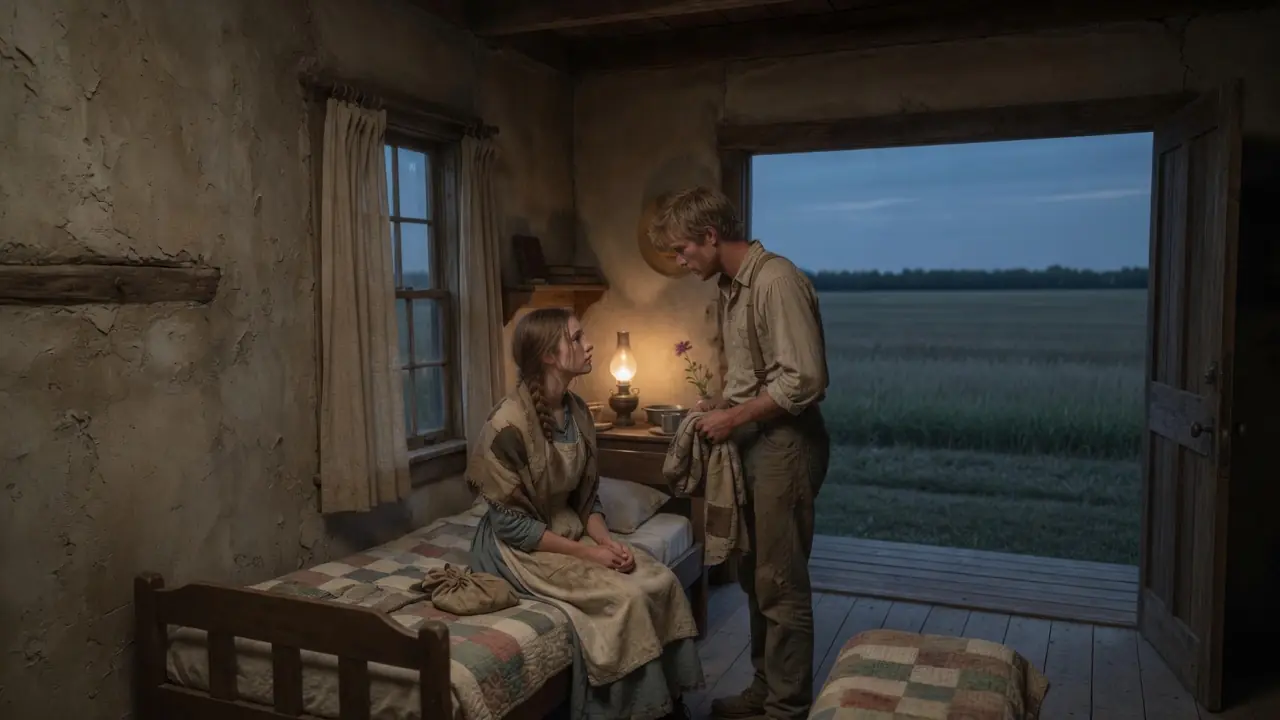
The morning after Emily Cross was given to Colt Reed, the farmhouse looked nothing like the nightmare she had imagined. Sunlight came through the small kitchen window in thin clear strips, touching the rough wooden floor, the patched quilt, the tin cup beside the washbasin, and the folded blanket in Colt’s hands. Outside, chickens scratched near the fence, a mule shifted somewhere by the barn, and dew rested on the fields like the land had not heard what happened to her the day before. Emily sat on the edge of the narrow bed with her cloth bag beside her muddy boots, waiting for the first command that would prove she had become nothing more than payment.
Colt did not give one. He stood near the open doorway in a faded beige work shirt, brown suspenders, rough trousers, and boots still marked by yesterday’s road dust. His hair was messy from sleeping on the floor, and his gray eyes looked tired, but there was no ownership in them. If anything, he seemed embarrassed by his own presence, as if he felt the wrongness of her being there more heavily than she did.
Emily had spent the night awake more than asleep. She had listened to Colt’s breathing from the floor, listened to the boards creak in the early cold, listened to her own heart pound whenever he shifted beneath the blanket. He had not come near the bed, had not reached for her, had not even turned his face toward her once the lamp was blown out. That restraint confused her more than cruelty would have, because cruelty was something life had taught her to expect.
She was nineteen, white, fair-skinned from birth but browned softly by farm sun, with hazel eyes that still held too much fear for someone her age. Her faded blue cotton dress was wrinkled from yesterday’s wagon ride, and the cream apron tied around her waist made her look more like a hired kitchen girl than a bride. Her light brown braid had loosened overnight, leaving small strands around her tear-stained face. She felt ashamed of the way her hands trembled in her lap, but Colt noticed and looked away so she would not feel watched.
He folded the blanket carefully, smoothing one corner with his thumb. The gesture was simple, practical, almost ordinary, and somehow it made her throat tighten. He had slept on the floor of his own house so she could keep the bed, and now he was folding the evidence of that kindness as if it were nothing worth praising. Emily wondered what kind of man was poor enough to accept a debt arrangement but decent enough to refuse the power it gave him.
Her father had not spoken to her like that. The day before, Martin Cross had stood on the porch with his hat in both hands, his face red from shame and drink, telling Colt there was no other way. Forty dollars had become impossible to pay after failed crops, broken harnesses, and old debts that multiplied in silence. Emily had heard the sentence clearly, even though her mother had tried to close the window before the words reached her.
The girl will cover the debt. That was what her father had said. Not my daughter, not Emily, not the child who once carried water to him in the fields and mended his shirts by firelight. The girl, as if naming her too gently might make the bargain harder.
Colt had looked horrified when he heard it. Emily remembered that more clearly than the wagon ride, more clearly than the dust, more clearly than her mother crying behind the curtain. He had refused at first, his hands lifted as if pushing away something poisonous. But her father had told him that if Colt would not take her, another man would, and the silence after that had swallowed every choice in the yard.
Now morning stood between them, and Colt still looked like a man trying not to become the villain in her life. He set the folded blanket on a chair and cleared his throat, but the sound held no authority. Emily braced herself anyway. She had been raised around men who believed a woman’s fear was proof that the world was working as designed.
“You are not my debt, Emily. You woke up free in this house.”
The words were quiet, but they struck her harder than any shout. Emily looked up at him, uncertain whether she had heard correctly. Free was not a word that matched the wagon, the bargain, the wedding vows spoken like a receipt, or the ring that felt too heavy on her finger. Free was a word for people whose lives had not been traded to settle what their fathers owed.
Colt stayed by the doorway as if distance itself was part of his promise. His rough hands hung at his sides, calloused and scarred from work, but still careful in the way they moved. He could have ordered her to make breakfast, clean the house, or start paying down the debt with labor before the sun was fully up. Instead, he looked at the floor and waited, letting her decide whether to answer.
Emily’s voice came out smaller than she wanted. “Then why did you sleep on the floor all night?” It was the first thing she had asked him since arriving, and the question carried more than curiosity. It asked whether his kindness was temporary, whether it would disappear when the day warmed, whether morning would make him remember he had rights other men would have claimed without shame.
Colt’s face tightened with something like sorrow. He looked toward the fields beyond the porch, where the grass still held the silver trace of dawn. He seemed to be choosing words the way a farmer chooses seed, carefully, knowing a careless thing planted once could grow crooked for years. When he answered, his voice was soft enough that Emily had to listen with her whole heart.
“Because your fear deserved more respect than my comfort.”
Emily looked down before he could see what those words did to her. She had not known fear could be respected. In her father’s house, fear had been something to hide, something that made people impatient, something used against her when she hesitated. Colt said it like fear was a wound that needed clean hands around it.
The farmhouse around them seemed to breathe differently after that. It was still poor, still narrow, still built from weathered boards that let sound travel too easily through the walls. But the swept floor, the single wildflower in the cracked jar, the small Bible on the shelf, and the patched quilt folded neatly over the bed began to feel less like poverty and more like effort. Colt had prepared the house not to impress her, but to make sure she would not feel thrown into filth with her shame.
Emily stood slowly. Her knees felt weak, but she did not want to remain seated while he stood as though he were the one awaiting judgment. The shawl slipped from one shoulder, and she pulled it back with fingers that still trembled. Colt’s eyes moved toward the falling cloth by instinct, then away at once, and the respect in that small refusal made her chest ache.
She took one step toward him. Colt stiffened, not with rejection, but with caution, as if she were a frightened colt that might bolt if he moved too quickly. Emily saw the irony and almost laughed, though there was no humor in the morning. The man named Colt was the one standing perfectly still so he would not scare her.
The distance between them was only a few feet, but to Emily it felt like crossing every insult of the day before. Her father’s lowered eyes, the neighbor’s curious stare, the preacher’s rushed voice, the wagon wheels leaving Willow Bend behind. She crossed all of it and stopped before Colt with her hands still tight at her waist. He did not reach for her.
That mattered more than she could explain. Every choice had been taken from her in less than an hour, and now here was one waiting in the space between their bodies. Emily drew a breath that shook at the end. Then she lifted her hand.
Colt looked at it as if she had offered him something more valuable than land. He did not take the whole hand, only her fingertips, light as a question. His thumb brushed over her knuckles once, barely there, and the tenderness of it nearly undid her. She had been touched before by people guiding, correcting, pulling, handing her from one place to another, but this was different because she could pull away and he would let her.
“Then let me choose now. Stay close, but only because I ask you to.”
Colt closed his eyes for one brief moment. When he opened them again, the nervousness had not left, but something steadier stood beneath it. He nodded, and the nod felt more sacred than yesterday’s wedding vows. Emily realized that whatever paper, debt, and pressure had made them, this morning was the first honest agreement between them.
He did not kiss her. He only lowered his forehead near hers, leaving a breath of space between them, and waited. Emily chose to close that space first, resting her brow lightly against his. The contact was simple, almost childlike, but it sent a quiet warmth through her that had nothing to do with shame.
They stood that way while the morning grew brighter. Outside, a rooster called, the mule gave a low impatient sound, and the world continued as if nothing had changed. But inside the farmhouse, something had shifted at the root. Emily had not been rescued from her past, not yet, but she had found the first place where her fear did not have to defend itself.
Colt stepped back before the moment became too much. He cleared his throat, picked up the tin cup, and moved toward the pump outside. His awkwardness returned the instant tenderness passed, and that made Emily’s mouth soften. He looked like a man who could repair a roof in a storm but had no idea what to do with a woman’s trust.
She followed him to the porch, tying her shawl as she stepped into the clean morning. The farm stretched before her in rough lines: a small barn leaning a little, a chicken coop needing boards, a vegetable patch half-swallowed by weeds, and fields that looked thirsty but not defeated. It was not a rich man’s farm. Nothing here shone except the dew, and even that would be gone by noon.
Yet Emily saw work everywhere, and work was something she understood. Her father’s farm had taught her to milk before breakfast, weed until her back burned, carry water, mend hems, gather eggs, and save seed in folded cloth. Work did not frighten her. Being owned did.
Colt filled the cup at the pump and handed it to her without letting his fingers linger. She drank slowly, feeling cold water settle her stomach. He waited until she finished before speaking about the day, asking if she felt strong enough to help with the chicken coop. The way he asked, not ordered, made her grip tighten around the cup.
The coop stood west of the house with one side sagging and a loose strip of tin complaining whenever the wind moved. Colt handed Emily the smaller hammer and kept the heavier one for himself. He showed her which boards needed replacing, then stepped aside and let her try. When her first nail bent sideways, he did not laugh.
Instead, he knelt beside the board and showed her how to hold the nail lower. His shoulder was close enough that she could smell sawdust, sun, and old cotton. Emily expected embarrassment to flood her, but it did not. Colt’s nearness did not press on her; it steadied her.
By midmorning, the work had found a rhythm. Colt measured and cut, Emily nailed and stacked, and the chickens complained around their boots like small offended queens. Once, when she leaned too far to reach a corner, her braid slipped forward and caught on a rough edge. Colt lifted his hand, stopped halfway, and asked if he could help.
Emily looked at him, surprised by the question. Then she nodded. He freed the braid carefully, strand by strand, touching her hair only as much as needed. The tenderness was so clumsy and careful that Emily had to look away before he saw the feeling rising in her face.
At noon, they ate bread, beans, and sliced apples on the porch step. Colt apologized for the meal twice until Emily finally told him she had eaten worse in a better house. That made him glance at her sharply, but she only looked out at the fields. She had not meant to reveal so much in one sentence.
The silence afterward did not punish her. Colt did not ask questions he had not earned the right to ask. He ate slowly, elbows resting on his knees, watching a line of ants carry crumbs near the step. Emily understood then that his patience was not weakness; it was discipline.
In the afternoon, he took her to the garden. The rows were poor but honest, beans trying, onions leaning, a few pumpkin vines stretching weakly near the fence. Colt crouched and crumbled soil in his palm, explaining how to tell whether it still held moisture. His voice changed when he spoke of land, becoming surer, almost peaceful.
Emily listened more closely than she meant to. He was not educated in the way town men boasted about, but he knew rain patterns, root depth, mule moods, chicken illnesses, and the difference between dead dirt and tired soil. He spoke of feeding land instead of forcing it. That made her think of people, though she did not say so.
When she reached for a weed at the same moment Colt did, their hands touched. Both froze. This time, he did not jerk away immediately. He waited just long enough for Emily to decide, and when she did not pull back, he gently covered her fingers and helped loosen the weed from the soil.
The touch lasted only a few seconds. Still, Emily felt it travel through her like a secret. She was ashamed of how much she wanted kindness to stay. Not passion, not promises, not grand words, only this small proof that hands could be strong without taking.
Toward evening, clouds gathered in the west, but the light over the farm remained clean and pale. Colt moved the mule to a better patch of grass while Emily carried a bucket from the pump. The bucket was too full, and the porch step was still damp from morning dew. Her boot slipped.
Colt reached her before she fell. One arm came around her waist, firm but not crushing, and the bucket tipped, spilling water down the step. For one breath, Emily was against his chest, her hands gripping his shirt, her face close enough to feel his breath catch. The whole world narrowed to the thud of his heart beneath rough cotton.
He asked if she was hurt, but the words barely reached her. Emily looked up and found fear in his eyes, not fear of blame, but fear for her. He released her the moment he realized how tightly he held her, stepping back with apology already forming on his face. She shook her head before he could say it.
Something inside her had changed again. The man who had the legal shape of a husband had touched her only to keep her from falling, then let go before she could ask. It made her want to cry and smile at once. She bent to pick up the bucket because ordinary tasks were easier than standing under the weight of that feeling.
That night, Colt spread his blanket on the floor again. Emily sat on the bed and watched him arrange it with the same respectful distance as before. The room was quieter than it had been the first night. The silence no longer felt like a wall; it felt like a field waiting for seed.
She could have let him sleep there. Maybe another woman would have, and no one could have blamed her. But Emily looked at the floorboards, then at his tired shoulders, and remembered his words from morning. Her fear deserved respect, but so did his kindness.
She told him he could sleep inside closer to the bed, not on the porch, not by the doorway like a guard outside a prison. Colt stared at her as if the offer frightened him more than rejection. He asked if she was sure, and Emily nodded. Then he moved the blanket a little nearer, still far enough that his restraint remained visible.
The days that followed did not turn into romance all at once. They became something slower and more believable. Morning chores, repaired boards, shared meals, quiet thanks, careful glances, and moments when Emily forgot to be afraid. Colt kept giving her choices until choice became something her body recognized again.
He asked what tasks she preferred. He asked whether she wanted to visit town or avoid it. He asked if she wanted the bed moved closer to the window because the morning light seemed to comfort her. Each question was small, but small questions can rebuild a person who has been treated like an answer already decided.
Emily began to change the farmhouse. She scrubbed the washbasin until it shone, mended the quilt, tied herbs near the window, and planted more wildflowers in broken jars. Colt pretended not to notice every little improvement, but she saw him pausing at the doorway sometimes, looking around like a man entering a house that was becoming a home without permission. Once, she caught him touching the patched quilt with a smile he quickly hid.
A storm came at the end of the week. Wind moved across the fields in hard waves, bending grass and rattling every loose board Colt had not yet repaired. Emily was in the yard gathering laundry when the first hard gust snapped the line. Colt ran from the barn and caught the sheet before it blew into the mud.
The sky opened before they reached the porch. Rain came fast, soaking Colt’s shirt and Emily’s dress, turning the yard dark beneath their boots. She laughed suddenly, not because anything was funny, but because she was alive, drenched, breathless, and not alone. Colt looked at her in astonishment, then laughed too, and the sound changed the farm more than any repair could.
Inside, he gave her a dry towel and turned away while she fixed her hair. She watched his back and felt a tenderness so sharp it almost hurt. He was still poor, still awkward, still unsure how to stand in a room with her without measuring the distance twice. But he had given her safety long enough that her heart had begun looking for him before her eyes did.
Weeks passed. The debt remained unpaid, and the world beyond the farm had not become kinder. But Emily had learned the shape of Colt’s goodness, and Colt had learned the sound of Emily’s laughter. They worked side by side as if the land itself were teaching them how to love, slowly, by season, by effort, by trust.
One evening, Emily found Colt mending a harness by the barn while the fields glowed under the last light of day. She walked up behind him and placed a cup of water on the fence post. He thanked her, but before he could look away, she reached up and brushed a smear of dirt from his cheek. His whole body went still.
Emily smiled softly because she knew that stillness now. It was not rejection. It was wonder. Colt looked at her with eyes that said he did not know what he had done to deserve such gentleness, and Emily realized she felt the same about him.
That night, she moved his blanket beside the bed herself. Colt stood in the doorway, speechless. She did not rush him, did not tease him, did not make the moment bigger than his courage could bear. She simply held out her hand.
He came to her slowly. When he took her fingers, she guided him to sit on the bed’s edge. They stayed there without kissing, without promises, with only their shoulders touching and the lamp throwing soft light over their hands. For Emily, that was enough to mean everything.
Months later, when people in Willow Bend spoke of their marriage, they often said Colt had saved her. Emily never liked that version. Colt had protected her, yes, and he had given her safety when she had none. But what saved her was not being claimed by a good man; it was being allowed to choose until choosing became possible again.
The farm grew with them. Beans climbed the trellis, chickens filled the yard, the mule learned to come when Emily called, and the house gained curtains made from fabric she bartered for in town. Colt built shelves for her dishes, a bench for the porch, and a little writing desk under the window when he learned she liked to keep notes. Emily planted herbs, kept accounts, saved seed, and turned his poor farm into a place that looked held by two people instead of one.
The debt was eventually paid with help from neighbors who remembered every kindness Colt had given them. There was no grand miracle, only coins gathered, labor exchanged, market sales, and community standing firm when a creditor came asking for what was not his to take. Emily stood beside Colt that day, not behind him, her hand locked in his. When the man rode away empty-handed, she felt the last chain of her father’s bargain fall from her spirit.
Years later, Emily would still remember that first morning more clearly than the wedding itself. She would remember the daylight in the kitchen, the muddy boots by the bed, the folded blanket in Colt’s hands, and the way he looked ashamed of a bargain he had not made. She would remember how he told her she was free before she believed freedom could belong to her. Most of all, she would remember reaching for his hand and discovering that love, at its beginning, could be as quiet as a farmer standing still.
Colt never became rich in the way town people counted wealth. His boots stayed muddy, his hands stayed rough, and the farm always demanded more than it gave until harvest came. But Emily learned that there were men rich in patience, rich in restraint, rich in the rare courage to hold power and not use it. Colt Reed was that kind of man.
And Emily, who arrived as a debt, became the heart of the farm. She was not bought, not kept, not owned, and not silenced. She became a wife because she chose him, a farmer because she worked the land beside him, and a woman because she finally belonged first to herself. Under the bright Kansas mornings, with chickens in the yard and fields stretching beyond the porch, the life forced upon her became the life she freely claimed.