In the spring of 2007, Emily Turner believed the old red tractor was an insult to everything she wanted the family farm to become. It sat in the back of the machinery shed outside Broken Bow, Nebraska, covered in dust, with faded paint, cracked tires, and a hood that looked as if one more storm would finish it for good. Emily was eighteen, strong-willed, impatient, and certain that the future belonged to people who moved fast. Her father, Daniel Turner, stood beside the tractor with a shop rag in his hand, looking at it like it still had a heartbeat.
“Dad, this thing is dead,” Emily said, pointing at the rusted grill. “We need something better.”
Daniel did not answer right away. He only walked around the tractor, brushed dust from the fender, and pressed his palm against the metal. Emily hated how calm he looked. That calmness made her feel like he was refusing to see the obvious.
The Turner farm had survived three generations of drought, debt, and long summers that burned hope right out of the soil. Daniel had inherited it from his father, who had inherited it from a man who bought the first acres with borrowed money and a mule that limped. By 2007, the farm was doing better than it had in years. Corn prices were decent, the bank was finally quiet, and Emily believed they had earned the right to stop fighting with broken equipment.
She had spent her whole childhood watching her father repair machines other farmers would have hauled away. He could rebuild a planter in the dark, coax a stubborn engine awake, and turn scrap metal into something useful before breakfast. Everyone in the county respected him for it. Emily respected him too, but she also feared becoming trapped in the same life of endless repairs and delayed dreams.
“We can afford a newer tractor,” she said. “Maybe not brand new, but newer than this.”
Daniel finally looked at her. His face was lined from years in the sun, and his blue eyes carried the tired patience of a man who had heard many arguments from weather, banks, engines, and children. “You think newer means better?”
“When the old one doesn’t run, yes.”
Daniel folded the shop rag once, then twice. “Then rebuild it.”
Emily stared at him. “What?”
“You want to know whether this tractor is worth replacing,” Daniel said. “So rebuild it. Learn what it is. Learn what failed. Learn what can still be saved. After that, we’ll talk about buying something else.”
Emily let out a sharp laugh, but it came out more hurt than amused. “You’re punishing me because I asked for something reasonable.”
“No,” Daniel said. “I’m teaching you what reasonable costs.”
The words landed harder than she expected. Emily looked away, jaw tight, because she hated when her father spoke quietly. Yelling would have been easier to resist. Quiet words made her feel as if she had already stepped into a lesson she did not agree to learn.
The tractor was a 1968 International Harvester that Daniel’s father had bought used in the early seventies. It had planted corn, pulled wagons, hauled hay, and carried three generations through seasons that did not care who was tired. The last time it had run regularly, Emily was still in middle school. Since then, it had been shoved farther and farther into the shed, becoming less a machine than a memory.
The next morning, Daniel placed a thick service manual on the workbench. Its cover was stained with grease and old coffee rings. Emily looked at it as if he had dropped a brick in front of her. Daniel opened it to the engine section and tapped the page.
“Start there,” he said.
Emily crossed her arms. “You’re really going to make me do this alone?”
“I’ll help when you’re truly stuck,” Daniel said. “But your hands are doing the work.”
The first day was nothing but frustration. Every bolt seemed frozen in place, and every tool slipped at the worst possible moment. Dust fell into her hair, grease smeared across her cheek, and her fingers ached before noon. She had imagined farm work as something hard but clear; this was hard and confusing.
By sunset, she had removed only a side panel, a battery cable, and two bolts that looked insignificant. She stood beside the tractor, breathing sharply through her nose, embarrassed by how little she had accomplished. Daniel came into the shed carrying two bottles of water. He handed her one without comment.
“This is stupid,” she muttered.
Daniel leaned against the workbench. “Most useful things feel stupid before they start making sense.”
Emily hated that answer too, mostly because she could not prove it wrong. She went to bed that night with grease under her nails and anger sitting heavy in her chest. She told herself she would quit after one week. She told herself Daniel would see reason before harvest.
But Daniel did not soften.
The second week, Emily began to understand how deeply the tractor had been neglected. The fuel lines were brittle. The carburetor was clogged. The wiring had been chewed in places by mice. The clutch linkage was stiff, the hydraulic hoses were cracked, and one rear tire had a slow leak that sighed like the machine itself was tired.
Every discovery made Emily angrier. She wrote problems on a yellow legal pad until the list looked impossible. When she showed it to Daniel, he only nodded. He did not look surprised. That bothered her more than anything.
“You knew it was this bad,” she said.
“I knew it needed someone patient.”
“You could have fixed it years ago.”
“I could have,” Daniel said. “But then you wouldn’t learn anything from it.”
Emily slammed the notepad onto the bench. “Maybe I don’t want to learn from junk.”
Daniel’s face changed then, not with anger, but with disappointment so quiet it made her throat tighten. He picked up the notepad and looked at the list. “A thing isn’t junk just because it needs work.”
Emily looked at the tractor, then at her father’s hands. Those hands were scarred from a lifetime of fixing what others discarded. For a moment, she saw something she had ignored before. Her father was not defending the tractor because he loved old metal; he was defending a way of surviving.
Still, understanding that did not make the work easier. The carburetor alone took her three days. She disassembled it carefully, cleaned each tiny passage, replaced the gaskets, and reassembled it twice because the first time she missed a spring. Daniel watched from across the shop, letting her fail without mocking her. That was somehow both kind and infuriating.
When the engine finally coughed for the first time, Emily jumped back. It did not start, but it made a sound that was almost alive. She stood frozen, one hand on the ignition key, eyes wide. Daniel smiled faintly from the doorway.
“Again,” he said.
She turned the key again. The engine coughed, sputtered, then died. Emily wiped sweat from her forehead with the back of her wrist. For the first time, she was not thinking about buying something newer. She was thinking about what the engine wanted.
By late May, the tractor started and idled roughly. Emily stood beside it with her hands on her hips, listening to every uneven beat. A month earlier, that sound would have embarrassed her. Now it felt like a secret she had earned.
Daniel walked around the tractor and nodded. “Better.”
“Not good,” Emily said.
“No,” he agreed. “But better matters.”
The next problem was the hydraulic system. Emily had always treated hydraulics like magic: fluid went in, power came out, and if something failed, adults fixed it. Now she had to trace hoses, understand pressure, replace seals, and learn why one small leak could make an entire implement useless. She read the manual until the diagrams stopped looking like tangled lines and started becoming a map.
One afternoon, she sliced her knuckle on a bracket and stepped back with a sharp breath. It was not serious, but it stung enough to make her eyes water. Daniel reached for a clean rag. Emily shook her head and took it herself.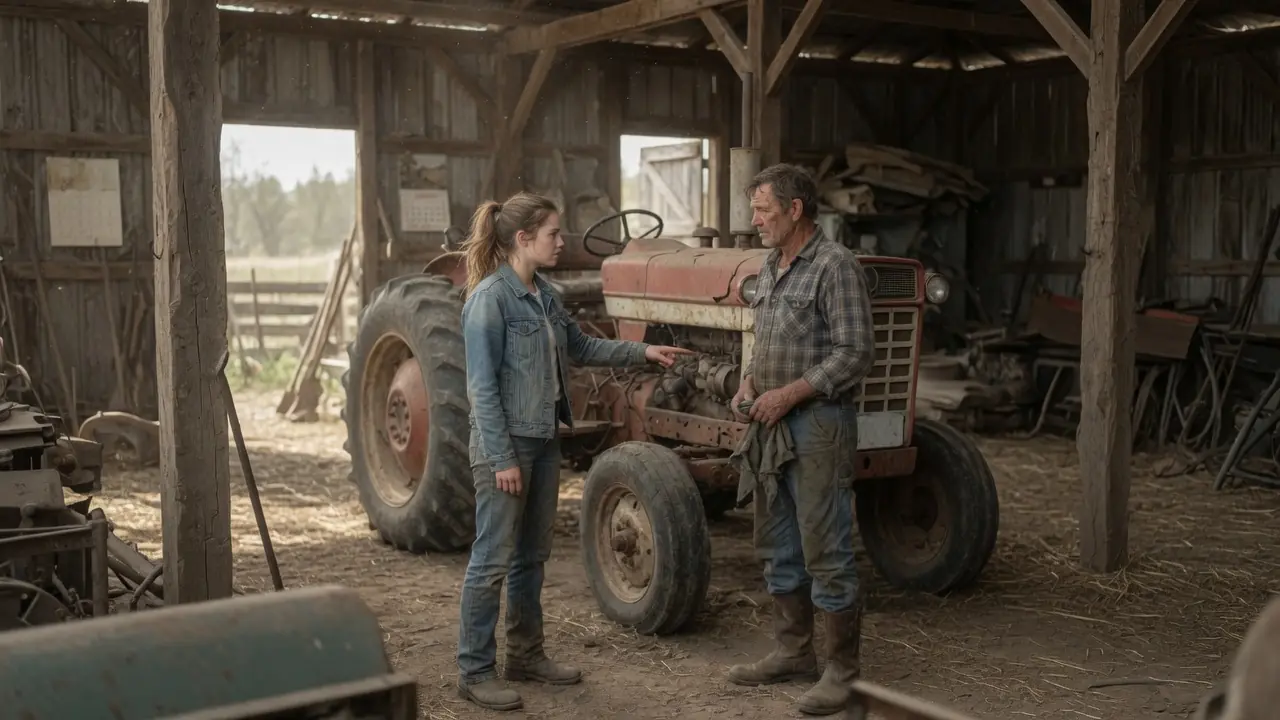
“I’ve got it,” she said.
Daniel paused, then let her handle it.
That small moment stayed with her. She realized she had stopped waiting for rescue. She still wanted help sometimes, but she no longer expected someone else to take over. The tractor was changing her in ways she did not want to admit.
At school, her friends talked about college, summer jobs, and leaving town. Emily listened but felt strangely distant. She had been accepted to a community college program in agribusiness, and she planned to go, but the farm still pulled at her. She used to imagine leaving because she was afraid staying meant becoming stuck. Now she wondered whether staying could mean becoming capable.
By June, neighbors began noticing the shed lights on late into the evening. One of them, Carl Jensen, stopped by with a grin and asked Daniel if he had hired a mechanic. Daniel pointed toward Emily, who was lying on a creeper under the tractor, tightening a hydraulic fitting. Emily slid out, hair messy and face streaked with grease.
Carl raised his eyebrows. “You’re fixing that old thing?”
Emily sat up. “Trying to.”
Daniel corrected him gently. “She’s rebuilding it.”
Carl looked at Emily with new respect. It was not praise exactly, but it was recognition. Emily felt it settle somewhere deep inside her. For the first time, someone outside her family saw her not as Daniel Turner’s daughter, but as someone learning the work.
The tractor fought her all summer. Once the hydraulic lift worked, the clutch stuck. Once the clutch was repaired, the cooling system leaked. Once the radiator was flushed, the electrical system failed in three separate places. Each problem felt like the tractor testing whether she truly meant to continue.
There were evenings when she stood alone in the shed, exhausted and furious. She would grip the edge of the workbench until her fingers hurt. Sometimes she whispered things she would never say in front of Daniel. Sometimes she simply stared at the tractor and wondered how an old machine could make her feel so small.
But then morning came, and she returned.
Daniel never gave speeches unless she asked. Instead, he told small stories while they worked. He told her how his father had used the tractor during a dry summer when newer machines broke under dust and heat. He told her how her grandfather once drove it through the night to help a neighbor bring in hay before a storm. He told her how the tractor had once been the best machine on the farm.
Emily listened while cleaning parts, tightening bolts, and sorting washers into coffee cans. The stories gave the tractor weight beyond steel. It had been present for fear, sacrifice, stubbornness, and relief. It had carried more than equipment; it had carried people through seasons they were not sure they would survive.
One evening, Emily found an old photograph tucked in a drawer of the workbench. It showed Daniel as a young man standing beside the same tractor, one hand on the fender, smiling beside his father. Daniel looked barely older than Emily was now. His father stood straight and proud, with the quiet hardness of men who spent more time working than explaining themselves.
Emily carried the photo to Daniel. “You never showed me this.”
Daniel looked at it for a long moment. “I forgot it was there.”
“You look happy.”
“I was,” he said. “That was the year your grandfather let me take over planting for the first time.”
Emily studied the younger version of her father. “Did he make you rebuild it too?”
Daniel smiled. “No. He made me rebuild a baler. I hated every minute.”
Emily laughed before she could stop herself. Daniel laughed too, and the sound softened the whole shed.
By August, the tractor was nearly ready. Emily had replaced the worst wiring, repaired the hydraulic lift, cleaned the fuel system, adjusted the clutch, flushed the cooling system, patched the tire, changed every fluid, and repainted the hood just enough to protect the metal without hiding its age. It still looked old, but no longer abandoned. It looked like something that had been chosen.
The day they tried to drive it, Emily was nervous in a way she had not expected. She climbed into the seat and placed both hands on the wheel. Daniel stood beside the tractor, arms folded, watching. The engine started on the second turn of the key.
Emily eased the tractor into gear. It lurched, then rolled forward. She pressed the clutch, corrected herself, and tried again. This time it moved smoothly out of the shed and into the bright Nebraska afternoon.
The field beyond the yard stretched green and wide beneath the open sky. Emily drove slowly at first, listening to the engine, feeling the steering, watching the gauges. The tractor was not fast. It was not comfortable. It did not impress anyone from a distance.
But it worked.
Daniel walked alongside for a few yards, then stopped. Emily looked back and saw him standing in the yard with his hands on his hips. He was smiling, not broadly, but enough. She felt something rise in her chest that was stronger than pride and quieter than victory.
That fall, the old tractor returned to work pulling wagons and running small jobs around the farm. It did not replace the newer machines, and Daniel never pretended it would. That was not the point. The point was that Emily could hear a change in the engine and know what it meant.
One afternoon, a neighbor’s newer tractor stopped working during a busy hay day. The machine needed a technician, and the technician could not arrive until Monday. Daniel offered help, but Emily spoke first. She suggested using the old International to pull wagons until the other machine was repaired.
The neighbor looked doubtful. Emily looked him in the eye. “It’ll do the job.”
And it did.
That evening, Emily parked the tractor beside the shed and shut off the engine. The sudden silence felt different now. It did not feel like failure waiting to happen. It felt like rest after honest work.
Daniel came up beside her. “You were right about one thing.”
Emily glanced at him. “What?”
“We will need newer equipment someday.”
She looked at the tractor, then at the fields beyond it. “I know.”
“But?”
“But not because I’m scared of old things anymore,” she said. “Only when it makes sense.”
Daniel nodded. “That’s the difference.”
Emily went to college that fall, but she came home every weekend she could. Her classmates learned about farm management in clean classrooms under fluorescent lights. Emily learned those lessons too, but she carried something extra in her hands. She knew what it meant when a budget line became a machine, when a repair decision became a harvest deadline, when pride became expensive.
Years passed, and Emily became the kind of woman people called when they needed a practical answer. She did not always have one immediately, but she knew how to find it. She learned agribusiness, soil management, marketing, and machinery systems. She respected technology, but she never worshiped it.
Daniel aged slowly, then all at once. His shoulders rounded, his knees bothered him, and he began letting Emily make more decisions. The first time he asked her what she thought before buying a piece of equipment, she felt the weight of it. She remembered standing in the shed at eighteen, demanding something newer because she thought that was the same as progress.
Now she studied numbers, repair records, debt risk, and long-term use. She asked what could be fixed. She asked what needed replacing. She asked whether the farm would be stronger after the decision or only more comfortable for a while.
In 2018, a summer storm damaged part of the farm and delayed work across the county. Several neighbors struggled with equipment issues at the worst possible time. Emily spent long evenings helping where she could, diagnosing problems, loaning tools, and making repairs that kept people moving. More than one farmer said Daniel had taught her well.
Emily always smiled at that. “He did.”
But privately, she knew the tractor had taught her too.
When Daniel passed the farm to Emily more fully, there was no single ceremony. It happened in small ways. Her name went on documents. Her decisions became final. Her father stopped correcting her and started trusting her.
One evening, Emily found him in the shed standing beside the old International. The tractor’s paint had faded again, and dust had settled along the hood, but it still ran. Daniel touched the fender the way he had years before. Emily stood beside him in silence.
“You remember how mad you were?” he asked.
Emily laughed softly. “I thought you were the most stubborn man in Nebraska.”
“I probably was.”
“You still are.”
Daniel smiled, then grew quiet. “I needed you to know you could handle broken things before this farm handed you any real ones.”
Emily looked at him then, and the old irritation she once carried was gone. In its place was gratitude so strong it almost hurt. She understood that he had not denied her the future. He had prepared her for it.
A few years later, Emily had a daughter of her own named Grace. Grace grew up climbing into tractor cabs, running across fields, and asking questions faster than adults could answer. She loved shiny machines and screens and anything with buttons. Emily saw herself in that impatience and smiled.
When Grace turned twelve, she pointed at a compact utility tractor in a dealership catalog and said, “Mom, someday we should get one like this.”
Emily looked at the picture, then toward the shed. “Maybe.”
Grace knew that tone. “But?”
Emily stood and motioned for her to follow. They walked across the yard as the evening sun spread clean light over the farm. Inside the machinery shed, the old red International waited in the back, quiet and patient. Emily pulled the cover off the hood.
Grace wrinkled her nose. “That thing is ancient.”
Emily laughed because the words sounded familiar enough to ache. She placed a hand on the fender. “Yes, it is.”
“Does it even run?”
“It does,” Emily said. “Because your grandfather made me rebuild it when I was eighteen.”
Grace looked at her mother, surprised. “You rebuilt this?”
“With a lot of frustration.”
“Why?”
Emily looked across the shed, remembering Daniel with the shop rag in his hand and the quiet lesson in his voice. “Because I thought new meant better. Your grandfather wanted me to learn that better means understanding what you already have before you replace it.”
Grace ran her fingers over the faded paint. “Are you going to make me rebuild it?”
“Not today,” Emily said. “But someday, you’re going to rebuild something.”
Grace sighed, but there was curiosity in her eyes. Emily recognized that too. The lesson had not begun yet, but the door had opened.
That night, Emily stood alone in the shed after everyone else had gone inside. The farm was quiet except for insects humming beyond the open doors. She looked at the tractor and thought about how angry she had been the first time Daniel challenged her. She had believed he was standing between her and progress.
Now she knew he had been standing between her and helplessness.
The old tractor had not made the farm rich. It had not made work easy. It had not solved every problem or prevented every hard year. But it had changed the way Emily saw difficulty.
When something broke, she did not panic. When money was tight, she did not reach first for debt. When the future looked uncertain, she trusted her ability to learn, repair, adapt, and continue. That was the inheritance Daniel had hidden inside rusted steel.
Years later, people would ask Emily why she kept that old tractor when the farm owned newer, stronger machines. She could have said it was sentimental. She could have said it reminded her of her father. Both things were true.
But the deeper answer was harder to explain.
She kept it because every farm needs something that teaches more than it produces. Every family needs a reminder that easy and valuable are not always the same. Every generation needs one hard lesson that turns frustration into confidence.
And for Emily Turner, that lesson came from a broken tractor her father refused to replace.
It came from scraped knuckles, long evenings, ruined plans, and a service manual stained with grease. It came from a summer when she wanted something new and received something better. It came from a father wise enough to let her struggle and loving enough to stay nearby while she did.
By the time Emily finally understood, the tractor was no longer just a machine.
It was proof.
Proof that broken things were not always finished.
Proof that patience could become strength.
Proof that the future was not built by replacing every difficult thing, but by learning which ones were worth saving.