Here is the cleaned and properly formatted English version:
In October of 2019, at the annual Dell Valley Harvest Auction, Alara Vance sold the entire yield from her 17.4 acres of bottom land for a single preemptive bid of $413,100. The man who made the bid, a buyer for a national organic food consortium, never even tasted one of the cranberries. He just looked at a lab report confirming the proanthocyanidin content and wrote the number on a card.
The auctioneer read it aloud. A silence fell over the room. A quiet so profound you could hear the hum of the fluorescent lights in the ceiling of the community hall. This was the same 17.4 acres that her father, John Vance, 10 years prior, had publicly offered to lease to the county for $1 a year just so they would mow the reeds. Nobody took him up on it.
Let me tell you about that land, because the story of the money is really the story of the soil. The Vance family had farmed in Dell Valley for 158 years. They grew grapes. Specifically, they grew the Regent grape, a hardy, disease-resistant varietal that did well in the valley's particular combination of loamy soil and cool, wet springs.
The Vances had 220 acres in total, but their operation, the heart of their legacy, was the 185 acres of gently sloping, south-facing hillside they called the Highfield. The remaining land was a patchwork of utility sheds, access roads, the old family homestead, and the 17.4 acres of bottom land that ran alongside Hemlock Creek.
John Vance, who was 78 years old the year his daughter sold her first full harvest, was a man shaped by the Highfield. He was 6'2, stooped from decades of checking vines, and was known for two things: the immaculate, weedless rows of his vineyard, and his unwavering belief that God had designed Dell Valley for the express purpose of growing Regent grapes. Anything else was a waste of time and an insult to Providence.
He farmed the Highfield for 55 of his 78 years, taking over from his own father, who had taken over from his. He knew its contours, its damp spots, its windbreaks, the way a man knows the lines on his own hand. The bottom land, however, he considered a curse.
It was a geological anomaly, a low-lying bowl of peat and clay that the creek flooded every third spring, and that remained stubbornly waterlogged the rest of the time. The soil pH hovered between 4.2 and 4.5, acidic enough to stunt the roots of any grapevine they ever tried to plant there. His father had tried in the 1950s, spending what was then a small fortune on drainage tiles. The tiles sank into the muck within a decade.
John himself had tried in the 1980s, trucking in 400 tons of lime to raise the pH. The acidic peat swallowed the lime in two seasons, a chemical ghost, and the land went back to what it was, a sour, marshy expanse of reeds, rushes, and skunk cabbage. For John Vance, land that could not grow grapes was not land at all. It was a void, a failure.
It was 17.4 acres of evidence that perfection was not total. He hated it with a quiet, simmering resentment. He hated the way the water squelched under his boots in July. He hated the red-winged blackbirds that nested in the reeds, birds that had no business on a proper farm.
He told his daughter Alara when she was a girl, “The bottom land is where God ran out of ideas. It’s the county’s problem, not ours.” He meant it. He paid property taxes on it, $88.40 a year out of legal obligation, but in his mind, it was a dead limb on an otherwise healthy body. He walked the high field every morning. He had not set foot on the bottom land in 20 years.
Alara Vance was 48 years old when she came home in 2009. She had been gone for nearly three decades. She left Dell Valley at 18 to study botany at Cornell, then went on to get a PhD in wetland ecology from the University of Wisconsin. She worked for the Nature Conservancy for a while, then for a private firm that specialized in wetland restoration for federal mitigation credits.
She was quiet, methodical, and possessed a patient observational capacity that her father, a man of action and immediate results, often mistook for indecisiveness. While he spent his life forcing the land to yield a specific outcome, she had spent hers learning to understand what the land was already doing. She came home because her mother was ill. After the funeral, she stayed.
She moved back into her childhood bedroom with its view not of the prized high field, but of the unruly green and brown tapestry of the bottom land. Her father was grateful for her presence, but bewildered by her purpose. She helped with the bookkeeping for the vineyard, but showed little interest in the grapes. Instead, she spent her days on the bottom land.
She wore knee-high rubber boots and carried a soil auger and a notebook. She took samples. She cataloged the existing flora. She measured the depth of the water table, which in some places was only 18 inches below the surface. She spent hours watching the way the light fell, the way the water moved, the way the frost settled in the lowest depressions.
Her father watched her from the kitchen window. He saw it as a kind of folly, a harmless but pointless obsession. He’d say, “There’s nothing down there but mud and mosquitoes. The real work is up here.” She would just nod.
Let me tell you about her great-grandmother, Sarah Vance. Sarah had not come from Dell Valley. She was from the sandy shores of Cape Cod, and she arrived in 1890 as the young bride of the first Vance to plant grapes. She was a woman who understood tides and salt marshes, not rolling hills and loamy soil.
The story, passed down through Alara’s mother, was that Sarah took one look at the bottom land by the creek and said, “That’s the only piece of ground here that makes any sense.” Her husband and his family laughed. They were men of the hill, of the sun, of the well-drained soil. They gave her a small vegetable garden near the house and told her to forget the swamp. But she didn’t.
She would walk it just as Alara now did, and she recognized the acidic soil, the peat, the constant wetness. It reminded her of home. Before she died, she gave her granddaughter, Alara’s mother, a small, tightly stitched deerskin pouch. Inside were a few dozen tiny, dried, dark red berries. They were cranberries from a wild bog near her childhood home.
“Keep these,” she had said. “One day, a Vance might learn to see the water for the gift it is, not the curse.” The pouch had lived in Alara’s mother’s jewelry box for 60 years. After the funeral, Alara’s mother had given it to her. It wasn’t a piece of jewelry. It was a seed bank. It was an idea. It was an inheritance of a different kind of knowledge. One that had been dormant in the family for a century.
One evening in the late fall of 2009, Alara came to the dinner table with her notebooks. Her father was there, going over receipts from the harvest. “I want the bottom land,” she said. John Vance looked up, confused. “Want it for what? It’s worthless.”
“I don’t think it is. I want you to deed it to me.” He laughed, a short, dry bark. “You can have it. Hell, I’d pay you to take it. But what in God’s name are you going to do with it?” “I’m going to grow cranberries.”
The statement hung in the air. To John Vance, it was the most absurd thing he’d ever heard. They were a grape family. They had been for five generations. They did not grow berries in a swamp. It was an affront to their very identity.
“That’s the stupidest damn thing I’ve ever heard,” he said, his voice flat. “This is a vineyard. We make wine. We don’t make sauce for turkeys.” “You make wine on the high field,” she replied, her voice just as even. “The bottom land has never grown a single grape. It’s not vineyard land. It’s bog land.”
He stood up from the table, his face flushed. “It’s Vance land, and Vances don’t play in the mud.” He left the room. The conversation was over. But the deed was transferred the following week. He signed it without looking at her, a gesture of dismissal, of washing his hands of her and her foolishness.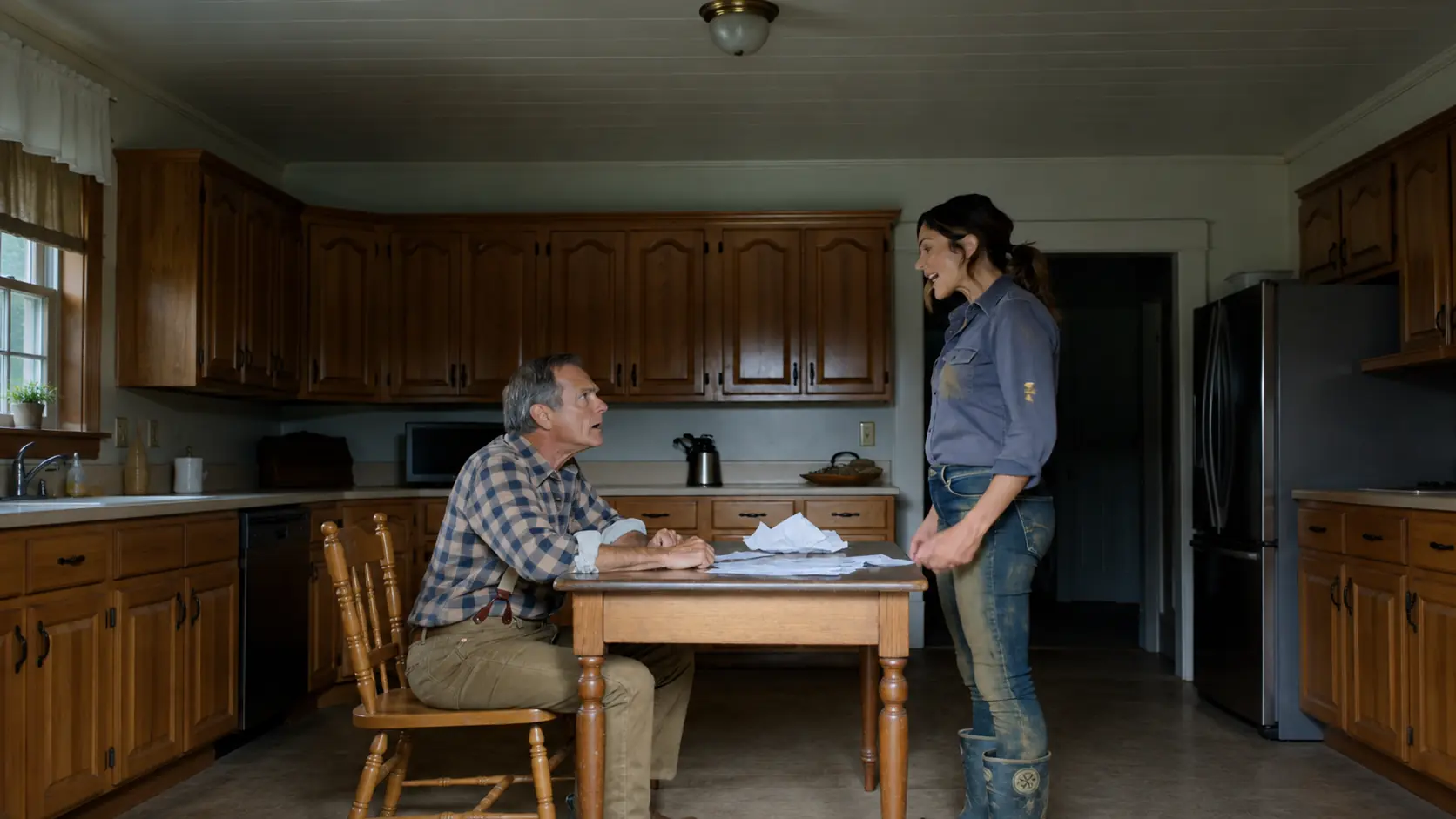
To him, he wasn’t giving her land. He was giving her a 17.4 acre monument to her own stubbornness. The next spring, the trucks began to arrive. This is when the community started to notice. Dell Valley was a small place.
A new tractor at the co-op was news for a week. A fleet of bulldozers and excavators rumbling down Hemlock Creek Road was a seismic event. The work began in April of 2010. Alara, using the entirety of her personal savings, $187,000 she had carefully invested over her career, and a small high-interest loan from a credit union two towns over, began to build her bog.
Let me tell you about building a cranberry bog because it is not like planting a field. It is an act of engineering. It is a slow, brutal, expensive ballet of earth moving. First, they cleared the native vegetation. Then, the excavators, with their 36-inch buckets, scraped off the top layer of peat, setting it aside.
They dug down 24 inches, leveling the entire 17.4 acres to a tolerance of less than 1 inch. They created a series of rectangular beds, each about 3 acres in size, separated by earth and dikes wide enough to drive a truck on. They sculpted the land, creating a slight, almost imperceptible grade, so the water would flow exactly where she wanted it to.
Then came the irrigation. They laid miles of pipe. They dug a deep reservoir at the lowest point of the property. A 4-acre holding pond to capture winter rains and creek overflow. Water that her father had spent his life trying to get rid of. She was hoarding it.
She installed two 60-horsepower electric pumps to move that water from the reservoir into the bogs and back out again. After the earthwork and the plumbing, they brought the peat back, spreading it in a uniform 6-inch layer over the clay subsoil. And then came the sand.
Truck after truck for 3 solid weeks, 22 tongue loads of coarse construction grade sand, 650 truckloads in total. They spread a 4-inch layer of sand over the peat. The cost of the sand alone was $78,000. Her father watched from the porch, shaking his head. “All that money,” he said to anyone who would listen, “to bury perfectly good peat under worthless sand.”
The community watched, too. The other farmers, men like her father who understood the rhythms of the high field, saw it as madness. They would stop their trucks on the road and just stare. They saw a woman spending a fortune to create a perfectly flat, sand-covered desert. It defied every principle of agriculture they had ever known. They didn’t see a bog, they saw a grave for a woman’s inheritance.
This is when Marcus Thorn arrived. Thorn was 38 years old, held a master’s in viticulture and enology from UC Davis, and had worked for a major agricultural consulting firm in Napa for 10 years before striking out on his own. He was hired by the Dell Valley Wine Growers Association to help them modernize, to increase yields, to push the valley’s reputation beyond that of a reliable but unexciting regional producer.
Thorn was the epitome of the confident outsider. He was sharp, articulate, and he came armed with data. He had spreadsheets, satellite soil maps, and PowerPoint presentations. He spoke of brick levels, canopy management, and deficit irrigation with the easy authority of a man who believes that every problem has a data-driven solution.
He heard about Alara’s project and, seeing it as a teachable moment, decided to intervene. He believed he was doing her a favor. He saw a woman making an emotional, unscientific decision, and he wanted to save her from herself. He found her one afternoon by the newly dug reservoir, where she was taking water samples.
Marcus Thorn was 38 years old, had been consulting for 12 years, and was known for his ability to turn struggling vineyards into profitable enterprises. He wore polished Blundstone boots, a stark contrast to Alara’s mud-caked Mucks. “Ms. Vance,” he said, extending a hand, “Marcus Thorn. I’m working with the Growers Association. I couldn’t help but notice your project.”
Alara, who was 49 by then, and had been working 14-hour days for 6 months, just looked at his clean hand and nodded. “Alara Vance.” He gestured toward the vast expanse of sand. “I’ve run the numbers on this parcel, the soil chemistry, the water table. I understand the challenge, but I think you’re going about it the wrong way.”
“With the right inputs, we could make this land productive. We’d have to put in about $30,000 worth of French drains, truck in about 800 tons of lime to balance the pH over 5 years, and plant a rootstock like 101-14 MGT. It’s tolerant of wet feet. We could have a viable crop of Chambourcin grapes here in 4 years. My projections show a potential gross of $9,000 an acre at maturity.”
He said it with the calm assurance of a doctor prescribing a proven cure. “Productive for what?” Alara asked, her voice quiet. “Productive for grapes, of course. For the valley. For your family’s legacy.”
“This land doesn’t want to grow grapes,” she said. “It has spent a hundred years telling my family that. I’m just the first one to listen.” Thorne smiled a patient, slightly condescending smile. “Ms. Vance, with all due respect, land doesn’t talk. Data talks. And the data says this is a correctable problem of soil management, not a fundamental flaw in the land itself.”
“You’re spending a fortune to turn what could be a C+ vineyard into an A+ swamp. It’s an economic tragedy.” He saw it as a problem to be solved. She saw it as a nature to be understood. He was trying to change the land to fit the crop. She was choosing a crop that fit the land.
“It’s not a swamp,” she corrected him gently. “It’s a bog. There’s a difference, and I’m not interested in your data. I have my own.” She held up her notebook, its pages filled with handwritten observations. Thorne shook his head, the gesture of a reasonable man dealing with an irrational zealot.
“The offer stands. When this fails, and it will, call me. We can still salvage the investment and turn this into something that makes money.” He walked away, confident that he had planted a seed of reason. He didn’t realize he was standing on 26,000 tons of sand that was about to prove his data and his entire worldview wrong.