That was the first thing she remembered clearly, even years later, when the whole morning came back to her in pieces. Her father sat at the head of the rough pine table, his gray beard trimmed badly and his eyes fixed on the folded paper before him. Clara, her stepmother, sat to his right with her hands folded and her mouth pressed thin, wearing the dark green dress she saved for church and difficult conversations. Judith sat on the other side in better fabric than Andrea had ever owned, looking almost bored, as if her sister’s life were only another household matter to be finished before noon.
Across from them sat James Christopher.
He was not the man Andrea had expected. He was tall, broad-shouldered, and quiet, with weathered skin, short dark hair, and eyes so steady they seemed to take in the whole room without moving. His dark wool coat was still buttoned against the cold, and his leather gloves rested on the table beside the paper her father had just signed. He did not smile, did not lean back proudly, and did not look at Andrea the way men looked at horses after a bargain.
That made the room feel stranger, not safer.
Andrea had been sent downstairs in her good brown dress before breakfast. Clara had told her to brush her hair properly and stop asking questions, which meant something important and terrible had already been decided. When Andrea entered the front room, she found everyone seated except her, and that alone told her enough. In the Douglas house, a person left standing was usually the person being discussed.
Her father never said her name when he explained it.
He said “the debt,” “the agreement,” and “the settlement.” He said four hundred dollars as if the number had more flesh than she did. He said James Christopher had been kind enough to take the matter off his hands. Then he slid the paper across the table and told Andrea to stand still while the men finished.
Andrea’s fingers clenched at her waist.
She looked at Judith first, because Judith had always enjoyed knowing things before anyone else. Her stepsister lowered her eyes to the table, but the corner of her mouth betrayed her. Clara stared straight ahead, relieved more than ashamed. Holt Douglas, the man who had fathered Andrea, kept his hand near the signed paper and refused to look at his daughter at all.
“So that is what I am?” Andrea asked.
Her voice sounded smaller than she wanted, but it did not break. Holt’s jaw shifted once, and Clara made an irritated sound through her nose. Judith finally looked up, her dark eyes sharp and curious. James Christopher alone stayed still, his gaze lifting from the paper to Andrea’s face.
“You are not being asked to speak,” Holt said.
Andrea looked down at him, standing so close to his chair that she could see the ink stain on his thumb. This was the same man whose socks she had washed, whose meals she had cooked, whose shirts she had patched by lamplight after Clara said there was no sense wasting candles on slow sewing. He had taught her to be useful and then called her usefulness a burden. Now he was trading that burden for a debt.
Clara folded her hands more tightly. “Don’t make this ugly, Andrea.”
Andrea laughed once, but there was no humor in it. “Ugly?” she whispered. “You all sat down and decided my life before I even came downstairs.” Her eyes moved from Clara to Judith, then finally to her father. “Did any of you think to ask me whether I wished to go?”
“No daughter of mine speaks like that in this house,” Holt said.
The words landed with an old weight, but something in Andrea did not bow beneath them this time. Perhaps it was because she already knew the house was no longer hers. Perhaps it was because being given away stripped fear down to its plainest form and left nothing for obedience to hide behind. She swallowed hard and turned toward James Christopher.
“And you?” she asked.
James’s eyes did not move from hers. “I came to settle a debt,” he said quietly. Holt gave a satisfied grunt, but James continued before anyone else could speak. “Not to strip a woman of her voice in her own father’s house.”
The room changed.
It was not a loud change. No one stood, no chair scraped, no hand struck the table. But Andrea saw Holt’s face darken, Clara’s lips part, and Judith’s posture sharpen with interest. James Christopher had spoken only one sentence, and already the room had lost the shape her family expected it to hold.
Holt leaned back. “The paper is signed.”
“I know,” James said.
“You paid the money.”
“I did.”
“Then she goes with you.”
James looked at the folded paper, then at Andrea, then back at Holt. “She goes with me because staying here would leave her in worse hands.” His voice remained even, but something harder moved beneath it. “Not because any man at this table owns her.”
Andrea stared at him.
No one had ever said such a thing in that house. No one had ever placed her and ownership in the same sentence only to reject the connection. Clara’s face tightened as if she had tasted something sour. Judith watched James now with a new kind of caution, as if the rancher seated across the table had become less simple than she first believed.
Holt stood abruptly.
Andrea took one step back, not because he had touched her, but because every muscle remembered the danger of his anger. James stood too, slowly, not challenging, not threatening, but rising to his full height as if the room itself had required balance. Holt’s eyes flicked toward him and stayed there. For the first time that morning, Andrea saw her father measure another man and choose not to push.
“Get your things,” Holt said to Andrea.
The words were flat. Finished. Empty.
Andrea turned toward the stairs, but her feet would not move. She looked once more at the table where her family sat, all of them except her. Holt stood with his hand on the back of his chair. Clara looked at the window, already done with the scene. Judith touched the edge of the folded paper as if wishing she could read the ending before it happened.
Andrea climbed the stairs alone.
Her room was barely a room, only a narrow space under the slanted roof where winter came in through the boards. She packed the small trunk she had owned since she was sixteen. Two dresses, one shawl, a pair of gloves, a comb that had belonged to her mother, and a book with a broken spine. Her hands shook only when she picked up the comb, because it was the last thing in that house that had ever been given to her with love.
When she came downstairs, James was waiting near the door.
He did not take the trunk from her immediately. He looked at it, then at her face, and asked, “May I carry it?” The question was so unfamiliar that Andrea almost did not understand it. In her father’s house, men took what they wanted carried, cooked, cleaned, mended, or surrendered. James waited for her answer.
She nodded once.
He picked up the trunk and carried it outside. Andrea followed, passing the table without looking at anyone. Holt said nothing. Clara muttered something about ingratitude. Judith leaned back in her chair and smiled faintly, as if Andrea’s silence proved she had lost.
At the door, Andrea stopped.
She turned around and looked at the room one last time. The stove, the pine table, the window Clara had always claimed let in too much dust, the chair where Holt sat every night after supper. She had spent years trying to earn kindness from those walls. Now, leaving them felt less like exile than waking from a fever.
Then she stepped outside.
The Oklahoma morning hit her face cold and clean. The wagon waited in the yard, the horses shifting under their harnesses, their breath rising white in the air. James placed her trunk in the back and offered his hand to help her climb up, then seemed to remember himself and lowered it slightly, leaving the choice to her. Andrea stared at that hand for a moment before taking the side rail instead and climbing up on her own.
James did not look offended.
He simply walked around the wagon and took his seat beside her. Holt did not come out to watch them leave. Neither did Clara. Judith appeared at the window for a moment, her face pale behind the glass, and Andrea met her eyes without blinking. Then the horses started forward, and the house began shrinking behind them.
For a long while, neither Andrea nor James spoke.
The road out of Bristow ran past bare fields, low fences, and patches of winter grass bent under the wind. Andrea kept her hands folded in her lap, because if she loosened them, she feared they would shake. Beside her, James held the reins with quiet skill, neither forcing the horses nor letting them drift. He sat like a man who knew the weight of silence and did not fear it.
After nearly an hour, he spoke.
“There is a room at the ranch,” he said. “It has a lock.” Andrea turned her head sharply. James kept his eyes on the road. “The key will be yours. Nobody will enter without your permission.”
Andrea watched his profile.
She wanted to believe the words. She also knew wanting to believe was dangerous. Her father had once told her he would never let Clara treat her unfairly, and by spring Clara had taken over every corner of Andrea’s life. Men said many things when the road was long and no witnesses stood nearby.
“Why?” she asked.
James glanced at her then, briefly. “Because a person should have a door that is hers to open.”
Andrea looked away quickly.
The answer was too simple. Too decent. It left her with nowhere to put her suspicion, so she held onto it harder. She told herself that kindness could be a form of patience, and patience could be a form of control. If James Christopher meant to own her, perhaps he was simply clever enough to begin with softness.
They reached the ranch near noon.
It sat low against the plains, built of timber and stone, with a covered porch facing the west and a barn standing a little distance away. Smoke rose from the chimney, thin and gray against the pale sky. Two horses watched from the paddock, ears forward, while a ranch hand near the barn lifted one hand in greeting. The place was clean, solid, and quieter than any home Andrea had ever known.
James carried her trunk inside.
Andrea followed him down a hallway that smelled faintly of wood smoke and soap. He opened the last door and stepped aside. Inside was a small bedroom with a clean bed, a wool blanket folded at the foot, a washbasin, and a window facing east toward the pasture. On the nightstand sat a book.
Andrea froze.
The book was familiar in a way that made her stomach tighten. She crossed the room slowly and picked it up, turning it in her hands. The spine was cracked, the corners worn, and the title stared back at her like a memory she could not yet place. She had spoken of this book once, years ago, at a market stall in Bristow, to a quiet stranger who had listened as if her small thoughts mattered.
She looked up.
James stood in the doorway with a small iron key in his palm. For the first time since she had met him, something like uncertainty passed over his face. He set the key on the washstand and said, “Dinner will be at sundown. You may come down if you wish. If not, I’ll leave food outside the door.”
Andrea’s fingers tightened around the book.
“Why is this here?” she asked.
James did not answer at once. He looked at the book, then at her. “Because you said once that stories made the world feel less small.” His voice was low. “I remembered.”
The room seemed to tilt.
Andrea remembered the market then. She had been nineteen, standing beside a trader’s stall, laughing softly over a passage before a man nearby asked what had amused her. He had been younger then, but the eyes were the same. They had spoken for only a few minutes, no more than that. She had forgotten the shape of his face, but not the rare feeling of being heard.
“You were there,” she whispered.
James nodded once.
“You remembered that?”
“Yes.”
Something hot rose behind Andrea’s eyes, and she hated it. She had not cried when her father signed her away. She had not cried packing the comb. She would not cry now because a silent rancher remembered a book. But her throat tightened so sharply she had to turn away.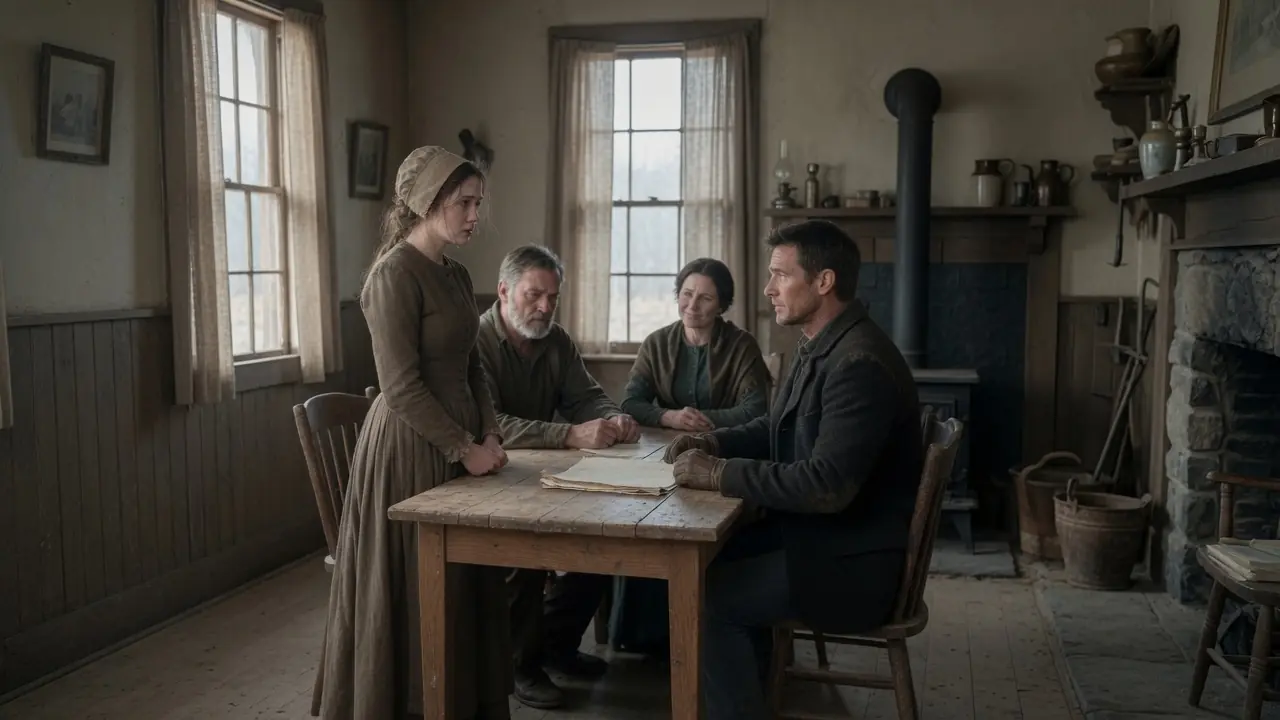
James seemed to understand.
He stepped back from the doorway. “The room is yours,” he said. “So is the key.” Then he left.
Andrea stood alone in the clean room, the book in one hand and the key shining dully on the washstand. Outside the window, the pasture rolled toward the horizon, empty and open. She had been handed away like a debt, but for the first time that day, she stood behind a door no one opened without asking. She did not know what that meant yet.
The first night, she locked the door.
No one tried it.
That mattered more than she wanted it to.
In the days that followed, Andrea waited for the hidden cost. She woke early, dressed before sunrise, and went downstairs expecting orders. James was already at the kitchen table with coffee and a map, but he only nodded toward the stove where another cup had been poured. He did not ask why she had locked the door. He did not comment on the shadows beneath her eyes.
“You don’t have to serve here,” he said on the second morning.
Andrea stared at him.
“I know how to cook badly enough to survive,” he continued, and the faintest crease appeared near his mouth. “Otis knows how to burn biscuits better than any man in the territory.” From the doorway, Otis grunted in protest but did not deny it. Andrea almost smiled, and the almost frightened her.
The ranch did not become home quickly.
Trust came slowly, and James never hurried it. He showed her the pantry, the well, the barn, the smokehouse, and the boundary fences. He told her where storms gathered first, where the creek flooded in spring, and which horse would accept carrots but not apples. He gave information without turning it into obligation.
Andrea kept waiting for him to ask for gratitude.
He never did.
One afternoon, while they repaired a section of fence, she finally asked the question that had followed her since Bristow. “Why did you pay my father’s debt?” James drove a post into the hard ground before answering. His sleeves were rolled, and the wind had reddened his hands. “Because Holt Douglas was going to sell that debt to Amos Bell.”
Andrea’s body went still.
Everyone knew Amos Bell. He was old, rich, and cruel in the way powerful men can be when a town teaches itself not to notice. Andrea had avoided his eyes at church and market for years. The thought of him sitting where James had sat, signing that paper, made her stomach turn cold. She gripped the fence rail until the rough wood bit into her palm.
James saw it but did not move toward her.
“I heard the talk in town,” he said. “I rode to your father’s house before Bell did.” He looked across the plains, his expression closed but not empty. “I did not know how to stop the wrong without becoming part of it. So I paid the debt and decided the rest would be your choice.”
Andrea swallowed hard.
“My choice?” she repeated.
“If you want to leave,” James said, “I will take you where you wish to go when the roads clear. If you want work and wages, we can write terms. If you want to stay until you decide, stay.” He looked at her then. “What happened in that room was wrong. I know it was wrong.”
Andrea turned away because his words opened something raw.
No one had ever named what her family did as wrong. They had called it necessary, proper, fair, practical, best for everyone. Wrong was a clean word. It cut through every excuse and left the wound visible.
That night, Andrea did not lock the door.
She noticed it only after lying down.
Her hand reached toward the key on the nightstand, then stopped. The house was quiet. Wind tapped at the window, and somewhere outside, a horse shifted in its stall. Andrea let her hand fall back to the blanket and stared at the ceiling until sleep came.
Spring approached slowly.
The frost loosened from the earth, and the ranch began to breathe differently. Andrea found herself stepping outside before breakfast just to watch light move across the pasture. She learned to milk the gentler cow, learned to mend harness leather, and learned that James liked his coffee too strong but never complained when it wasn’t. Otis began leaving small tasks for her without instruction, trusting she would ask if she needed help.
Trust, Andrea discovered, could be contagious.
Then Judith arrived.
She came in a fine green dress with a carpet bag and a smile Andrea had feared since childhood. Andrea saw her from the east window and felt her old self rise inside her, the self that lowered her eyes before Judith spoke. Judith stepped from the wagon like a woman entering a room already convinced it belonged to her. James opened the door and let her in, but he did not invite her to sit until Andrea came downstairs.
Judith noticed that.
Her smile sharpened.
She claimed the debt agreement had conditions. She claimed Andrea’s family retained certain rights if James had not fulfilled them. She claimed Andrea might need to return to Bristow until matters were clarified. Each sentence was delivered gently, but Andrea heard the hook beneath every word.
James listened without changing expression.
Then he placed a sealed document on the table. “Territorial office in Guthrie confirmed the agreement and the payment,” he said. “Recorded properly. Witnessed properly.” Judith’s smile flickered. “There is no claim.”
Judith looked at Andrea then.
“He hasn’t told you why he really wanted you, has he?” she said softly.
Andrea felt the room tilt again, but this time she did not shrink. She looked at Judith, then at James. James’s face changed only slightly, but she saw the pain cross it. Not guilt. Fear.
“I know enough,” Andrea said.
Judith blinked.
Andrea stepped closer to the table. “I know he gave me a key when my own father gave me away. I know he offered me a choice when my own family offered me none. I know he protected me from Amos Bell and never once asked me to thank him by becoming smaller.” Her voice steadied as she spoke. “That is more truth than I ever received in Holt Douglas’s house.”
Judith’s face hardened.
“You always were foolish,” she said.
Andrea looked at her stepsister calmly. “No. I was frightened. There is a difference.” She turned toward the door. “You should go.”
Judith looked at James, perhaps expecting him to overrule Andrea. He did not move. That silence gave Andrea more strength than any argument could have. Judith left with her carpet bag and her ruined smile, and Andrea closed the door herself.
Afterward, the house felt different.
Not peaceful, exactly, but cleared. Andrea stood with her hand still on the door latch, breathing hard. James remained by the table, watching her as though he was afraid one wrong word might undo the courage she had just gathered. For once, she did not mind being watched.
“You did not speak for me,” she said.
James shook his head. “You were speaking well enough.”
Andrea let out a breath that almost became a laugh. It surprised them both. Then, because the room had already held too much truth to return to silence, she asked him the question she had carried since the book. “Did you really remember me for seven years?”
James looked down at the table.
“Yes.”
“Why?”
He was quiet a long moment. “Because you laughed like a woman who had not been allowed to laugh often.” He looked up then. “And because, for ten minutes at a market stall, I wanted to be the kind of man who could make the world less small for you.”
Andrea’s eyes burned.
“You did,” she whispered.
It was not a confession of love. Not yet. But it was the first bridge between them built from both sides.
Weeks passed, and Andrea began to choose the ranch in small ways. She planted herbs beside the kitchen door. She moved her mother’s comb from the trunk to the washstand. She placed the remembered book on the shelf in the front room instead of hiding it by her bed. When James noticed, he touched the shelf once with his fingertips and said nothing.
One evening in late April, they stood near the paddock while the sky turned rose and gold over the plains. The mare pressed her nose against the fence, impatient for attention. Andrea rested her hand on the rail, close enough to James that their sleeves almost brushed. She thought of the farmhouse table, her father’s hand near the paper, her family seated while she stood like a thing to be assigned.
Then she looked at James.
He had never once tried to take what her family had tried to sell.
“I want to stay,” she said.
James turned toward her slowly.
Andrea’s heart beat hard, but her voice stayed clear. “Not because I have nowhere else to go. Not because of the debt. Not because of what you paid.” She faced him fully in the fading light. “Because I choose to.”
James’s expression opened in a way she had never seen before.
For a moment, he looked younger, almost undone by the gift of her words. “Then stay,” he said softly. “As long as you choose.”
Andrea smiled then, truly smiled, and the sight of it struck him so visibly that she almost laughed. “You look surprised, Mr. Christopher.” The corner of his mouth lifted. “I suppose I had forgotten what happiness looks like when it arrives without warning.”
She held out her hand.
This time, not for help into a wagon. Not for rescue. Not because she had been taken from one life and carried toward another. She held it out because she wanted him to take it.
James looked at her hand first, then at her face, asking without words.
Andrea nodded.
He took her hand gently, as if it were something living and sacred. His palm was rough from work, warm despite the cooling air. No one spoke for a while. The plains did not need words, and neither did they.
Months later, when they married, Andrea stood beside James by choice.
There was no pine table deciding her fate, no debt paper, no father refusing to meet her eyes. Otis stood as witness, the mare watched from the paddock, and the Oklahoma wind moved softly through the grass. Andrea wore a simple blue dress she had sewn herself, and her mother’s comb held her hair in place. James looked at her as though he had been waiting seven years and also no time at all.
When the vows were spoken, Andrea did not promise obedience.
She promised partnership.
James did not promise protection as though she were weak.
He promised respect, patience, and a home with every door still belonging to her.
Years later, Andrea would tell people that the worst morning of her life did not end the way her family intended. They had sat at a table and traded her for a debt. They thought they were sending her into another kind of ownership. Instead, they sent her to the first place where her voice mattered.
Sometimes, she still dreamed of standing beside Holt Douglas’s chair while everyone else sat.
But in the dream now, James sat across from her with calm eyes and a folded paper in his hand. He did not claim her. He did not save her loudly. He simply looked at her as though she had been worth remembering all along.
And when she woke in the ranch house, with morning light coming through the east window and James asleep beside her, Andrea knew the truth.
Her family had sold her because they did not know her worth.
James had paid the debt because he did.